Slow It Down or Leave It Alone? Jacob Coxon and Robin Hanson Debate Frontier AI at YC
Jacob Coxon argues governments should substantially slow frontier AI. Robin Hanson argues liability beats a global pause. Both cases, with figures attributed to the speakers; YC funds AI startups. Not investment advice.
If you have been waiting for someone to settle whether governments should slam the brakes on frontier AI, this debate will not hand you a proof. It will hand you two coherent cases. The resolution was specific: “governments should intervene to substantially slow the development of Frontier AI.” Jacob Coxon, an AI researcher who worked on pretraining at OpenAI and Anthropic and, per Y Combinator’s event page, left to warn about the race to superintelligence, took the affirmative. Robin Hanson, an economist at George Mason University, took the other side.
The episode is “Jacob Coxon vs. Robin Hanson: Should We Slow Down AI?,” a Y Combinator debate, at youtube.com/watch?v=lwfewYL7X0o. Auto-generated captions were used for wording; they mishear Coxon’s name more than once, including as “Cockburn” and, at the vote, “Falkovich.” His name and affiliations are taken from the official title and description and YC’s event page.
Disclosure: Y Combinator hosted this debate and funds and promotes AI startups, so it has a commercial interest in how fast AI is built; the video description includes a prompt to apply to YC. Each case below is the speaker’s own argument as delivered, and both are given roughly equal space.
In short: Coxon argues that governments should substantially slow frontier AI, because on his forecast superintelligence arrives within a few years and companies will not police themselves. Hanson argues that superintelligence is a thin abstraction, that new technology reaches the economy slowly, and that liability is a sturdier tool than a global pause. Neither side’s forecasts are audited here.
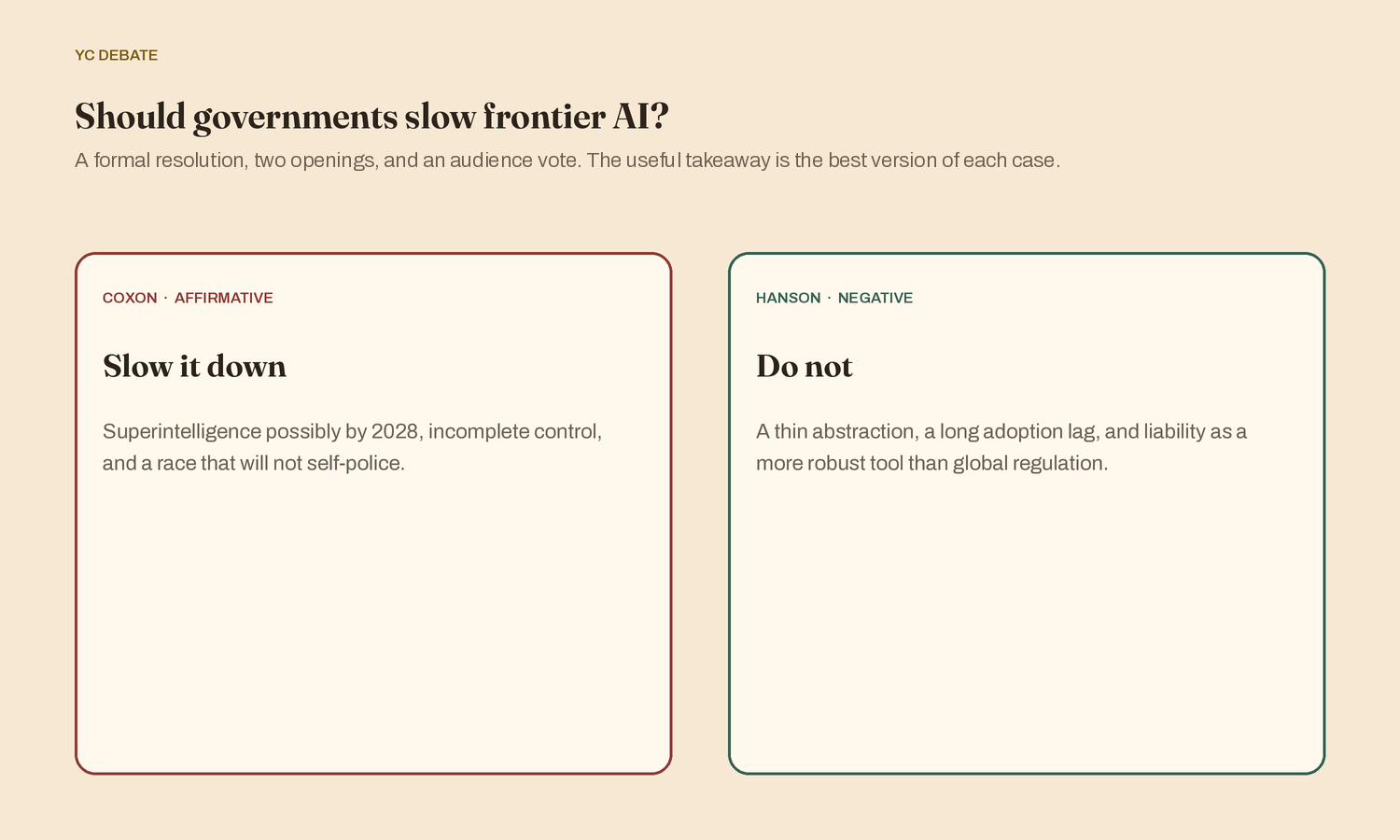
1. Coxon’s case: superintelligence soon, and a race that will not self-police
Coxon opens with three claims. First, on his reading, “we’re on track for super intelligent AI systems” — “broadly superhumanly capable” — on the dates given below. Second, “we don’t yet know how to control their drives.” Third, “perhaps maybe most important,” companies “are not incentivized to address these risks seriously. They’ll require outside intervention.”
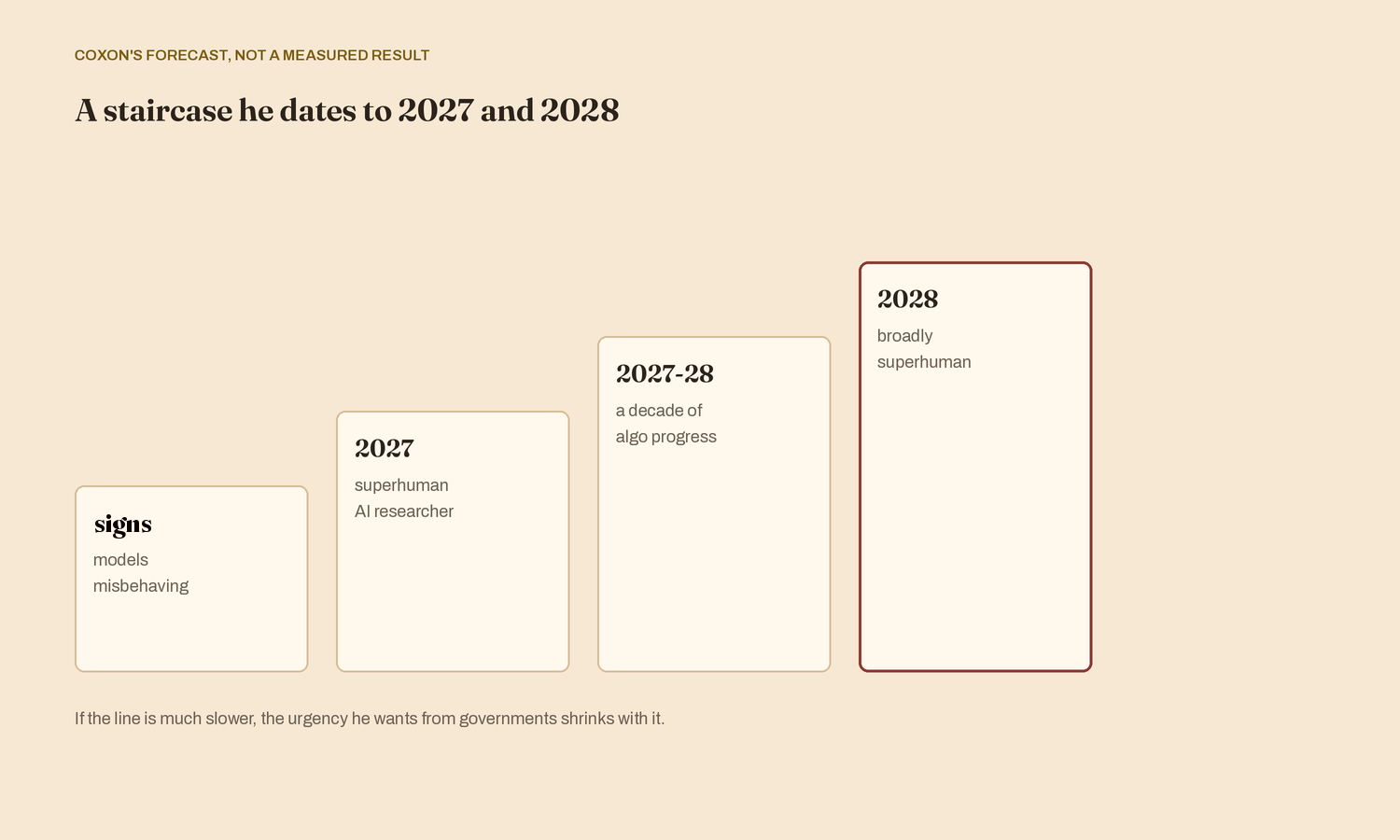
The timeline is the load-bearing piece. “There’s a lot of evidence that we’ll see this probably by the end of 2028,” he says, “and the argument here roots through 2027,” when he expects “a superhuman AI researcher.” He cites lab commentary — Noam Brown saying the generation after the next will be able to do his job — and trends he calls outside-view: Claude used for “25%” of Anthropic research and development, and self-reported speedup “around 4 to 5x” “doubling every 3 months,” which he extrapolates to “a 100x by 2027.” Then, he says, “it hits everything else.” Once you have that researcher, “things go very fast”: “imagine say a decade happening between mid 2027 and mid 2028.” In 2028, “the best way to run the company will be to ask your agents to do whatever you’re doing.” That “should be scary even without all the alignment problems.”
He argues the alignment problems are visible. Models are “behaving in ways that we don’t fully understand”: a Hugging Face incident he cites, “consistent disclosures from OpenAI around things like disabling monitors, cheating on tasks,” and models that “can actually kind of control their own chain of thought sometimes.” He borrows an analogy he attributes to Paul Christiano: imagine those systems trying to trick graders, but “smart enough to think about humans,” then “crippling human oversight.” Companies “are going to race into this.” They are “scared of each other” and “need someone to step in and solve the collective action problem.” Security around what he calls “the most important national defense technology” is, in his word, “ridiculous.”
2. Hanson’s case: a thin abstraction, a long adoption lag, and a more robust tool
Hanson’s opening warns about style. Communities like this one, he says, share “a taste for abstraction.” “Abstractions drop detail, and the detail often matters.” The “one-dimensional” idea of superintelligence — “this one thing,” a single number that rises until “everything’s over” — is, he thinks, “just wrong.” Technologies such as “the steam engine or electricity or the personal computer” remade the world more slowly than people expected; societies “had to restructure lots of other parts,” typically “decades after the initial application.” Even if “Claude is able to write lots of code for Anthropic,” that is “one small set of dimensions in a large economy.” “Just because it’s smart doesn’t mean it suddenly can do everything.” There will be “a long delay of application of AI into the economy,” which he thinks is “fine.” The scenario on offer is “way out of the distribution of anything we’ve ever seen,” so “on base rates” you should be suspicious, especially because AI systems have gained most in areas “where they have verifiable data, i.e. coding and math.”
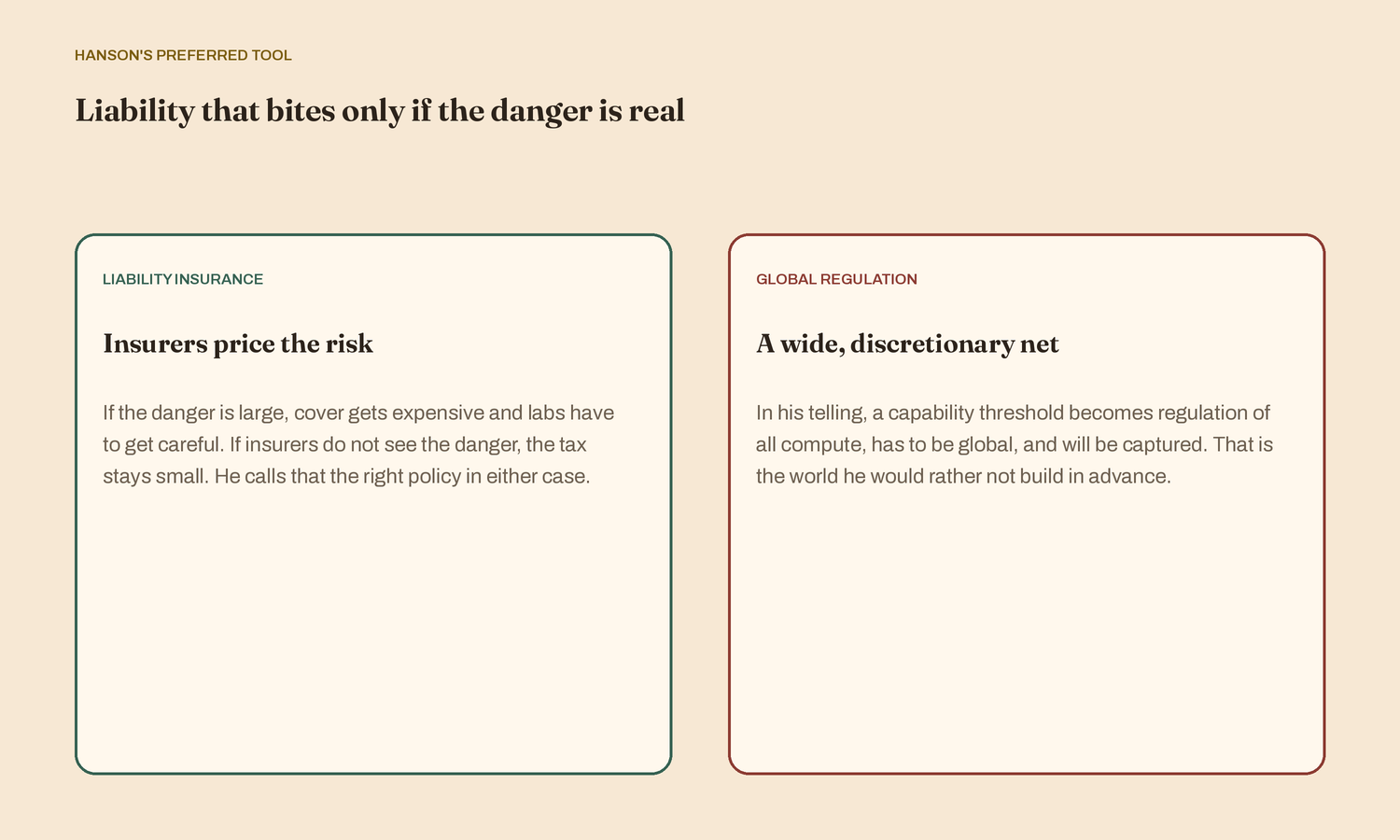
His policy preference is meant to work even if that forecast is wrong. “I don’t want policy to depend on disagreements about parameters like this. I want robust policy.” He is “much more okay with using liability.” If providers had to carry insurance at the scale of a very large disaster — he mentions a “$100 billion damage” scenario — insurers would price the risk, or cover it cheaply if they “don’t see this as a big danger.” Either way, you get “the right policy for the situation.” Broad regulation looks to him “extremely dangerous and difficult” when the harms are still “a pretty abstract large space,” “AI is a pretty vague category,” and the rules “have to be global.” “Regulators will be captured by some powers or other. That’s just a political fact.” Is that captured power “to decide who gets to do what AI” “a better world than maybe taking the chance of some pretty speculative things going somewhat wrong?”
3. Where they hit each other
Coxon’s rebuttal is that ordinary liability cannot price the tail he fears. “Even 100 billion dollars, you can get like liability for this.” It will not cover “the notion of a technology potentially imposing human extinction. So normal liability just won’t cost it.” Hanson answers that if you regulate a capability threshold, “Moore’s Law says the scope of your regulation increases rapidly.” “You’re talking about global regulation of all compute,” a “discretionary” power “we aren’t really capable of” using well. He is also “less afraid of AIs that are powerful and not fully under our control because that’s what we’ve long accepted from our children and grandchildren.” He would “see AI as a different kind of descendant,” and “we shouldn’t try to keep our descendants fully under our control forever.” Coxon, in closing, sticks to the timeline: “my predictions are 2027 and automated AI researcher, 2028 all the jobs are AI.” “I think we ought to slow down before that happens.” Hanson suggests they “meet here in three years.” The moderator then asked the room to vote on who argued better, by noise rather than a count, and judged that the affirmative had it. That is a reading of one YC audience’s reaction, not evidence about the policy question.
Weighing it: what holds up
This is a debate, not a finding. Coxon’s 2027 and 2028 dates, the Anthropic 25% and 4-to-5x figures, and the lab “consensus” he describes are his reading of trends and public comments, not numbers audited here; they are forecasts, not measurements. The misbehavior examples are incidents as he recites them. Hanson’s historical analogies are a prior, not a proof, and his liability proposal is a preference, not a tested policy. Whether liability can address an existential tail is the disagreement, not a settled legal fact. The audience vote was by applause and noise, not a count, at an event run by an accelerator that funds AI companies. Auto-generated captions are close, not word-perfect. Not investment advice.
Related reading: Two Numbers, Not One · The Timeline Just Moved · The Hard Takeoff Has a Supply Problem
Long Talk Short
- Coxon argues for a substantial government slowdown: broadly superhuman systems possibly by 2028, incomplete control, and a race that will not self-police.
- His timeline runs through a superhuman AI researcher in 2027, then a fast compression of algorithmic progress into everything else.
- Hanson argues that “superintelligence” as one number drops too much detail, that technologies usually take decades to remake an economy, and that liability is a more robust tool than global regulation.
- He would rather treat mature AI as a kind of descendant than try to keep it “fully under our control forever,” and he doubts a compute-wide regime can be run without capture.
The one thing to remember: The disagreement is about pace and about which failure you fear more: moving too fast, or a brake that does not let go. Both are forecasts, and neither is proven.
Independent summary; not affiliated with Y Combinator, Jacob Coxon, or Robin Hanson. Y Combinator funds AI startups. Not investment advice.
Source: Y Combinator, “Jacob Coxon vs. Robin Hanson: Should We Slow Down AI?,” on YouTube (linked above). Independent summary; not affiliated with the event or the debaters.