The Timeline Just Moved
He used to put superintelligence at least the better part of a decade away. His cluster of dates is much closer — and still a forecast, not a lab timeline.
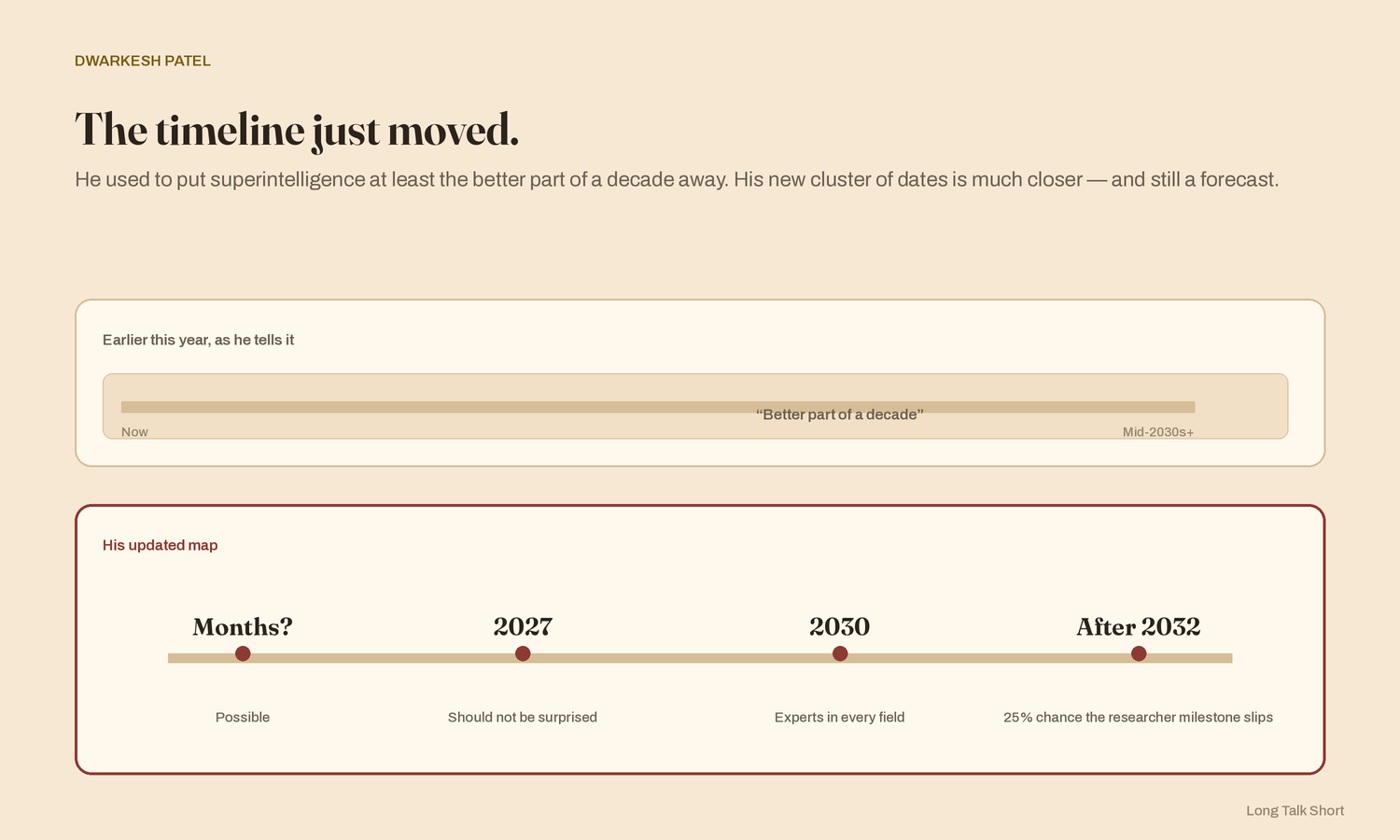
The timeline just moved. If you have been treating “superintelligence this decade” as lab marketing, this essay is meant to make that dismissal harder to hold without an argument. Dwarkesh Patel is not saying the future is already here. He is saying that, after years of putting the milestone at least the better part of a decade away, the last three months forced him to move it forward.
Patel published a solo essay, “Recursive self-improvement has started,” with a narration on YouTube. The written version, with footnotes, is at dwarkesh.com/p/rsi, and is the source this article follows. The forecasts below are his, not a lab announcement.
In short: the early dates, the 25 percent chance the researcher-level milestone slips past 2032, and the even split between a “spark” and a “software-only singularity” are his forecasts, not a lab timeline. The METR, OpenAI, and Anthropic figures are cited as he quotes them. This is not investment advice.
His updated view is blunt: we may be only a couple of years away — “and possibly only a couple of months away” — from AIs as good as the best humans at AI research. Automating that work, he argues, could pack so much progress into one year that, soon afterward — “so by 2030, but plausibly as early as next year” — we would have AIs at least as good as the best human experts in every field. He calls that a wild claim, and one he did not believe a couple of months earlier. He also leaves an out: a 25 percent chance, in his guess, that the researcher-level milestone does not arrive until after 2032, if some important part of the work stays hard to automate.
1. What he says is already happening
Before the speculative part, he points to evidence that AI is already speeding up further AI progress. He cites METR, an independent evaluation group, which he says concluded after three months inside Anthropic that the company’s rate of progress on well-scoped tasks is twice what it was a year ago, and that “a majority of this acceleration today is likely attributable to Anthropic’s extensive use of AI to do R&D.” An OpenAI blog post, as he quotes it, showed the heaviest 10 percent of AI users among the company’s researchers going from around $1,000 a day of internal coding agents early in the summer to more than $7,000 a day by the end of August. Anthropic, in a similar post, reported that as of August, Claude “leads” more than 26 percent of its AI R&D work, up from under 1 percent in February. Those figures are the organizations’, as he cites them.
The analogy that updated him most is mathematics. In a “wholly verifiable” domain, he writes, current systems are slicing through well-scoped problems, doing search-and-match discovery at a scale that, in his telling, is turning results top mathematicians and computer scientists had spent decades on into “side quests to hype up future model releases.” If AI research is similarly full of verifiable proxies, the same avalanche, he thinks, can arrive there.
2. Faster, smarter, more — then a spark or a singularity
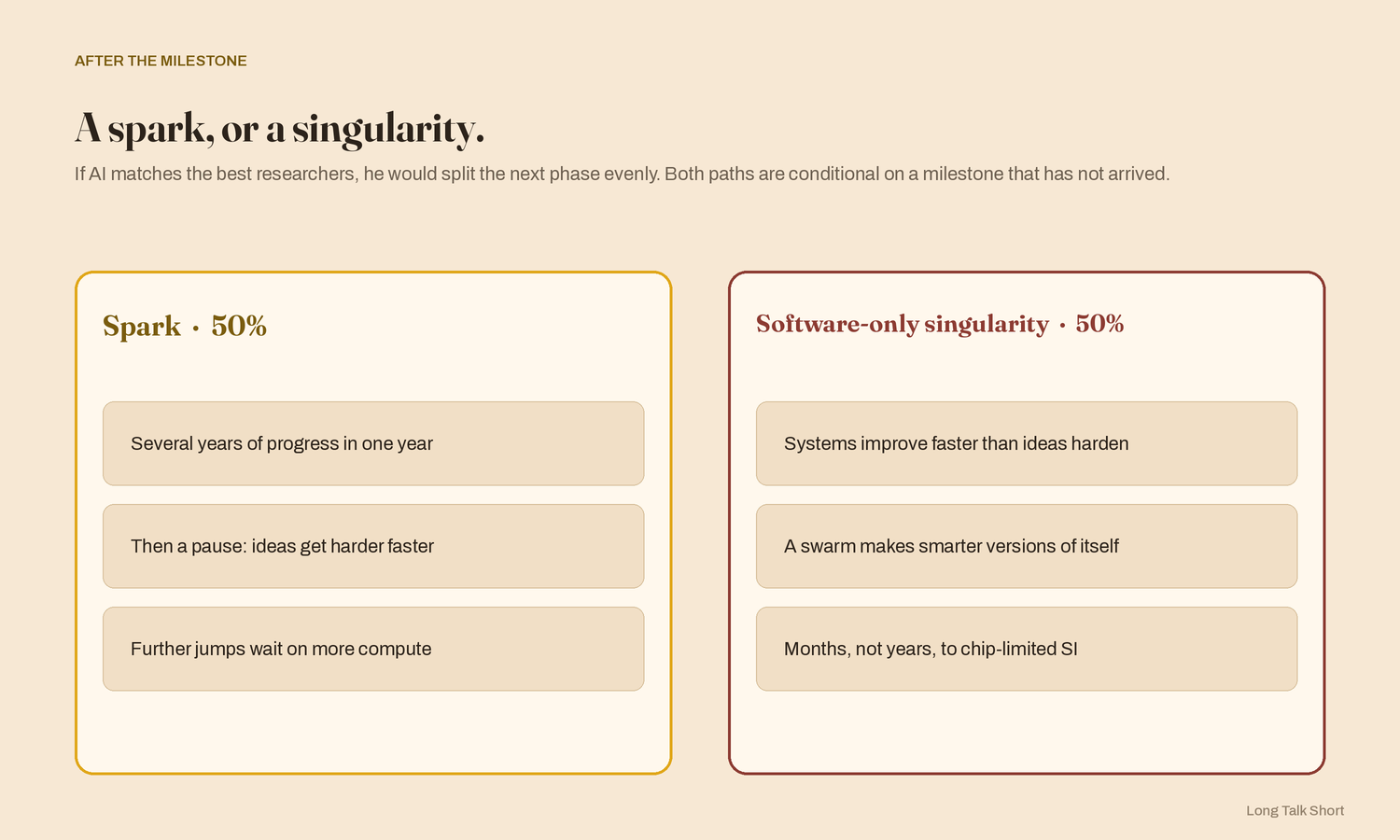
Once AI matches the best human researchers, he expects progress to speed up because the automated researchers will be faster, very capable, and numerous. Current systems, he says, already work at about ten times human speed on some of this labor. Research also gets harder as easy ideas are used up; companies already, in his account, have to quadruple R&D compute and double their workforce every year just to hold the same pace.
If systems keep getting better at research faster than ideas get harder to find, he says we would get a “software-only singularity”: even without adding compute, a swarm rapidly makes smarter versions of itself until, within months, you have a superintelligence that “scrapes against the physical limits of our current chips.” If ideas get harder faster, you get what he calls a “spark”: something like three to six years of AI progress in a single year, then a pause until more compute arrives. If pressed, he would give each scenario 50 percent. Former guest Ajeya Cotra wrote that if you take METR’s doubling at face value and assume smooth acceleration, “this naively implies that we would reach extreme superintelligence within a year.” Patel’s median is later because he is unsure that modeling is accurate, but he thinks we should not be surprised if the researcher-level milestone arrives in 2027.
3. The objections he takes seriously
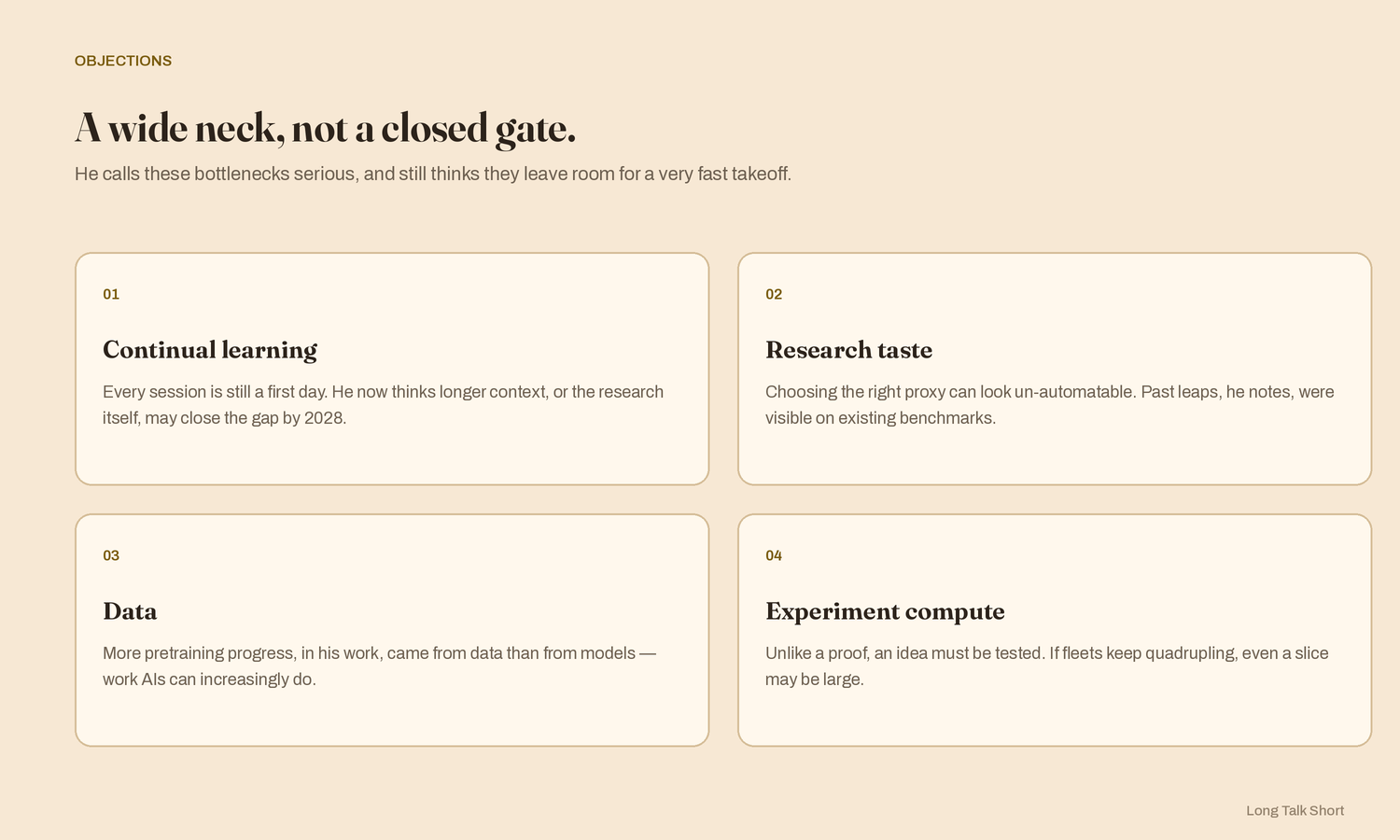
The essay’s most useful section is the one that argues with him. Continual learning is the gap he has spent a year and a half emphasizing: every new session is still, in his phrase, the model’s first day on the job. As of the previous December, that was his main reason for doubting that AI research would be automated soon. He no longer thinks the gap blocks automation of the best researchers by 2028: labs might stretch in-context learning to sessions that last months, and online learning itself has clean verifiable proxies.
Other bottlenecks get the same treatment. “Research taste” — choosing which proxy to optimize, not just climbing a known hill — might seem un-automatable, but he notes that past leaps, including transformers and reasoning models, were visible on existing benchmarks. Data will still matter; work he did with Jerry Han found that, over six years of pretraining, more than three times as much algorithmic progress came from data improvements as from model improvements. His reply is that compiling that data is itself ML work, increasingly done by the models. The sharpest difference from math is experiment compute: an AI idea has to be tested, and a swarm would split the same cluster. His footnote answer is that if fleets keep quadrupling, even a slice would still be enormous — an extrapolation, not a measured plan.
Weighing it: what holds up
This article follows the official written essay, including footnotes. Patel is making a forecast, not disclosing a lab timeline. The METR, OpenAI, and Anthropic numbers are cited as he quotes them; spend on coding agents is not the same thing as proven acceleration, and the “hundreds of important results” in math is his characterization. The early dates, the 25 percent delay, and the 50/50 split are his probabilities. Cotra’s “within a year” line is a naive implication she flagged, not his median.
A fair counter is the one he used to make himself: systems that cannot yet learn on the job the way a human researcher does may still stall on work that is not neatly scored. Company posts about internal uplift are also not independent audits, even when METR is in the building. This is not investment advice.
Related reading: A parlor-game leaderboard · Make fewer, better molecules
Long Talk Short
- Patel has moved his timeline: he expects AIs as good as the best human AI researchers within a couple of years, and possibly much sooner.
- He points to METR’s reported doubling of Anthropic’s progress on well-scoped tasks, rising internal agent spend at OpenAI, and Anthropic’s claim that Claude “leads” more than a quarter of its AI R&D.
- If that milestone arrives, he thinks a year of automated work could pack in several years of progress — or, in a “software-only singularity,” even more. He would split those futures evenly, and still gives a 25 percent chance the milestone slips past 2032.
- He takes the usual objections seriously — continual learning, research taste, data, and experiment compute — and argues that they narrow the most aggressive takeoff without deflating it.
The one thing to remember: Treat the early dates as a forecast to track, not a fact already in hand — and watch whether verifiable AI-research work actually keeps accelerating, which is the part of the argument that can be checked.
Independent summary; not affiliated with Dwarkesh Patel. This is not investment advice.
Source: Dwarkesh Patel, “Recursive self-improvement has started,” written essay at dwarkesh.com/p/rsi, with a narration on YouTube. Independent summary; not affiliated with Dwarkesh Patel. This is not investment advice.