The Correct Life That Went Wrong: Tolstoy's Ivan Ilyich and the Question to Ask Before It's Too Late
Tolstoy's The Death of Ivan Ilyich follows a judge who did everything properly and discovers, dying, that he never really lived. What the story says about lies, approval, honesty and a life well lived.
He did everything properly. Career, marriage, house, manners. Then, dying, he realized he had never really lived.
Leo Tolstoy's The Death of Ivan Ilyich (1886) is short, and it asks the most uncomfortable question in literature: what if a correct life is the wrong one?
The story opens after the ending. In a break in a court session, judges read in the newspaper that their colleague Ivan Ilyich Golovin has died. Each one's first thought is promotions and transfers. Under the sympathy, Tolstoy writes, each felt "it is he who is dead and not I." At the funeral, the widow's chief concern is getting a grant of money from the government. Then Tolstoy goes back to tell the dead man's life, which:
had been most simple and most ordinary and therefore most terrible.
In short: a life built around approval and comfort keeps truth and real connection away, Tolstoy argues, and it isn't too late to turn toward them. The novella leaves the reader one practical test, which we draw out below.
(Quotations are from the public-domain Louise and Aylmer Maude translation, which spells the name "Ilych.")
1. A life lived "pleasantly and properly"
Ivan is a capable, correct judge who rises steadily. His ideal is that life should flow "easily, pleasantly, and decorously."
- He marries because it's agreeable and approved of.
- When the marriage sours, he retreats into work and cards (vint, a form of bridge, is his great pleasure).
- His proudest project is decorating a new apartment, until his drawing-room resembles all other drawing-rooms.
While hanging curtains he slips from a step-ladder and bangs his side. The pain doesn't go away. Doctors debate a floating kidney or the appendix with the same air of importance Ivan assumed in court. He is dying, and none of his competence helps.
Tolstoy wrote the story after the spiritual crisis he described in A Confession (1882), and it reads like that book's argument told as fiction: status, comfort and correctness can fill a life without making it mean anything.
2. The lie everyone agrees to
What hurts Ivan most isn't the pain.
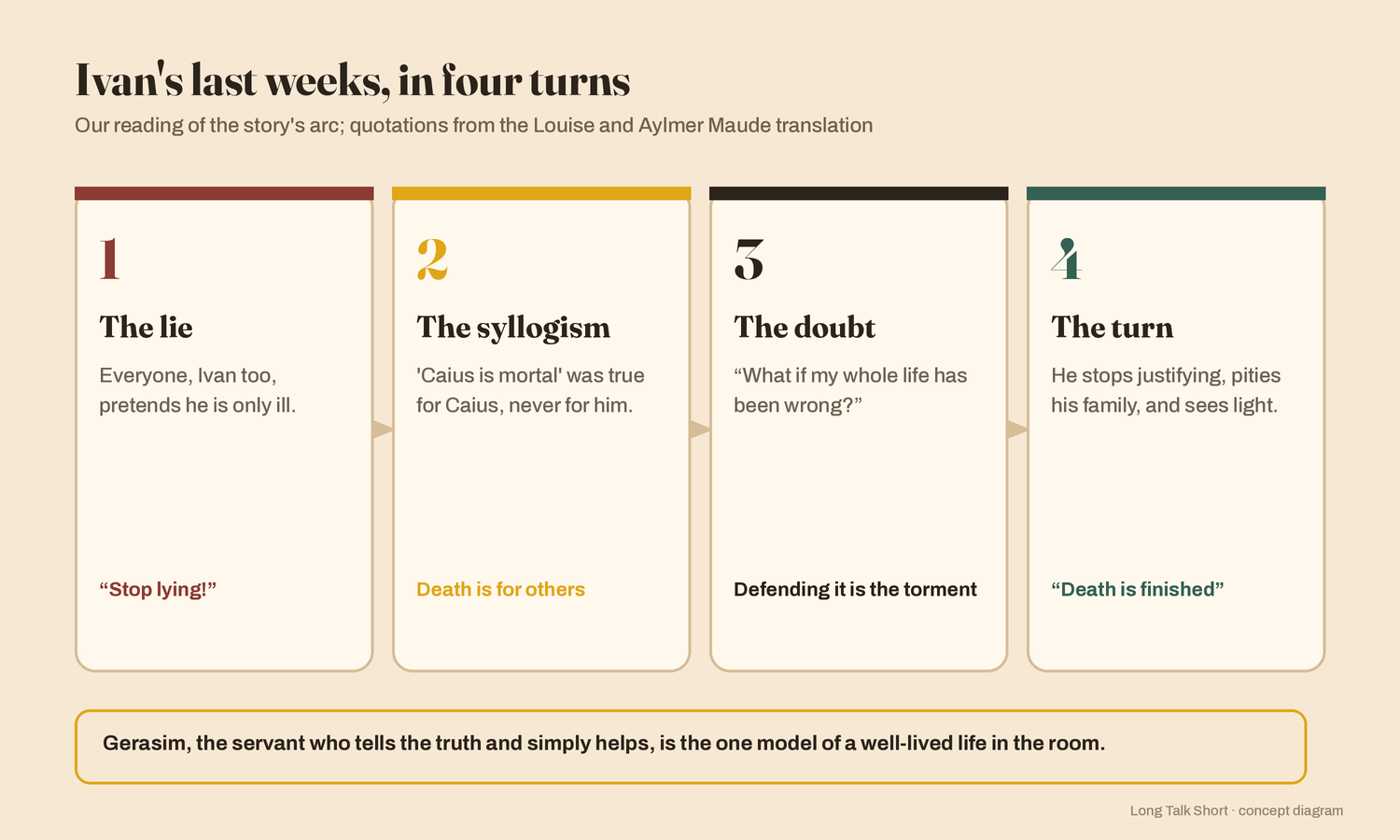
What tormented Ivan Ilych most was the deception, the lie, which for some reason they all accepted, that he was not dying but was simply ill.
His wife, daughter, doctors and friends all perform the decorum he spent his life perfecting, and he wants to scream, "Stop lying! You know and I know that I am dying." The lie is the social version of a private one. Ivan had learned the syllogism "Caius is a man, men are mortal, therefore Caius is mortal," and it had always seemed correct for Caius, but not for himself.
One person breaks the pattern.
3. Gerasim, the one who didn't lie
Gerasim, a young peasant servant, holds Ivan's legs up on his shoulders for hours because it eases the pain, and does it cheerfully. "Gerasim alone did not lie." When Ivan apologizes for the trouble, Gerasim answers:
We shall all of us die, so why should I grudge a little trouble?
He is the novella's picture of a well-lived life: honest about death, and therefore free to be kind.
4. Going downhill while thinking you're going up
As the illness worsens, Ivan reviews his life. Only childhood holds anything really good, and the bright memories grow fewer as his career advances.
I was going up in public opinion, but to the same extent life was ebbing away from me.
He tries the obvious defense: "Maybe I did not live as I ought to have done," then, "But how could that be, when I did everything properly?" That defense is the trap. When the question finally comes, "What if my whole life has been wrong?", he fights it, screaming for three days, and Tolstoy is precise about why he can't move forward: "That very justification of his life held him fast and prevented his moving forward, and it caused him most torment of all."
The ladder becomes a bitter joke: he lost his life over that curtain "as I might have done when storming a fort."
5. The turn
Near the end, his schoolboy son creeps in and kisses his hand, and Ivan feels sorry for him, then for his wife. Tolstoy compares the change to a railway carriage, when "one thinks one is going backwards while one is really going forwards and suddenly becomes aware of the real direction."
- He admits it: "Yes, it was not the right thing," he says to himself, "but that's no matter. It can be done."
- He tries to say "Forgive me" and manages only "Forego," trusting he will be understood.
- He looks for his old fear of death and can't find it. "In place of death there was light."
Then, to himself: "Death is finished." "It is no more!"
Weighing it: what holds up
The facts. A novella makes no factual claims to check, so we checked the reading instead. The 1886 date, the link to Tolstoy's late-1870s conversion and A Confession, and the surname Golovin match standard references.
The reading isn't just ours. Martin Heidegger's Being and Time (1927) points to the story as an illustration of what he called Being toward death. Akira Kurosawa's film Ikiru (1952) and its 2022 remake Living retell its question in a modern office. Vladimir Nabokov summed it up in a lecture as a man who lived a bad life, which, being "nothing but the death of the soul," meant Ivan lived a living death.
The ending divides readers. Some find the conversion too sudden and too religious, a moral delivered at the last moment. Others note that Tolstoy keeps it physical and unexplained, and that it comes from a small act of pity, not a doctrine. Our view: the story's case doesn't depend on the light. The diagnosis does the work. Ivan's life failed not because it had bad things in it but because it was arranged to avoid seeing anything true, about death or about other people.
Related reading: for a psychiatrist's answer to the same question, drawn from the camps rather than a drawing-room, see Viktor Frankl's Man's Search for Meaning.
Long Talk Short
- Ivan's life was "most simple and most ordinary and therefore most terrible": correct, comfortable, approved of, and missing what mattered.
- Everyone around him lies about his dying, and the lie hurts more than the pain. Death happens to Caius, not to me.
- Gerasim, who simply tells the truth and helps, is the story's model of a good life.
- "Going up in public opinion" can mean life ebbing away; Ivan's defense, that he did everything properly, is what holds him fast.
- The turn comes when he stops justifying himself and feels pity for others, and then the fear of death is gone.
The one thing to remember: ask Ivan's question while there's still time to change the answer. Is this life true, and close to people, or only correct?
Source: The Death of Ivan Ilyich by Leo Tolstoy (1886), quoted from the Louise and Aylmer Maude translation (public domain in the US). This is an independent summary and is not affiliated with any publisher.
This article is for general information only.