Patient on the Goal, Impatient on the Day: An Ex-Amazon VP on How Jeff Bezos Really Ran Amazon
Ex-Amazon VP Ethan Evans on Jeff Bezos: decades-long patience, daily urgency, the one-character "?" email, why a B is sometimes enough, and how being right so often led to the Fire Phone.
A five-year plan is really 20 quarters, and according to a former Amazon VP, Jeff Bezos refused to waste a single one.
Ethan Evans spent about two decades at Amazon. He joined in 2005, worked on early digital media, ran the company's app store, and later sat on Twitch's executive team as Amazon's "parental guardian" after the acquisition. On My First Million he gives a fan's account of Bezos that is also critical. Bezos was right about the big bets, ran a demanding feedback system, and at times let his certainty hurt the company.
In short: Bezos was patient about goals that take decades and impatient about every day spent getting there. He used quick signals, like a forwarded email with a single question mark, to keep standards high across a huge company. Evans also admits that being right so often helped lead to the Fire Phone.
1. Strategically patient, tactically impatient
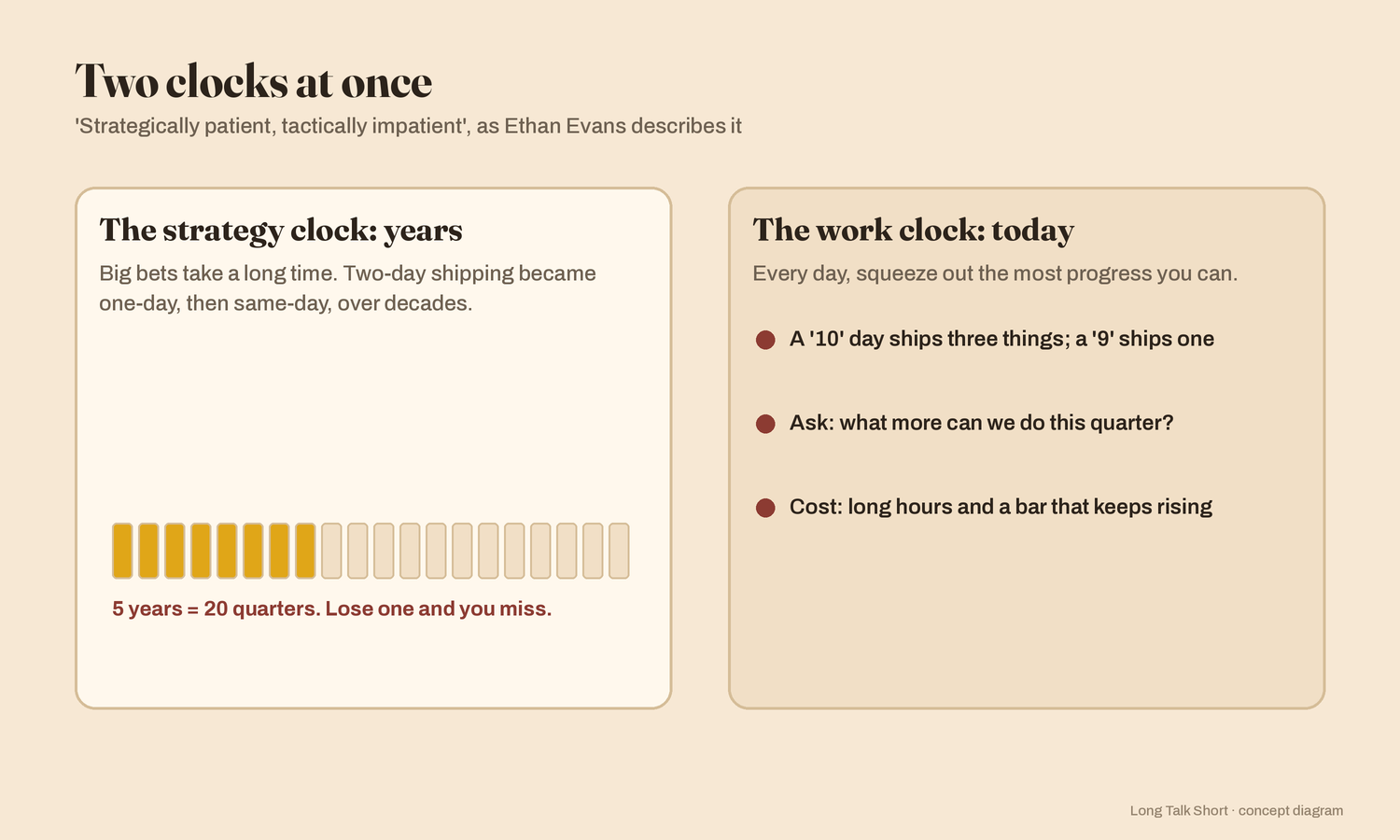
Evans calls the phrase "another Jeff idea." Rockets, or turning two-day shipping into same-day, are "decades of work." You need patience for the result, and urgency for the day:
every day you better be making every tiny bit of progress you can squeeze out.
The gap between a 9 and a 10 day is one thing done versus three, and that compounds. Bezos framed it as arithmetic: a five-year project is
an accumulation of 20 quarters. We can't lose any of those or we won't get there.
So he kept asking what more could be done this quarter. Long horizons didn't excuse slow weeks; they made each week matter more.
2. Free shipping, found by experiment
Customers hated paying for shipping, and finance pointed out that shipping costs money. So Amazon started with a high order minimum and lowered it step by step; in Evans's telling, $25 stuck for years. Experiments showed why: when Amazon mostly shipped books, music and DVDs, $25 meant two items, and two items in one box made free shipping pay. Prime later turned the idea into a membership.
Patience on the goal; experiments on the way. The daily pressure came from somewhere else.
3. The question-mark email
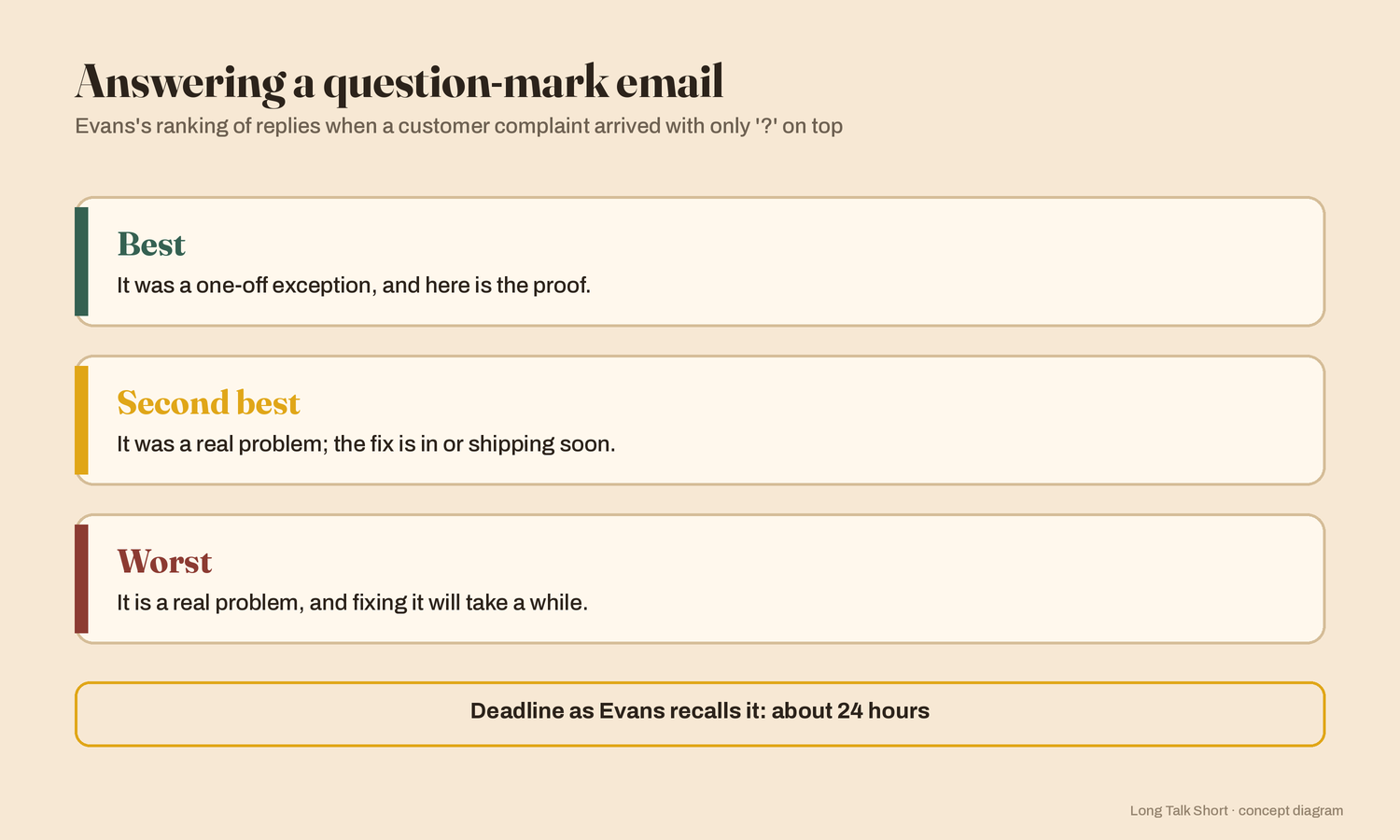
Customer complaints reached Bezos directly. He'd forward one to the person responsible with nothing but a "?" at the top. Everyone knew that meant about 24 hours to find out what happened. Evans ranks the possible answers:
- Best: it was a one-off exception.
- Second: a real problem, but a fix is in or shipping soon.
- Worst: a real problem that will take a while.
Behind it was a principle Evans quotes:
between data and anecdotes, trust the anecdotes.
At Amazon's scale, even 1% is a lot of real people. A complaint is a real story from that 1%, and seeing the same one five times in a week reveals a trend dashboards miss. (Evans's figure of 25 million failed deliveries a day looks far too high; read it as an illustration.)
Some emails were worse than a question mark. When Evans ran the app store, Bezos wrote, "Please tell me we're not doing this." Told they were, he answered: "Just euthanize me."
4. Sometimes all you need is a B
Evans's most useful point for managers concerns a long-serving executive Bezos rewarded handsomely, not for brilliance but for taking on any mess and turning "a D into a B." At Amazon's size:
sometimes all you need is a B because there's some other A product that's going to drag through the revenue.
A steady fixer can be worth more than a brilliant but erratic leader.
The high bar had costs. People said that "Amazon is a place where high performers go to feel bad about themselves": hit a goal and it goes up. Bezos could be cutting, once asking whether "the A team for this project" was available, "because this is clearly the B team." When a CFO warned that money in the bank was limited, Bezos replied, "How much is that, Tom? I might want to spend it." Evans credits his judgement partly to pattern recognition built from years of reading three to five business documents a day.
5. The flaw of being right
Evans's main criticism: Bezos "fell into the flaw of every great man." Having been right so often, on Kindle, Prime and products people said wouldn't work, he came to believe his vision was perfect. When everyone said the Fire Phone was a bad product, he didn't listen.
it turns out that everybody's right, not Jeff.
The hosts point to Bezos's return to an operating role at Project Prometheus, his new AI company, as another long, patient bet.
Weighing it: what holds up
Confirmed:
- The "?" emails are described in Brad Stone's The Everything Store, and Bezos told Business Insider in 2018 that the mark meant "Can you look into this?"
- The Fire Phone led to a $170 million charge in Q3 2014, mostly for unsold inventory and supplier commitments, after its price was cut from $199 to 99 cents.
- Anecdotes: Bezos has said publicly that "when the data and the anecdotes disagree, the anecdotes are usually right."
- Prime launched on February 2, 2005. Reports in 2025 and 2026 describe Bezos as co-CEO of Project Prometheus, which builds AI for engineering and manufacturing.
Approximate: Super Saver Shipping launched in January 2002 at a $99 minimum, dropped to $49 that June and $25 in August. Evans recalls a $100, $75, $50, $25 sequence; we found no $75 step. "Strategically patient, tactically impatient" is widely attributed to Bezos by former Amazon staff, but we found no primary Bezos source.
Not checked: the A-team remark and the CFO exchange (both only from Evans), his compensation and stock figures, and the 25-million-packages number, which looks inflated.
Related reading: on separating the quality of a decision from its outcome, see Judge the Bet, Not the Result.
Long Talk Short
- Be patient on goals that take years and impatient every day: a five-year plan is 20 quarters, and none can be wasted.
- Free shipping came from experiments with order minimums, not one bold launch. Prime came after.
- A single "?" on a forwarded complaint was a 24-hour review; the best answer is a one-off, the worst a lasting problem.
- Trust repeated anecdotes when they conflict with averages.
- Not every area needs an A. A reliable leader who turns a D into a B can be exactly what a large company needs.
The one thing to remember: long-range patience only works when paired with daily urgency, and with enough humility to listen when everyone says the bet is wrong.
Source: "Ex-Amazon VP tells us what it’s really like working with Jeff Bezos", My First Million. This is an independent summary and is not affiliated with My First Million, Ethan Evans, Jeff Bezos or Amazon.
Quotes are taken from automatic captions and may contain small transcription errors. Nothing here is investment advice.