This Is the Worst AI Yet: Ethan Mollick's Four Rules for Working With AI, and the Study Behind Them
Ethan Mollick's four rules for working with AI, the jagged frontier study he co-wrote, and why a tool that is usually right can make you stop checking.
Whatever AI tool you use, Ethan Mollick wants you to assume it is the worst one you will ever use. Not because it is bad, but because the next one will probably be better. That is the fourth of the rules in Co-Intelligence, a short, practical book by the Wharton management professor who became one of the most-read voices on how ordinary people should work with AI. His pitch is simple: stop waiting for experts to tell you what these tools are for. You will only find out by using them, on real work, with your eyes open.
In short: Mollick treats AI as a strange, capable co-worker that is brilliant at some tasks and confidently wrong at others, with no clear line between the two. His four rules are about finding that line in your own work. The study he leans on most, which he co-wrote, backs both halves of the warning. The book's specific tools have dated; its habits mostly haven't.
1. Four rules
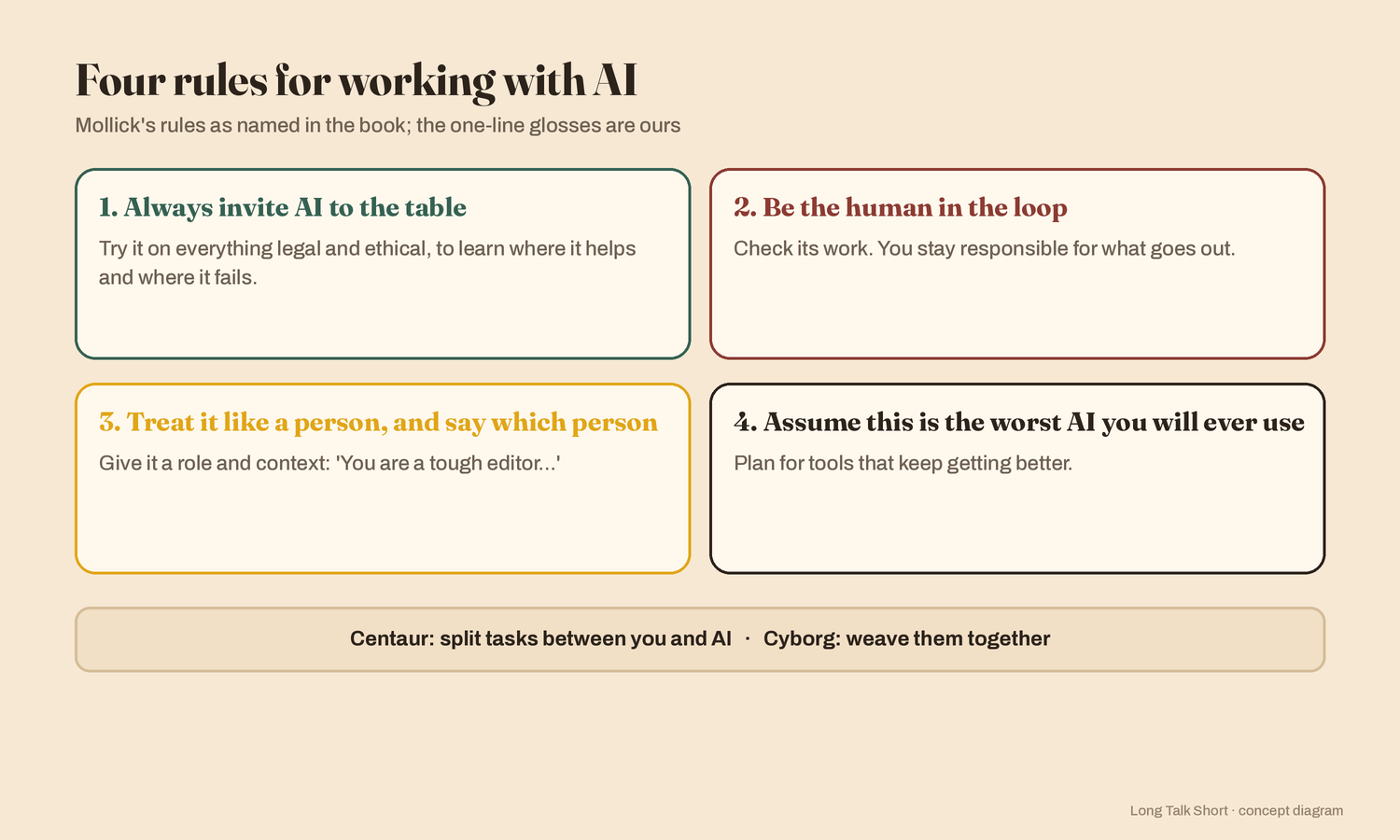
Always invite AI to the table. Try it on everything you do, within legal and ethical limits, because nobody knows exactly where it helps. The people who learn fastest, Mollick argues, will be the ones who experiment in their own field, because they are the experts in what good looks like there.
Be the human in the loop. AI makes things up, sounds sure of itself when it is wrong, and has no sense of what matters to you. You check the work, and you stay responsible for what goes out. Mollick also frames this as keeping your own skills sharp, so you are able to judge.
Treat AI like a person, but tell it what kind of person it is. Mollick knows the risk of treating software as human. His point is practical. These systems respond to context, so you get better results if you give them a role and a situation: you are a tough editor, a sceptical investor, a patient tutor for a 12-year-old.
Assume this is the worst AI you will ever use. Build your habits, and your plans, on the expectation that the tools will keep improving. The book sketches four possible futures, from AI being "as good as it gets" through slow growth and exponential growth to a "machine god", and argues that the first is the least likely.
Rule two sounds like common sense. The experiment at the heart of the book shows why it is harder than it sounds.
2. The jagged frontier
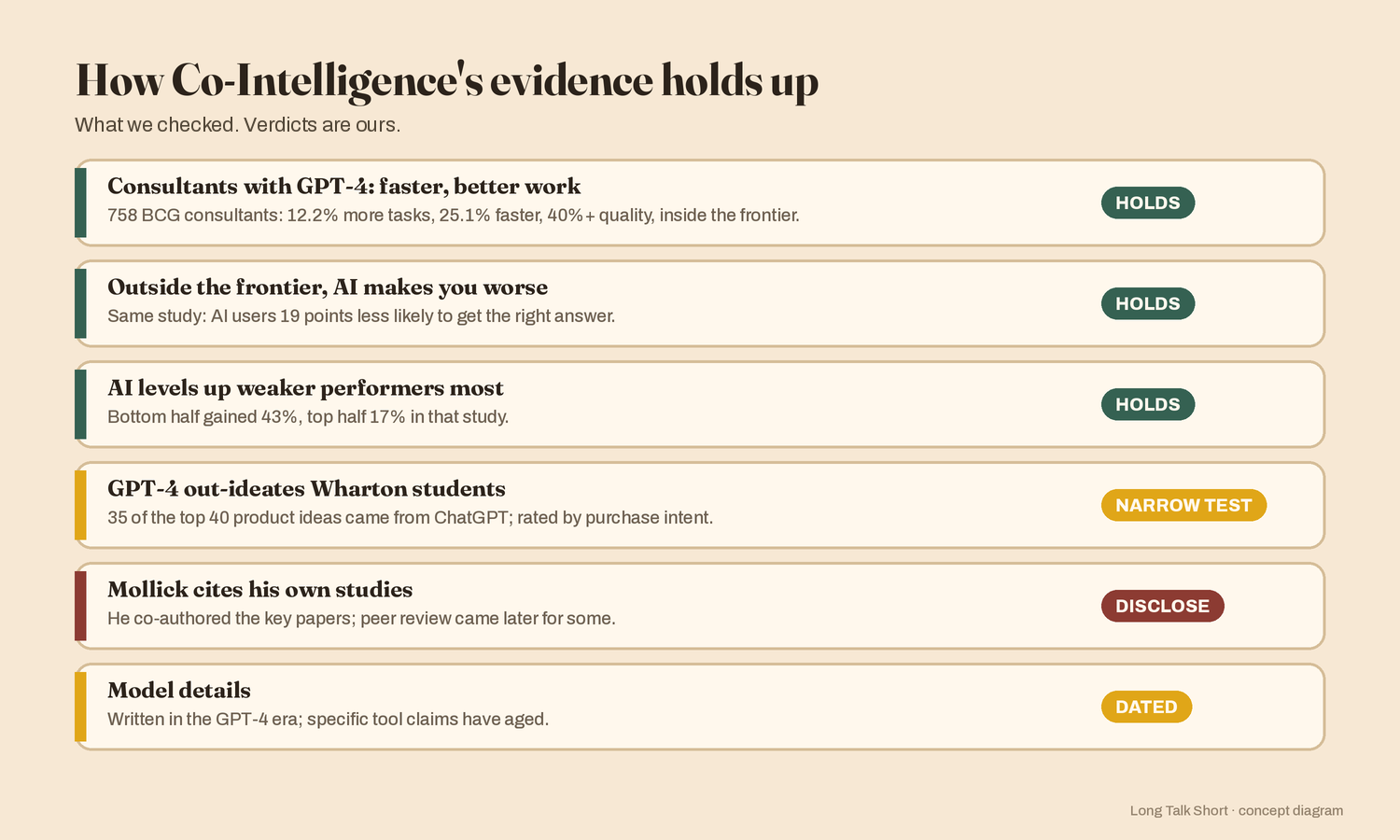
Mollick and colleagues from Harvard, MIT and elsewhere worked with Boston Consulting Group, where 758 consultants did realistic tasks with or without GPT-4. On tasks inside what the researchers called AI's "jagged frontier", the consultants using it finished 12.2% more tasks, worked 25.1% faster and produced work rated more than 40% higher in quality. The biggest gains went to weaker performers, whose scores rose 43%, against 17% for the stronger ones.
But one task was chosen to sit just outside the frontier: a problem that looked like something AI could handle but where it tended to steer people wrong. There, consultants using AI were 19 percentage points less likely to reach the right answer than those working alone. About 85% of the control group got it right, against roughly 60% to 71% of the AI groups. The frontier is jagged because you can't tell from the outside which side a task is on. Two tasks that look equally hard can fall on opposite sides.
Mollick describes two styles that worked. Centaurs split the job, handing AI the parts it is good at and keeping the rest. Cyborgs weave back and forth, working with the AI on almost every step. Both depend on knowing where your tool fails.
3. Partner, tutor, coach
The book then works through the roles AI can play: creative partner, co-worker, tutor and coach. On creativity, Mollick cites a Wharton study in which GPT-4 and students each produced 200 product ideas for college students. Of the 40 ideas rated best, 35 came from ChatGPT. On teaching, he argues AI tutors could give every student something like one-to-one help, while making homework essays far easier to fake. Striking claims, and much of the evidence has one name in common.
Weighing it: what holds up
Holds up: We checked the consulting study, by Fabrizio Dell'Acqua, Mollick and colleagues, which was later published in Organization Science. The figures above match it. Its key strength is that it shows both sides: real gains inside the frontier and a real penalty outside it. A separate field experiment by Dell'Acqua found that recruiters given a very good AI tool put in less effort and were less accurate than those given a weaker one, which they learned to double-check. That supports the "human in the loop" rule: a tool that is usually right can make you stop looking.
Read with care: Mollick is a co-author of the consulting study and of a later version of the ideas paper, so a fair share of the book's evidence is his own research. That doesn't make it wrong, and his authorship is a matter of public record, but it is a reason to look for independent work too. The ideas study rated ideas by how likely people said they were to buy them, a narrow test of creativity, on one task. The results describe GPT-4 and one kind of knowledge work; how far they carry to other jobs and other tools is unsettled.
Conflict of interest: Mollick has said publicly that he takes no money from AI companies, but that he gets early access to some models, sometimes under a non-disclosure agreement. We checked that statement. Early access is a normal part of covering the field, and it is also a relationship worth knowing about.
Dated, and not checked: The book was written in the GPT-4 era, and details about particular models have aged fast, which, to be fair, is exactly what his fourth rule predicts. We didn't check his claims about education or the four futures, which are forecasts, not findings. The verdicts in the table are ours.
Bottom line: The habits are sound and the core study is solid, two-sided evidence. Just remember who ran it.
Related reading: Does It Actually Work? AI Snake Oil and How to Spot AI That Can't Deliver · Own the Test, Rent the Model: Satya Nadella on Your Company's Real AI Asset · The Wave and the Narrow Path: Mustafa Suleyman on Containing AI
Long Talk Short
- Treat AI as a capable but erratic co-worker: brilliant at some tasks, confidently wrong at others.
- Mollick's four rules: use it on everything you can, stay the human in the loop, give it a role, and expect better tools.
- In his study with BCG, consultants using GPT-4 were faster and better on most tasks, but worse on one designed to trip it up.
- The line between those tasks is jagged and invisible, so you have to find it in your own work by testing.
- Much of the book's evidence is Mollick's own research, and its model details have dated.
The one thing to remember: the more often an AI tool is right, the more carefully you need to check the times it isn't.
Source: Co-Intelligence: Living and Working with AI by Ethan Mollick (Portfolio, 2024). This is an independent summary and is not affiliated with the author or publisher.