Genetics Loads the Gun
David Perlmutter tells The Diary Of A CEO that Alzheimer's is primarily a metabolic condition of the brain — and significantly preventable. Genetics loads the gun, he says. Lifestyle pulls the trigger.
Genetics loads the gun. Lifestyle, he says, pulls the trigger. If you have been waiting for a drug to rescue your memory later, David Perlmutter would tell you that you are already writing the ending. On The Diary Of A CEO, the board-certified neurologist tells Steven Bartlett that Alzheimer's is "primarily a metabolic condition of the brain," that it is "significantly preventable," and that this is the line to remember.
In short: Perlmutter's case is that everyday choices — movement, food, sleep, and connection — shape the brain's immune cells and its long-term risk, and that waiting for a pharmaceutical rescue is a way of giving your agency away. He is also promoting his book, Brain Defenders. The episode title, "The Brain Doctor That Figured Out The Cause Of Dementia," oversells a complex disease. This is not medical advice.
1. A high risk, and a claim that it is not destiny
If you live to 85, he says, the risk of dementia, "generally Alzheimer's," is "close to a high 40%, or a flip of a coin," and "women have twice the risk of Alzheimer's in comparison to men." A 2025 lifetime-risk study of dementia after age 55 landed near that ballpark — about 42% overall, higher in women — but that is the chance of eventually developing dementia, not the share of 85-year-olds who already have it. The 2026 Association facts and figures put the prevalence of clinical Alzheimer's among people 85 and older at about 36%. Lifetime risk of Alzheimer's has often been cited as roughly twice as high in women as in men; same-age incidence is more mixed, and longer life explains a lot of the gap. Perlmutter points instead to the drop in estradiol at menopause.
The first item on his lifestyle list is not a food or a workout. It is that people have "offloaded agency" of their brains to the drug industry, waiting for a rescue that, in his view, has not arrived. Lifestyle choices, he says, are "the architects of our brain's destiny." On APOE4 — a common risk variant he says about a quarter of people carry — he is clear: more copies raise risk, but "you are not necessarily destined to get Alzheimer's." It is a predisposition, "not a genetic determinant."
2. Microglia, sugar, sleep, and the multi-tool
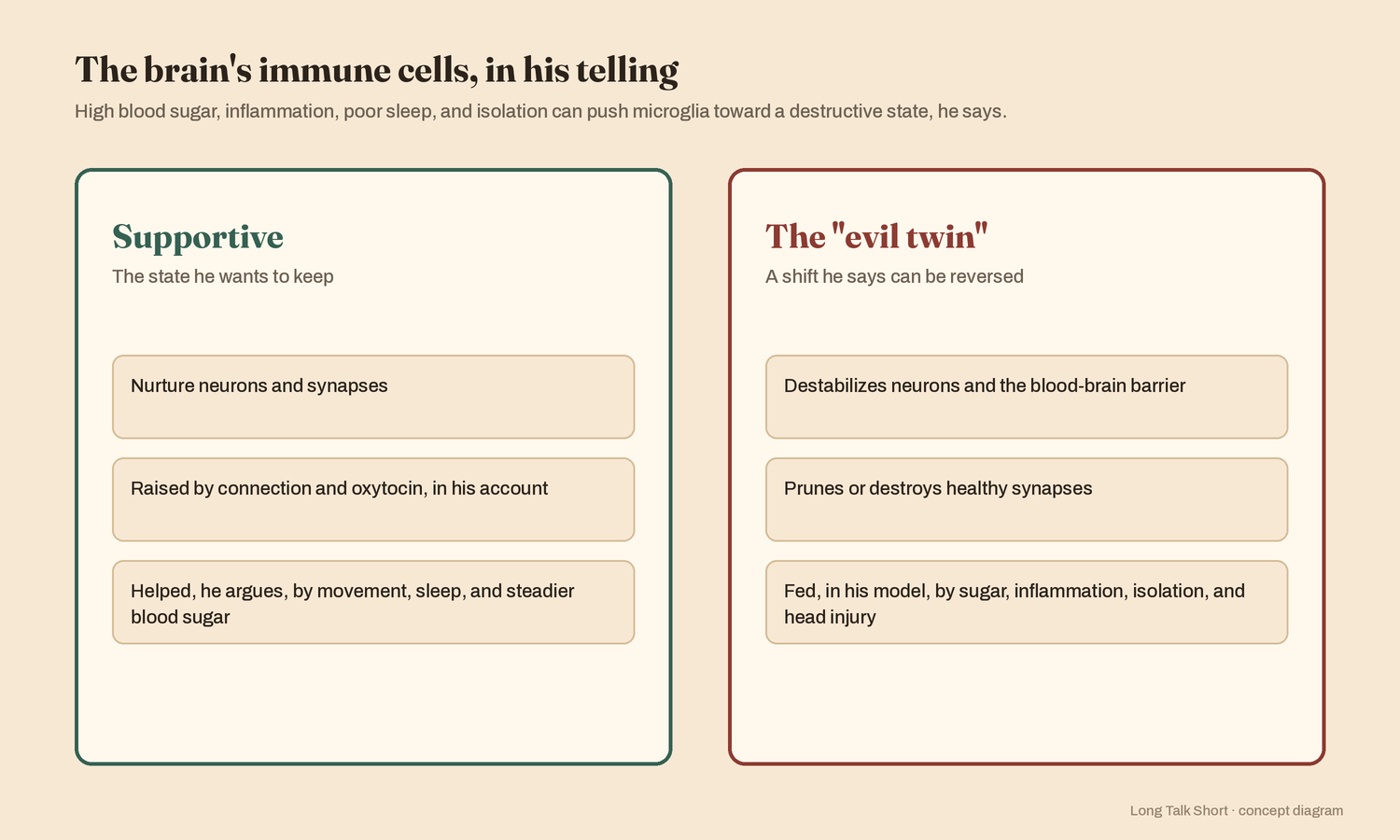
The mechanism he keeps returning to is microglia, the brain's resident immune cells. In a supportive state, he says, they nurture the brain; under high blood sugar, inflammation, poor sleep, isolation, or a blow to the head, they can shift toward what he calls the "evil twin" and start destroying synapses — the connections between neurons. He notes that the shift is not strictly binary. Type 2 diabetes, visceral fat, and even a head injury on top of diabetes, in his account, make that shift more likely. He also links type 2 diabetes to higher risk of Parkinson's.
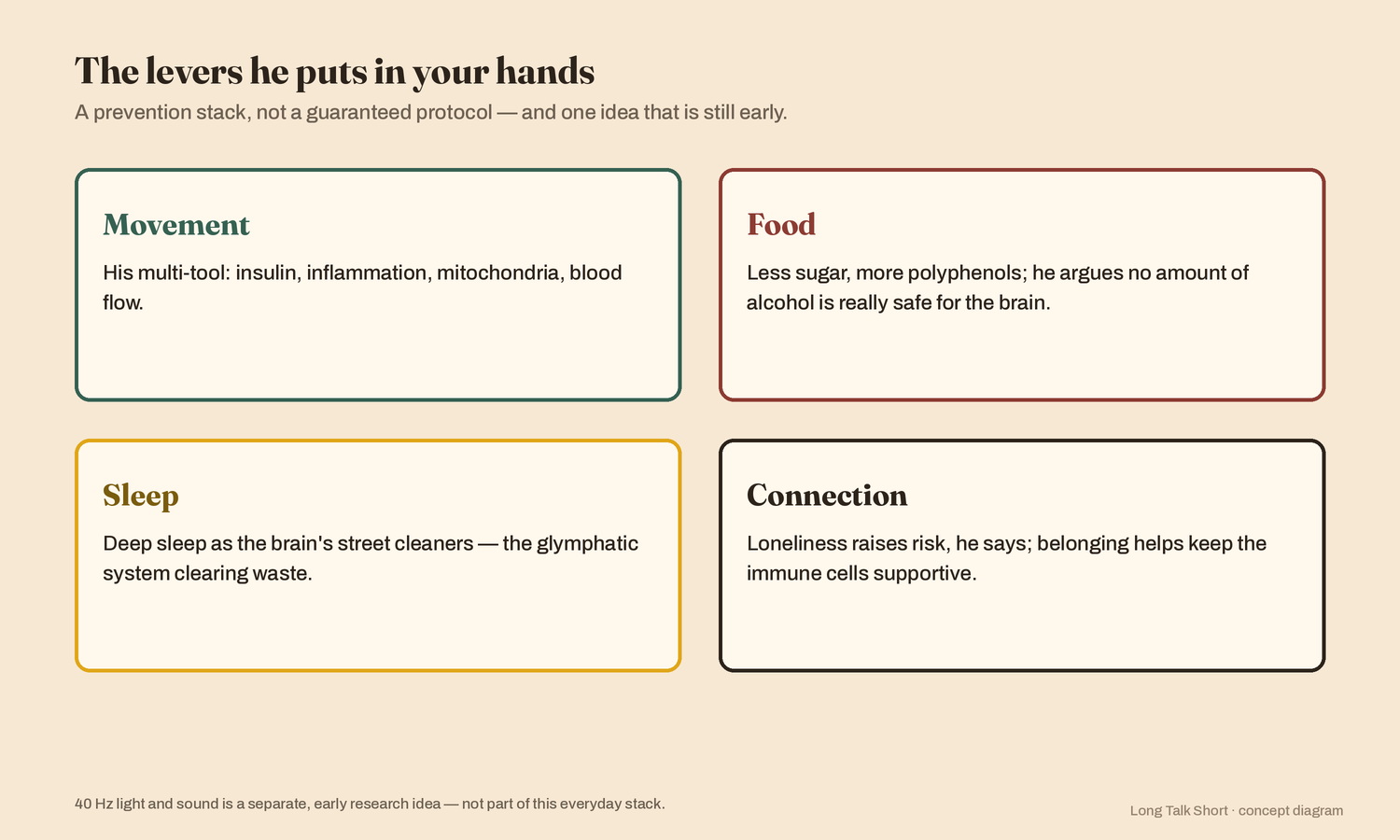
Exercise is his "multi-tool": it targets insulin, inflammation, mitochondria, and blood flow. He cites a 2025 Framingham analysis by Francesca Marino and colleagues, and gives large risk reductions for more active middle-aged people and for active APOE4 carriers in later life; those percentages are his reading of the paper. Loneliness, he argues, raises risk; connection, through oxytocin, helps keep microglia supportive. Deep sleep, in a metaphor he likes, sends out the brain's "street cleaners" — the glymphatic system — to clear waste, including amyloid-beta. (He places his own deep sleep late in the night; deep sleep usually comes in the first part of the night.)
3. Food, a wartime sugar study, and what he would not wait for
On food, he is blunt about sugar, including a glass of orange juice that he fills with eight teaspoons to make the point, and he likes a continuous glucose monitor as a way to see what meals actually do. He wants polyphenol-rich foods — he mentions coffee and extra-virgin olive oil — and he argues that no amount of alcohol is really safe for the brain, even if he still drinks wine occasionally. A section on gluten and glyphosate is more contested, and is not the center of his argument here.
He is impressed by a natural experiment around the end of UK sugar rationing in 1953: children whose first thousand days, from pregnancy onward, fell under rationing went on to show a substantially lower Alzheimer's risk — he says about 40%. One 2026 analysis reported a 46% lower Alzheimer's association; another found a smaller reduction. These are quasi-experimental associations, not a clinical trial, and the cohorts are still younger than the ages when Alzheimer's is most common.
For 40 Hz flickering light and sound — work associated with Li-Huei Tsai at MIT — he is enthusiastic, keeps a light on his desk, and says the human results beat amyloid-targeting drugs. That is his claim. The human evidence is still early, with small samples; he also says he cannot prove the desk light is doing anything for him. For people already living with Alzheimer's or mild cognitive impairment, he points to a small 20-week lifestyle study (exercise, a plant-forward diet, stress reduction) in which he says most participants stabilized or improved, and to a ketogenic diet or ketone supplements as a way to feed a brain that is struggling to use glucose. Neither is presented as a cure. He also describes the supplements he takes, including methylated B vitamins and fish-oil DHA.
The personal stake is not abstract. His father, a brain surgeon, died of Alzheimer's; Perlmutter says he recognized it late. Bartlett reads a letter from Perlmutter's son, Austin, about watching his father try to give people tools. Perlmutter thinks of his dad, and of staying in his lane for as long as his own brain holds up.
Weighing it: what holds up
Checked. Official Diary Of A CEO upload: title confirmed. Wording is from auto-generated English captions (youtube-transcript-api); treat quotes as close, not word-perfect. Lifetime-risk and prevalence figures, and the two sugar-rationing papers, as cited above. An independent research PDF linked in the YouTube description was used as a companion, then checked against those sources. This is a Perlmutter metabolic-prevention piece, distinct from the Health pieces on brain imaging or the gut.
Unverified, and his. That Alzheimer's has a single metabolic "cause," or that it is as preventable as the title implies. The precise exercise and diabetes risk reductions he quotes, pending a closer read of each paper. That 40 Hz stimulation already outperforms approved drugs, or that a ketogenic diet can reverse the disease. Official U.S. death rankings usually place Alzheimer's lower than third. This is not medical or therapy advice.
Disclosures. He is promoting Brain Defenders, and the description offers a free habits assessment.
If you or someone you know is struggling, you can call or text 988 to reach the Suicide & Crisis Lifeline in the US. Outside the US, contact local emergency services or a local crisis line.
Related reading: Paul Thompson on brain aging and metabolic health · Outlive: Medicine 3.0
Long Talk Short
- Perlmutter's core claim is that Alzheimer's is largely a metabolic condition of the brain, significantly preventable, and steered more by lifestyle than by a verdict in your genes.
- His practical stack is familiar on purpose: move, sleep, eat with blood sugar in mind, stay connected, and do not outsource the whole problem to a future drug.
- Some supporting numbers are in the right neighborhood; the 40 Hz enthusiasm, and some of the neurology, run ahead of what is firmly shown.
The one thing to remember: You cannot rewrite your APOE status, but you can decide whether the next decade is spent waiting for a rescue, or feeding, moving, and resting the brain you already have.
This summary is for general information only and is not medical, mental health or professional advice. Perlmutter's claims are his reading of the evidence, not findings endorsed here, and not a treatment plan.
Source: Dr. David Perlmutter on The Diary Of A CEO with Steven Bartlett, "The Brain Doctor That Figured Out The Cause Of Dementia - Dr. David Perlmutter," on YouTube. Independent summary; not affiliated with Dr. Perlmutter or The Diary Of A CEO. This is not medical or therapeutic advice.