Seven Shortcuts That Say Yes for You: Cialdini's Influence, and Which Persuasion Studies Survived
Robert Cialdini's Influence names seven shortcuts that make us say yes, from reciprocity to unity. How each is used on you, how to resist it, and which classic studies held up under replication.
A stranger hands you a free Coke. Later he asks you to buy raffle tickets. You buy twice as many, even if you don't like him.
That 1971 experiment by psychologist Dennis Regan is the kind of study at the heart of Robert Cialdini's Influence (1984). Your brain has shortcuts for saying yes, and other people know where they are.
Cialdini, a social psychologist at Arizona State University, wrote the book after years of studying compliance in the lab and in sales training programs.
In short: we rely on mental shortcuts to decide when to say yes, and persuaders can trigger them on purpose. Cialdini names seven. Most rest on real effects, but some classic studies are smaller, shakier or more context-dependent than the book suggests.
Why the shortcuts exist
Automatic responses are usually smart. We can't analyze every request, so we use cues that are usually right, like "expensive means good" or "an expert said so." The trouble is that anyone who knows the cue can fake it. Cialdini calls those people compliance professionals: salespeople, fundraisers, marketers, recruiters, negotiators.
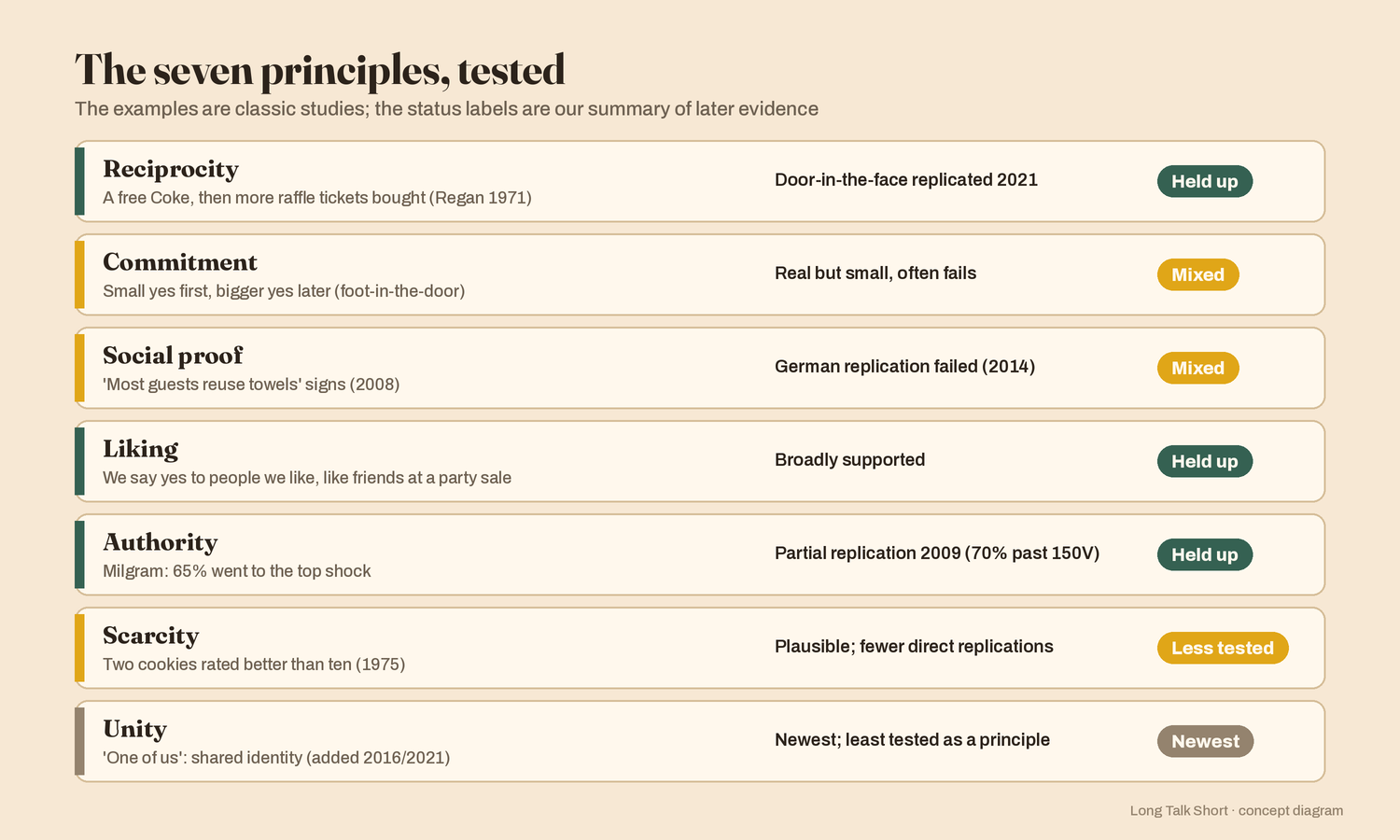
Here are the seven cues, how each gets used on you, and how to defend yourself.
1. Reciprocity
We feel obliged to repay what we're given, even gifts we didn't ask for. That's why charities mail free address labels and supermarkets hand out samples. Its sharpest form is the "door-in-the-face": ask for something big, accept the refusal, then make the smaller request you wanted all along. Your retreat feels like a concession, and people return it. In Cialdini's 1975 study, students who had just turned down a huge volunteering request were far more likely to agree to a small one.
Defense: accept favors, but ask whether it was a gift or a sales tactic. You only owe a return for the first.
2. Commitment and consistency
Once we take a stand, especially in public, in writing or with effort, we act to stay consistent with it. The "foot-in-the-door" starts small: agree to a tiny sign, and a larger request later seems natural. The "lowball" gets you to commit to a deal, then quietly worsens the terms.
Defense: ask whether, knowing what you know now, you'd make the same choice again.
3. Social proof
When we're unsure, we look at what others do. Hence reviews, "bestseller" badges and old TV laugh tracks. Cialdini also uses it to explain bystanders who don't help: in an ambiguous emergency, everyone reads everyone else's calm as proof nothing is wrong.
Defense: check whether the crowd is real, and whether it's like you.
4. Liking
We say yes to people we like, and we like people who are attractive, similar, complimentary, familiar and linked with good things. His classic case is party-plan selling, where you buy from the friend hosting as much as from the company.
Defense: if you like a salesperson unusually fast, separate the person from the deal.
5. Authority
We defer to titles, uniforms and confident experts. Stanley Milgram's obedience studies are the extreme case: in his best-known version, 65% of participants kept giving what they thought were shocks to the top of the scale because a researcher in a lab coat told them to.
Defense: ask whether this person is really an expert on this topic, and how much they gain from your agreement.
6. Scarcity, and 7. Unity
Things seem more valuable when they're rare or running out, and losing a freedom makes us want it more. In a 1975 study by Stephen Worchel and colleagues, people rated the same cookie as more desirable when the jar held two rather than ten, especially when it had just gone from ten to two. Think countdown timers and "only 3 left." Defense: notice the rush, then ask whether you want the thing for what it does or for how rare it is.
Unity was added in Pre-Suasion (2016) and the expanded 2021 edition of Influence. It goes beyond liking someone to feeling you're one of them, through family, place, faith or shared struggle. Brand "communities" and "as a fellow parent" pitches use it. Defense: ask whether the "we" is real or just a marketing line.
The book predates psychology's replication crisis. So how have these findings fared?
Weighing it: what holds up
Held up. The door-in-the-face got a direct test in 2021: Oliver Genschow and colleagues at the University of Cologne repeated Cialdini's 1975 procedure in Germany and found compliance about as high as 45 years earlier, with the reciprocity explanation intact. Authority partly replicated: in 2009 Jerry Burger re-ran Milgram's study, stopping at 150 volts for ethical reasons, and found 70% willing to continue past that point, not significantly different from Milgram's rate. A 2011 meta-analysis by Peter Fischer and colleagues, covering more than 7,700 participants, confirmed that bystanders reduce helping, though less so in clearly dangerous emergencies.
Mixed. Foot-in-the-door effects are real but small in meta-analyses, and Burger's 1999 review found the technique often fails or backfires. The famous hotel-towel study (Goldstein, Cialdini and Griskevicius, 2008), where "most guests reuse their towels" signs beat environmental appeals, didn't replicate in German hotels in 2014, probably because reuse there was already high. Our reading: a norm persuades best when it tells people something new.
Debunked example. The book's account of the 1964 murder of Kitty Genovese relied on the New York Times report of 38 neighbors watching and doing nothing. Later reporting showed only a few saw parts of the attack, some did call the police, and one woman went to help; the Times later acknowledged its account was flawed. The bystander effect is real. That story just isn't good evidence for it.
Less tested. We found no large direct replication of the cookie-jar study. Unity is the newest principle and the least tested on its own, since it overlaps with liking and group-identity research.
Related reading: for a modern, more aggressive take on the same levers, see Chase Hughes's persuasion playbook, fact-checked, and The Nod That Rewrites You.
Long Talk Short
- We rely on shortcuts to decide when to say yes, and anyone who knows the cue can fake it.
- Reciprocity (unrequested gifts, door-in-the-face) is the best-replicated principle, confirmed again in 2021.
- Commitment, social proof, liking, authority and scarcity all work, but effects vary with context; foot-in-the-door and the towel signs are weaker than the book implies.
- Unity, being "one of us," is the newest principle, added in 2016 and 2021.
- The Kitty Genovese "38 witnesses" story is a myth, even though the bystander effect holds up.
The one thing to remember: when you feel a sudden pull to say yes, name the shortcut being pulled, then decide on the merits.
Source: Influence: The Psychology of Persuasion by Robert B. Cialdini (William Morrow, 1984; new and expanded edition, Harper Business, 2021). This is an independent summary and is not affiliated with the author or publisher.
This article is for general information only and is not professional advice.