Fewer Sets, Harder Sets: Jeff Cavaliere on Lifting as You Age, and What the Studies Say
Physical therapist Jeff Cavaliere tells Peter Attia that older lifters should cut junk volume, train closer to failure where it's safe, and route around injuries instead of resting. His rules, his exercise graveyard, and what the research says.
If you've lifted for years and wake up with sore joints instead of sore muscles, you may be tempted to keep doing what you've always done, only lighter. Jeff Cavaliere, a physical therapist and the founder of the ATHLEAN-X training channel, tells Peter Attia that the better move runs the other way: do fewer sets, and make each one harder. He calls the rest "junk volume", and he thinks it's quietly wearing out the joints of people in their 40s, 50s and 60s.
In short: Cavaliere's rules for lifting as you age are to accept some decline, warm up properly, cut low-effort sets, take the rest close to failure where it's safe, and treat an injury as a detour, not a reason to stop. Most of the episode is a muscle-by-muscle menu of exercises, with a few he'd retire. This isn't medical advice: if you're in pain or injured, see a clinician.
1. First, admit things have changed
Cavaliere, 50, has flat feet, sore knees and a right shoulder with a torn labrum and a partly torn rotator cuff, the result of a $1,000 bet that he could throw a baseball from the outfield to third base. His signals that something needs to change are joint soreness rather than muscle soreness, waking up tired, and irritability. His fix was a longer warm-up with resistance bands. His starting point is to stop fighting the fact that "it isn't exactly like it was".
2. Cut the junk, keep the intensity
His rule fits in one line:
I want volume to come down. I want productive repetitions to go up.
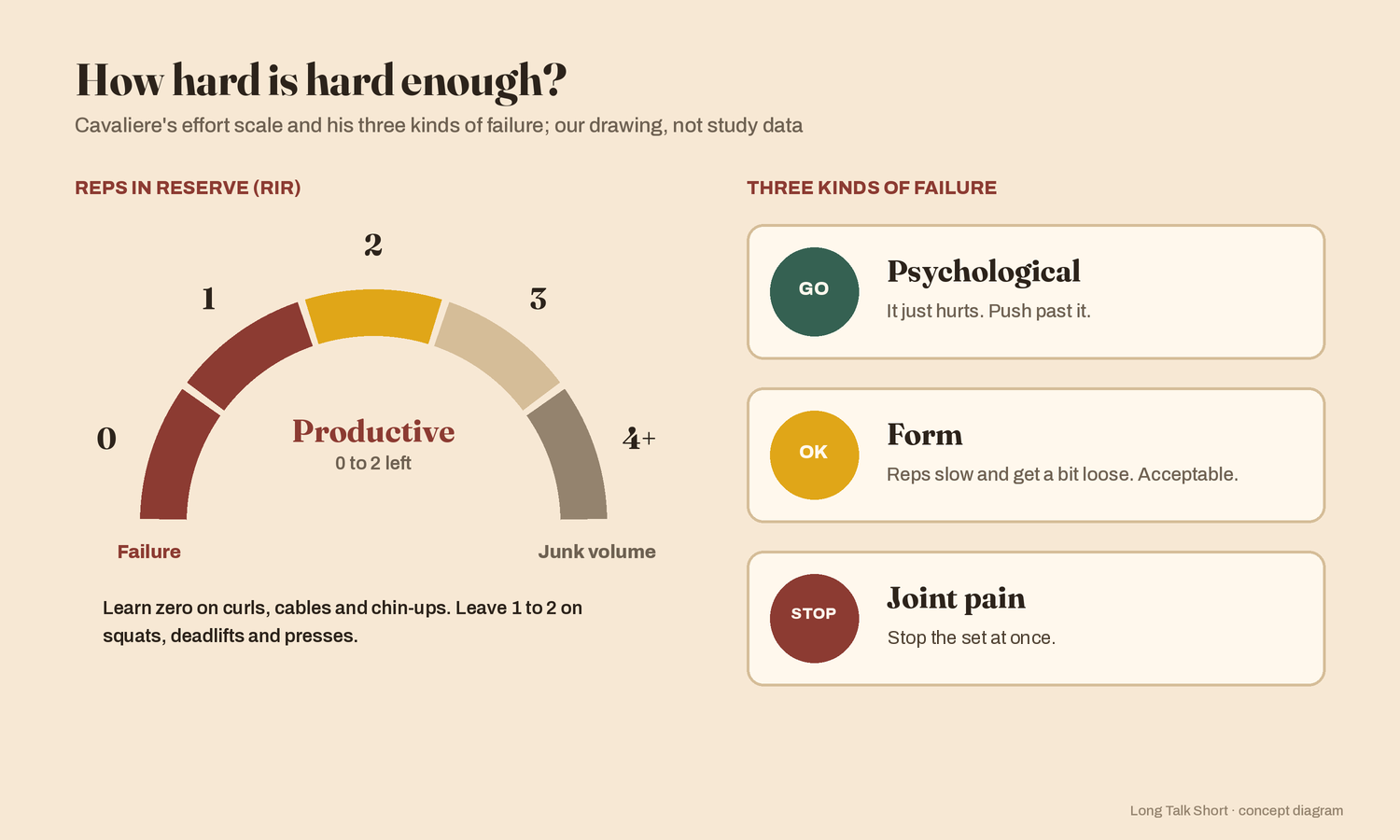
He measures effort in "reps in reserve" (RIR): how many more good reps you could have done. Zero means you couldn't do another rep with good form; one or two means a grinding rep or two were left. Four or more, outside warm-ups, he calls junk volume. Most people, he says, underestimate what they have left by one to three reps.
He separates three kinds of failure. Psychological failure is when it simply hurts too much to go on, and he wants you to push past it. Form failure, where reps slow down and get a little loose, is acceptable. Joint pain means stop immediately. Every rep, he says, is "another rotation on the tire", so don't spend one that doesn't build anything. But where should you go all the way to zero?
3. Find your limit where it's safe
Learn what zero reps in reserve feels like on exercises where failing is safe, such as curls, cable work or chin-ups, where you can just let go. On squats, deadlifts and presses, stop a rep or two short. Use safety pins, a box to squat to, or a trap bar with raised handles while you learn. Attia adds that going to true failure on big lifts "is a sport. It's called powerlifting."
4. An injury is a lane closure, not a city shutdown
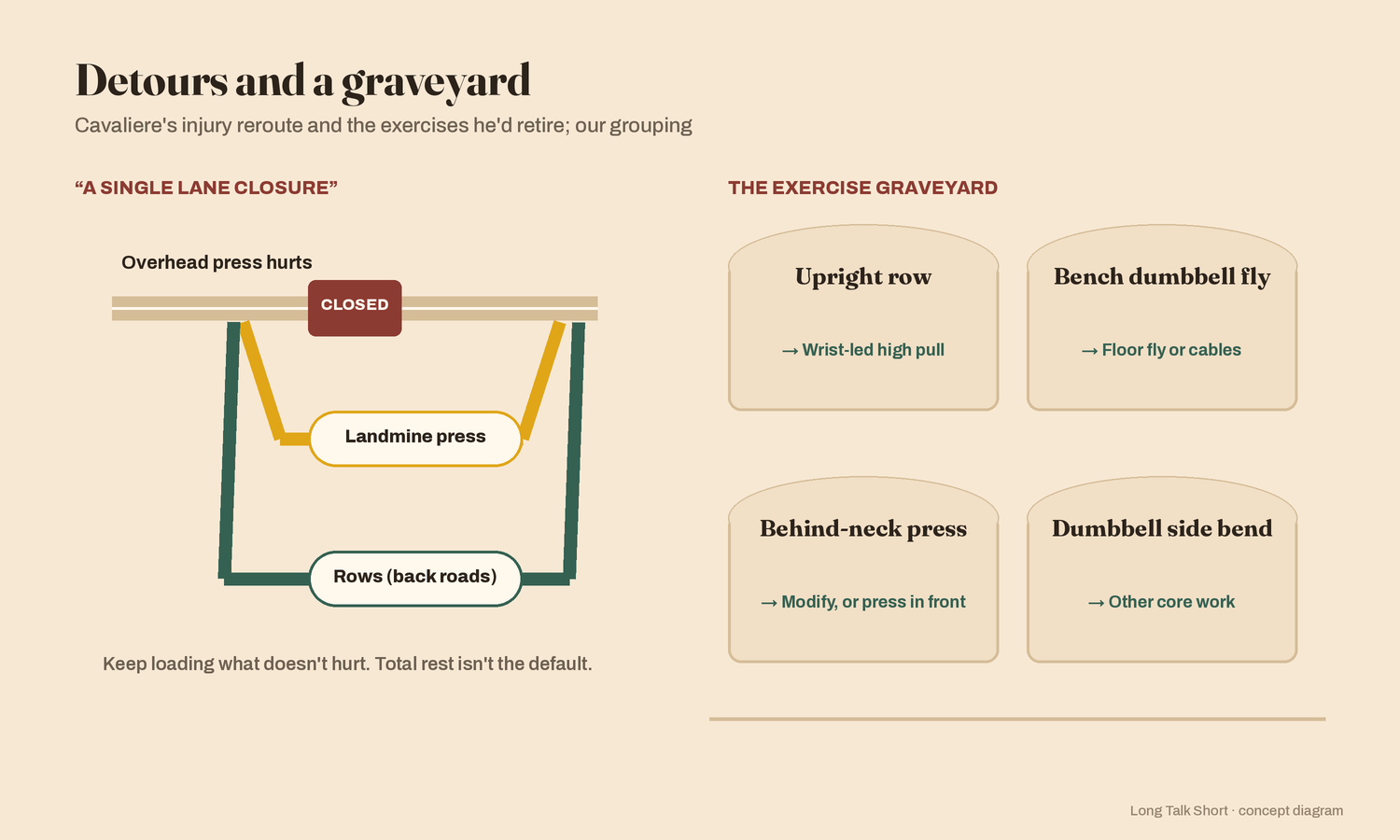
His most useful idea for older lifters is how to train around pain. If overhead pressing hurts, "it's just a single lane closure." Try a landmine press, which tilts the press about 45 degrees forward. If that hurts too, "take the back roads" with rows, which still move the shoulder through its range. Total rest, he argues, often makes things worse, because loading the tissue is part of how it recovers.
5. The menu, muscle by muscle
For most muscle groups, he suggests about 8 to 10 hard sets a week, built around one compound lift. Some of his picks:
- Shoulders: a standing overhead press first, then cable lateral raises and wide-elbow rows for the rear delts.
- Arms: lying triceps extensions with the arms taken back past vertical to stretch the long head, plus pushdowns. For biceps, slow lowering, incline curls and chin-ups.
- Chest: an incline press at about 30 degrees, split roughly evenly with cable crossovers.
- Back: pulling with your elbows close to your sides for the lats, with no need for an extra-wide grip, and lower-back work treated as "15 sets of one" rep each.
- Legs and calves: front, belt and "Spanish" squats, Bulgarian split squats with your chest upright, and slow calf raises with a four-second pause at the bottom, two to four times a week.
His "exercise graveyard" is short: the upright row (lead with your wrists in a "high pull" instead), heavy dumbbell flyes on a bench (do them on the floor or with cables), behind-the-neck presses and pulldowns, and dumbbell side bends.
Weighing it: what holds up
Framing: "As we age" frames the talk, but only a small part of the long episode deals with aging. The rest is a general muscle-building guide that would apply at 25.
Holds up: A 2024 analysis in Sports Medicine pooling many studies (Robinson and colleagues) found that muscle growth increases as sets end closer to failure, while strength gains barely depend on it. That supports pushing hard on safe exercises and leaving a rep or two on heavy lifts. His overhead-triceps advice matches a 2023 trial by Maeo and colleagues in which overhead extensions grew the triceps about 40% more than pushdowns. A 2014 study of grip width (Andersen and colleagues) found similar lat activation across narrow, medium and wide grips.
Partly holds: Calling sets with four or more reps in reserve "junk" goes too far: in the same 2024 analysis, those sets still built muscle, just less. The 8-to-10-set figure is an efficient dose, not a ceiling: a 2024 analysis by Pelland and colleagues found growth keeps rising with more weekly sets, with diminishing returns. His doubts about training only in the stretched position are partly backed: a 2025 trial found partial reps at long muscle lengths matched full range of motion but didn't beat it.
Not checked: trials on the injury risk of the "graveyard" exercises (his case is reasoning about joint mechanics), his calf advice, and standard claims such as the loss of fast-twitch fibres with age.
Disclosures: We worked from YouTube's automatic captions, so quotes may contain small errors. The Drive carries no ads; it's funded by premium memberships. Cavaliere sells training programs through ATHLEAN-X. Attia runs a medical practice and wrote Outlive. He says he has no affiliation with Voltra, a home-gym device he praises.
Bottom line: fewer, harder sets is well supported for muscle growth. Calling easier sets "junk" overstates it, and more volume can still help if you have the time and joints for it.
Related reading: Peter Attia's Outlive: training for the 90-year-old you want to be · Your Brain Pays Your Body's Bills
Long Talk Short
- Joint soreness, waking up tired and irritability are Cavaliere's signs to warm up longer and recover better.
- Fewer, harder sets beat many easy ones for growth, and the research leans his way on that.
- Learn what failure feels like on safe exercises. Leave a rep or two in reserve on squats, deadlifts and presses.
- Stop for joint pain, not for discomfort, and route around a painful exercise instead of quitting.
- Around 8 to 10 hard sets a week per muscle is a solid start, and more can still help.
The one thing to remember: as you age, count the reps that build something, not the reps you do.
This summary is general information, not medical advice. Consult your doctor before starting or changing a training program, especially if you have pain, an injury or a health condition.
Source: Peter Attia with Jeff Cavaliere, "#414 ‒ Resistance training as we age: exercise selection, training intensity, and much more," The Peter Attia Drive, on YouTube. This is an independent summary and is not affiliated with Peter Attia, Jeff Cavaliere or ATHLEAN-X.