You See What You Aim At: Jordan Peterson on Value, Stories and a Claim About Young Women, Checked
Jordan Peterson argues that what you value decides what you see, and that stories teach you what to aim at. Jonathan Pageau says fairy tales can't be bent at will. Plus Peterson's claim about young liberal women, checked against CDC and Gallup data.
You probably think you look at the world first and decide what matters afterwards. Jordan Peterson argues it runs the other way. In a live lecture in Miami, released on his podcast under a headline about young women's misery, he says what you value decides what you even notice, and that stories are how people learn what to value. He's joined by Jonathan Pageau, an icon carver who writes about religious symbolism, and his wife Tammy Peterson, who hosts the question session. The headline claim takes up about a minute of the evening, so we check it carefully below.
In short: Peterson's core idea is that value comes before perception. You see the world through what you aim at, and you learn your aims by imitating patterns in stories. Pageau argues that fairy tales can't be bent at will without becoming boring. Peterson's claim that liberal women aged 18 to 34 are America's most miserable group has survey support in direction, but "the most miserable they've ever been" and his explanation for it go beyond the evidence.
1. You see what you're aiming at
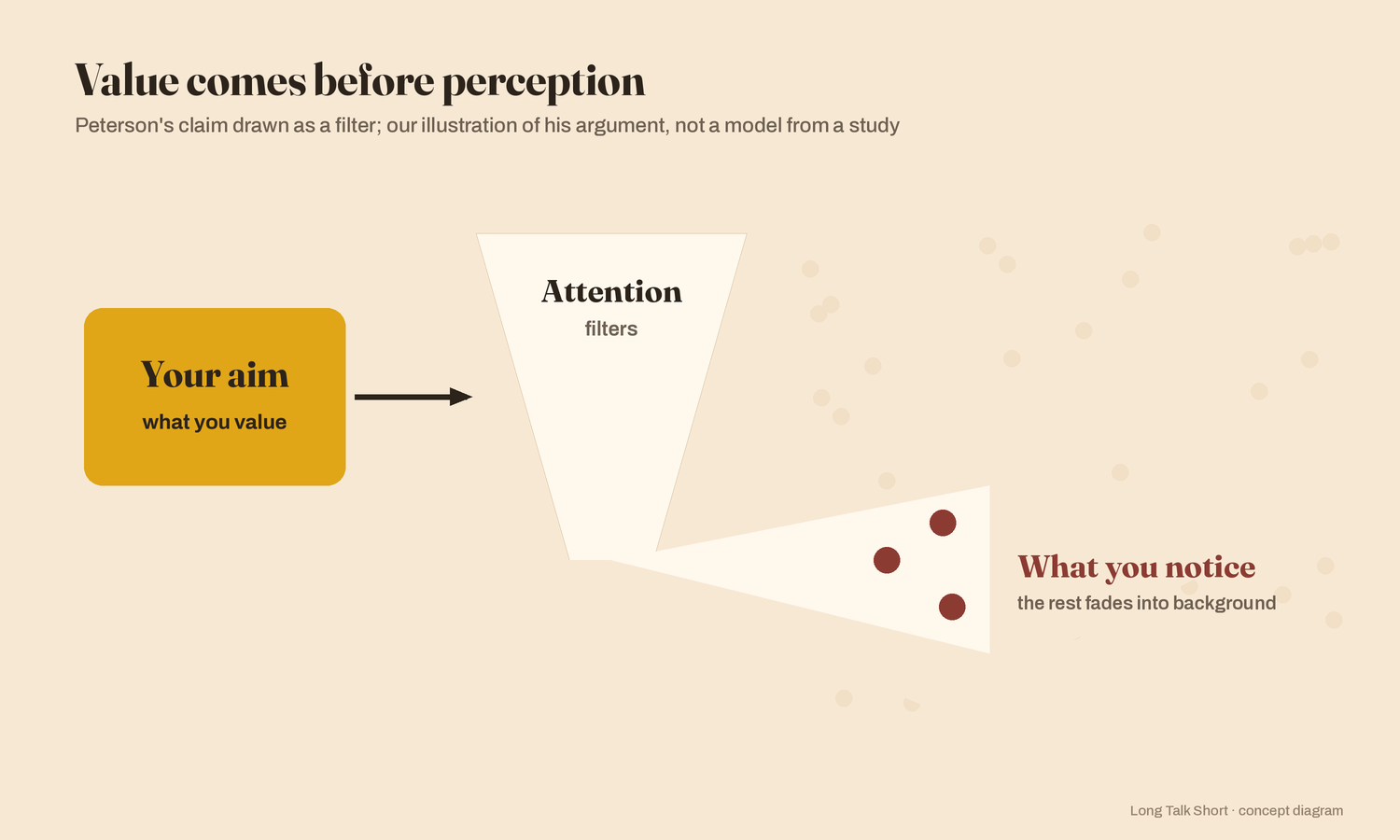
Peterson's starting point is that you can't perceive a neutral world of objects. Your attention is organized by what you're trying to do, so a goal works like a filter: it highlights what helps or blocks you and hides the rest. When you watch a film, he says, you're working out "what does this person worship?", meaning what they put above everything else. In his view, everyone worships something; the only question is whether it's worth it.
That leads to his hardest line, aimed at the audience: if the sacrifices you're making aren't met with appreciation from yourself, others or God, "it's very possible that there's something pathologically wrong with your aim". It's a challenging test: instead of asking why no one values your effort, ask whether you're aiming at the right thing. But where do aims come from?
2. Stories teach you what to imitate
Peterson's answer is imitation of patterns, not rules. A child playing "dad" isn't copying one father. He's extracted an abstraction from many fathers in real life, films and books, and he acts it out: "the spirit of the father". Stories, in this telling, are compressed records of what has worked over long periods, which is why people find them so compelling. The biblical heroes, he says, are models of voluntary sacrifice: giving up what isn't needed in order to move upward.
3. Why the fairy tale can't be rewritten
Pageau takes up the 2025 Snow White remake. He asks why it was boring and argues that stories are "not infinitely malleable": their characters have jobs to do, and changing them for message reasons breaks the pattern audiences respond to. Peterson reads the original as a story about the "negative feminine", an older woman who clings to her own attractiveness and poisons the next generation instead of mentoring it. Pageau describes his own retelling, Snow White and the Widow Queen, part of a project of fairy tales for families.
In the question session, a line about parenting drew applause:
Your job is not to protect your children from serpents. Your job is to teach them how to handle serpents.
Fairy tales, on this view, are rehearsal: a safe way for children to meet envy, danger and temptation before they meet them for real. Then Peterson turns the evil queen on the present.
4. The claim in the headline
About an hour in, Peterson applies the evil-queen story to universities, which he says have been "taken over by evil queen types who are poisoning the young women". He adds: "We bloody well know that the most miserable people in the United States are liberal women between 18 and 34." The more educated they are, he argues, the more "poisoned apples" they've been fed.
Weighing it: what holds up
Framing: The title is a podcast headline, not the theme of the talk, which is about value, attention and fairy tales. The event was recorded in March 2025, well before its YouTube release. Automatic captions don't label speakers; we attributed lines from context, such as Peterson saying "That's true, Jonathan."
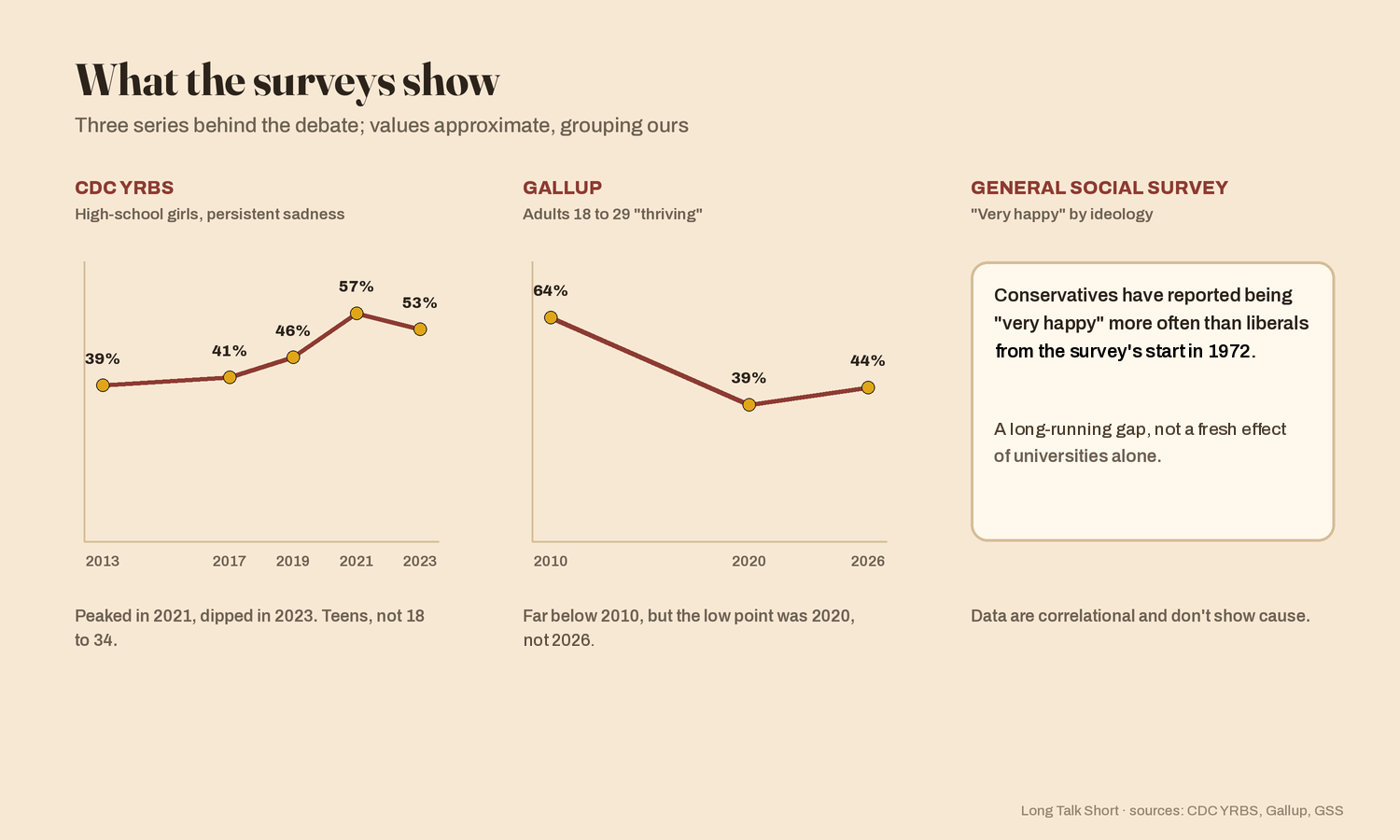
Holds up: In direction, several datasets do put young liberal women at or near the bottom on well-being. In Monitoring the Future surveys of US 12th-graders from 2005 to 2018, Gimbrone and colleagues found the sharpest rise in depressive symptoms among liberal girls. A gap in which conservatives are happier than liberals appears in the General Social Survey as far back as 1972. Gallup finds that 15% of women aged 18 to 29 rated their mental health excellent in 2020 to 2024, down from 48% in 2010 to 2014.
Partly holds: "The most miserable they've ever been" overstates it. In the CDC's Youth Risk Behavior Survey, persistent sadness among high-school girls peaked at 57% in 2021 and fell to 53% in 2023. Gallup's share of 18-to-29-year-olds who are "thriving" was lower in 2020 (39%) than in 2026 (44%), though far below 2010 (64%). Most series start in the 2000s, so "ever" can't be tested. The data are correlations, and researchers offer competing explanations: social media, falling marriage and church attendance, a rise in LGBT identification among young liberal women (a group with much higher reported distress), the #MeToo era, and liberals' greater readiness to report symptoms. Peterson's claim that universities are the cause is his interpretation; we found no study that shows it.
Corrections: His "quarter of a billion dollars" for Snow White is about right: the reported production budget was roughly $270 million, and the film grossed about $206 million worldwide. He calls Barbara McClintock's genetics foundational to cancer cures, which overstates it; her 1983 Nobel Prize was for discovering mobile genetic elements.
Not checked: his figures on Chinese surveillance cameras, his passing claims about gain-of-function research in Wuhan, and a statistic on alcohol and violence.
Disclosures: Peterson sells books, courses and tour tickets, and the lecture was part of his touring. Pageau promotes his own Snow White book in the talk. We worked from YouTube's automatic captions, so quotes may contain small errors.
Bottom line: the value-shapes-attention idea is a thoughtful frame, and the decline in young women's well-being is real. The "ever" and the university blame are his additions.
Related reading: Jordan Peterson on leaving the tent: comfort and false adventure · Jonathan Haidt's The Righteous Mind: the elephant and the rider
Long Talk Short
- Your aims act as a filter: change what you're aiming at and you'll notice different things.
- If your efforts are never appreciated, Peterson says, check your aim before blaming the audience.
- People learn values by imitating patterns drawn from many examples, which is what stories supply.
- Fairy tales can rehearse danger for children; Pageau argues they lose their force when rewritten for a message.
- Young women's well-being fell sharply from the early 2010s, some measures improved after 2021, and the causes are contested.
The one thing to remember: what you notice is a clue to what you value, so check both.
This summary is general information, not medical or mental-health advice. If you're struggling, talk to a qualified professional. If you're in crisis or thinking about harming yourself, call or text 988 (the Suicide & Crisis Lifeline in the US) or contact local emergency services.
Source: Jordan B Peterson with Jonathan Pageau and Tammy Peterson, "Why Young Women Are The Most Miserable They've Ever Been," The Jordan B. Peterson Podcast, on YouTube. This is an independent summary and is not affiliated with Jordan Peterson, Jonathan Pageau or Tammy Peterson.