The Elephant Decides First: Jonathan Haidt on Why Good People Disagree and How to Talk Across the Divide
Jonathan Haidt's The Righteous Mind says we judge by gut and reason afterward, and that morality runs on more than harm and fairness. The elephant and rider, six foundations, and what has held up.
You probably didn't reason your way to your politics. According to Jonathan Haidt, almost nobody does.
Haidt opens The Righteous Mind (2012) with Rodney King's plea during the 1992 Los Angeles riots: "Can we all get along?" The rest of the book is the social psychologist's long answer to why that is so hard. His explanation is not that the other side is stupid or evil. It's that all of us reach moral conclusions first, by gut, and then hire our reasoning to defend them.
In short: Haidt argues that moral judgment is driven by fast intuitions (the elephant), with conscious reasoning (the rider) mostly acting as its press secretary; that morality runs on more than harm and fairness; and that it binds groups together while blinding them to each other. The first idea has held up well. Some of the evidence for the details hasn't.
He sums up the book in three principles: "intuitions come first, strategic reasoning second", "there's more to morality than harm and fairness", and "morality binds and blinds".
1. The rider and the elephant
The mind, he says, is like a small rider on a large elephant.
- The elephant is "the other 99 percent of mental processes": the quick, automatic judgments and feelings that fire before we've thought anything through.
- The rider is conscious reasoning. We like to imagine it's steering.
Haidt's verdict:
the rider's job is to serve the elephant
It explains, justifies and spins whatever the elephant has already decided.
His early evidence came from what he called moral dumbfounding. He gave people short stories built to feel wrong while harming no one, such as a family that eats its pet dog after a car kills it. Many insisted the act was wrong, struggled to say why, and kept their verdict even after every reason was knocked down. To Haidt, that showed judgment arriving before reasons.
But if gut feelings run the show, why do different people's guts disagree so sharply?
2. Six taste receptors
Haidt's second principle is that moral concerns work like a tongue with several taste receptors. He and his colleagues proposed a set of "moral foundations": care and harm, fairness and cheating, loyalty and betrayal, authority and subversion, sanctity and degradation, and, new in this book, liberty and oppression. Each is an evolved sensitivity that cultures build on in different ways.
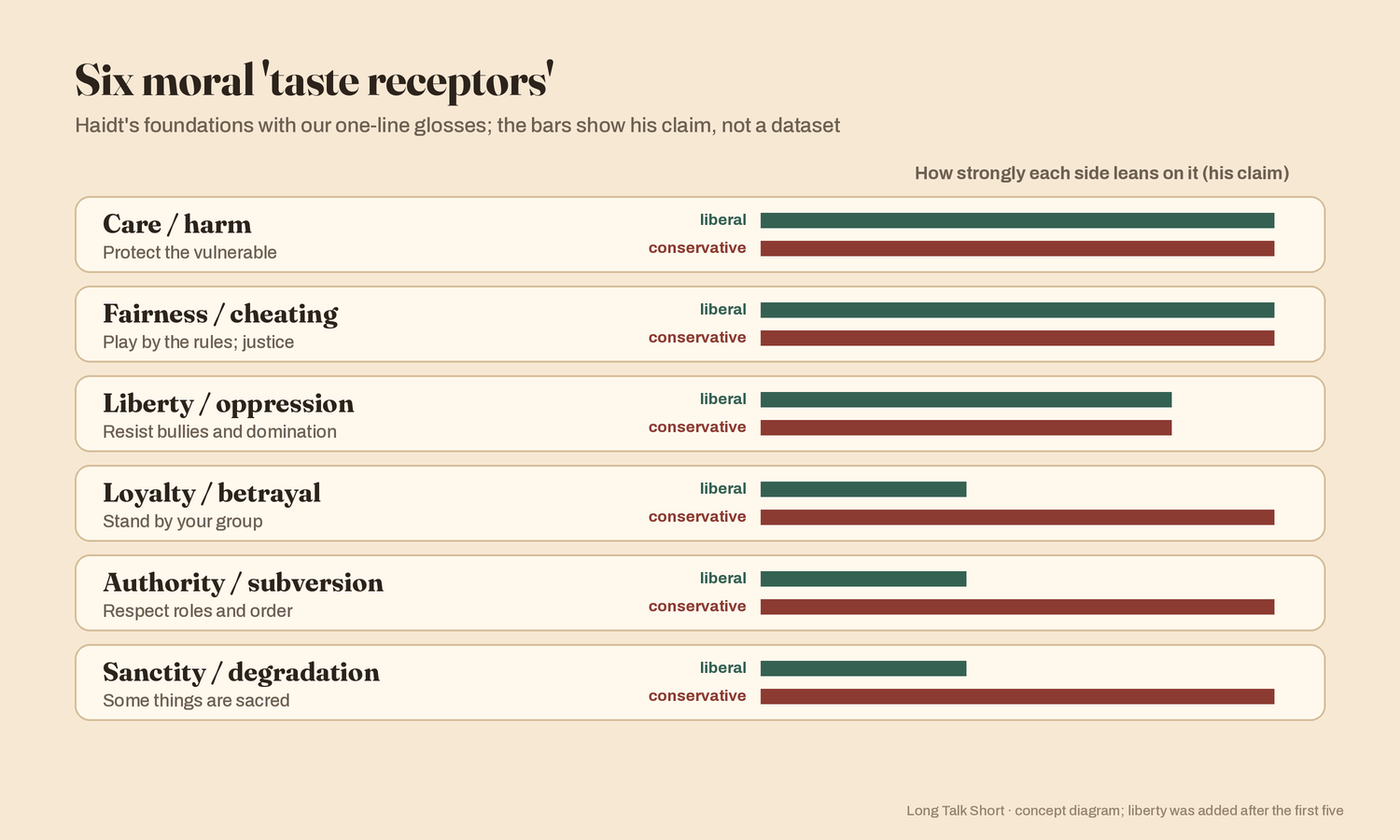
The political argument follows. In his team's surveys, American liberals leaned mostly on care and fairness, while conservatives drew on all the foundations more evenly. That, Haidt argues, gives conservatives a wider moral palette and helps explain why their messages reach voters that liberal campaigns miss. It also means each side hears the other's core concerns, about loyalty or about harm, as something other than morality.
3. Groupish by design
The third principle is that morality binds and blinds. Haidt describes humans as "90 percent chimp and 10 percent bee": mostly selfish, but able to lose ourselves in a group, which he calls a "hive switch."
- Binds: shared sacred values make teams, tribes and religions cohesive.
- Blinds: the same values make it hard to see an opposing team's view as anything but bad faith.
To explain where that groupishness comes from, he leans on group selection, the controversial idea that natural selection can act on whole groups as well as individuals.
All of which raises the practical question: if reasons don't move people, what does?
4. How to talk to someone who disagrees
Arguments aimed at the rider rarely work, because the rider is a lawyer for the elephant, not a judge. To change someone's mind, you have to reach the elephant first: build trust and goodwill, lead with what you share, and acknowledge the concerns they actually hold.
Empathy is an antidote to righteousness, although it's very difficult to empathize across a moral divide.
A few habits follow (our distillation):
- Name the foundation you hear before you argue: "you're worried about fairness to people who played by the rules."
- Start from a value you both hold.
- Remember you're an elephant with a lawyer too.
Weighing it: what holds up
Holds up:
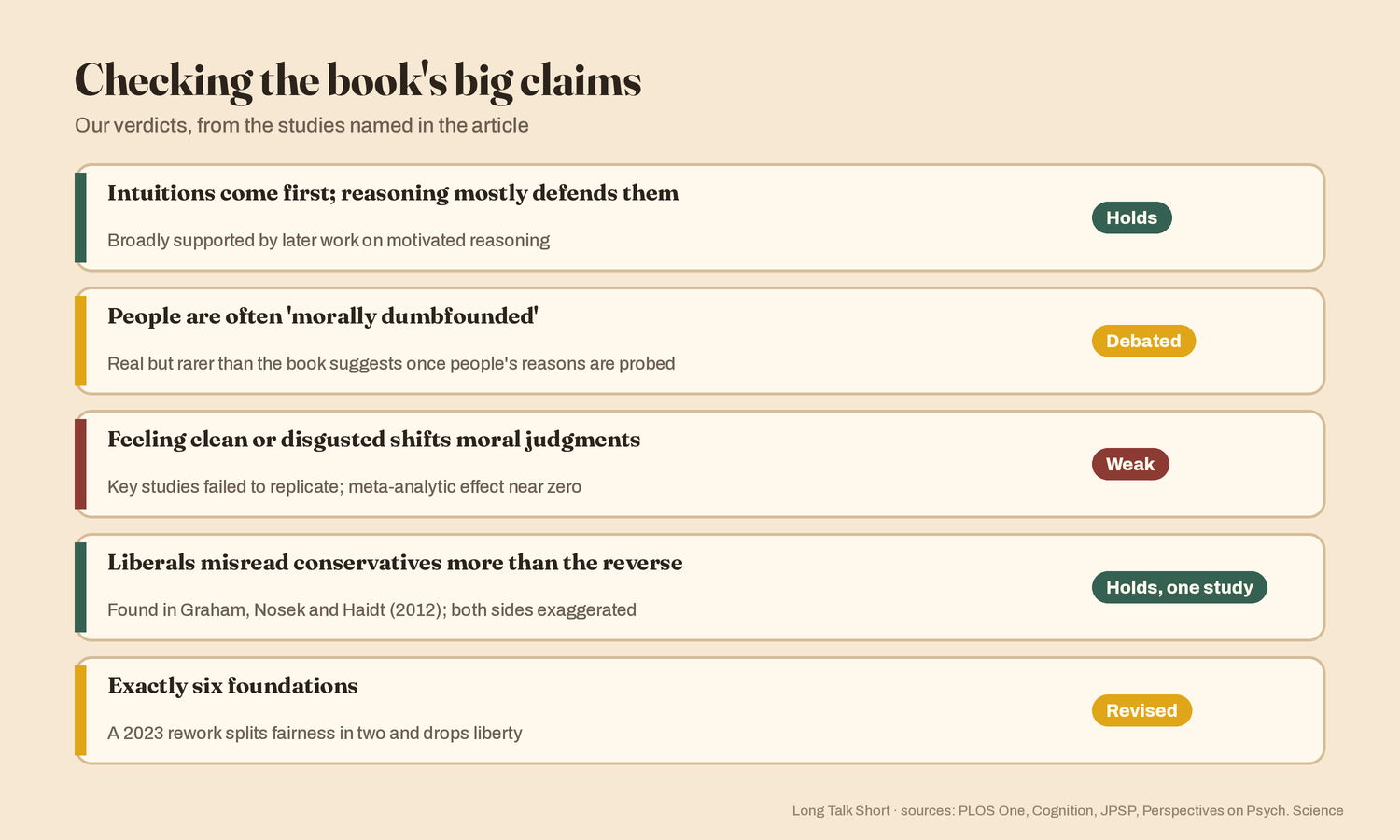
- Reasoning backward: the core claim fits a large body of research on motivated reasoning.
- Mutual misreading: in a 2012 PLOS One study by Jesse Graham, Brian Nosek and Haidt, people answered as a typical liberal or conservative would. Both sides exaggerated how far apart they were, and liberals were the least accurate about conservatives.
Overstated:
- Dumbfounding is rarer than the book implies. Probed carefully, many people turned out to have principled reasons, such as doubting the stories were really harmless. A 2015 study by Edward Royzman and colleagues found almost no genuine dumbfounding; a 2017 study by Cillian McHugh and colleagues found rates of roughly 9 to 32 percent, depending on the measure.
- Disgust effects have faded. A 2008 finding that feeling clean softened moral judgments failed to replicate in 2014. A 2015 meta-analysis by Justin Landy and Geoffrey Goodwin found the effect of induced disgust was small and disappeared after correcting for publication bias.
Disputed:
- The list of foundations is still changing. A 2023 revision of the main questionnaire, led by Mohammad Atari and tested in 25 populations, split fairness into equality and proportionality and left out liberty.
- Group selection remains contested. Steven Pinker's 2012 essay "The False Allure of Group Selection" argued it isn't needed to explain human cooperation. Haidt replied, and the debate didn't settle.
Related reading: for a practical playbook on disagreeing without needing to win, see Make It Safe to Be Wrong.
Long Talk Short
- Haidt's three principles: intuitions first, reasoning second; morality is more than harm and fairness; morality binds and blinds.
- The elephant (fast intuition) usually decides; the rider (conscious reasoning) mostly defends the decision.
- His foundations: care, fairness, liberty, loyalty, authority and sanctity. Liberals lean on the first two or three, he argues; conservatives on all six.
- Well supported: reasoning backward, and both sides exaggerating their differences. Shakier: dumbfounding rates, disgust effects, the exact list and group selection.
- To persuade, reach the elephant first: trust, shared values, and naming the concern you hear.
The one thing to remember: the person across the divide isn't missing reasons; they're tasting different values. Talk to that, and expect your own mind to move a little too.
Source: The Righteous Mind: Why Good People Are Divided by Politics and Religion by Jonathan Haidt (Pantheon, 2012). This is an independent summary and is not affiliated with the author or publisher.