Right Person, Wrong Time? Mel Robbins's Blunt Relationship Advice for Her 27-Year-Old Daughter
Mel Robbins and her daughter Sawyer take on relationship questions: three signs someone isn't right, why skills can change but traits can't, the exhale-smile-hug test, money, stalemates and breakups.
Sometimes the dread you feel about a good partner isn't about them. It's about you.
Mel Robbins has been married to her husband Chris for 30 years, through debt, unemployment and what she calls rock-bottom stretches. On The Mel Robbins Podcast, her daughter Sawyer, 27, reads out relationship questions from friends and listeners, and Robbins answers as she would for her own child.
The answers are blunt and practical, and they keep returning to one idea: most relationship problems are about patterns, needs and timing, not about finding someone perfect.
In short: Robbins gives three signs someone isn't right for you, a test for the right one (do you exhale, smile and hug when you see them?) and rules for ambition, money, conflict and breakups. Some of it rests on research she names. Much of it is her own experience.
1. Three signs it isn't right
Sawyer's first question is the hardest: how do you tell the right person from an incredible person who just isn't the right fit?
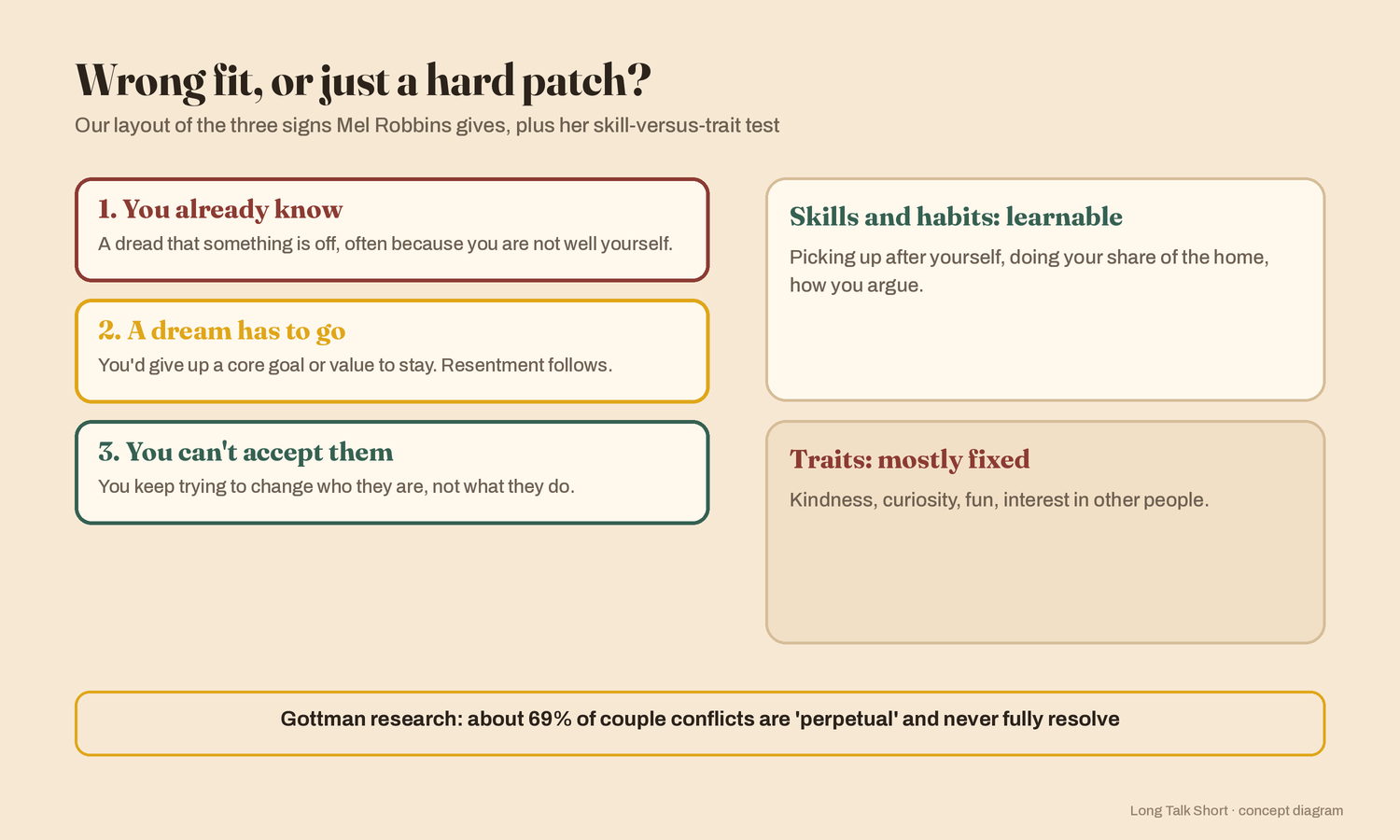
- Deep dread. A "just awful dread," which she says she has felt with two people. Her twist: it's often about you. "You think the problem is the other person... Actually, no, you're the problem cuz you're not healthy." Right person, wrong time.
- Giving up a dream or a value to stay together. She says relationship researchers John and Julie Gottman are "very conclusive" that this doesn't work. Trading away your own business, your own money or the four children you always wanted breeds resentment.
- Not accepting who they are. She cites the Gottmans' best-known figure: about 69% of what couples argue about never goes away. Trying to change it, she says, is "an act of violence" against them and yourself.
Sawyer adds a distinction Robbins builds on: skills and habits can be learned; traits mostly can't. Picking up after yourself is a skill ("not a freaking gender role"). Being boring, unkind or uninterested in others are traits.
If you're with somebody that's boring, they're going to get more boring.
So what does the right one feel like?
2. The home-base test
"Home base." Imagine walking in after a long commute, with no food in the house:
Can you exhale? Do you smile when you see this person? Are you happy when they give you a hug?
"If you have those three things at the end of a stressful day, you have everything that matters." She pairs it with advice from divorce lawyer James Sexton, an earlier guest: find someone for whom you stay "my favorite person," through weight gain, grief and unemployment.
3. When to be single
If you've gone from one relationship straight into the next, you need to be single. Relationships have become a way "to regulate yourself" instead of dealing with your problems. Without a break to study the last two or three relationships, ideally with a licensed counsellor, you'll repeat them.
You cannot outdate your bad habits.
And: "It's not the person, it's the pattern." She says this rests on research she learned while writing The Let Them Theory with Sawyer, but doesn't name it.
4. Ambition, money and comfort zones
A listener whose partner is chasing big ambitions feels sidelined. Taking a back seat is sometimes right, Robbins says: careers can work "like a relay race," with one person leading while the other is in build mode or graduate school. Two conditions:
- Money is power. "The person who typically makes more money drives the decisions," which is why she's told her daughters to make their own money.
- Say what you need in return, such as Saturdays together, or resentment builds.
If your partner is struggling, let them "borrow your belief" that things will work out.
For a partner who seems stuck, she points to Jonathan Haidt, who argues that cheap dopamine from short videos, porn, gambling and social media blunts motivation, especially in young men, and that two weeks off the phone can reset it.
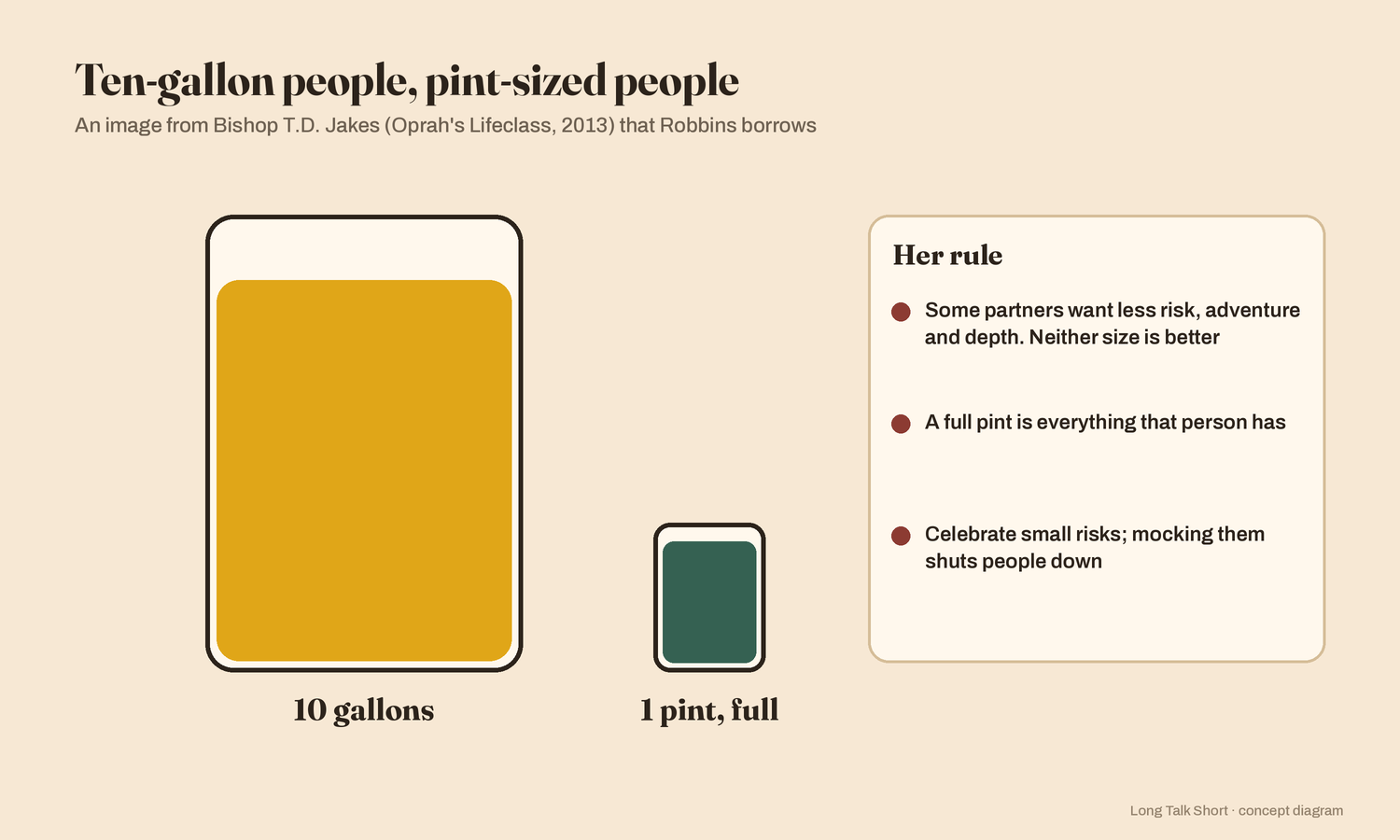
She also borrows an image from pastor T.D. Jakes, via Oprah: some people need ten gallons of risk, adventure and deep conversation; others need a pint. Neither is better. A ten-gallon person can be happy with a pint-sized partner if they see that a pint-sized risk may feel huge to that person, and celebrate it.
5. Stalemates and breakups
Sawyer asks about a real stalemate: whether to take a partner's last name. Robbins's rule is to "go a layer deeper" and ask what it means to them when you're introduced by a different name. She kept her own name at first and changed it later, when her sense of identity shifted. She closes with couples therapist Terry Real:
You can be right or you can be connected, but you can't be both.
- Feeling left behind while single? Get in the best shape of your life; hire a trainer instead of paying for dating apps, because "physicality changes your mentality."
- After a breakup, the hard part is "the three months that come next," while your body and imagination unlearn the shared future. No new relationship, and no sex with your ex: it "takes you right back to day one."
Weighing it: what holds up
Confirmed:
- The 69%: Gottman research does describe about 69% of couple conflicts as "perpetual problems" based on lasting differences.
- 30 years: Mel and Chris Robbins married in August 1996.
- The book: Mel and Sawyer Robbins co-wrote The Let Them Theory (December 2024).
- The jar image comes from Bishop T.D. Jakes on Oprah's Lifeclass in 2013 (the captions garble his name).
Loosely quoted: Terry Real's own line is usually "You can be right, or you can be married."
Not checked: that the Gottmans are "conclusive" on giving up dreams or values; the unnamed research behind "it's not the person, it's the pattern"; Haidt's two-week dopamine reset, his view as she reports it; the three-month breakup timeline; and the money-drives-decisions rule, which she states from experience.
Bottom line: treat this as experienced advice, not clinical guidance.
Related reading: on choosing connection over winning an argument, see Make It Safe to Be Wrong.
Long Talk Short
- Dread in a good relationship can mean you aren't healthy yet, not that they're wrong: right person, wrong time.
- If staying means giving up a core dream or value, or you can't accept who they are, it won't work, Robbins says.
- Skills and habits can be learned. Traits such as kindness, curiosity or being fun mostly can't.
- Home base: at the end of a hard day, do you exhale, smile and enjoy their hug?
- Serial daters should go single and study the pattern.
- Make your own money, say what you need in return for sacrifices, and go a layer deeper in any stalemate.
The one thing to remember: when you choose someone, check traits and patterns, including your own, rather than chemistry or a checklist.
Source: "The Best Relationship Advice I'd Give My 27-Year-Old Daughter", The Mel Robbins Podcast with Mel Robbins and Sawyer Robbins. This is an independent summary and is not affiliated with Mel Robbins or her podcast.
Quotes are taken from automatic captions and may contain small transcription errors. This article is for general information only and is not therapy or counselling. If a relationship leaves you feeling unsafe or in crisis, please reach out to a qualified professional; in the US you can call or text 988.