Memory Series, Part 2: There's No Such Thing as a Bad Memory (Jim Kwik's Case, and Where It Falls Apart)
Memory Series, Part 2. A teacher called him "the boy with the broken brain." Now Jim Kwik tells Steven Bartlett memory, focus and motivation are things you do, not traits you own. His learning habits hold up. His speed-reading promises and brain types don't.
Memory Series, Part 2 of 3. New here? Start with Part 1: how a six-time memory champion uses the memory palace.
"Am I bullshitting myself?" Steven Bartlett asks, after years of telling himself he forgets names. "You are," Jim Kwik replies.
Kwik's claim: there's no such thing as a good or bad memory, only a trained or untrained one. Some of what follows is genuinely useful. Some is neuroscience-flavored marketing.
The brain coach behind the bestseller Limitless builds his case on his own story: a head injury at five, a teacher who called him "the boy with the broken brain," and a turnaround. On The Diary Of A CEO, he tours his whole system, from beliefs and questions to speed reading, flow and motivation.
In short: memory, focus and motivation are things you do, not things you have. Change the story you tell about your brain, ask better questions of what you learn, and take small steps, but treat his speed-reading promises with care.
1. Your memory is a story you tell
Kwik calls Bartlett's line about names a BS belief system. Self-talk, he says, is the program the brain runs.
His fix is grammatical: turn nouns into verbs. You don't have motivation, focus or energy; you do them.
You don't even have a memory, you do a memory.
It's a three-step process: encoding, storing and retrieving. And when the old line creeps in, add one word: "I don't have a great memory yet."
Changing the story is step one. Step two is changing how you take things in.
2. Stop mistaking listening for learning
Kwik says we confuse consuming with learning, and challenges listeners to spend an hour applying for every hour of podcast. To get there, he asks three questions of anything he consumes:
- How can I use this? It turns passive input into a search for answers.
- Why must I use this? "Common sense is not common practice." You need an emotional reason.
- When will I use this? Put it in the calendar, as you would a meeting.
3. Learn it like you'll have to teach it
He adds what he calls the explanation effect: learn something as if you must teach it, and you pay closer attention, take better notes and ask more questions. Bartlett links it to the Feynman technique: explain it simply, and go back wherever you stumble.
For memorizing, he sketches PIE: place, imagine and entwine, tying a vivid image to a location. It's the same family as the memory palace from Part 1 of this series, with Nelson Dellis, though here it gets only a brief mention.
Techniques only go so far, though, if the brain running them is tired, stressed or underfed.
4. Ten keys, rated zero to ten
Instead of a single trick, Kwik offers his book's ten lifestyle "keys" and asks you to score yourself out of ten on each. He gets through about nine:
- A brain-healthy diet
- Killing automatic negative thoughts
- Exercise
- Brain nutrients such as vitamin D and omega-3s
- A clean environment
- Protecting your head
- Sleep, when, he says, the day's memories are consolidated
- New learning
- Stress management
Then comes the part that sells the most courses, and draws the most skepticism.
5. Read faster, he says
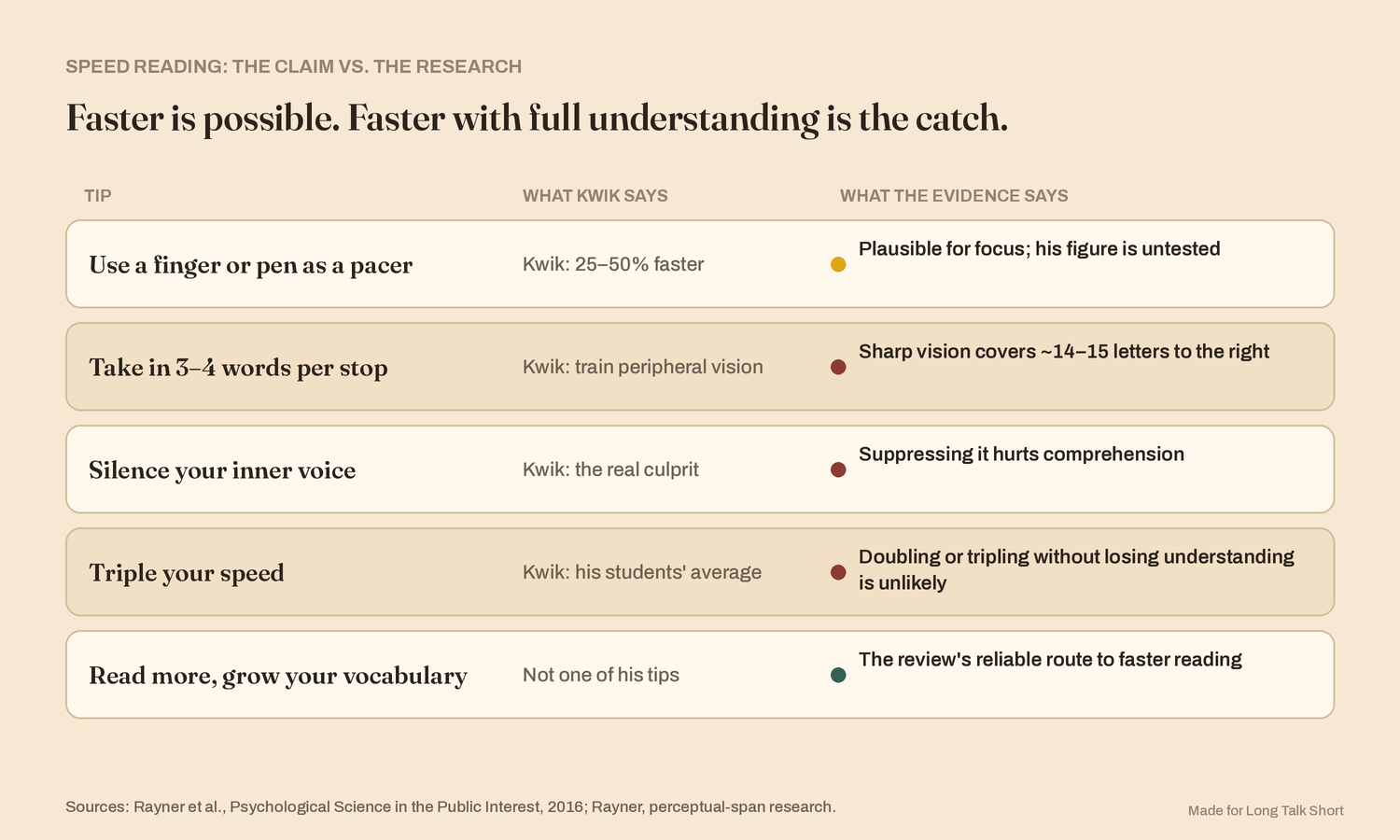
Kwik claims his students triple their reading speed on average. His tips:
- Use a visual pacer. Run a finger or pen under the line, which he says makes you 25 to 50 percent faster after a one-minute test.
- Widen your gaze. Train your peripheral vision to take in three or four words per stop.
- Quiet the inner voice. Reduce subvocalization, which he says caps your reading at talking speed.
6. Flow, open loops and small steps
Flow, he says, comes when challenge meets skill. Clear distractions, then just start, because of the Zeigarnik effect: an unfinished task nags at you until you close it.
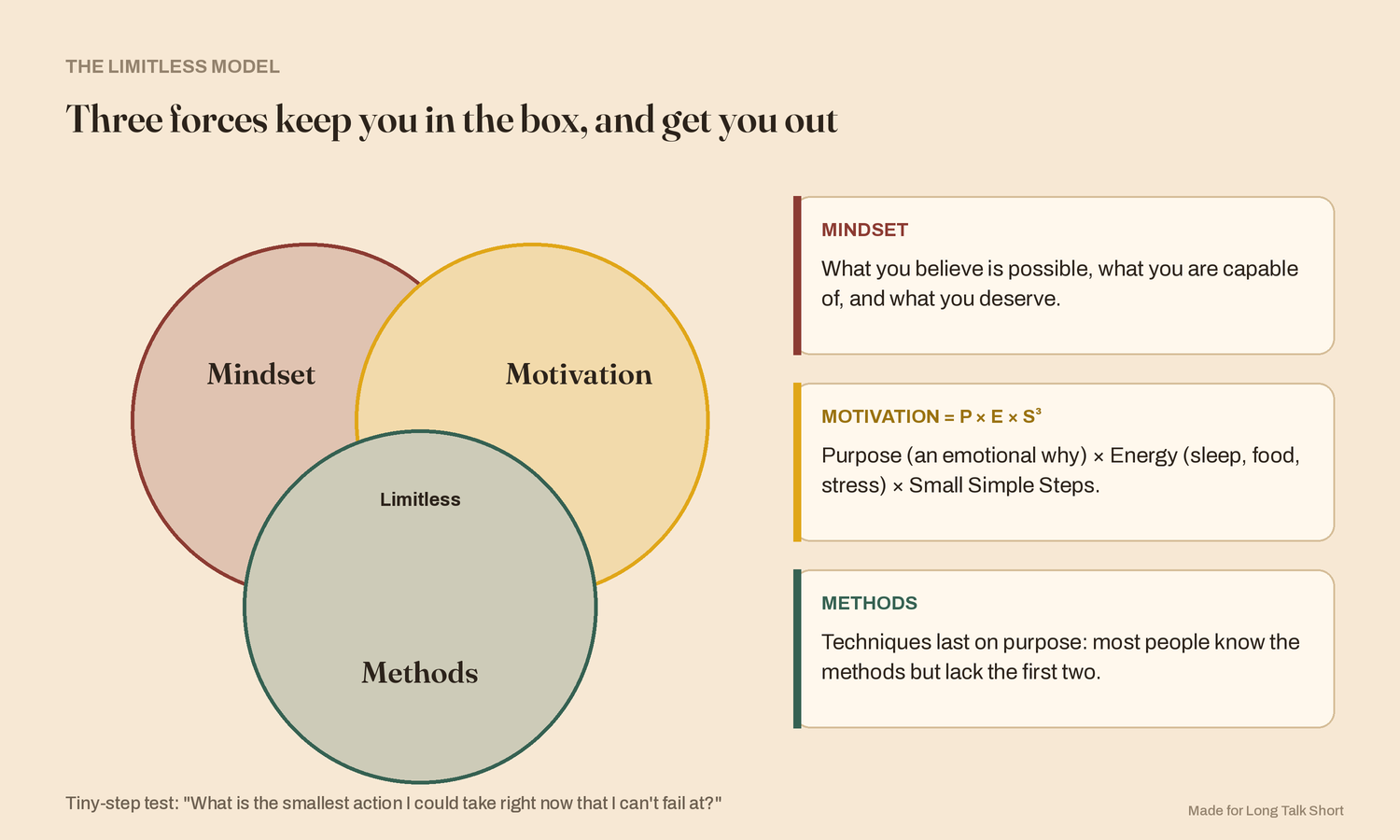
He closes with what he wants on his professional tombstone, the Limitless model. Three overlapping circles keep you stuck in any area, and the same three get you out:
- Mindset: what you believe is possible, what you can do and what you deserve.
- Motivation: purpose times energy times "S3," small simple steps.
- Methods: last, because most people already know them.
His daily question: what is the tiniest action I could take toward this goal that I can't fail at? Floss one tooth.
So how much of this survives contact with the research?
Weighing it: what holds up
The learning advice is the strongest part. A 2014 study by Nestojko and colleagues found that simply expecting to teach a passage improved recall, and questioning, applying and scheduling what you learn fits mainstream research better than rereading. Sleep's role in memory consolidation and exercise's links to brain health are well supported. A line from Limitless that air pollution causes up to 30 percent of strokes is roughly in line with the Global Burden of Disease estimate of about 28 percent of stroke burden.
Speed reading is the weakest. A 2016 review by Keith Rayner and colleagues found a trade-off between speed and accuracy: doubling or tripling speed while understanding as much is unlikely, and the dependable route is reading more and building vocabulary. Suppressing inner speech hurts comprehension, and sharp vision covers only about 14 or 15 letters to the right of where you look. His tripling figure comes from his own company, and his pacer figure isn't backed by a study he names.
Several claims are neuromyths. A 2013 study of more than 1,000 brain scans found no left-brained or right-brained types. Brain Gym, the cross-crawl exercises he uses at events, was found in a 2007 review to lack credible evidence. His animal "cognitive types" quiz echoes learning styles, which a 2008 review by Pashler and colleagues found unsupported. Digital dementia is a popular term, not a diagnosis. The Zeigarnik memory effect failed to show up in a 2025 meta-analysis, though the tendency to resume interrupted tasks, which "just start" needs, did hold.
Some anecdotes are garbled. The Nun Study is observational and did not find that "half" of longevity was faith and gratitude. Warren Buffett's "500 pages a day" was advice to students, recalled years later, not a measured habit. Kwik's injury story can't be independently checked, and critics note his material rarely names sources.
Promotion is heavy. Kwik plugs Limitless, a free masterclass and his brain-type quiz; Bartlett promotes his own book and reads ads for Huel, a company he has invested in, and Airbnb. And despite the episode's title, there is no "perfect memory" method here.
Long Talk Short
- "Bad memory" is usually a belief, and beliefs steer effort. Add "yet."
- Memory, focus and energy are processes you run, not traits you own.
- Ask of anything you learn: how can I use this, why must I, and when will I?
- Learn as if you'll have to teach it, then explain it simply to find the gaps.
- Fix sleep, exercise and stress before chasing hacks.
- Be skeptical of tripled reading speeds; real gains come from reading more.
The one thing to remember: pick one idea from this article, decide when you'll use it, and put it in your calendar today.
Source: The Diary Of A CEO with Steven Bartlett, "The Memory Expert: Do You Want A Perfect Memory? WATCH." with Jim Kwik (June 2023). This is an independent summary of that episode and is not affiliated with the show.
This article is for general information only and is not medical advice. If you notice memory problems that worry you, or have had a head injury, please talk to a doctor.