The Last Class: What Tuesdays with Morrie Teaches About Living, and Which Lessons Research Backs
Fourteen Tuesdays with a dying professor: Morrie's lessons on death, love, regret and money, which ones research supports, and the Auden line that drifted.
Imagine you found out that a teacher who once mattered to you had only months to live, and that you could visit every week and ask whatever you wanted. What would you ask? Mitch Albom, a busy Detroit sports writer, got that chance in 1995. His old sociology professor, Morrie Schwartz, was dying of ALS, the disease that slowly shuts down the muscles. Albom flew in on Tuesdays, the day they used to meet in college, and wrote down what Morrie said. The result, Tuesdays with Morrie, became one of the best-selling memoirs ever written.
In short: across fourteen Tuesdays, a dying man talks about death, love, family, regret, money and ageing, and his former student, who had drifted into a life of work and deadlines, slowly listens. The lessons are simple and old. Some line up well with research on what makes a life go well. It is a memoir, not a study, and its dialogue is Albom's reconstruction.
1. How it started
Albom had been one of Schwartz's students at Brandeis University and had promised to keep in touch after graduating. He didn't. Sixteen years later he saw his old professor on the ABC programme Nightline, where Ted Koppel interviewed Schwartz about dying. Albom called, flew to Massachusetts, and kept coming back. A newspaper strike at the Detroit Free Press had freed up his schedule, and the visits became a weekly class with one student. Schwartz died on November 4, 1995.
The book had a practical purpose too. Schwartz wanted to die at home, and his medical bills were large. Albom wrote the book partly to help pay them, and half the royalties go to the Schwartz family. The first printing was 20,000 copies. It went on to spend 206 weeks, about four years, on the New York Times bestseller list, and Albom's website puts sales at nearly 18.5 million copies. So what did the class actually teach?
2. The syllabus
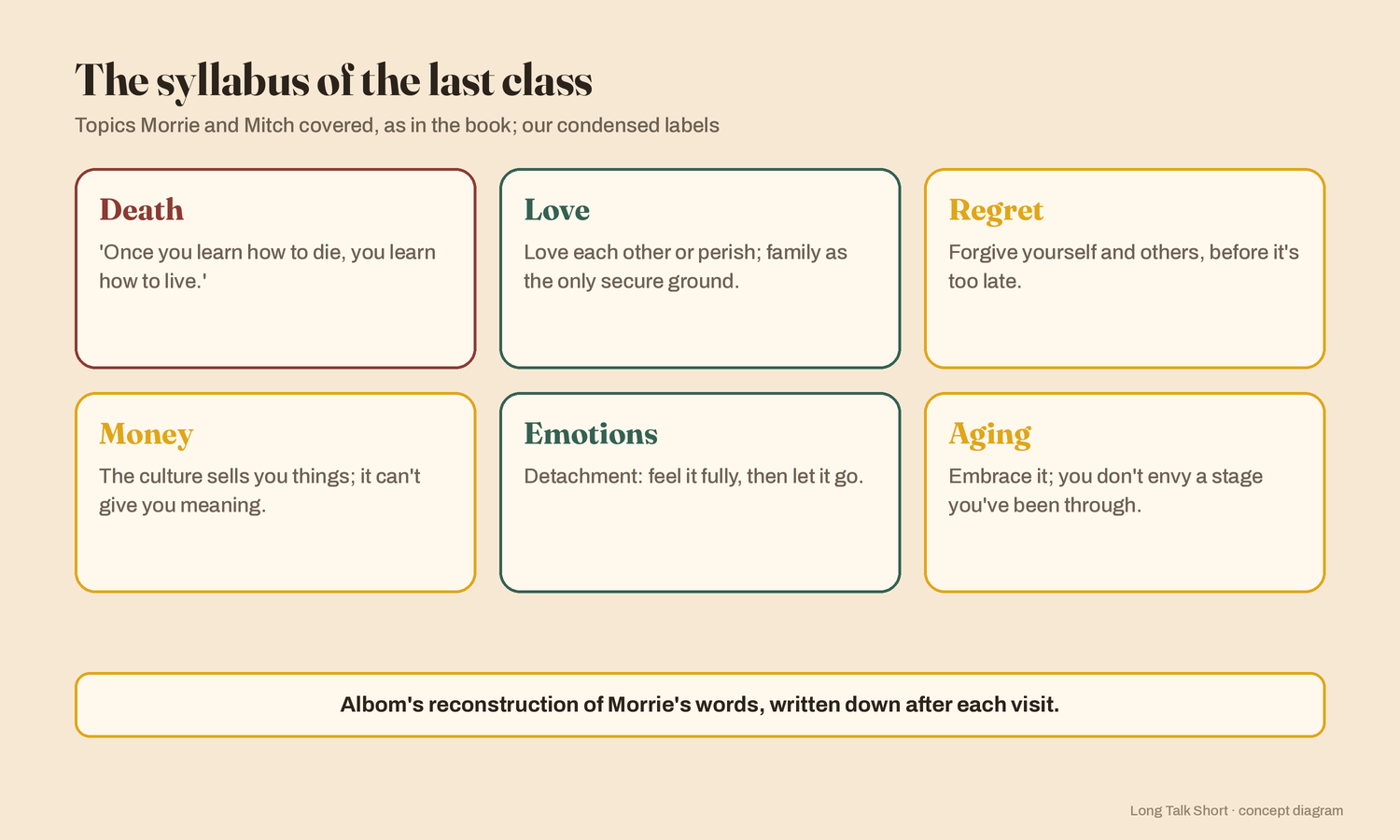
The chapters are organised as a syllabus, each Tuesday given a topic. On death, Morrie's line is the one most people remember:
Once you learn how to die, you learn how to live.
His point is that accepting you will die, really accepting it, clears away much of what you were busy worrying about. On love and family, he quotes the poet W. H. Auden: "Love each other or perish." Without other people, he argues, there is no solid ground under you.
On emotions, Morrie teaches what he calls detachment, which is not the same as not caring. You let yourself feel fear, grief or love completely, so you know what it is, and then you let it go. On money and culture, he says the culture sells you things in place of meaning, and you are free to build your own small culture instead. On ageing, he says he doesn't envy the young, because he has been every age he once was. And on forgiveness, he urges Mitch to forgive himself as well as others, before there is no time left.
3. Why it lands
The book works less because of any single idea than because of its frame. Mitch is the reader: successful, overworked, always on the phone, sure there will be time later. Morrie is the person who has run out of later. Each week Morrie's body gets weaker and his ideas get plainer, and the contrast does the persuading. By the end, the student is the one being changed, which is the quiet point: you don't need to be dying to take these questions seriously.
4. How to use it
If you want to use the book rather than just read it, the frame is the tool. Pick someone you have lost touch with and call them. Write down the one question you would ask a teacher with months to live, then answer it yourself. Or try Morrie's detachment exercise the next time a strong feeling arrives: name it, let it run its course, and then put it down. None of these takes long, which is rather the point of the book. But are the lessons true, or only moving?
Weighing it: what holds up
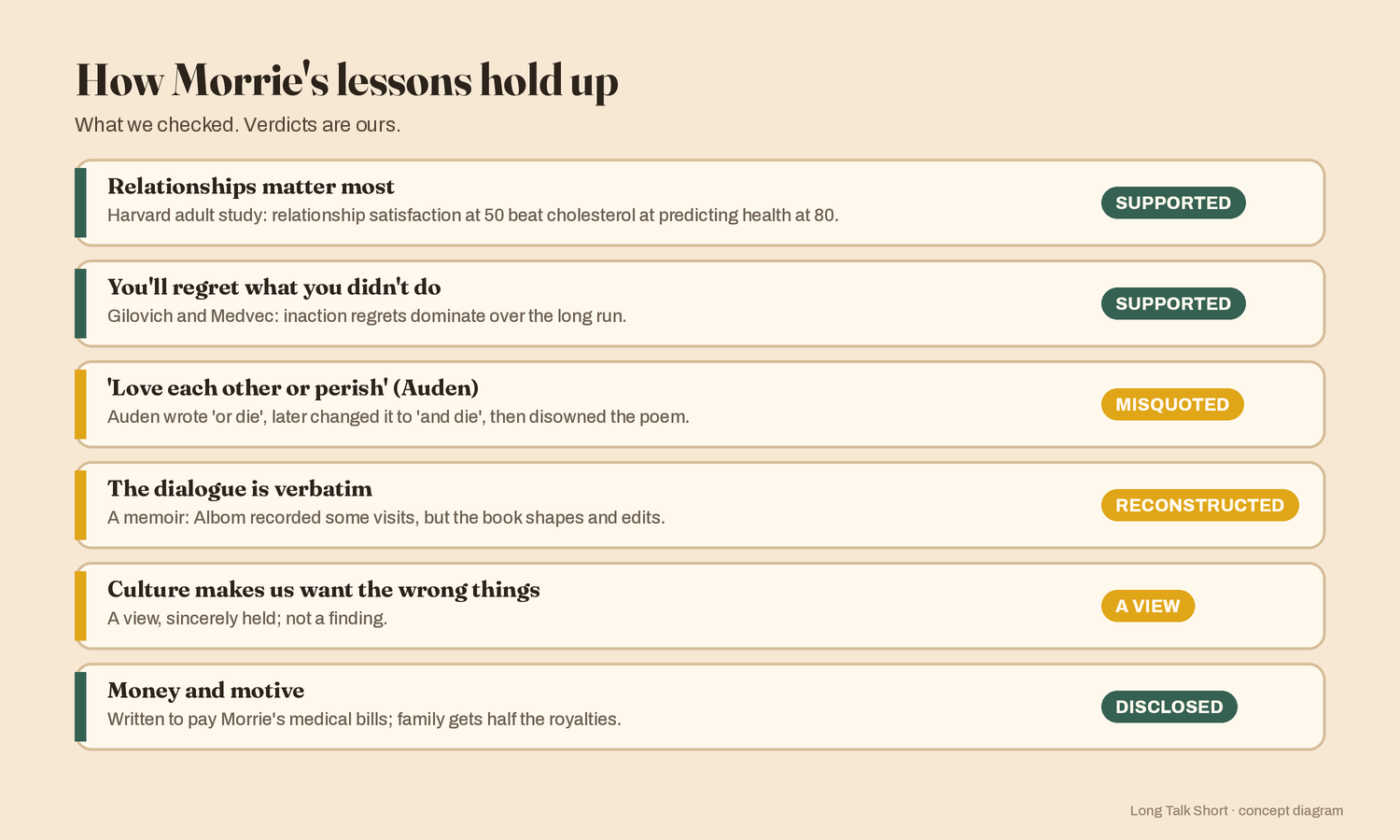
Holds up: Morrie's central claim, that relationships matter more than achievement, fits the best-known long-running study on the subject. The Harvard Study of Adult Development, which began following participants in 1938, found that how satisfied people were with their relationships at age 50 was a better predictor of their health at 80 than their cholesterol levels. We checked that finding as reported by Harvard. His urging to act before it's too late also fits work by Thomas Gilovich and Victoria Medvec: in the short term people regret things they did, but over the long run they regret more the things they didn't do.
Misquoted: Auden's line, from the 1939 poem "September 1, 1939", is "We must love one another or die." Auden later decided it was false, because we die anyway; he changed it to "and die" and eventually disowned the poem. The book's version is a paraphrase, and the irony is that the poet came to reject the very line Morrie loved. The sentiment survives; the attribution needs a footnote.
Reconstructed: It is a memoir. In the book, Albom brings a tape recorder to the visits, but the dialogue on the page is his shaping of them, and Morrie appears through one former student's admiring eyes. Many of the lessons are views, not findings, such as the claim that the culture makes us want the wrong things. Some readers find it sentimental, a view we didn't survey systematically.
Checked, with a caveat: We checked the book's history, the Nightline origin, the strike, the date of Schwartz's death, the sales figures from Albom's site and the royalty arrangement, which CBS reported as continuing. Other sources give slightly lower sales totals, so treat the number as approximate.
Money and motive: The book was written in part to raise money for Morrie's care, and the author has earned a great deal from it, while sharing half the royalties with the family. That is worth stating plainly. The verdicts in the table are ours.
Bottom line: Simple lessons, honestly felt, and the core ones have good research behind them. Read the dialogue as Albom's memory, not a transcript.
Related reading: What Are You Willing to Trade? Atul Gawande's Being Mortal · The Time You Have Left: Paul Kalanithi's When Breath Becomes Air · The Correct Life That Went Wrong: Tolstoy's Ivan Ilyich
Long Talk Short
- A dying professor and a former student meet on fourteen Tuesdays to talk about how to live.
- Morrie's lessons: accept death, put love and family first, feel emotions fully and then let go, and forgive early.
- Long-term research supports his core point that relationships predict a good life and even good health.
- People tend to regret what they didn't do more than what they did, which matches his warning not to wait.
- The famous Auden line is a paraphrase the poet himself came to reject, and the dialogue is Albom's reconstruction.
The one thing to remember: ask the questions you would ask in a last class, and act on the answers while there is still later.
Source: Tuesdays with Morrie by Mitch Albom (Doubleday, 1997). This is an independent summary and is not affiliated with the author or publisher.