Not Just a Smarter Intern
Dwarkesh Patel says the last four years took AI from a preschooler to a savant intern. A similar jump from 2027 or 2028, he argues, could beat humans at chips, trading, and materials science. The dates are his forecast.
Not just a smarter intern. If you have been measuring the last four years of AI as a smoother chatbot, Dwarkesh Patel wants you to feel the size of the jump first, and only then ask what a second jump that large would actually be able to do. In his telling, we have already gone “from a preschooler to a savant intern.” A similar leap, starting in 2027 or 2028, would not produce a slightly better assistant. It would, he argues, produce a mind that is “vastly superhuman in domains that are even slightly verifiable.”
Patel published a short clip, “The Next 4 Years of AI Will Look Nothing Like the Last 4,” at youtube.com/watch?v=SeGUXN8XIu8. The wording is taken from his essay, “The avalanche that hit math is coming for AI development,” at dwarkesh.com/p/rsi, which is the source this article follows. The clip is a cut of that essay, not a separate paper. This piece stays with the size of the jump and what he says it would mean for chips, markets, and materials science. The forecasts are his, and they are conditional. It is distinct from The Timeline Just Moved, which follows the same essay’s case that automating AI research could compress a decade of progress.
In short: the preschooler-to-intern measure, the 2027 or 2028 start, and the chip, trading, and materials-lab examples are his forecasts, with conditions attached. This is not a lab timeline, and it is not investment advice.
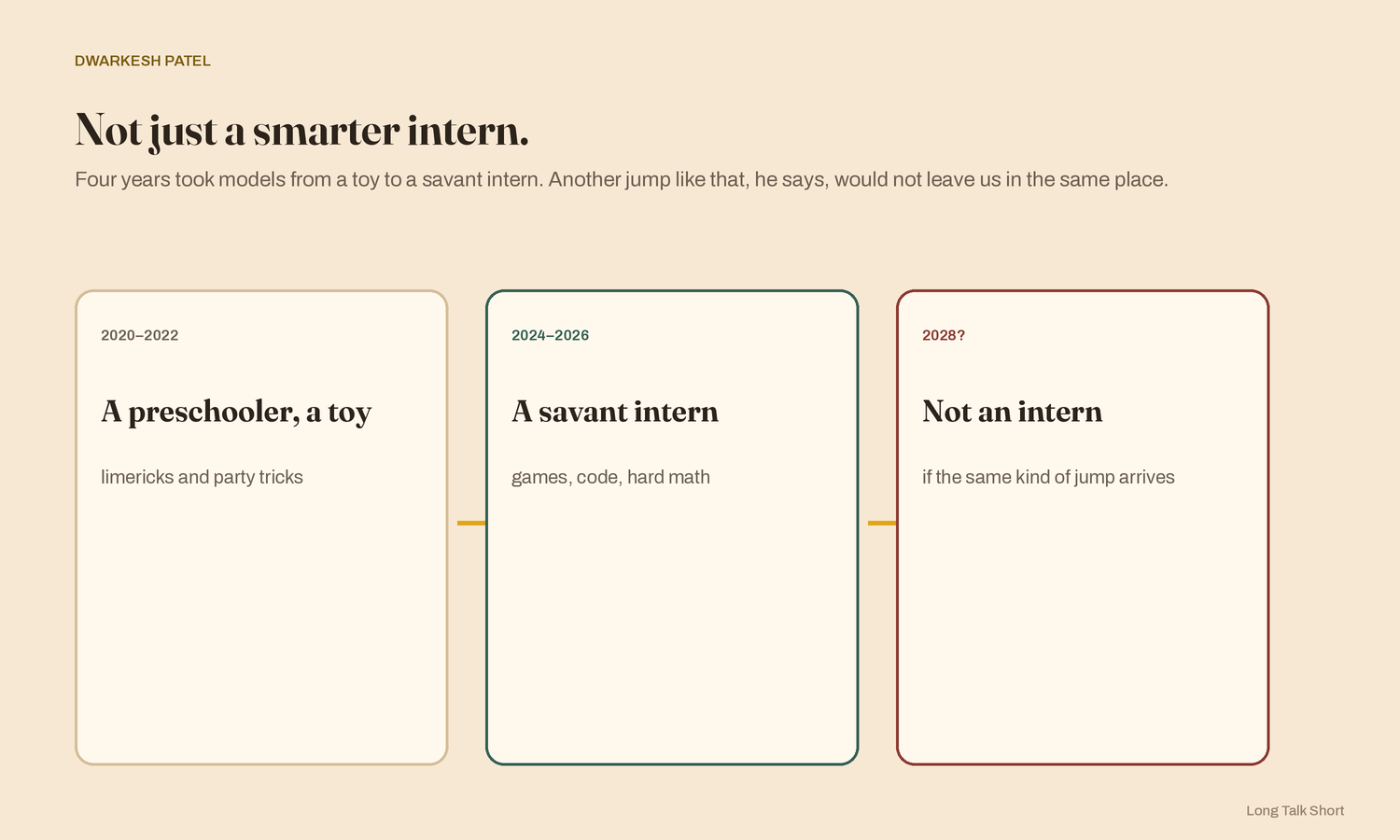
The comparison he uses to make the last four years concrete is deliberately homely. GPT-3.5, he writes, “was able to write a passable limerick and autocomplete a trivial Python function, but was mostly a useless toy.” The system he calls Astra, by contrast, “can build whole video games from scratch and churn out Fields Medal–worthy mathematical contributions to such a great extent that we’re already desensitized.” That is the interval he is calling preschooler-to-intern. Whether you buy the intern metaphor, the point is the compression: a toy that rhymes, then a system he describes as already flooding a field that used to move at the pace of a career.
1. What he thinks a second jump would be good at
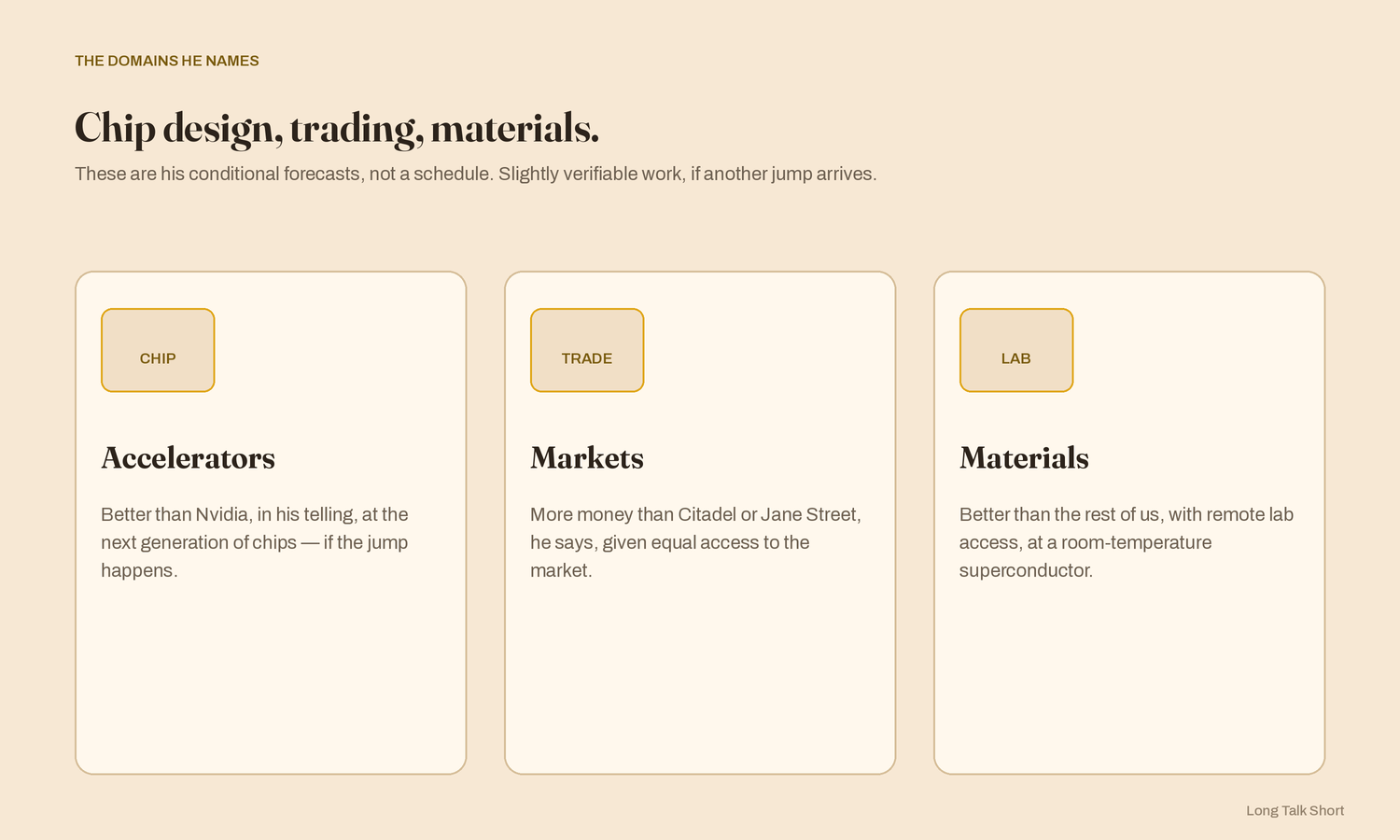
If you made “another jump that big, but starting in 2027 or 2028,” he writes, you would “probably get a mind that would be vastly superhuman in domains that are even slightly verifiable.” He offers three examples, and each one has a condition attached. “It’d be better than Nvidia at coming up with the next generation of AI accelerators.” “It would make more money than the current human versions of Citadel and Jane Street (if it had equal access to the market).” “If you gave it remote access to a materials science experiment lab, it’d be better than the rest of humanity at finding a room-temperature superconductor.” Those are forecasts, not results. The parentheticals matter: market access, a lab, a domain you can check.
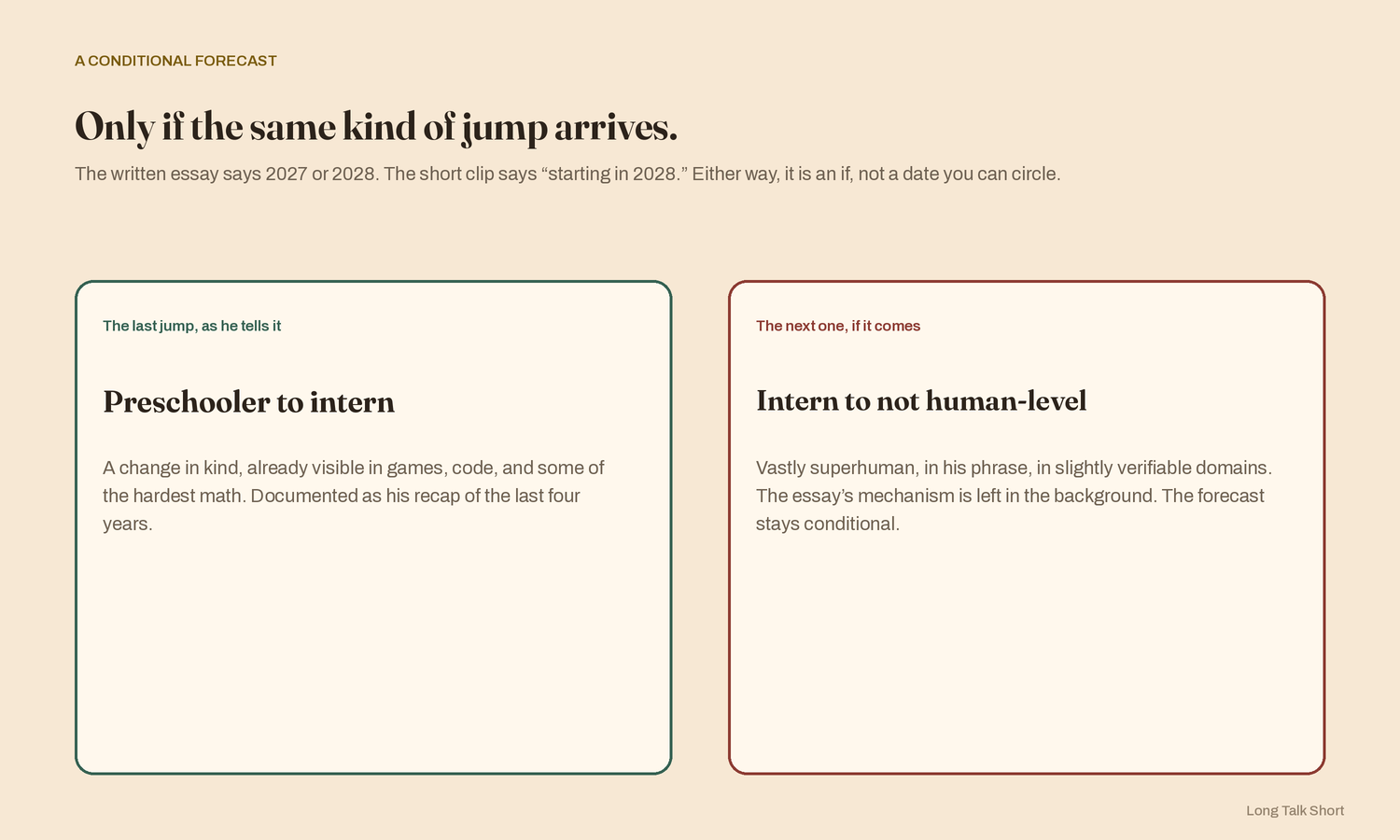
The clip itself says “starting in 2028”; the essay says “2027 or 2028.” This article uses the written version. The year is not a delivery date. It is the start of a jump he thinks would be comparable, in scale, to GPT-3.5 to Astra — a jump he elsewhere describes as the sort of thing that could be packed into about a year of progress after AI research itself is heavily automated. That mechanism is the subject of the longer essay, and of The Timeline Just Moved. The useful claim here is narrower: if the last four years are the unit of measure, the next unit does not look like a slightly more polished intern. It looks, in his picture, like a specialist that can out-design, out-trade, and out-experiment human teams in any field where the score is reasonably clear.
2. The objection he anticipates: the real world is not a unit test
He knows the obvious reply. How does a system trained “within a datacenter” beat human experts in work whose knowledge comes from “years and years of real-world experience”? Day trading, building a business, winning a court case, or helping a candidate win an election cannot, he has argued, be fully recreated as a test inside a server hall. He does not claim that every answer can be baked into the weights. His claim is that a lot more training on tasks you can grade will teach a more general skill: “seek out relevant information, make a plan, push forward on it through mistakes and obstacles, keep track of what you’ve learned, and collaborate with other people.” Domain knowledge still has to be acquired. The bet is that the ramp-up, once those general skills are in place, gets short.
In the same section of the essay he adds a further, still-conditional picture. Even if software progress “peters out” after a first compressed year, the systems that come out of that year would, he thinks, be “jaggedly superhuman” at helping add more compute — “designing AI chips, laying out the design of a new fab, and even teleoperating robots to help build parts of fabs and datacenters.” Global AI compute, he writes, has already been growing “roughly 3x a year” without that help. The hardware path is slower than a purely software leap, in his telling, but it does not stop. That 3x figure is his summary of the build-out, not a number recomputed here.
Weighing it: what holds up
This is a short clip of a longer essay, and it should be read as a forecast, not as a lab roadmap. It is distinct from The Timeline Just Moved, which takes up the same essay’s research-automation timeline. The preschooler-to-intern line, the Astra comparisons, the Nvidia, trading, and superconductor examples, and the 2027–2028 start are Patel’s. “Fields Medal–worthy” is his characterization of mathematical output, not a medal citation. A second jump “that big” assumes that the last four years are the right unit, and that a compressed year of further progress arrives; both are claims under debate. The chip, market, and lab examples are explicitly conditional on access and on the work being checkable. Nothing here is a prediction of a particular company’s stock, a particular scientific discovery, or a date on which any of those things will have happened.
Related reading: The timeline just moved · A parlor-game leaderboard
This clip is distinct from The Timeline Just Moved, which follows the same essay’s case that automating AI research could compress a decade of progress.
Long Talk Short
- Patel’s measure of the last four years is a jump from a “useless toy” that could rhyme to a system he says can build games and flood a research field — “from a preschooler to a savant intern.”
- He argues that another jump of that size, starting in 2027 or 2028, would be vastly superhuman in domains you can even slightly verify: next-generation accelerators, trading with equal market access, and a materials lab hunting a room-temperature superconductor.
- Those examples are forecasts with conditions attached, not results. The clip says 2028; the written essay says 2027 or 2028.
- He does not claim that every real-world job can be graded inside a datacenter. His follow-on bet is that better general learning skills would let a system ramp quickly once it is allowed out.
The one thing to remember: If you use the last four years as the unit, the question is not whether the next intern will be a bit more polished — it is whether a second jump that size would outrun human teams anywhere the score is clear.
Independent summary; not affiliated with Dwarkesh Patel. This is not investment advice.
Source: Dwarkesh Patel, “The Next 4 Years of AI Will Look Nothing Like the Last 4,” a short clip drawn from the essay “The avalanche that hit math is coming for AI development” at dwarkesh.com/p/rsi, on YouTube. Independent summary; not affiliated with Dwarkesh Patel. This is not investment advice.