Own a Piece of Everything? Robinhood's Ownership Pitch, Weighed
You may feel AI's gains are going to people who are already rich. Robinhood's CEO agrees, and pitches stock tokens, AI trading agents and venture funds as the fix. He sells all of them. His case, what checks out, and what's still open.
If you have ever felt that the biggest gains in AI are going to people who are already rich, Vlad Tenev agrees, and he has products to sell you as the answer. On the No Priors podcast, Robinhood's co-founder and CEO lays out a single idea that he says ties the company together: ownership. A society where few people own assets is fragile, he argues, and one where many do is stable. Tokenized stocks, AI agents that trade for you, retail venture funds and the government's children's accounts are his tools for widening it. Every one of them is a Robinhood product.
In short: Tenev argues that broad ownership makes societies more stable, and that the AI boom is narrowly owned because the leading companies stay private. His fixes include stock tokens on Robinhood's own blockchain, listed funds holding private companies, looser accredited-investor rules and "agentic trading," where AI agents run strategies for retail users. The ownership argument is plausible; whether these products widen ownership or mainly raise trading is unproven.
1. Why ownership, and why it matters
Tenev grounds the mission in his childhood. He grew up in Bulgaria as inflation soared, and recalls his grandfather, a doctor, converting each salary into copper cookware because it held value better than the currency. He calls it the first real-world asset he saw anyone invest in.
His political argument is that people who own a stake in the system defend it. He contrasts crypto with AI. Crypto was broadly held by individuals from the start, he says, and even after heavy losses its holders mobilized against regulation. AI's gains, by contrast, sit in private companies backed by venture funds and institutions. Microsoft and Amazon listed at valuations in the hundreds of millions, letting early public investors earn enormous multiples. An AI lab listing at a trillion dollars or more cannot offer that. If people get only the noise, pollution and job threats of data centers and none of the upside, he asks, why would they support it?
2. Four products, one pitch
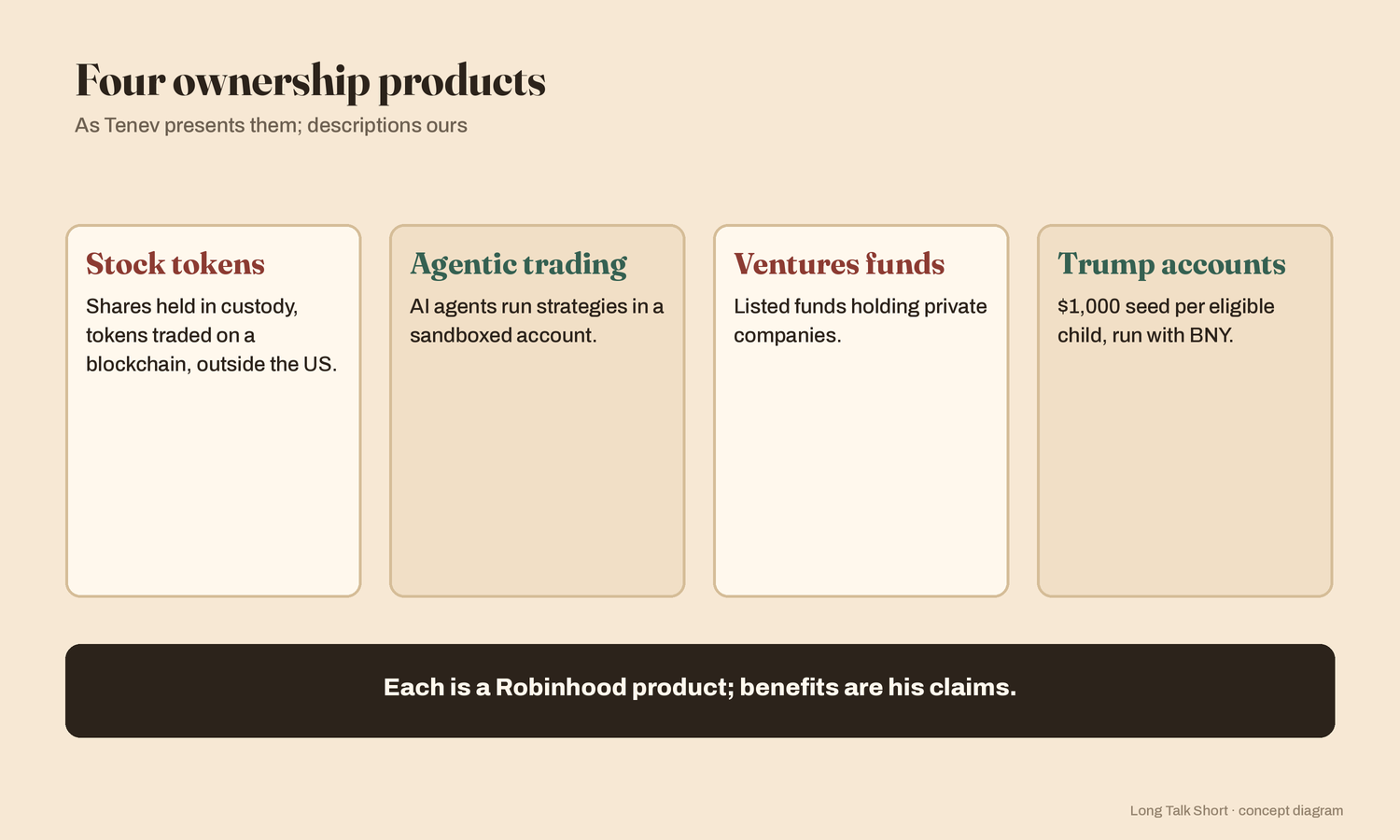
Stock tokens. Tenev explains tokenization by analogy with stablecoins: put real shares in custody, then issue and redeem tokens against them that trade on a blockchain. Robinhood offers these outside the US, on its own chain. He argues they can become the default way people in countries with weak capital markets get exposure to US stocks, and answers critics who call it a "corpo chain" by saying a company-backed chain gives focus and trust.
Agentic trading. Robinhood lets AI agents connect to a separate, sandboxed trading account and also run strategies inside its app. Tenev says more than 150,000 customers have opened such accounts and that agent tool calls run around 30 million a day. His goal is to put hedge-fund capabilities in ordinary pockets. He expects "more trading activity," first among sophisticated users, and sees no clear need for regulatory overhaul yet.
Asked whether market infrastructure can cope if everyone becomes an algorithmic trader, Tenev points to the safeguards: agent accounts are funded separately from a customer's main balance, trades require approval by default (though users can switch that off), and exchanges and market makers already handle enormous volumes of automated trading. Agent-driven trades, he says, are still a small share of activity, so there will be warning before they matter.
Private markets. Robinhood Ventures funds, listed on a major US exchange, hold stakes in late-stage private companies, and a second fund with Y Combinator targets seed and Series A startups. Tenev wants US accredited-investor rules loosened and argues that it is irrational to let people buy memecoins freely but not private shares.
Trump accounts. Robinhood is the broker and initial trustee for the federal children's accounts. Tenev says the program could lift household stock ownership from about 65% to 95%.
3. Prediction markets and math
Tenev also defends prediction markets as "an evolution of news": odds that show what is likely to happen, plus a way for people with specialist knowledge to profit from it directly. Robinhood plans contracts on company metrics such as earnings per share. Separately, he discusses Harmonic, his AI math startup, whose model Aristotle earned a gold-medal score at the International Mathematical Olympiad. He worries that AI-driven discovery will be too centralized in big labs and wants tools in individuals' hands.
Weighing it: what holds up
Framing: The ownership mission is real as a company pitch. The hosts did not press him hard on risks to retail users.
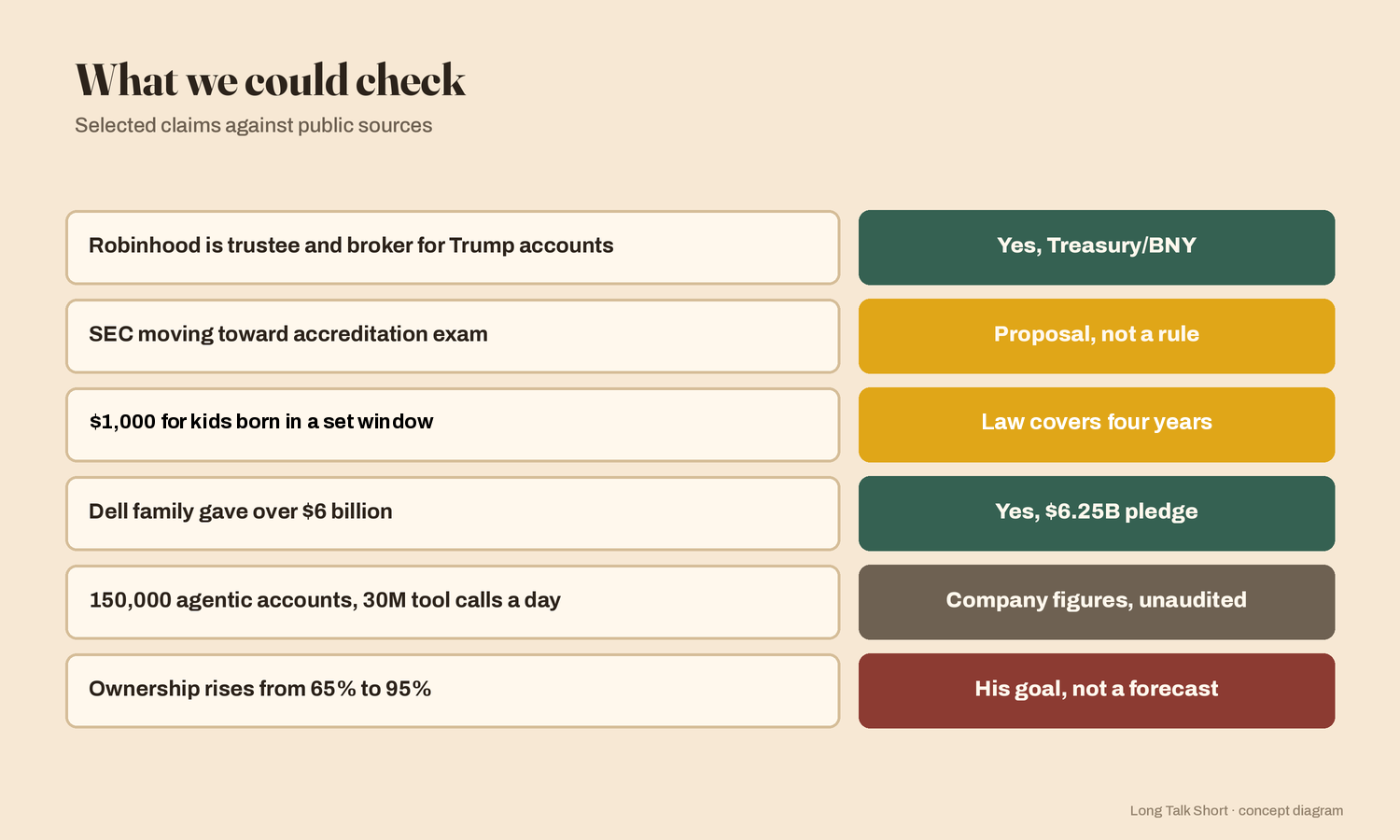
Holds up: Treasury and BNY announced that Robinhood would serve as brokerage and initial trustee for Trump accounts, and an SEC filing describes Robinhood as the sole broker-dealer and says it may not charge the accounts fees. Michael and Susan Dell pledged $6.25 billion.
Partly holds: The $1,000 federal seed covers children born across four calendar years, not the "three" he said. The SEC has asked for comment on a FINRA-developed accredited-investor exam; it is a proposal, not an adopted rule.
Corrections: His "three years" for the seed window understates the law's four-year span.
Not checked: His agentic trading figures, Robinhood chain's growth claims and the 65% ownership baseline are company or self-reported numbers we did not verify; the baseline varies by survey. His inflation figures for Bulgaria are his recollection. Quotes were checked against YouTube's automatic captions, a machine transcript.
Disclosures: Tenev runs the company that sells every product he argues for, and benefits from the rule changes he advocates. That does not make him wrong, but it means his account of benefits should be read as a pitch. Several of his products would, by his own description, increase trading activity. More trading is not the same as more long-term ownership, and frequent retail trading has often been linked with worse returns. The Trump accounts, a diversified low-cost index product, fit his ownership argument most directly. The figure groupings are ours.
Bottom line: a coherent ownership pitch from the CEO selling the products; ask whether you would end up holding assets longer or just trading them more often.
Related reading: Josh Brown on the AI earnings story · Who holds the key when AI agents log into banks · Anthropic's compute bill, weighed
Long Talk Short
- Tenev argues broad ownership stabilizes societies, and that AI's gains are concentrated because top AI firms stay private.
- His fixes are Robinhood products: stock tokens, agentic trading, listed venture funds and Trump accounts.
- He wants accredited-investor rules loosened; the SEC is only consulting on an exam route.
- Several products would raise trading activity, which is not the same as widening ownership.
- He is the CEO selling what he argues for, so treat the benefits as claims.
The one thing to remember: when someone promises to widen ownership, ask whether you'd end up holding assets longer or just trading them more often.
This summary is for general information only and is not investment, financial or trading advice. Nothing here is a recommendation to buy or sell any security or token.
Source: Vlad Tenev, "Tokenization, Agentic Trading, Harmonic: Robinhood's Mission to Expand Ownership with CEO Vlad Tenev," No Priors, on YouTube. This is an independent summary and is not affiliated with No Priors, Robinhood or Vlad Tenev.