The Bill Has a Number: Anthropic's $895 Billion Compute Tab, Weighed
Anthropic's amended IPO filing puts a number on the AI bill: about $895 billion in compute commitments. On Prof G Markets, the FT's John Foley explains why costs outpacing revenue, a possible junk rating and Big Tech's borrowing all matter if you are weighing the boom.
If you judge the AI boom by revenue alone, you are reading half the ledger. Anthropic's third-quarter numbers, filed in an amended IPO prospectus, put a figure on the other half: about $895 billion in commitments for computing power and data centres. On Prof G Markets, Ed Elson and John Foley, who runs the Financial Times' Lex column, spent the opening segment on what that bill means.
In short: Anthropic's revenue is still soaring, but in the third quarter its compute costs grew faster than its sales, and it swung back to an operating loss. Its commitments run for years and outstrip its revenue. Foley's view is that the numbers are close to impossible to forecast, so any IPO price should account for that. A second guest argues that the same timing risk sits on the balance sheets of the biggest tech companies.
1. The quarter in two lines
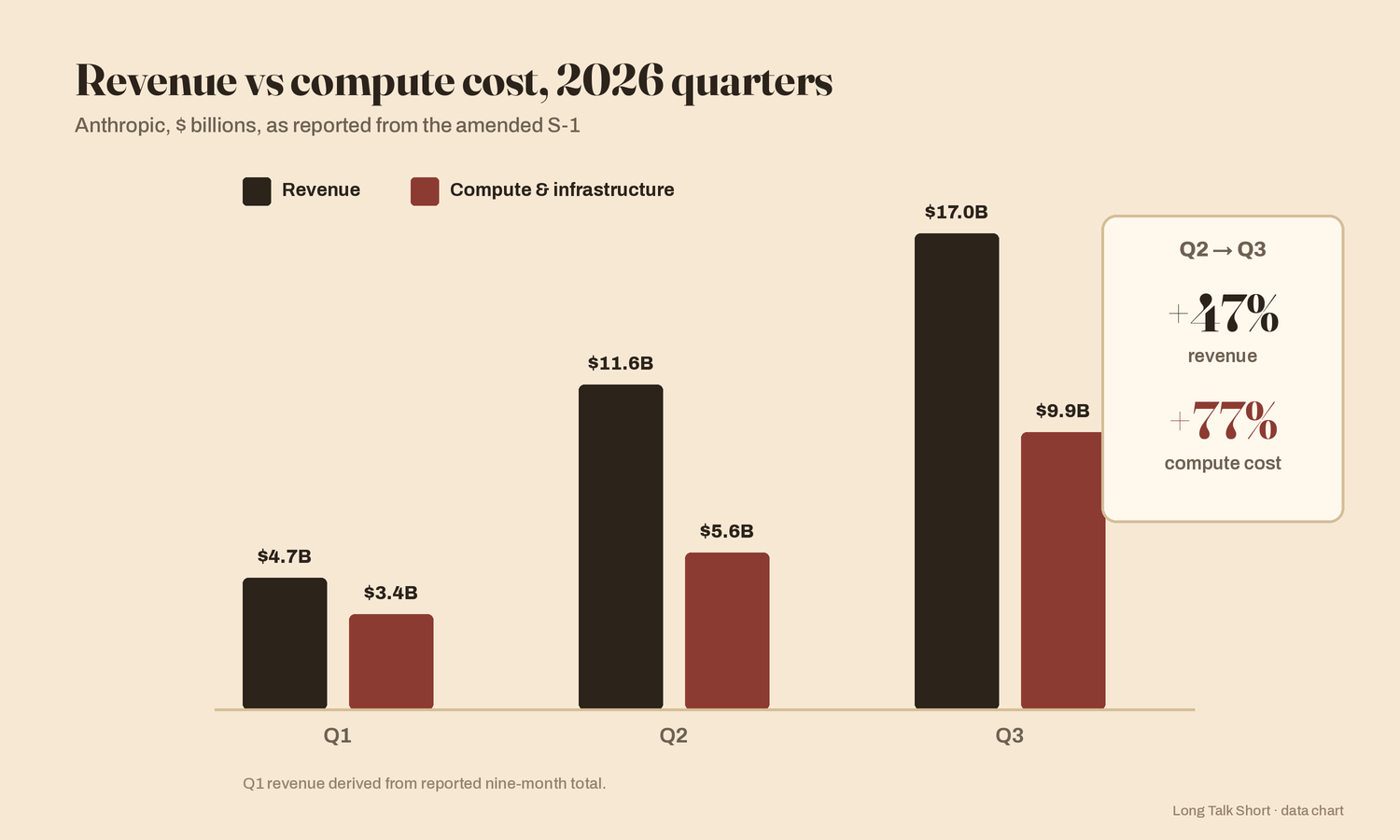
The revenue line looks extraordinary. Anthropic reported almost $17 billion for the quarter, about twelve times the same period a year before. But growth from the previous quarter slowed to about 47%, down from 144% in the second quarter.
The cost line is the one Elson keeps returning to. Compute and infrastructure cost about $3.4 billion in the first quarter, $5.6 billion in the second and $9.9 billion in the third. Revenue grew about 47% from the second quarter to the third; compute costs grew close to 80%. The cost of serving customers is rising faster than what they pay.
The company swung from about $974 million of operating profit in the second quarter to a $567 million operating loss in the third. The filing blames much of that on $5 billion of pricier short-term compute contracts. So how big is the bill behind those quarters?
2. What $895 billion actually is
The headline number is easy to misread. It is not a yearly bill. As reported, about $447.5 billion falls before the end of 2030, and the rest runs out as far as 2045. Roughly $69.8 billion comes due within twelve months, which Elson notes is more than Anthropic's annualized revenue.
Foley's counterweight is the forecast. Anthropic has reportedly told investors it expects about $200 billion of revenue in 2028. If that happens, he says, even $100 billion a year of compute would be covered, and a valuation around $1.4 trillion "wouldn't be ridiculous." The trouble is the word if. Prices are falling as cheap open-weight models, many from China, push in.
And the filing's risk factors mention something no spreadsheet can price. If AI reaches what the company calls a moment of dramatically accelerated progress, Anthropic says it may have to slow down for safety reasons. "What does that do to the revenue?" Foley asks. "It really is impossible to say."
3. Why the credit rating matters to you
A company spending faster than it earns has two ways to cover the gap: borrow or sell more shares. Elson cites a Financial Times report that Blackstone told investors it expects Anthropic to get a high junk credit rating after the IPO, not the investment grade it had expected. Foley's point is practical. In a race where "you do that by throwing money into the furnace," a lower rating makes every future dollar more expensive.
His warning for IPO buyers is about psychology: the risks should shape the price you are prepared to pay, and his fear is that buyers will treat it as a scarcity play: there is only one Anthropic, so get in at any price.
4. The same problem, at Big Tech scale
The second segment, with Deirdre Bosa of Deirdre Bosa Live, widens the lens. The Nasdaq 100 had fallen more than 10% from its peak, and the biggest AI and chip stocks had lost about $5 trillion in a month. Bosa's explanation is that the healthiest balance sheets in the world are changing. Citing Bank of America, she puts AI-linked debt issuance at nearly $400 billion in 2025, about $655 billion in 2026 and a forecast $1 trillion in 2027.
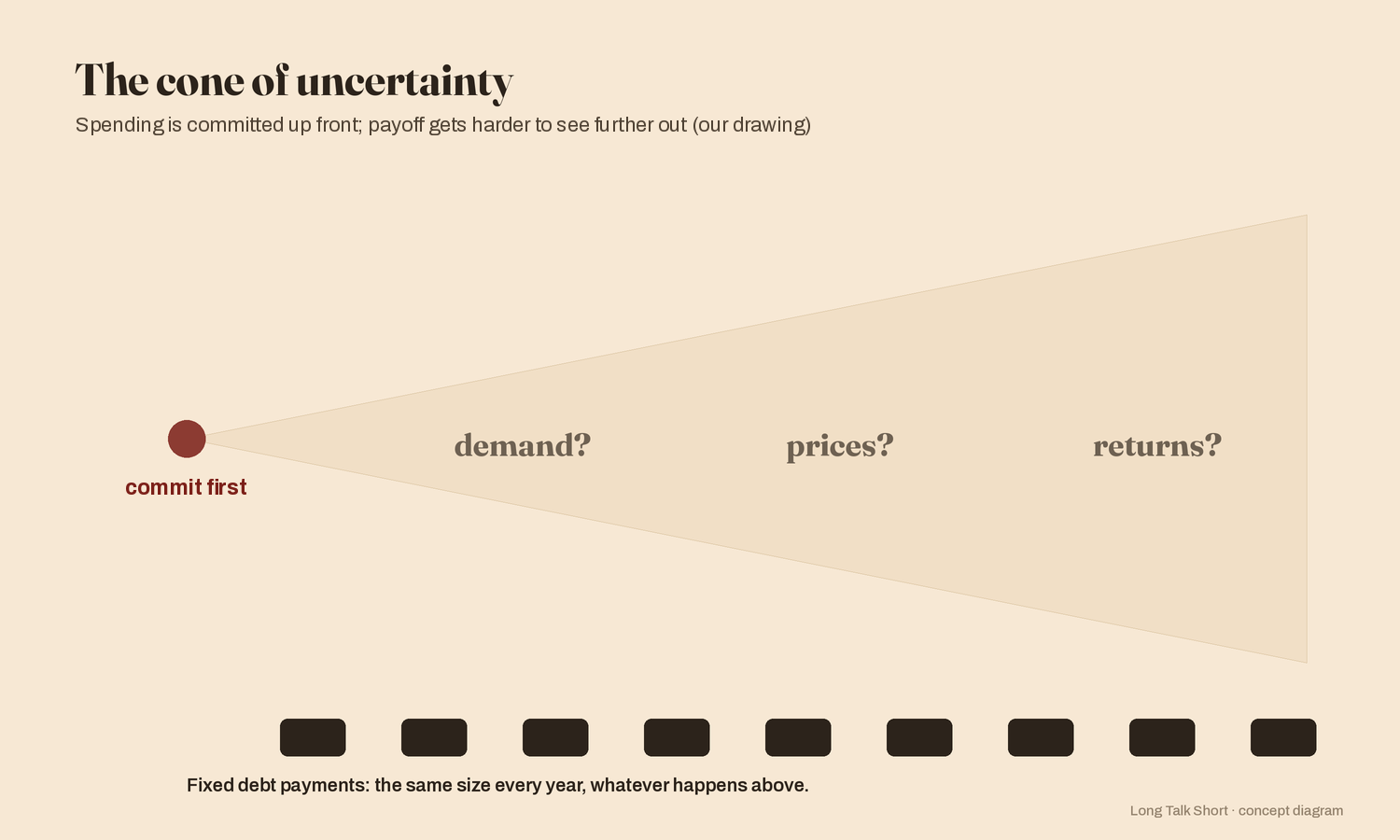
Debt changes the nature of the bet. Borrowing to do it adds fixed payments that come due "whether or not the AI investments are paying off." She calls it a cone of uncertainty: you commit first, while demand, costs and returns grow harder to see the further out you look.
Bosa gives the bull case too. Wall Street consensus, she says, expects Alphabet, Amazon, Meta and Microsoft to generate more than $600 billion of combined free cash flow by 2030, which, if right, makes the squeeze "an insane buying opportunity." The disagreement is about timing, not demand.
Weighing it: what holds up
Framing: The title fits the opening segment. Roughly the second third of the episode is about Big Tech borrowing, and the last third is an interview with Moody's Analytics economist Mark Zandi about the US economy before the midterms, which we have left out.
Holds up: Against press reports of the amended S-1 (CNBC, Business Insider, Bloomberg Tax, DCD): revenue of about $17 billion, up about 1,127% year on year; quarter-on-quarter growth of 47% after 144%; compute and infrastructure costs of $9.86 billion against $5.56 billion in the second quarter, about 77% growth by our arithmetic; $895.4 billion of commitments, about $69.8 billion within twelve months and about $447.5 billion through 2030.
Partly holds: The $895 billion is real but not all firm. According to one detailed reading of the filing, about $213.8 billion sits in arrangements that can be terminated or depend on conditions such as a supplier securing financing. Separately, up to $125 billion to $150 billion of further Google chip capacity is reportedly not counted in the total.
Corrections: The episode's "close to 80%" compute growth is about 77% by our arithmetic.
Not checked: the $200 billion 2028 revenue guidance, the roughly 3% of revenue in discounts, the Blackstone credit-rating report, Elon Musk's quoted post about AI serving costs, Bank of America's debt figures, the $600 billion free-cash-flow consensus and the cloud growth rates. Treat them as the speakers' figures.
Disclosures: Google and Amazon are both large Anthropic shareholders and also its biggest compute suppliers, so the same companies appear on both sides of the bill. We found no stake in Anthropic by the hosts or guests. We worked from YouTube's automatic captions, so names and quotes may contain small errors.
Bottom line: the reported figures check out and the cost gap is real; whether $895 billion is affordable depends on forecasts no one can pin down.
Related reading: All-In on Anthropic's S-1 and the Google deal · why debt could be the AI bubble's first domino
Long Talk Short
- Anthropic's revenue grew about 47% in the third quarter; its compute costs grew about 77%.
- The $895 billion is a multi-decade commitment, not a yearly bill, but about $70 billion is due within a year.
- A junk rating would make the gap between spending and earning more expensive to fill.
- Big Tech is borrowing for AI too, which turns a spending bet into one with fixed payments.
The one thing to remember: in the AI build-out, watch the cost line and the debt, not just the growth rate.
This summary is for general information only and is not investment advice. Do your own research or consult a qualified adviser before making investment decisions.
Source: Ed Elson and John Foley with Deirdre Bosa and Mark Zandi, "Anthropic's Q3 Results Are In — The Costs Are Exploding," Prof G Markets, on YouTube. This is an independent summary and is not affiliated with Prof G Media or Anthropic.