Narcissism Is a Dial, Not a Diagnosis: Ramani Durvasula on Spotting the Pattern and Healing Without Leaving
Ramani Durvasula says the question isn't whether someone is a narcissist but how narcissistic they are. Her guide to love bombing, gaslighting and healing without leaving, plus a check on the headline's "1 in 6", which isn't a diagnosis rate.
Someone is charming all evening at a dinner party and cruel in the car home. Which version is real? The clinical psychologist Ramani Durvasula says both are, and that the question to ask isn't "Is this person a narcissist?" but:
How narcissistic are they, and what is it doing to me?
In a long Big Think interview, she sets out how to recognise the pattern, why people stay and how to recover, whether or not you leave.
In short: Durvasula treats narcissism as a spectrum of traits built around entitlement and low empathy, not a yes-or-no label. The harm builds slowly through love bombing, gaslighting and future faking, and healing starts with accepting the person won't change. The headline's "1 in 6" figure never comes up in the interview, and it isn't a diagnosis rate.
1. A pattern, not a label
Durvasula sees narcissism as a personality style in the "antagonism" family, the same family that includes psychopathy. It is not a disorder in itself. Narcissistic personality disorder (NPD) is a clinical diagnosis, and she says it is rarely given, partly because of stigma and insurance.
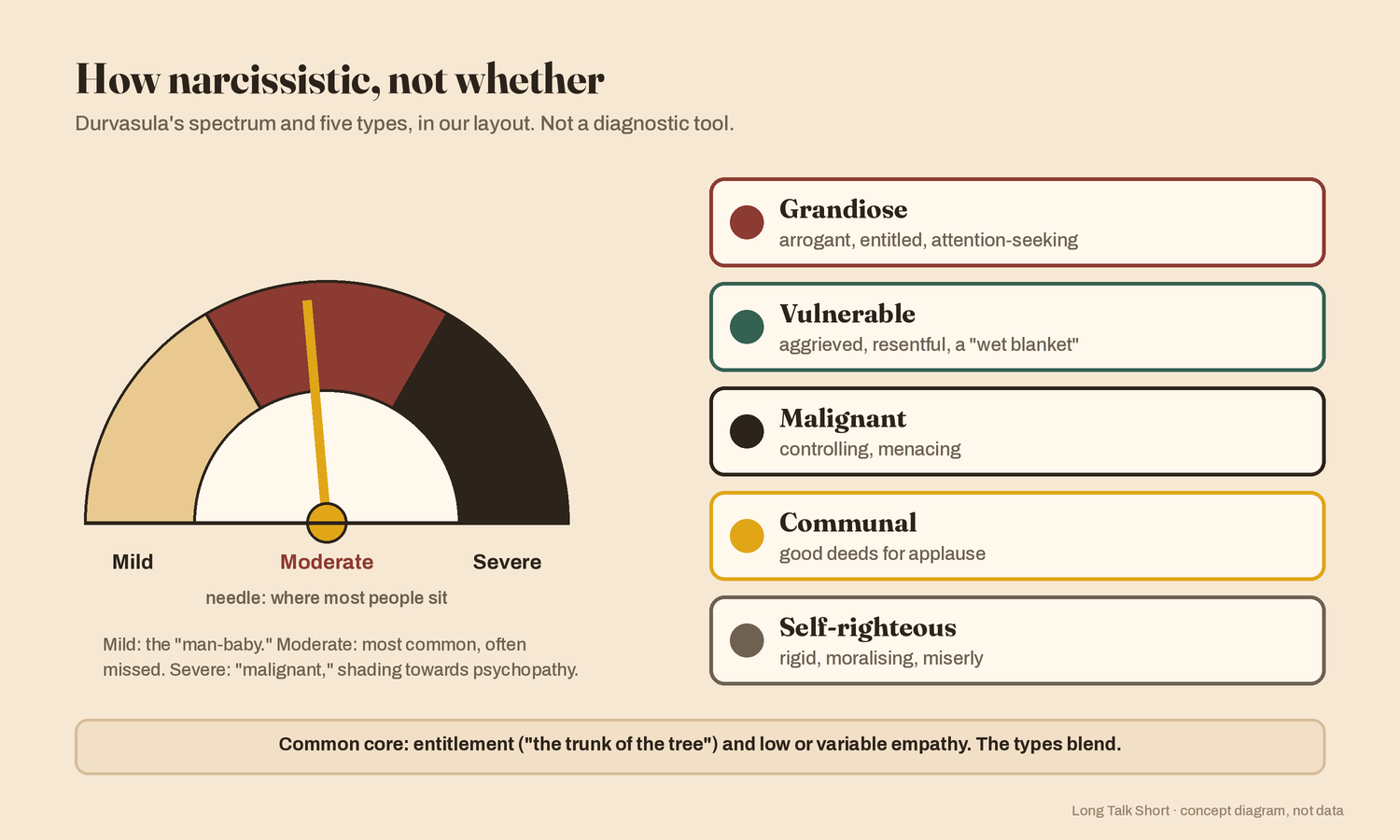
The traits she lists are grandiosity (arrogance, entitlement, fantasies of greatness), variable or low empathy, selfishness, superficiality, envy and a hunger for validation, often with poor emotional regulation. Entitlement is "the trunk of the tree," she says, but one trait alone doesn't make the pattern: an entitled person who still has empathy can be held to account. Underneath, she describes a fragile core of shame and insecurity covered by armour.
Her scale runs from mild (the "man-baby") through moderate, where most sit, to severe or "malignant." She also names five types, which blend:
- Grandiose.
- Vulnerable: resentful and aggrieved, a "wet blanket."
- Malignant: controlling and menacing.
- Communal: good deeds done for applause.
- Self-righteous: rigid, moralising and miserly.
"They can't help it" is wrong, she says. Someone charming at dinner and vicious in the car reads people perfectly well, so the cruelty involves choice. And those closest see the worst. Strangers meet what she calls the C-suite traits: charm, charisma, confidence, credentials, comfort and curiosity. Partners, children and employees meet the rest.
If the traits are this recognisable, why is the damage so hard to see from inside?
2. How the harm accumulates
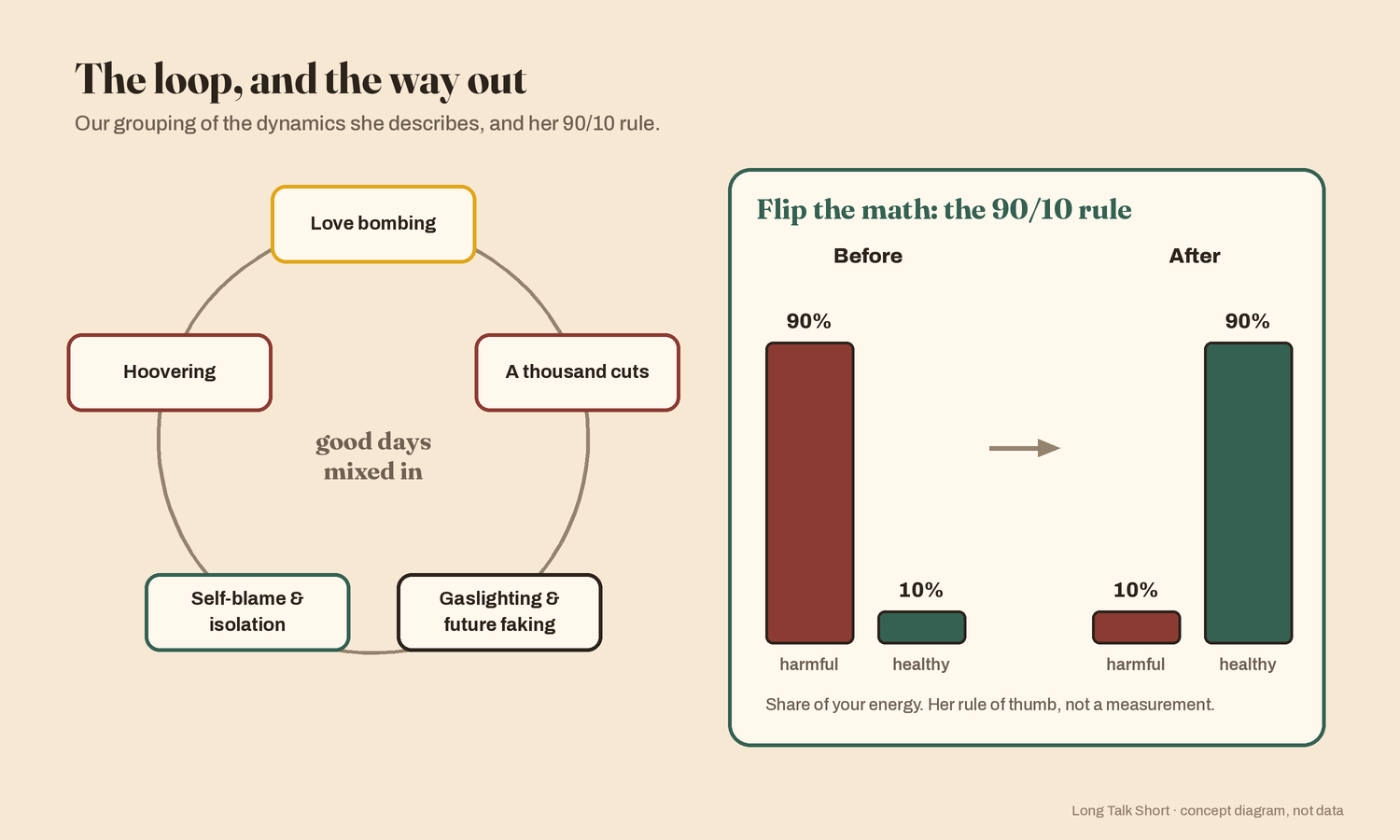
There is rarely one dramatic moment. The relationship mixes good times with small jabs, broken promises and betrayals, what she calls "death by a thousand cuts." Nobody counts "bad thing number 532," so confidence erodes quietly.
Love bombing draws people in: constant messages, gifts, trips, meeting the family early and pressure to move in or get engaged fast. The tell is what happens when you set a pace or a boundary. Ask to slow down, or keep your Thursday pickleball with friends, and you are told you must not really care.
Gaslighting, in her definition, needs three things: trust, a denial of reality ("I never said that") and an attack on the person ("there's something wrong with you"), repeated over time. A lie alone, or a difference of opinion, isn't gaslighting. One outside voice saying "that didn't happen" can break the spell.
Future faking holds people with promises (therapy, a holiday, children "once I make partner") that slip when the date arrives. Then comes hoovering, a fresh burst of charm or apology that pulls someone back in.
Why stay? She lists fear, love, hope, money, housing, children, culture and nostalgia, plus trauma bonding. Self-blame feels safer, because if it's your fault you can fix it. She adds that the chronic stress shows up in the body.
3. Healing without a dramatic exit
Her first advice is to breathe and go slowly. Well over half the time, she says, leaving isn't realistic, because the person is a parent, a co-parent or a boss. You don't have to leave to heal, and no contact is not the only route. Her alternative is disengagement: share less, "stick to the weather" and stop bringing good news to someone who won't celebrate it.
Recovery starts with radical acceptance: seeing that the pattern won't change. The first feeling is usually grief. Her tools include an "ick list" of what really happened, to read when nostalgia or hoovering arrives (keep it off any shared cloud account), and an unsent letter. Optimists, forgivers and fixers, she adds, are especially easy to keep hooked.
Her closing idea is the 90/10 rule. Most of us pour about 90% of our energy into the hardest relationship and give 10% to the healthy ones. Flip it.
Weighing it: what holds up
Doesn't hold: the "1 in 6" headline. Durvasula never says it in this interview. It is Big Think's title, and it echoes her 2024 Diary of a CEO episode, where it described people with noticeable narcissistic traits. A 2018 meta-analysis of Western community samples put NPD at about 1.2%. The large U.S. NESARC survey (Stinson et al., 2008) found 6.2% lifetime NPD, the highest major estimate and still closer to 1 in 16 than 1 in 6.
Holds up: Orth and colleagues' 2024 meta-analysis of 51 longitudinal samples found narcissism fairly stable in rank order but declining on average with age. Grijalva's 2015 meta-analysis found men score modestly higher on grandiose narcissism, with no significant gender gap in vulnerable narcissism; a transcript line about something being "much more common in women" appears to be a slip. In England and Wales, prosecutors' coercive-control guidance names love bombing as a tactic.
Softer claims: the idea that survivors return "seven times" on average is widely repeated, but we found no study establishing it, though research shows leaving is often a repeated process. We didn't check her points on autoimmune illness and cancer, which she offers as clinical impressions. The five types and the C-suite list are her own frameworks.
Context: Durvasula writes books and runs courses on this topic, including It's Not You. None of this is a way to diagnose anyone.
Bottom line: the spectrum view and the tactics are well grounded; the headline number is not a disorder rate.
Related reading: for the manipulation tactics in close-up, see Whoever Frames the Room Wins; for how chronic stress shows up in the body, see When Words Aren't Enough.
Long Talk Short
- Ask how narcissistic someone is, not whether they are. It's a spectrum built on entitlement and low empathy.
- The harm is cumulative: love bombing, gaslighting, future faking and self-blame, mixed in with good days.
- "They can't help it" is a myth. Selective charm shows choice.
- You can heal without leaving: disengage, grieve, keep an honest record and lean on safe people.
- "1 in 6" isn't an NPD rate. Major estimates run from about 1% to 6%.
The one thing to remember: stop trying to fix the difficult person, and move your best energy to the people who already treat you well.
Source: "1 in 6 people are narcissists. Learn to spot them early | Ramani Durvasula: Full Interview", Big Think (YouTube). We worked from Big Think's published transcript. This is an independent summary and is not affiliated with Big Think or Dr Durvasula.
This article is for general information only and is not medical, psychological or legal advice. If you are in an abusive relationship, contact a local domestic-abuse helpline or a qualified professional. If you are struggling or in crisis, call or text 988 (the Suicide & Crisis Lifeline in the US) or your local emergency number.