How Robert Caro Gets the Truth Out of Power: Know the Documents, Ask Why, Watch Who Calls
Robert Caro has spent 50 years getting powerful people to say what they shouldn't. Talking to Dwarkesh Patel, he explains how: know the documents, ask why, read small signs of power and get every book down to one sentence. We check his numbers.
If you have ever had to get the real story out of someone who didn't want to tell it, you know that asking nicely rarely works. Robert Caro has spent about 50 years getting powerful people and their aides to say things they knew they shouldn't.
In a conversation with Dwarkesh Patel, billed as Caro reflecting at 91, he says less about what power is than about how you find out what it does. His method has three parts: do the homework, ask "why" and protect your concentration.
In short: Caro gets people to talk by knowing the documents better than they expect, then asking why. He reads power through small signs, such as who is calling. Before writing, he gets each book down to one sentence. Most of what he learned never reached the page, so he gave his archive away for less money to keep it open.
1. Do the homework, then ask why
Some people, Caro says, he simply has to interview, and he won't take no for an answer. His example is Lyndon Johnson's first secretary, the man who rode in the car with him across Texas during campaigns:
There's no other human being on earth who knows what Lyndon Johnson is doing all these hours.
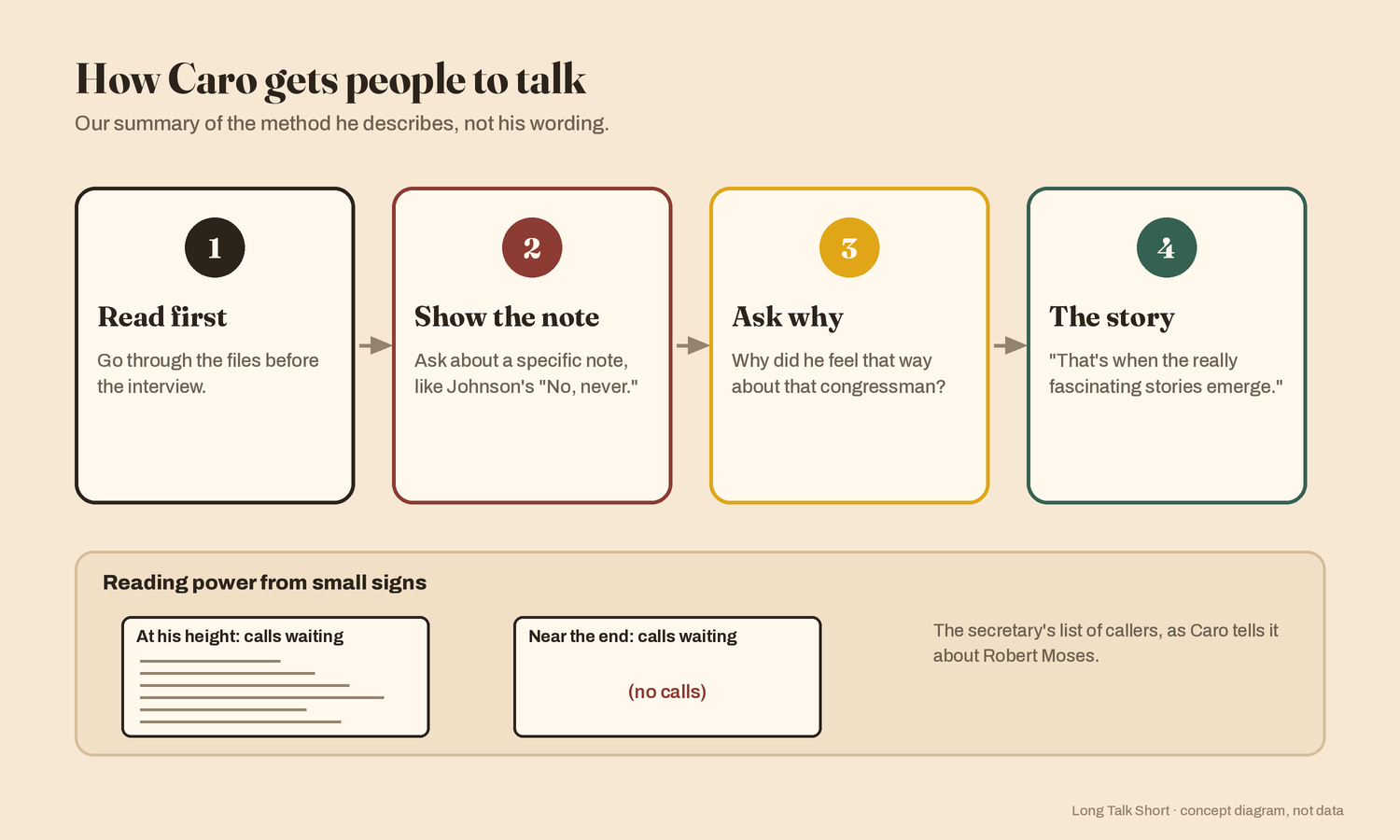
The harder problem is the willing source who won't say the important thing. His example is John Connally, who collected and handed out campaign money on Johnson's instructions. Caro had already been through the files. On requests for money, Johnson would write "Okay, 1,500," or "500," or "no" and, sometimes, "No, never."
So Caro could put a specific note in front of Connally and ask what it meant. ("This guy was never going to get money from Lyndon Johnson.") Then he asked why Johnson felt that way about that congressman. "That's when the really fascinating stories emerge."
The lesson travels: a vague question gets a vague answer. Specific evidence plus "why" is much harder to deflect.
But documents only tell you so much. Caro also reads power from what isn't there.
2. Watching power through small signs
When Robert Moses was at his height, the secretary would arrive after each interview with a list of people who had called wanting something. Near the end, after one long interview, there were no calls. The secretary had nothing to bring in. Caro took the empty list as a measure of lost power.
Asked what he would ask Moses in an eighth interview, after Moses stopped talking to him, Caro said: "Did you realize you were changing?" He doubts Moses did. That is his recurring theme: power doesn't just reveal people, it reshapes them, usually without their noticing.
On Johnson, he makes two points that go beyond tactics. Persuasion works because power stands behind it. And sheer drive is hard to explain: "I think it's just their will." On why Johnson kept escalating in Vietnam, the subject of the volume he is working on, he declines to answer: "I'm still trying to figure that out." Refusing to answer before he has done the reading is part of the method.
3. One sentence, then a million words
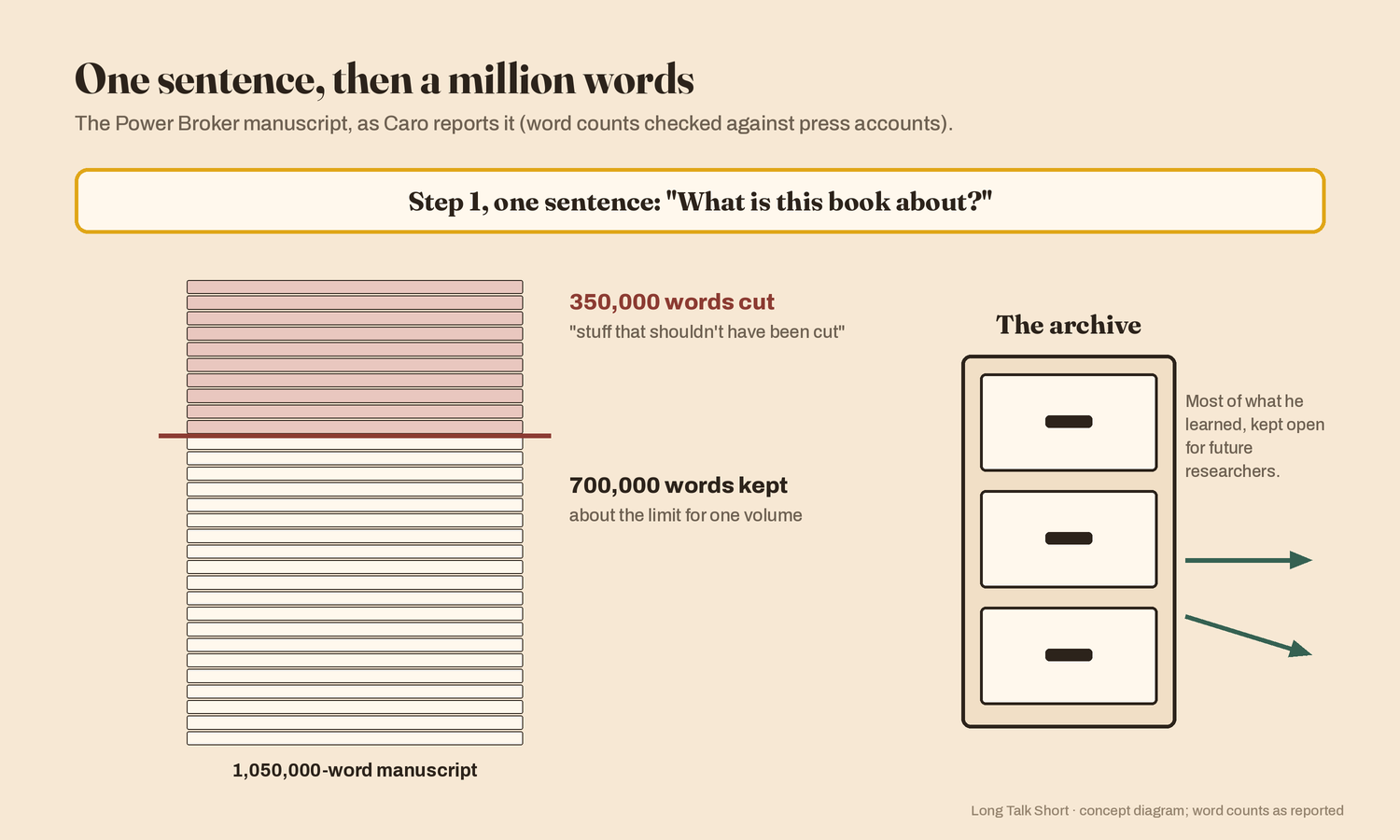
Before he writes, Caro sits at his desk, sometimes for a long time, asking, "What is this book about?" He tries to get the answer down to one sentence, or at most a paragraph. Without it, he warns, three years in you lose track of what you are trying to do.
The reason is the scale of his material. He handed his editor, Robert Gottlieb, a Power Broker manuscript of 1,050,000 words. One volume could hold about 700,000, so 350,000 had to go, including material Caro says "shouldn't have been cut out."
Digital archives help, he says. For a chapter on the 1965 battle of the Ia Drang Valley, he can find from his computer which colleges hold soldiers' oral histories. But he doesn't think his books would have gone faster: "finding them is a small thing compared to reading them." Retrieval is cheap. Understanding still takes time.
4. Solitude and the archive
His working day is deliberately lonely. He comes in, turns off the phone and talks to no one until the day's work is done. He calls himself "a friendly guy" and admits it is hard, but a call breaks the concentration. For decades he and his wife, Ina, his research partner, have largely worked alone.
He also knows most of what he learned won't appear in his books, by his guess the "vast majority." He mentions about 700 interviews for The Power Broker and says there is still no good biography of Sam Rayburn, though the material is in his files. So he gave his archive to the New-York Historical Society, turning down "a lot more money" elsewhere, so it would be easy for others to use.
Weighing it: what holds up
Holds up: the 1,050,000-word manuscript and the 350,000-word cut match accounts of Caro and Gottlieb's work, including The Atlantic's. The Robert A. Caro Archive is held by the New-York Historical Society. Published accounts confirm seven interviews with Moses before he cut Caro off.
Overstated: 700 interviews. Caro says "I think I have 700 interviews" for The Power Broker; the figure usually published is 522. He hedged and may count differently, so treat 700 as approximate.
Disputed: Ia Drang. He says nobody has written about it "in detail," yet Harold Moore and Joseph Galloway's 1992 We Were Soldiers Once… and Young is a well-known, detailed account. He may mean from Washington's side.
Not checked: that he received less money for the archive, the Rayburn gap and the golf-course donation detail. The method steps are our grouping, and we left out the Moses and Johnson tactics covered in our companion piece. We worked from the transcript Dwarkesh Patel published; the episode carries sponsor reads, and we found no financial tie between Patel and Caro.
Bottom line: the method is well documented in his own work; a couple of his numbers are looser than the legend.
Related reading: for what Caro found about Moses and Johnson themselves, see Power Without a Vote.
Long Talk Short
- Know the documents before the interview. Put a specific note on the table and ask why.
- Read power from small signs, such as who is calling and who has stopped.
- Power changes people without their noticing: "Did you realize you were changing?"
- Get the book, or any big project, down to one sentence before you start.
- Finding sources is the easy part. Reading them is still the job.
The one thing to remember: the truth about power is usually in the paperwork and the follow-up question, not the first answer.
Source: "What Robert Caro learned about power after studying it for 50 years", Dwarkesh Patel (YouTube), also on the Dwarkesh Podcast as "Robert Caro – The master biographer reflects at 91." This is an independent summary and is not affiliated with the podcast or Mr Caro.
This article is for general information only and is not professional advice.