Wisdom Can't Be Taught: Hermann Hesse's Siddhartha and the Seeker Who Walked Away From the Buddha
Hermann Hesse's Siddhartha follows a seeker who leaves every teacher, even the Buddha, because wisdom can't be handed over. The story, why it says wisdom must be lived, and where the idea goes too far.
He met the Buddha, was deeply impressed, and walked away anyway. That choice is the whole point of Hermann Hesse's Siddhartha.
Near the end of the novel, an old monk named Govinda crosses a river and asks the ferryman, his childhood friend, whether he has a teaching that helps him live. Siddhartha's answer, in the Project Gutenberg English translation:
wisdom cannot be passed on. Wisdom which a wise man tries to pass on to someone always sounds like foolishness.
And then: "Knowledge can be conveyed, but not wisdom." It can be found and lived, he says, "but it cannot be expressed in words and taught."
In short: Siddhartha leaves every teacher he meets, including the Buddha, not because they're wrong but because no one can hand over the experience that turns knowledge into understanding. He has to live through ambition, pleasure, disgust and grief to get there. The novel is a century old and still widely read because it says something hard: the most important lessons can be pointed at, not given.
1. A story about leaving teachers
Hesse began the book in December 1919 and finished the first part by August 1920, then stalled for more than a year. The Museum Hermann Hesse Montagnola calls 1921 "a year of crisis and of unproductivity," a year that included psychoanalysis with Carl Jung. He finished in May 1922, and S. Fischer published it that autumn with the subtitle "An Indian Poem."
The setting is the India of the Buddha's time, which Hesse knew mostly from books and family: his grandparents and parents had been missionaries there. His own 1911 voyage east reached Ceylon and Southeast Asia, not India itself.
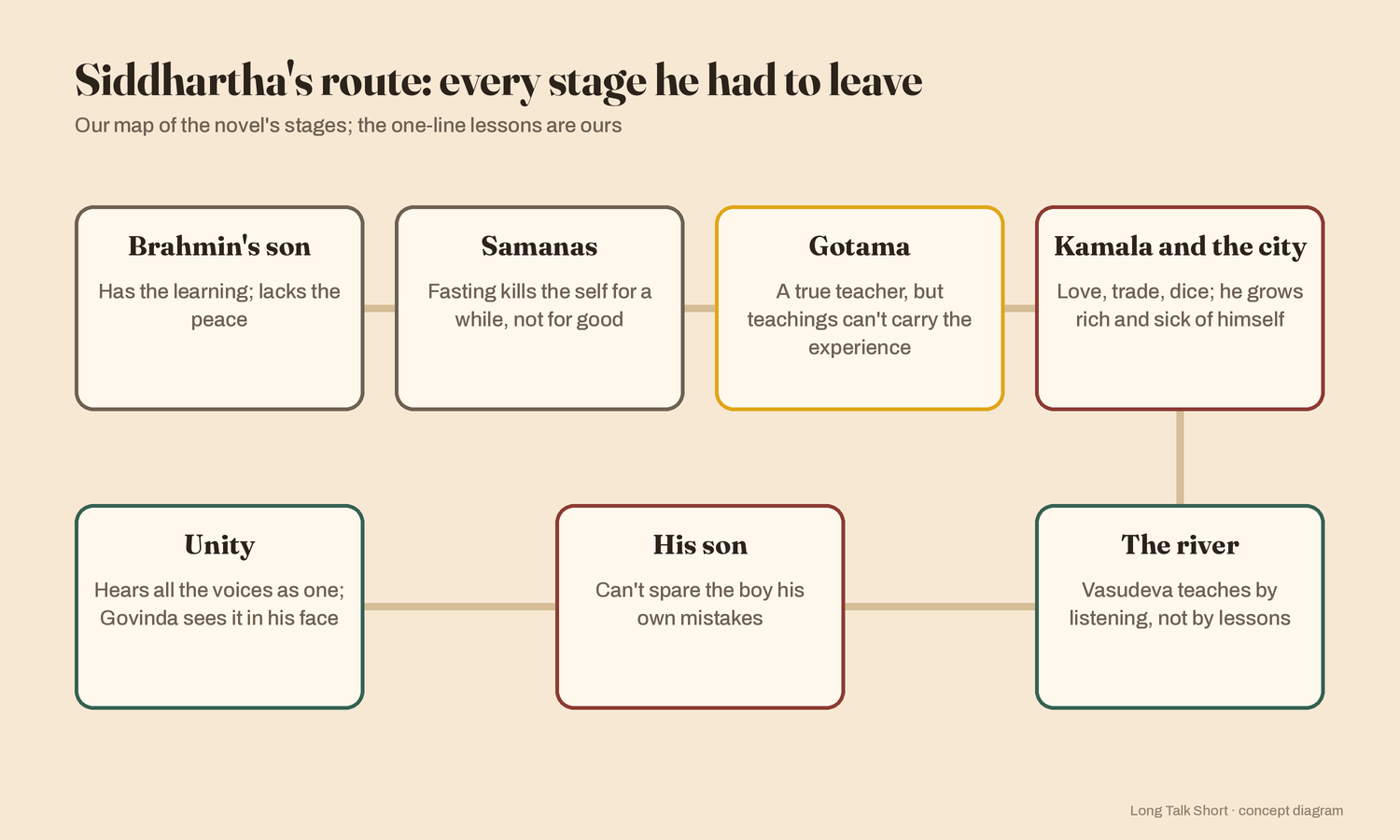
Siddhartha is a gifted Brahmin's son who has learned everything his elders can teach and still isn't at peace.
- The Samanas: with his friend Govinda he joins these wandering ascetics and learns to fast, wait and quiet the self. It works only for a while.
- Gotama, the Buddha: Govinda becomes a monk. Siddhartha, deeply impressed, leaves anyway, and tells the Buddha why:
nobody will obtain salvation by means of teachings!
So if not from teachers, where does he learn? The answer is the opposite of a monastery.
2. Living it the long way
In a city, Siddhartha meets Kamala, a courtesan who teaches him love, and goes to work for a merchant, Kamaswami. His only credentials are three skills from his ascetic years:
I can think. I can wait. I can fast.
Over the years he grows rich, gambles, drinks and slowly loses the inner voice that once guided him. Disgusted with himself, he walks out, reaches a river and is ready to drown. The sacred syllable Om rises in him and stops him.
At the river he stays with Vasudeva, a ferryman who "was no friend of words" and whose great skill is listening. The river becomes Siddhartha's real teacher. He learns to hear all its voices at once, and asks Vasudeva whether he too has learned "that secret from the river: that there is no time?"
3. The son he couldn't save
The hardest lesson comes last. Kamala dies and leaves Siddhartha a son he never knew: a spoiled, angry boy who despises his quiet father. Siddhartha tries to protect him from the mistakes he made himself. Vasudeva reminds him of his own story:
even if you would die ten times for him, you would not be able to take the slightest part of his destiny upon yourself.
The boy runs away. The grief, endured, finally gives Siddhartha the peace the teachers couldn't.
4. Why it can't be taught
The final chapter spells out the theory. Govinda, still searching in old age, is told he searches too much: "Searching means: having a goal. But finding means: being free, being open, having no goal."
Siddhartha explains why words fail. Any truth put into words is one-sided, so "The opposite of every truth is just as true!" And he prefers things to doctrines: "I can love a stone, Govinda, and also a tree or a piece of bark..."
Read practically (this is our gloss), the novel separates two things:
- Knowledge is information about life. It travels well.
- Wisdom is the changed person who has been through it. It doesn't travel at all.
A teacher, parent or book can point, warn and keep you company. They can't do the living for you, and trying to, as Siddhartha does with his son, tends to push people away.
Weighing it: what holds up
Holds up:
- The writing history comes from the Museum Hermann Hesse Montagnola and published Hesse scholarship.
- The central claim matches ordinary experience: most parents learn that warnings rarely spare a child the mistake, and most of us understand advice only after we've needed it.
- Its influence is real: after New Directions published Hilda Rosner's English translation in 1951, it became a touchstone of the 1960s counterculture.
Overstated: taken literally, the claim that teachings are useless goes too far, and the book half-admits it. Siddhartha himself learns from many teachers: the courtesan, the merchant, the gamblers, Govinda and above all Vasudeva. What he rejects is doctrine as a substitute for experience, not learning from others. And a novel that teaches by example is, unavoidably, a kind of teaching.
Disputed: readers have long debated how much the book reflects Buddhism or Hinduism at all. Its India is largely imagined by a European writer, and its hero turns away from the Buddha's path to find his own, which many readers see as closer to Western individualism than to the traditions it borrows from. That's our reading of a long-running critique, not a settled verdict.
Related reading: a master chef's version of the same idea, practice over instructions, in Learn the Technique, Not the Recipe, and another classic about living rightly, Tolstoy's The Death of Ivan Ilyich.
Long Talk Short
- Siddhartha leaves his father, the ascetics and even the Buddha because no teaching can transfer the experience of awakening.
- He lives through wealth, pleasure, self-disgust and near-suicide before a ferryman and a river teach him to listen.
- His son shows the hardest part: you can't spare someone you love the path they have to walk.
- The thesis: knowledge can be conveyed; wisdom can only be found and lived, and any truth in words is one-sided.
- Taken too literally it underrates teachers; read well, it says teachers can point, but only experience delivers.
The one thing to remember: treat advice as a map, not the trip. Offer yours lightly, and expect the people you love to learn the way you did.
Source: Siddhartha by Hermann Hesse (S. Fischer, 1922). Quotations are from the English translation published by Project Gutenberg (eBook #2500). This is an independent summary and is not affiliated with the author or publisher.