The Invisible List
Birthdays, bills, groceries: who carries the household list in their head? Eric Thomas and Mel Robbins offer tactics for making it visible and sharing it.
You cannot hand off a load nobody can see. On The Mel Robbins Podcast, Eric Thomas and Mel Robbins talk about the household work that lives in one person's head: birthdays, bills, groceries and everyone else's needs. Their strongest advice is narrower than the title's promise of better boundaries: make the invisible list visible, then share responsibility safely.
In short: Thomas, drawing on his marriage and the women in his family, urges people who carry everything to write down what they do, ask whether they are the best person for each job, and let some tasks drop. Robbins adds tactics of her own. The advice is personal and practical, not clinical, and it fits one well-documented research finding about invisible household work.
1. Who is talking
The episode description calls Eric Thomas, known as "ET, The Hip Hop Preacher," a pastor, educator and NYT bestselling author. He is not presented as a therapist, and neither is Robbins: her show notes say plainly that she is "not a licensed therapist" and that the podcast is not a substitute for professional advice.
The conversation is aimed mainly at women. The show notes list no sponsors but link to Robbins's own books; we did not review in-episode ads.
2. The title and the talk
The title promises boundaries and being less available. Much of the episode is instead about mental load: running the household calendar, the bills and other people's moods. There is little on saying no to colleagues or limiting how reachable you are. If you came for workplace boundaries, you will find the advice applies mostly at home.
3. Where the story comes from
Thomas says it became personal when he looked at his family's success. His career had taken off, his son and daughter had graduated, and he concluded that "there's one person in our family that is not as healthy as we are, and that's the person that's been helping everybody else." That person was his wife, whom the show notes name as Dede.
He describes years in which she held the steady job and benefits, and later a diagnosis of multiple sclerosis. He says he asked himself "what part of stress can you own?" That is his own reflection, not a medical claim, and nothing in the episode shows that stress caused her illness. He recalls her telling him that he protected her from everyone, "but you also have to protect me from you," including from his travel schedule and the red-eye flights.
He widens the picture to his mother, a caregiver for his father, who also has MS, and to his grandmother, who raised him. When his mother considered caring for her own mother at home, he told her: "you can't give a life for a life."
4. The tactics
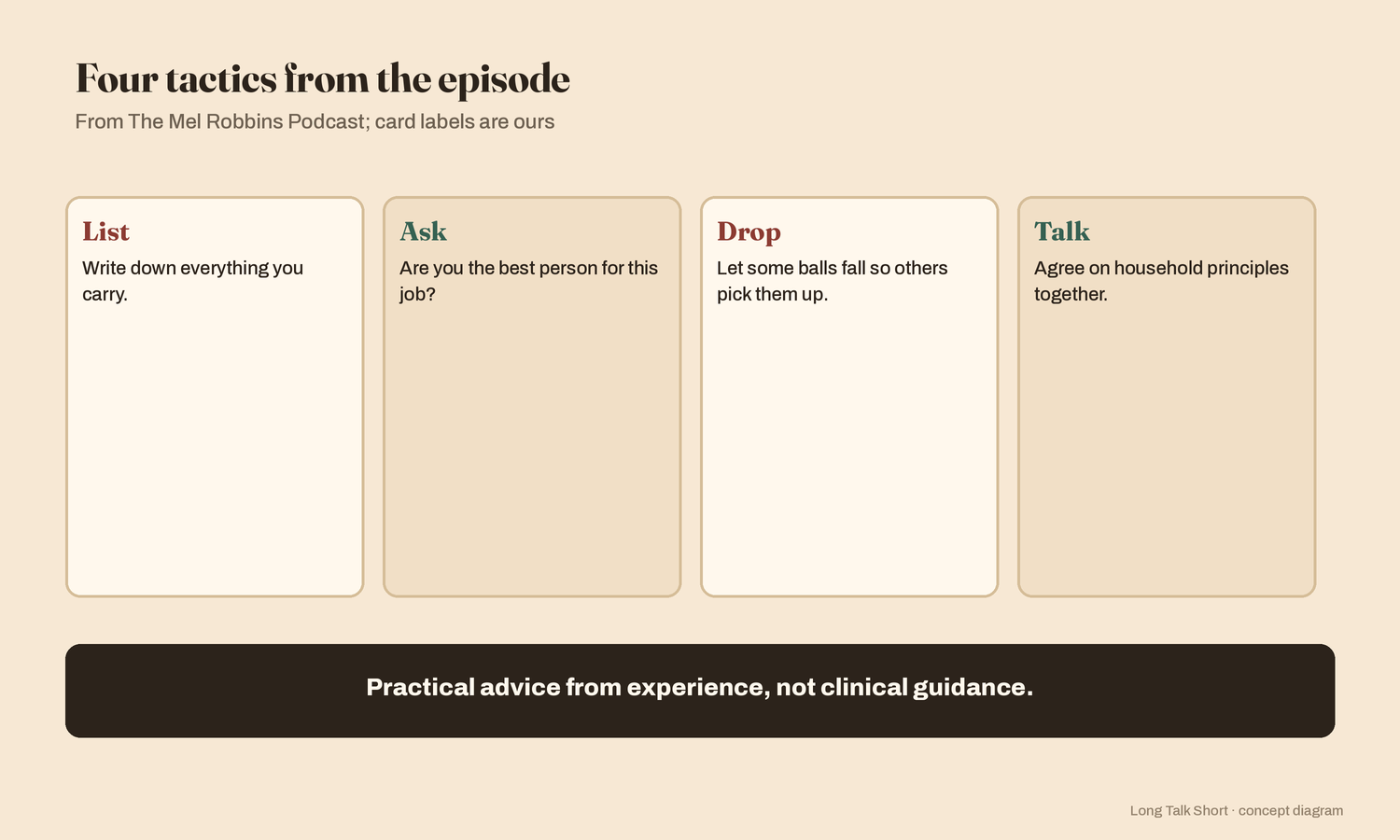
Make the list. Robbins builds on Thomas's question, "where are you on that list?". She says writing down the load is what lets you ask, "am I the best person for this job? Do I even want this job?" The two then add options: train someone else, or pay someone if you can afford it. Robbins reads a listener's list on air, from the grocery list to being the one who makes sure holiday photos get taken while never appearing in them.
Principles over feelings. Thomas says to "get out of your feelings" and into principles. A guilty, on-the-spot decision to pay a bill because someone is upset is a feeling. A principle is a shared rule, such as Robbins's "household chores are shared among the household." Both say many families lack an agreed vision for this chapter of family life, which leaves the default carrier to absorb whatever comes up.
Drop the ball. Robbins argues that others do not notice a task until it stops getting done: "maybe the ball needs to be dropped". Thomas offers his own proof. When his wife stopped paying the bills, he started, "and I didn't die." When she stopped doing laundry, he learned to do it. He also gave up making the family's Thanksgiving turkey, a role he admits had become part of his identity.
Lower the standard. Thomas says people struggle to ask for help partly because others won't do it their way. Robbins sums up the trade-off: "Can I lower my standards a little so I can raise my standard of living?". Thomas suggests reclaiming small blocks of time, a brief daily block of personal time, without a phone, and then telling your family directly that you need time of your own.
Weighing it: what holds up
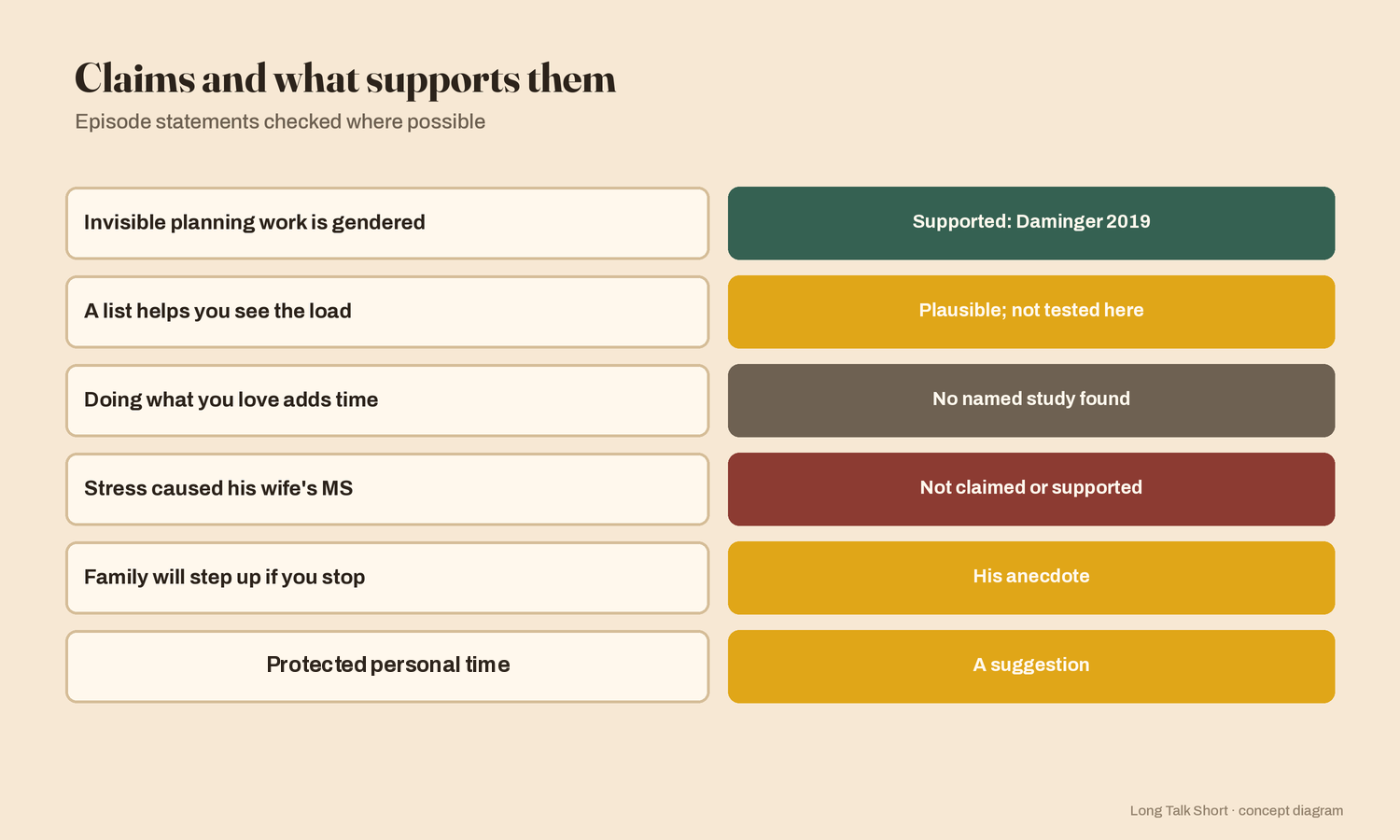
What research supports. The core idea has backing. In a 2019 American Sociological Review study based on 70 interviews with members of 35 couples, sociologist Daminger described "cognitive labor": anticipating needs, identifying options, making decisions and monitoring progress. She found it is often invisible to both partners, a frequent source of conflict, and done more by women, especially the anticipating and monitoring. That is a small interview study, not a population measure, but it matches the load the episode describes. Decision-making itself, she found, was split roughly equally.
What we did not verify. Robbins says "the research shows" that adding something you love makes you feel you have more time. She does not name a study, and we did not identify one to check, so treat that as unverified. Thomas's family history comes only from his own account. Our quotations come from YouTube's automatic captions, so wording may differ slightly.
Sources. Daminger 2019, episode page.
Limits. The advice assumes a partner or family who can step up, and money to pay for help in some cases. It does not address single parents, caregivers with no backup, or situations where dropping a task would cause real harm, such as care for a frail parent, which Thomas himself handled by pointing his mother to professional care and a nurse in the family. If the load feels like depression or burnout, the show's own disclaimer applies: talk to a qualified professional.
Disclosures: The show notes promote Robbins's books. Neither speaker is presented here as a licensed therapist; in-episode advertising was not reviewed.
Related reading: James Hollis on old patterns · Tony Robbins on stress: philosophy, not a universal explanation
Long Talk Short
- The episode is less about being available at work than about the invisible load one person carries at home.
- Thomas's main tactic is to write the list, then ask whether you are the best person for each job.
- Shared rules beat guilty, case-by-case decisions, and some tasks only get noticed once they are dropped.
- Research on cognitive household labor supports the idea that this planning work is real, often invisible and done more by women.
- Robbins's claim that adding something you love makes time feel more abundant was not backed by a named study.
The one thing to remember: Write down the invisible work before deciding who can carry it—without dropping tasks that protect someone's safety.
This summary is general information, not medical or mental health advice. If you are struggling or in crisis in the US, call or text 988 to reach the Suicide & Crisis Lifeline.
Source: The Mel Robbins Podcast, "Stop Being Available: How to Set Better Boundaries and Take Your Power Back," on YouTube. This is an independent summary and is not affiliated with Mel Robbins or Eric Thomas.