You Are Not What Happened to You: James Hollis on Breaking Old Patterns
If you keep repeating the same mistakes, Jungian analyst James Hollis says it's not a character flaw but an old pattern still running. How he says to spot yours, why a symptom can be a question, and what he thinks growing up really asks of you.
Nobody plans to repeat the same counterproductive move they have made for decades. Jungian analyst James Hollis says most of us will anyway, and that the reason is not a character flaw. In a long conversation on Huberman Lab, he explains why patterns learned in childhood keep running adult lives, how to catch them, and what he thinks psychological maturity actually asks of you.
In short: Hollis argues that much of what we do is driven by "complexes," emotionally charged programs learned early that were once protective and later become constrictive. You spot them through repeated patterns, honest feedback and dreams. Maturity, in his view, means moving from "what does the world want of me?" to "what wants expression through me?" and owning what your life passes on to others.
1. Why the same scene keeps replaying
Hollis borrows Carl Jung's idea of complexes: clusters of energy, charged by past experience, that can temporarily take over the conscious mind. You notice them afterward, he says, when you ask what came over you, or why you made an important decision you can no longer explain. Jung's word for the state, Hollis notes, meant something like possession.
His key point is that these responses usually made sense once. A child who learned to keep a volatile household calm may grow into an adult who cannot stop managing other people's moods, a pattern he says draws many people into the helping professions. What was once protective often becomes constrictive later. The clinical phrase he keeps returning to is simple: you are not what happened to you.
He also suggests the conscious, deliberate self is in control less than we think. Stepping into a shower that is too hot and adjusting it, he says, is the ego doing its job. If the controls are hidden, how do you find them?
2. Three ways to catch a pattern
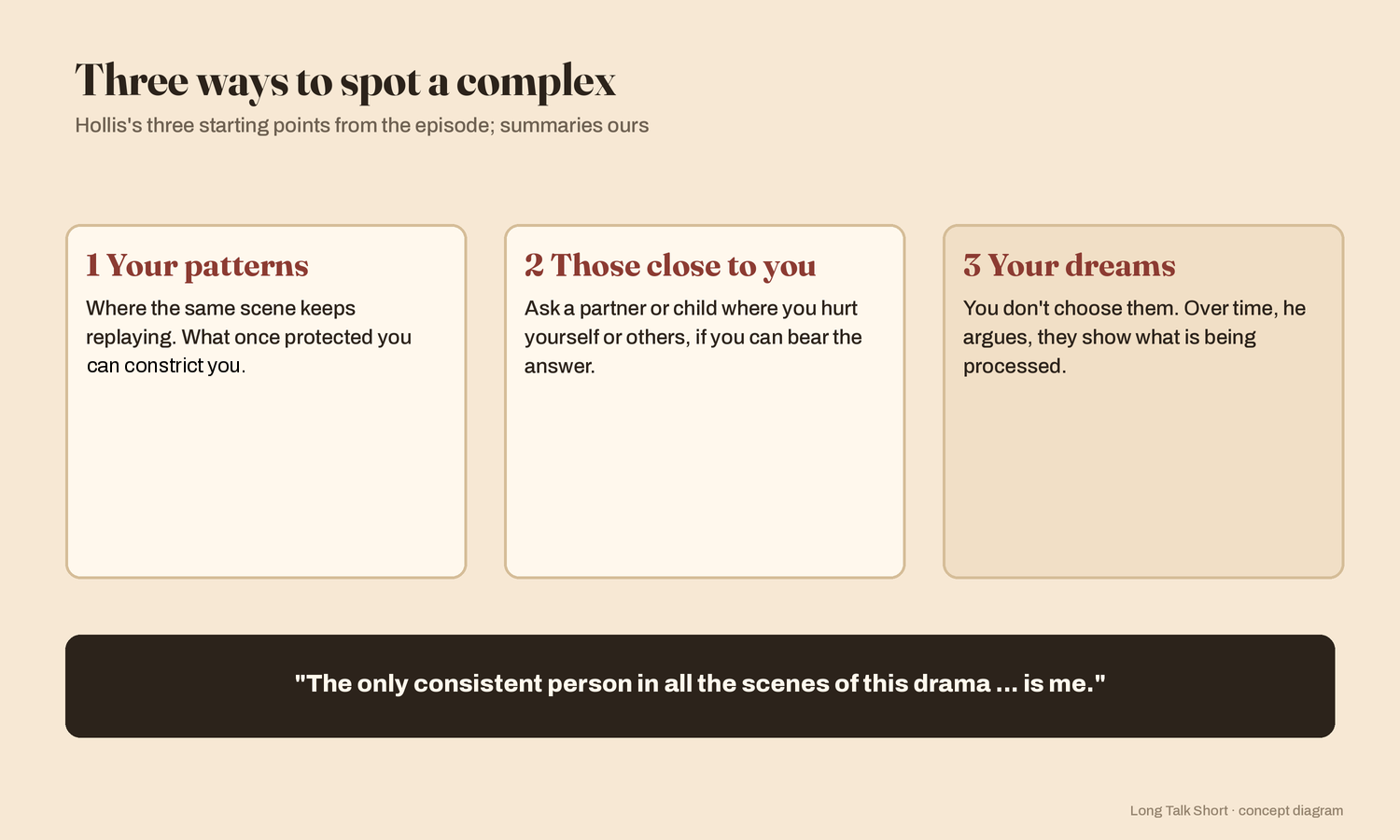
Because complexes are unconscious, Hollis offers three ways in. First, look at your patterns, the situations that keep recurring. Second, ask the people closest to you where they see you hurting yourself or others, "if you can bear to hear" the answer. Third, pay attention to dreams. You do not choose them, he says, and nature does not waste that much activity.
He puts the first route bluntly. When consequences pile up, you eventually realize that "the only consistent person in all the scenes of this drama I call my life" is you. He calls that recognition humbling, and necessary.
His own daily practice is modest: a short morning reflection, often on a dream, and another review in the evening of the stories he is living. Huberman adds that any activity that pulls you out of constant stimulus and response, such as walking or drawing, can serve a similar purpose. But what about when the pattern shows up as suffering?
3. Treat a symptom as a question
Hollis describes a serious depression he went through while his career was going well. His first question was how quickly he could get rid of it. He came to think that was the wrong question. The better one, he says, was why his psyche had "withdrawn its approval" from a perfectly good agenda. It led him to leave a tenured academic job and train as an analyst in Zurich.
He applies the same reframe to suffering generally. Instead of asking only how to remove a symptom, ask what it makes you do and what it keeps you from doing. For someone whose self-worth collapsed after a breakup, he says, rebuilding that self-worth is the task, because no other choice will be very good without it. The fears he faced at midlife, he found, were the ones he had as a child, with one difference: he brought adult capacities to them. That raises the bigger question of what being an adult means.
4. What maturity looks like
Hollis calls the first half of life, half jokingly, "a huge and unavoidable mistake," because it is spent reacting to what family and culture expect. The question there is what the world wants of you. A later question is what wants expression in the world through you. Being an adult, he says, "is not just to have a big body"; it is knowing you are accountable for what spills into the world through you.
That accountability extends to the next generation. He quotes Jung: the greatest burden a child must bear is the unlived life of the parent. Where you are stuck, your children may be stuck, or spend years getting unstuck. The best thing you can give them, he argues, is a model of a life lived with as much courage and integrity as you can manage.
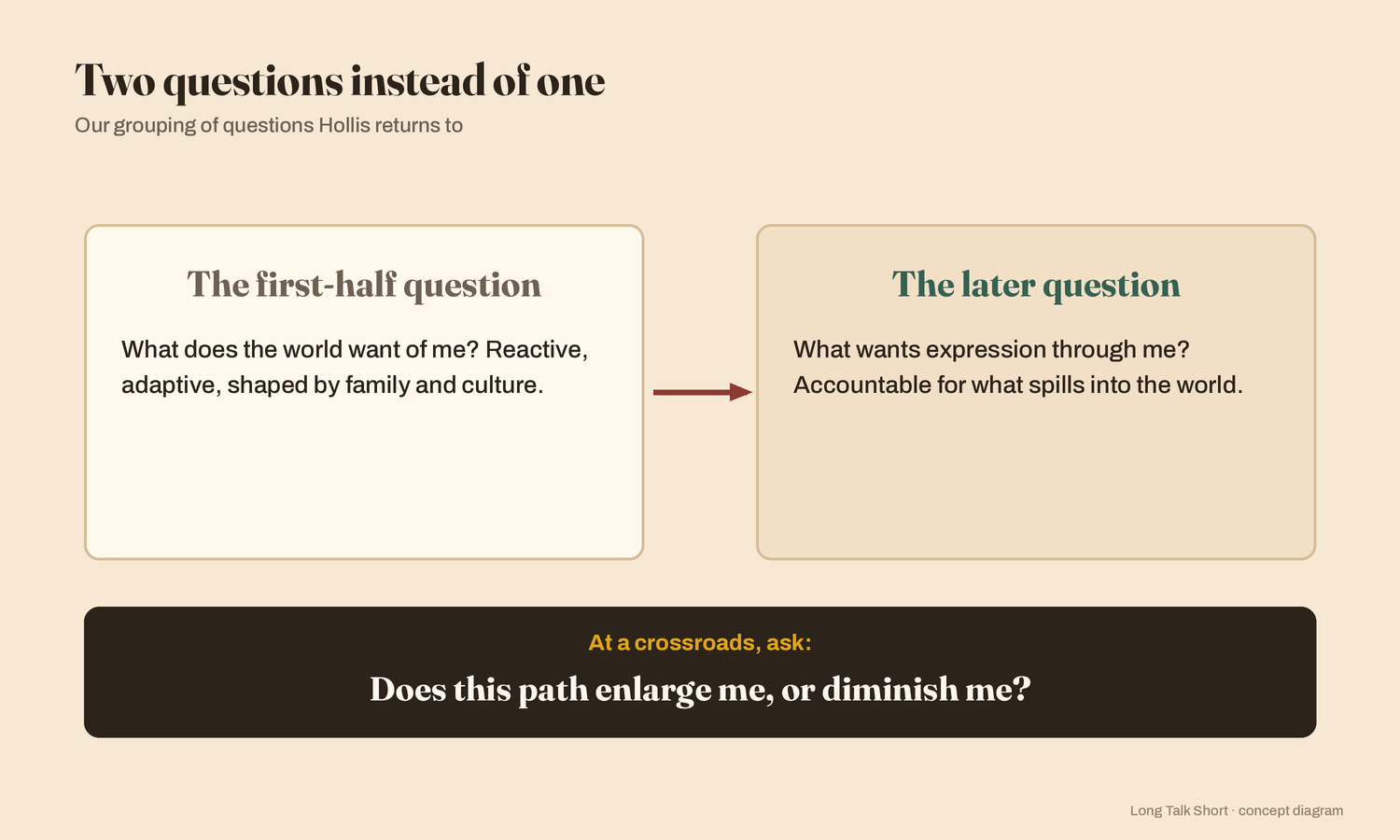
His practical test for big decisions closes the episode. Ask whether a path enlarges you or diminishes you. The larger path will cost you something, he says, but if you avoid it your life gets "narrower and narrower," and "something inside of you knows the difference."
Weighing it: what holds up
Framing: The episode is titled "How to Find Your True Purpose & Create Your Best Life." It does not offer a method for finding a purpose. The groupings in our figures are ours.
Holds up: The practical moves are low-risk and widely recommended in some form: noticing recurring situations, asking trusted people for honest feedback, and setting aside time for reflection.
Partly holds: Complexes, the shadow, archetypes and the psyche "withdrawing approval" are Jungian concepts. They are interpretive frameworks from clinical practice, not findings established by controlled experiments. Hollis himself calls some of his remarks on dreams and death "simply observations." Read them as a lens, not a diagnosis.
Corrections: None needed for the points summarized here. Wording suggests the Jung lines are paraphrased from memory rather than quoted exactly.
Not checked: The sleep-research figure of about six dreams a night, the survey of women executives he mentions, and his patient stories are his and were not verified. Quotes were checked against YouTube's automatic captions, a machine transcript, so they may contain small errors.
Disclosures: The episode carries ads for Matina yerba mate, which Huberman says he helped develop, as well as Joovv, BetterHelp, AG1 and Waking Up. Hollis is the author of more than 17 books, which are referenced in the episode, though he does not make a sales pitch.
Bottom line: a thoughtful lens for noticing old patterns, best used for reflection rather than as a substitute for treatment.
Related reading: Lisa Feldman Barrett on why red is a relationship · Tali Sharot on adaptation and habituation
Long Talk Short
- Patterns that repeat are often old protective responses that have outlived their purpose.
- To find them, look at what recurs, ask the people close to you, and notice your dreams.
- Treat a symptom as a question: what does it make you do, and what does it keep you from doing?
- Maturity means owning what spills into the world through you, including what your children inherit.
- At a crossroads, ask whether the path enlarges you or diminishes you.
The one thing to remember: when the same scene keeps replaying, the one constant in it is you, and that is where change starts.
This summary is for general information only and is not medical or mental health advice. If you are struggling or in crisis in the US, call or text 988 to reach the Suicide & Crisis Lifeline.
Source: Andrew Huberman and James Hollis, "How to Find Your True Purpose & Create Your Best Life | Dr. James Hollis," Huberman Lab, on YouTube. This is an independent summary and is not affiliated with Huberman Lab or Dr. James Hollis.