The Rally Call, Weighed: Tom Lee's Case and His Forecasting Record
Tom Lee told Prof G Markets the correction is over and the S&P 500 could reach 8,400 by the end of 2026. His test for an AI bubble is worth keeping. His forecasting record, which we checked, says to treat the target as one scenario, not a promise.
When stocks fall, you hear two kinds of confident voices: those who say this is the start of something worse, and those who say it is already over. On Prof G Markets, recorded with the Nasdaq in a correction, Ed Elson hosted Fundstrat co-founder Tom Lee, who is firmly in the second camp. His reasons are more interesting than his price target, and a few are useful even if the target is wrong. Keep in mind that Lee sells market research and has business interests that benefit when investors feel bold.
In short: Lee argues that the fall was driven by short-term trading and pattern-matching fear, not by a broken AI story. He sees the S&P 500 at 8,200 to 8,400 by the end of 2026. His test for telling an innovation boom from a bubble is worth knowing. His forecasting record, which we checked, is a reason to treat the number as one scenario, not a promise.
1. Why he thinks the selloff is ending
Lee's first point is pattern. He compares the fall, about 11% for the Nasdaq 100, with a previous slide that followed a viral AI essay: roughly a 12% drop and then a 15% rally. If the shape repeats, he expects tech to climb about 15% by the end of 2026. In July 2026, he says, he predicted an autumn correction followed by an S&P 500 at 8,000 by December; on the show he put the range at 8,200 to 8,400.
His second point is about who is trading. Lee blames part of the swing on zero-day options, contracts that expire the same day they are bought. Their popularity, he argues, has made markets far more short-term, so a few bad headlines can move prices further than the news justifies. The third is psychological. He says he has counted seven "black swans" being cited at once, and that investors are matching the market to the dot-com crash and 2008 because those are the stories they remember. So how does he tell a boom from a bubble?
2. His test for a bubble
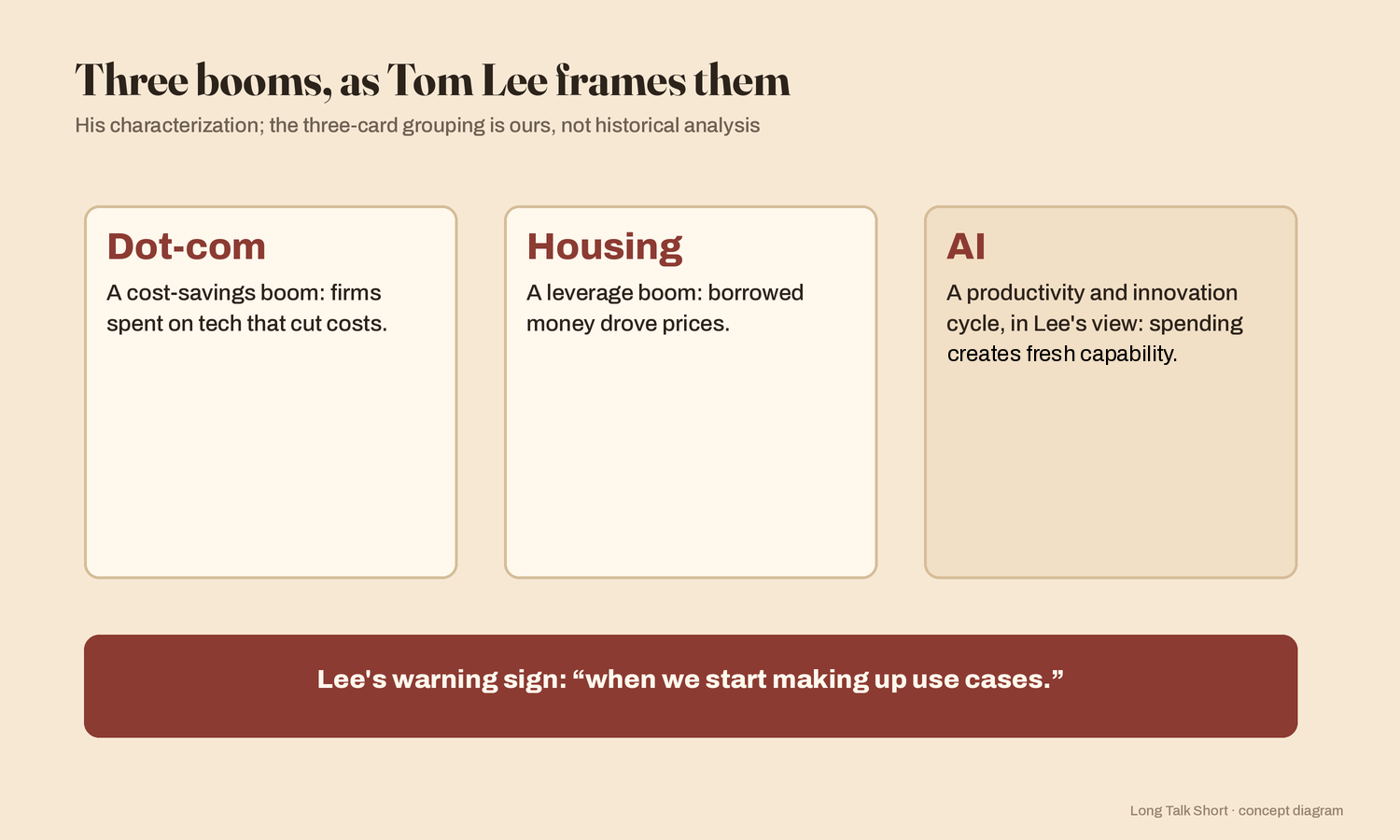
The most portable idea in the interview is Lee's three-way comparison. In his telling, the dot-com era was largely a cost-savings boom, as firms spent heavily on technology that cut costs. The housing bubble was about leverage. AI, he argues, is closer to a productivity and innovation cycle, where the spending creates capability that did not exist before.
His warning sign is specific: AI becomes a bubble "when we start making up use cases." As long as businesses buy AI to do work they actually need done, he sees the spending as justified, even if individual companies stumble. He defends deals in which AI firms invest in their own customers and suppliers as "ecosystem development," comparing them to the way RCA built radio stations so people would buy radios.
3. Slower growth is not a collapse
Lee also takes on the worry that AI leaders such as Anthropic are slowing. Very fast growth always decelerates, he says, pointing to Cisco in the late 1990s, which he recalls falling sharply in 1997 before becoming a market leader. He adds the Jevons paradox: when a resource gets cheaper to use, people tend to use more of it, not less. Cheaper AI, on that view, means more AI demand.
He also suggests that the biggest winners of a technology wave are often not the ones building it. In the internet era, he notes, they included Netflix, eBay and Apple, which used the infrastructure rather than laying it. You may get more from asking which companies will use AI best than from betting only on the builders. Then there is the calendar.
4. The midterm argument
Finally, Lee leans on history. He says markets have rallied in the twelve months after a midterm election "100% of the time", and he expects any result, including a Democratic sweep of Congress, to be followed by gains. His reasoning is that tech companies will court whichever party controls Congress, for example on data-centre policy. The interview was recorded before the results were known. Which brings us to the most useful question: how often has he been right?
Weighing it: what holds up
Framing: The episode title, "The Correction Is Over — Stocks Are About To Surge," states a forecast as fact. It is Lee's view, and it is conditional. His interview takes up roughly the first half of the episode; the rest covers Apple's earnings with author Patrick McGee and Elson's own midterm prediction, which we have left out.
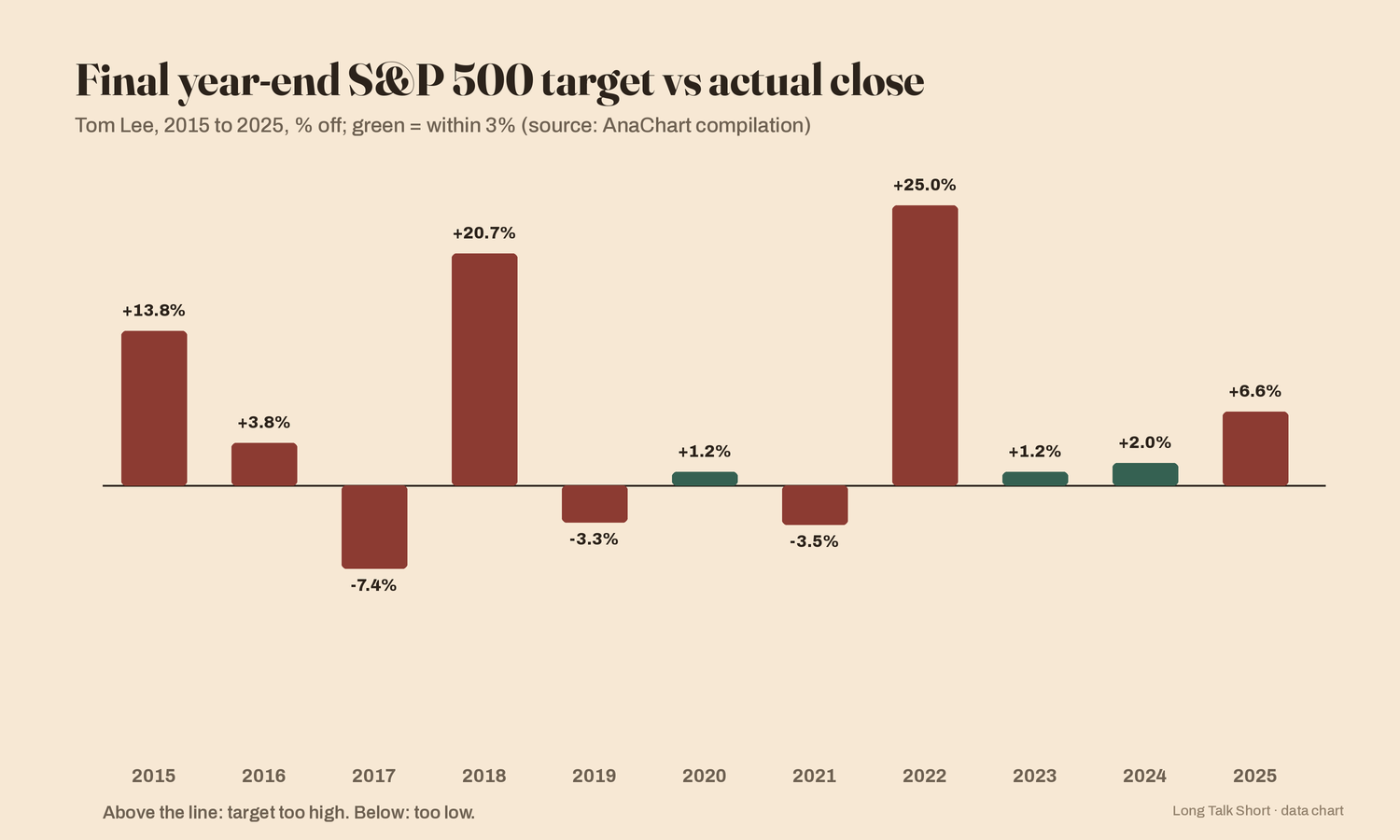
Holds up: According to AnaChart's compilation of Lee's published targets, his final year-end S&P 500 call was within 3% of the actual close in 3 of 11 completed years (2020, 2023 and 2024). CNBC and Business Insider reports from 2022 confirm his 5,100 and 4,800 targets that year.
Partly holds: He has been right about the direction of big rallies, but his misses tend to be on the high side. His largest was 2022: he began the year at 5,100, held that target into the autumn as other strategists cut, finished at 4,800, and the index closed near 3,840.
Corrections: AnaChart lists his 2026 target as 7,700, lower than the 8,000 he described on the show; we could not reconcile the two.
Not checked: the "situational awareness" selloff and rally figures, the role of zero-day options, his account of Cisco in 1997, and the claim that markets have risen every time in the year after a midterm. That pattern is widely cited, but a perfect past record is not a guarantee. Treat his historical analogies, and our three-way grouping, as framing rather than evidence.
Disclosures: Fundstrat sells market research, and a bullish public voice is part of its brand. News reports also describe Lee as chairman of BitMine Immersion Technologies, a company that holds the cryptocurrency Ether; we saw that role reported but did not confirm it independently. Neither firm is directly tied to the stocks discussed, but both benefit when risk appetite is strong. We worked from YouTube's automatic captions, so quotes may contain small errors.
Bottom line: borrow the bubble test, discount the price target, and weigh the record before you act on the call.
Related reading: Josh Brown on watching AI earnings, not valuations · why debt could be the AI bubble's first domino
Long Talk Short
- Lee blames the correction on short-term options trading and fear borrowed from past crashes, not on AI itself.
- His bubble test: AI turns into a bubble when people start inventing use cases.
- He argues that slowing growth at AI leaders is normal, and that cheaper AI will mean more demand.
- The biggest winners may be companies that use AI, not just the ones building it.
- His forecasts land close in some years and miss widely in others, usually on the high side.
The one thing to remember: check any forecaster's record, and their interests, before you act on a call.
This summary is for general information only and is not investment advice. Do your own research or consult a qualified adviser before making investment decisions.
Source: Ed Elson with Tom Lee and Patrick McGee, "Tom Lee: The Correction Is Over — Stocks Are About To Surge," Prof G Markets, on YouTube. This is an independent summary and is not affiliated with Prof G Media or Fundstrat.