Make Fewer, Better Molecules
Isomorphic Labs president Max Jaderberg tells No Priors he wants to move drug design onto computers. He names focus areas and a clinical team being built — not trial results. Not medical advice.
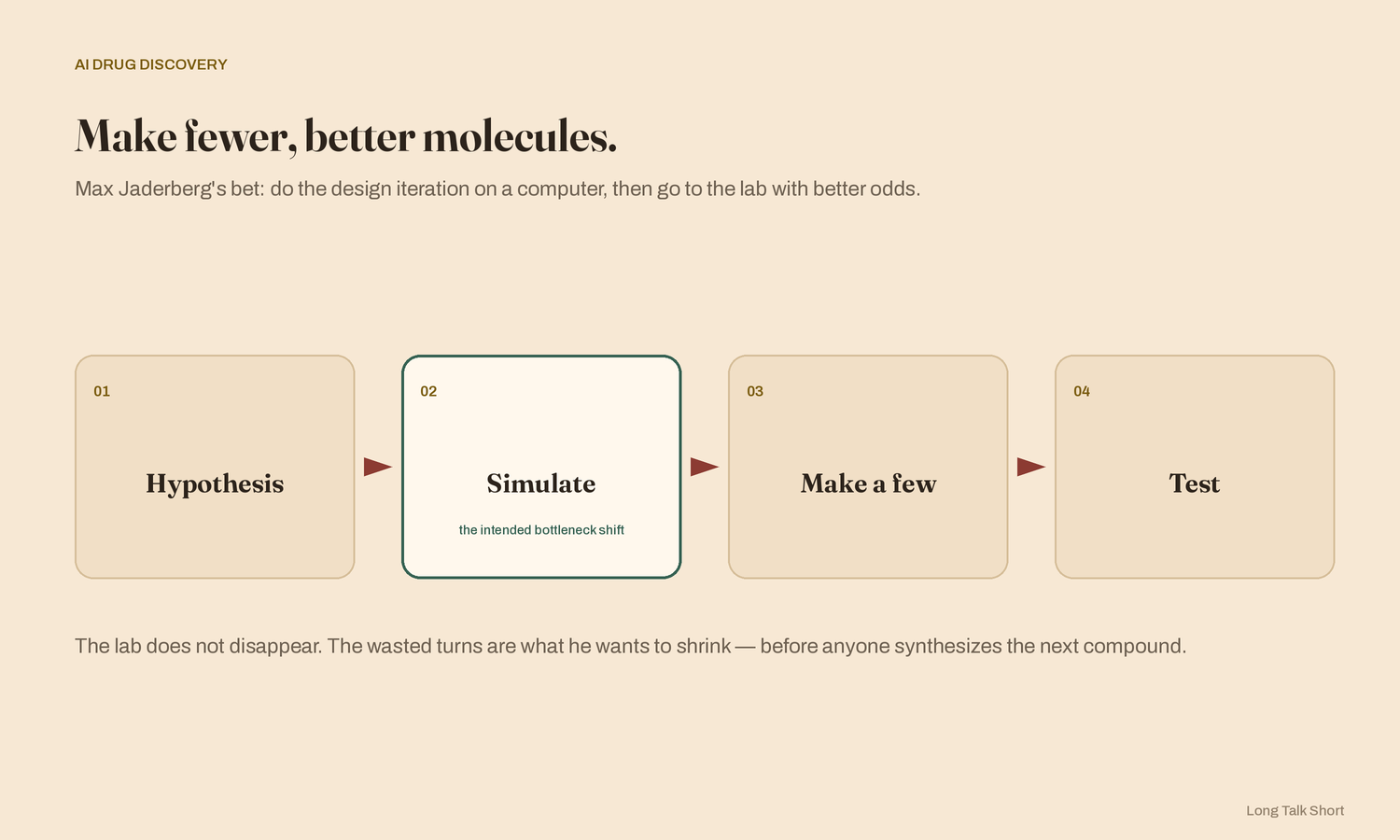
Make fewer, better molecules — by doing the wasted turns on a computer first. If drug discovery still looks to you like an expensive loop of guessing, synthesizing, and hoping the clinic is kinder than the last attempt, Max Jaderberg is arguing for a different bottleneck. The costly part, he says, is having to make and test real atoms every time you want to learn something. The bet is to move as much of that work as possible onto a computer, so that when you finally go into the lab, the odds are better.
Jaderberg is president of Isomorphic Labs, and part of the founding team, in a conversation with Elad Gil on No Priors. Isomorphic is the drug-discovery company spun out of Google DeepMind; he describes Alphabet as a major shareholder and sponsor. He is not a clinician reporting trial results. He is a machine-learning researcher describing a design engine he wants to build.
In short: he wants drug design to look more like computer-aided engineering — iterate in a model, then make fewer, better molecules in the real world. He names focus areas and a clinical team being built. He does not, in this episode, name a trial or a drug. Not medical advice.
His own path, as he tells it, runs through computer vision, a company sold to Google DeepMind around 2014, and work on generative models and reinforcement learning, including the AlphaGo and AlphaStar efforts. Isomorphic itself, he says, took shape around 2021, after AlphaFold — DeepMind's protein-structure model — made a point that mattered more than any one protein: a deep-learning model could generalize in biology. That is the proof of concept he keeps coming back to, not a claim that the company has already cured a disease.
1. Why the old process feels stuck
Gil and Jaderberg describe an industry in which the number of new drug approvals has been roughly flat even as papers, modalities, and spending have climbed. In their telling, the fully loaded cost of bringing a medicine through has risen from a few hundred million dollars to about $1.5 billion, and timelines from something like eight or nine years to around 15. Those are figures stated in the conversation, not numbers independently audited for this article, and industry cost estimates of this kind are often debated.
The deeper problem, as Jaderberg frames it, is method. A large part of medicine-making is still empirical trial and error: a hypothesis about a disease, a hypothesis about a molecule, then screening and iteration in the real world. That process found a lot of low-hanging fruit, he says, and it also caps the complexity of what you can find in a finite amount of time and money. Where programs really fail, he argues, is often in the clinic — toxicity or biology you did not see coming — which is why he wants more understanding before a molecule ever reaches a patient.
2. A design engine, not a named pill
The technical ambition is to get simulation models, or “world models,” to experimental accuracy. AlphaFold is the example he uses. Determining a protein structure by X-ray crystallography can take months or years; if a model can do that job well enough, you do not have to go into the physical world for that step. The same logic, he hopes, can extend to how a molecule will behave. You still make compounds and run assays. You just do fewer wasted turns.
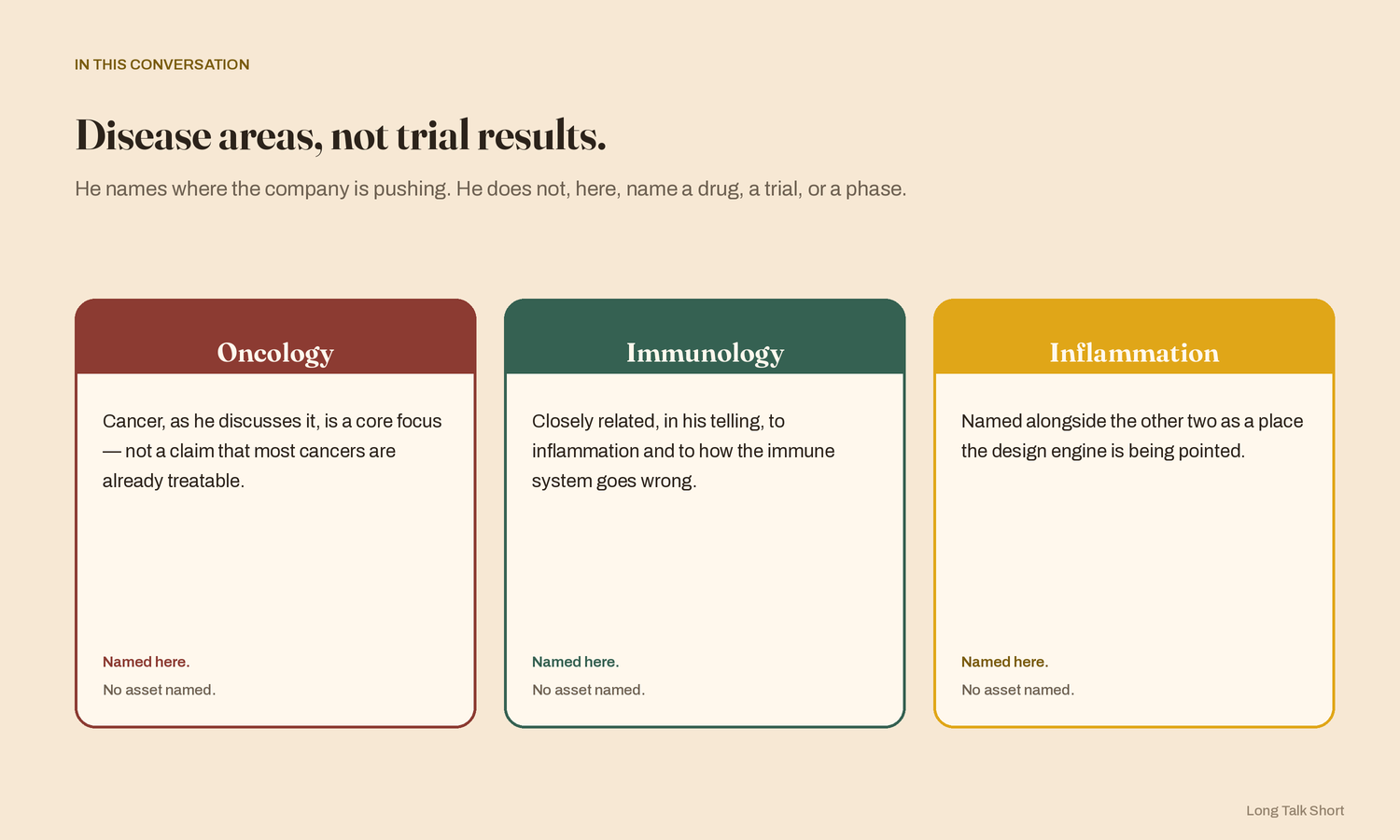
He is careful, in this episode, not to wave a completed human trial. He says the company has “really exciting medicines in the works,” is “pushing really hard to get these to patients as quickly as possible,” and has been building a clinical-development team — “getting ready.” That is a statement of intent, not a result. No drug name, no trial name, and no phase is given here, and this article is not treating those pipeline comments as clinical evidence. Focus areas he does name are oncology, immunology, and inflammation. He also talks about multi-drug “cocktails,” on the idea that some diseases will not yield to a single precise molecule.
Animal studies still appear in the traditional path, and he is skeptical that they tell you enough. Data from animal models, he suggests, often fails to predict what happens in people; a compound can look clean in a rat and still fail in people. Better in-vitro and in-silico endpoints are part of the hope for reducing that gap, and for using fewer animals over time. None of that is the same as having already replaced clinical testing.
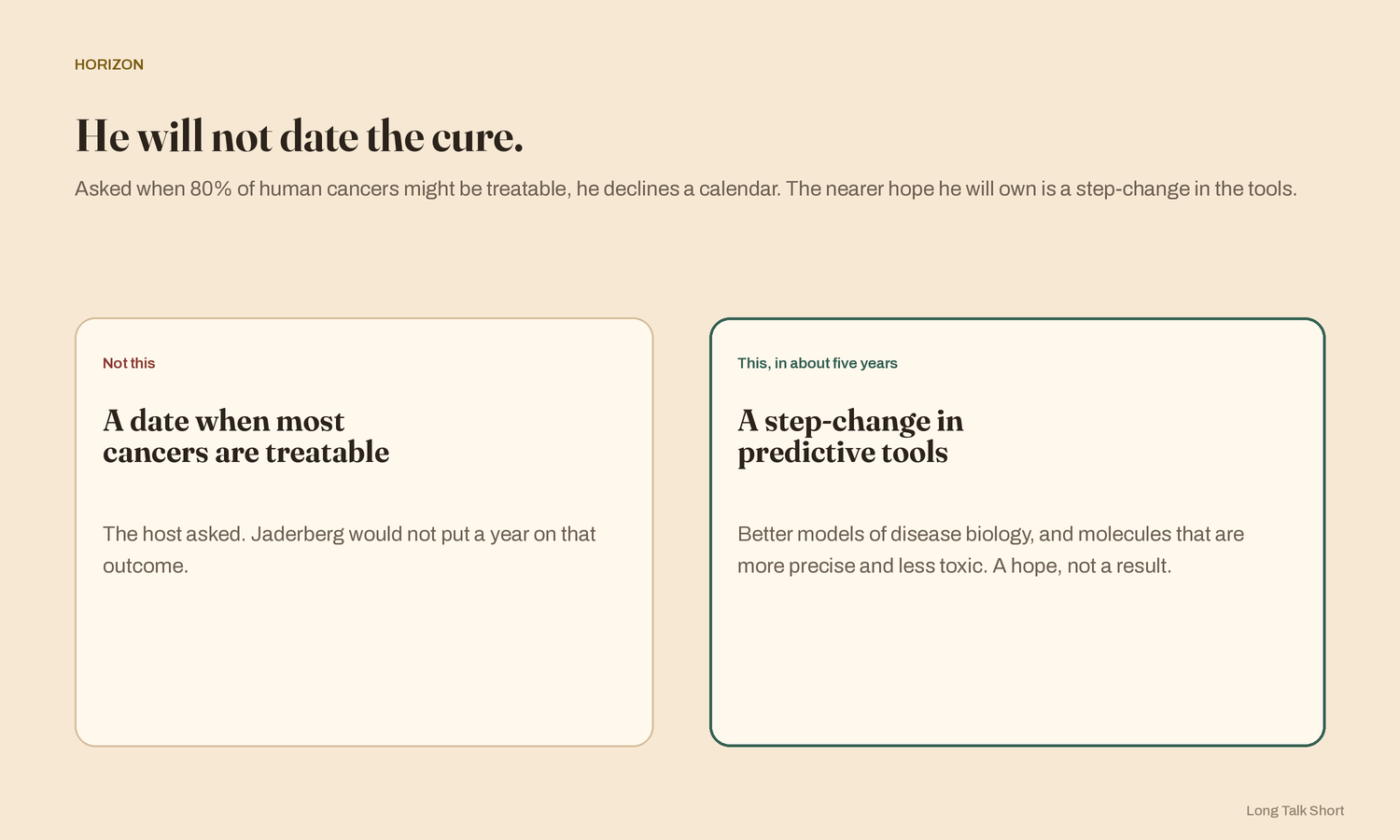
Asked for a prediction — when, for example, 80 percent of human cancers might be treatable — he does not give a date. He says he would be disappointed if, even five years on, the field had not seen a step-change in predictive understanding of disease biology, and in the ability to design molecules that are more precise and less toxic. On longevity, he notes that removing cancer and heart disease would add only a handful of years to average lifespan, which is both large and, from another angle, surprisingly small. Treating afflictions and looking at the biology of aging are, in his view, related projects. That is a research horizon, not a promise.
Weighing it: what holds up
Checked. This piece is based only on this No Priors episode: official YouTube metadata, plus English auto-generated captions from youtube-transcript-api. Quotes are close, not word-perfect; the captions regularly scramble names (including Jaderberg's). I did not find named drugs or clinical trials in this conversation, and I did not import claims from other interviews. The $1.5 billion and 15-year development figures are the speakers' and were not independently checked here.
Unverified, and his. That simulation can reach experimental accuracy across drug design, that a step-change in predictive tools is near, and that the company has “really exciting medicines in the works.” Those are statements of intent, not trial results. No drug name, no trial name, and no phase is given here.
Disclosures. Jaderberg is president and a founding-team member of Isomorphic Labs; he describes Alphabet as a major shareholder and sponsor. Company mission language about “solving all disease” is a goal, not a result. This is not medical advice, and nothing here should be read as evidence that an Isomorphic medicine is already in patients.
Related reading: Building ahead of the models · Genetics loads the gun
Long Talk Short
- Jaderberg wants drug design to look more like computer-aided engineering: iterate in a model, then make fewer, better molecules in the real world.
- AlphaFold is his proof that a deep-learning model can generalize in biology — a starting warrant, not a completed pharmacy.
- He names oncology, immunology, and inflammation as focus areas, talks about multi-drug combinations, and says a clinical team is being built. He does not, in this episode, name a trial or a drug.
- Asked when most cancers will be treatable, he will not date the outcome. He will own a nearer hope: a step-change in predictive tools within about five years.
The one thing to remember: The honest claim here is about moving discovery onto computers so the clinic is less of a surprise — not that the clinic has already been won.
This summary is for general information only and is not medical, scientific or professional advice. Jaderberg's claims are his, not findings endorsed here, and this article does not treat pipeline comments as clinical evidence.
Source: Max Jaderberg on No Priors with Elad Gil, on YouTube. Independent summary; not affiliated with Isomorphic Labs, Alphabet, or No Priors. This is not medical advice.