Red Is a Relationship: Lisa Feldman Barrett on Why Reality Runs on Agreement
Lisa Feldman Barrett argues that the red you see is neither in the object nor only in your head, but in the relationship between light and a brain your culture wired. Money and borders work the same way, she says, though reality is not infinitely flexible.
You probably think the red of a stop sign is out there in the world, waiting to be seen. In a short Big Think video, psychologist and neuroscientist Lisa Feldman Barrett argues that it is not that simple. The light is real and your brain is real, she says, but red exists only in the meeting of the two, and someone had to teach you how to make that meeting happen.
In short: Barrett calls her view relational realism. Colour, and much of what you take for granted, is a property of the relationship between the world and a brain that culture has wired. That makes some realities more flexible than they look, and gives you a hand in sustaining them, but reality is not infinitely flexible.
1. Colour is a relationship
Barrett opens with a run of questions: what is the colour red, what counts as a mountain versus a hill, what is a president, and what powers does a president have? Her answer is that all of them are rooted in social reality: a group of people collectively imposing a meaning on physical signals that the signals do not have on their own.
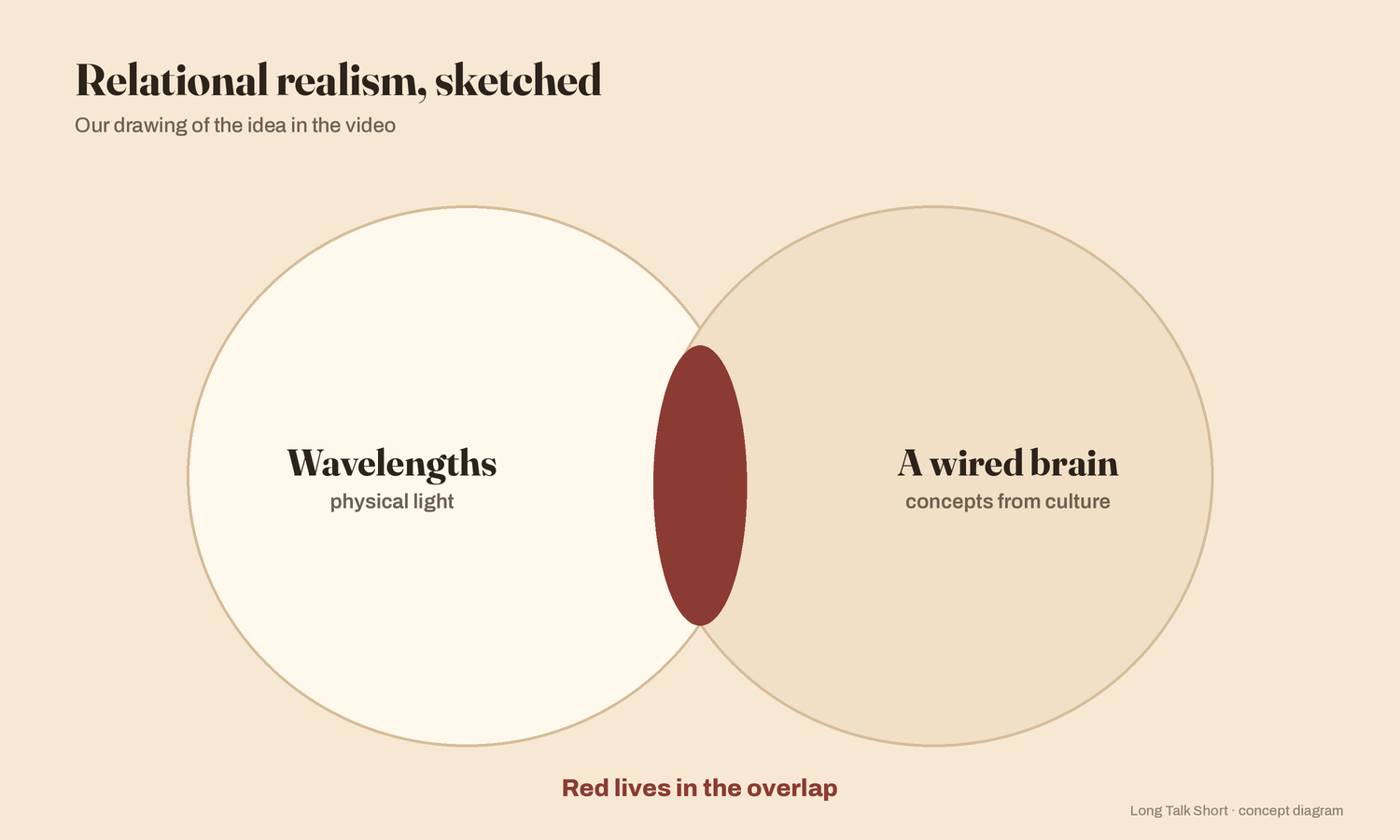
Start with colour. Light arrives as wavelengths, not colours. Relational realism, as she puts it, holds that colour is a property of the relationship between the wavelength of light that hits your retina and the signals in your brain. How do you know to make sense of those signals as red? You had to learn what they meant, which means somebody taught you. So colour, on her account, is not in the object and not only in your head. It belongs to the relationship. But where does that teaching come from?
2. The past you inherited
Barrett's term for that teaching is cultural inheritance. Through their actions and words, the people around you wire your brain with what she calls a remembered past, which you then use to create what she calls the relational present. It is a way of passing knowledge from one generation to the next, and in her view it is the foundation of how you perceive at all.
She makes it concrete with a chair. Looking at it, she experiences burgundy, or red, depending on a viewer's prior experience. The existence of burgundy as a colour, she says, depends on prior instances of people teaching her the patterns that let her use her remembered past, which she describes as her perception box for colour, to experience and act on those wavelengths as burgundy.
Her conclusion is a strong one. Because signals outside your head get their meaning from signals inside it, by a consensus or an implied consensus, even the existence of colour is a form of social reality. If colour works that way, what about the things people already know are made up?
3. From colour to money
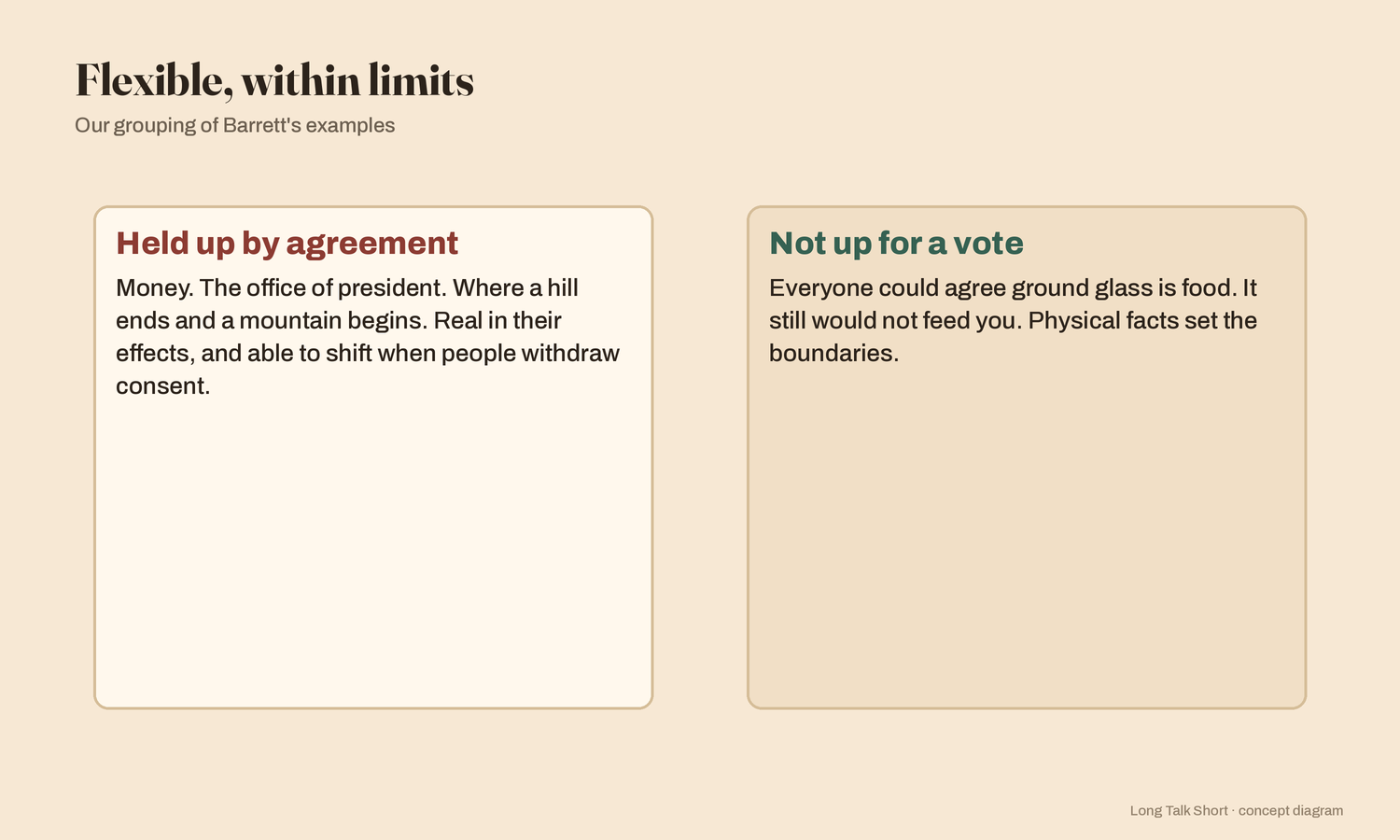
She then stretches the idea to things that exist only because people agree they do: money, the office of president, the line between a mountain and a hill. These are social realities, and they are real in their effects.
Money is her classic case. Every time you trade pieces of paper for something you can eat or use, she says, you are not just agreeing that money exists; you are helping to make it exist. The more people agree, the more solid the value becomes. And if a group withdraws its consent that the paper can be traded for goods, she argues, money in that sense stops existing.
That makes social realities fragile. Barrett offers the 2008 financial crisis as an example, describing it as a moment when a small group in finance withdrew their consent that mortgages had a certain value, and the world was plunged into an economic crisis as a result. So can agreement make anything real?
4. Flexible, but not infinitely
No, and this is the part of her argument that is easiest to skip. Reality, she says, is perspective-dependent and flexible, but not infinitely flexible. You cannot make something up, win consensus for it, and have it count as true.
Her example: everyone in the world could agree that ground glass is food, and it would still not nourish you. Other signals, from your body, are in relation to the signals in your brain too, and they count. There are biological constraints on what counts as food, and the patterns that include those signals matter a great deal. Physical facts set the boundaries; agreement works inside them.
5. Why it matters to you
If social realities rest on agreement, then you are one of the people keeping them going. Barrett's closing point is that what you do and do not do, say and do not say, helps constitute reality. Whether you vote or not, which social influencer you follow, even what you choose to eat: all of it, she argues, helps manifest the reality everyone then has to deal with. Seeing that, she suggests, gives you more power than you might think over which patterns count as real, and with it a share of the responsibility.
Weighing it: what holds up
Framing: The video is a short, one-voice argument for Barrett's view, not a survey of the field, and we have framed it that way.
Holds up: As an argument, the video holds together: her ground-glass limit keeps relational realism from sliding into anything-goes relativism.
Partly holds: Barrett's constructionist account of perception and emotion is influential but disputed. Many researchers see colour perception as largely shaped by the eye's biology, with culture and language affecting how colours are named and grouped more than whether they are seen. The video presents her view without that debate.
Corrections: Her account of 2008 as withdrawn consent is a metaphor. The crisis also involved real mortgage defaults and bank losses, not only a change of collective mind.
Not checked: We did not independently check the specific claims in the video. The diagrams are our grouping, not hers.
Disclosures: We found no commercial interest in the video's subject. We worked from YouTube's automatic captions, so wording may contain small errors.
Bottom line: a provocative, useful lens on social reality, with a sensible limit built in; treat the claim about colour as one side of a live scientific debate.
Related reading: Jonathan Haidt's elephant and rider · Anna Lembke on why more pleasure brings less joy
Long Talk Short
- Barrett argues that colour is a relationship between light and a culturally wired brain.
- Cultural inheritance, she says, is how other people teach your brain what signals mean.
- Money, titles and categories are social realities: real in their effects, sustained by agreement.
- Agreement has limits; physical and biological facts still set the boundaries.
- Your everyday choices, she argues, help keep social realities going.
The one thing to remember: some of what feels fixed is held up by shared agreement, and you are part of that agreement.
This summary is for general information only and is not professional or medical advice.
Source: Big Think with Lisa Feldman Barrett, "You Were Taught to See Red," Big Think, on YouTube. This is an independent summary and is not affiliated with Big Think.