You Never See the Whole Elephant
Harvard mathematician Dan Freed tells Curt Jaimungal that quantum field theory is an elephant you never see whole — and that quantum mechanics is projective geometry, with anomalies as theories, not only bugs.
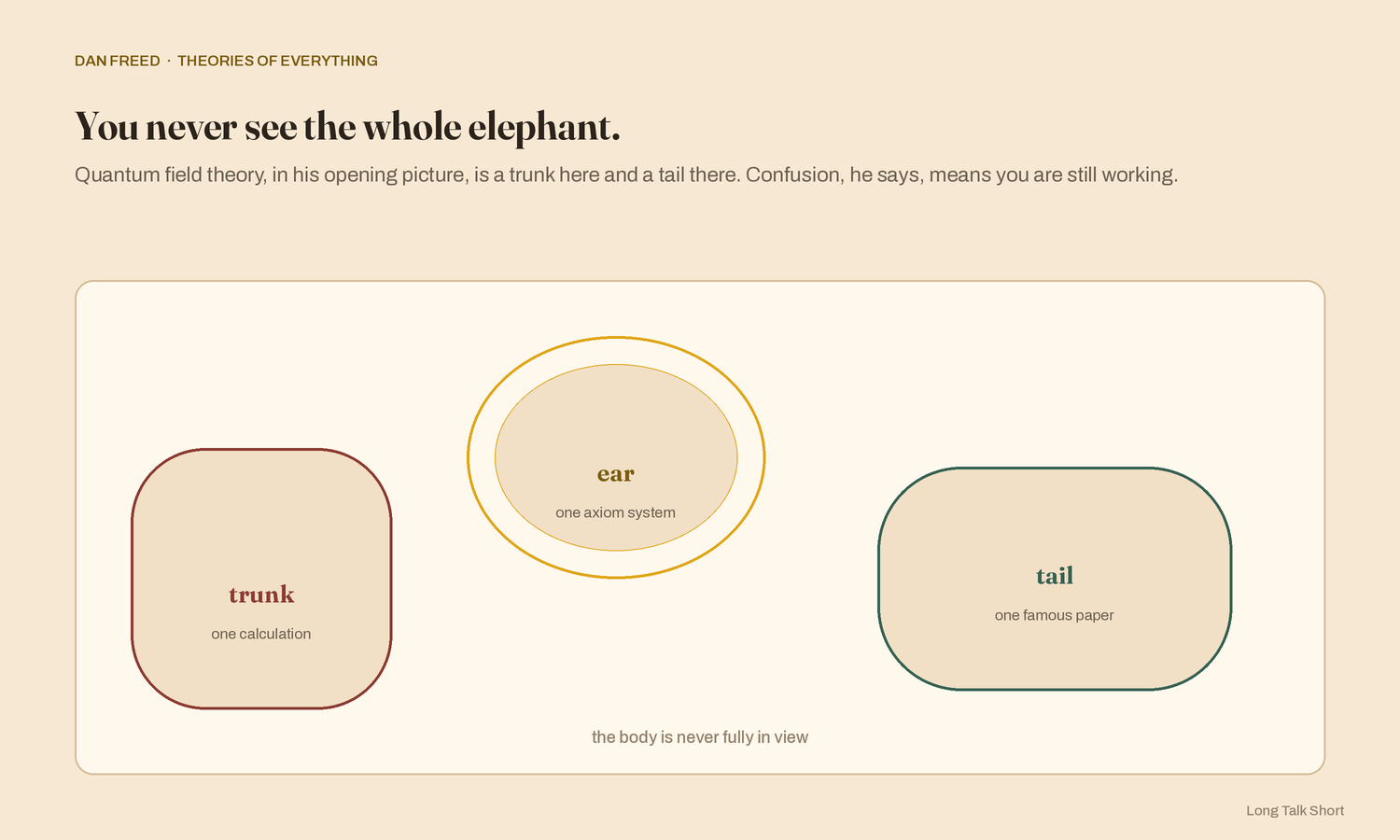
You never see the whole elephant. If you have ever tried to picture quantum field theory and come away with only a trunk, or only a tail, Dan Freed would say you are in the usual seat. “Quantum field theory appears like the proverbial elephant,” he says at the top of the conversation. “You see the trunk, you see the tail, but you never see the whole elephant.” And then the line that may be more useful than a definition: “If you’re not confused, you’re not working.”
Curt Jaimungal talked with Dan Freed, a Harvard mathematician and director of its Center of Mathematical Sciences and Applications, in “What Is Quantum Field Theory, Really?,” on his Theories of Everything channel, at youtube.com/watch?v=3jntzMm_SBs. Jaimungal calls it Freed’s first podcast. This article follows YouTube auto-captions — close, not word-perfect, especially on names and technical terms. It is a lay reader’s map of the pictures Freed draws, not a textbook.
In short: quantum field theory, in Freed’s opening picture, is an elephant you never see whole. Quantum states are lines, not arrows, and anomalies are theories you can study, not only bugs you compute. Auto-captions, not an official transcript.
Freed’s opening advice to students is not a formula. “You need to have the self-confidence to make errors.” “If you don’t have the freedom to err,” he says, “then you can’t make progress.” The rest of the interview is an attempt to show what kind of object a quantum field theory is, from a mathematician’s side of the elephant: geometry first, then how quantum states are packed, then the thing physicists used to treat as a bug — anomalies.
1. Classical curves, quantum lines
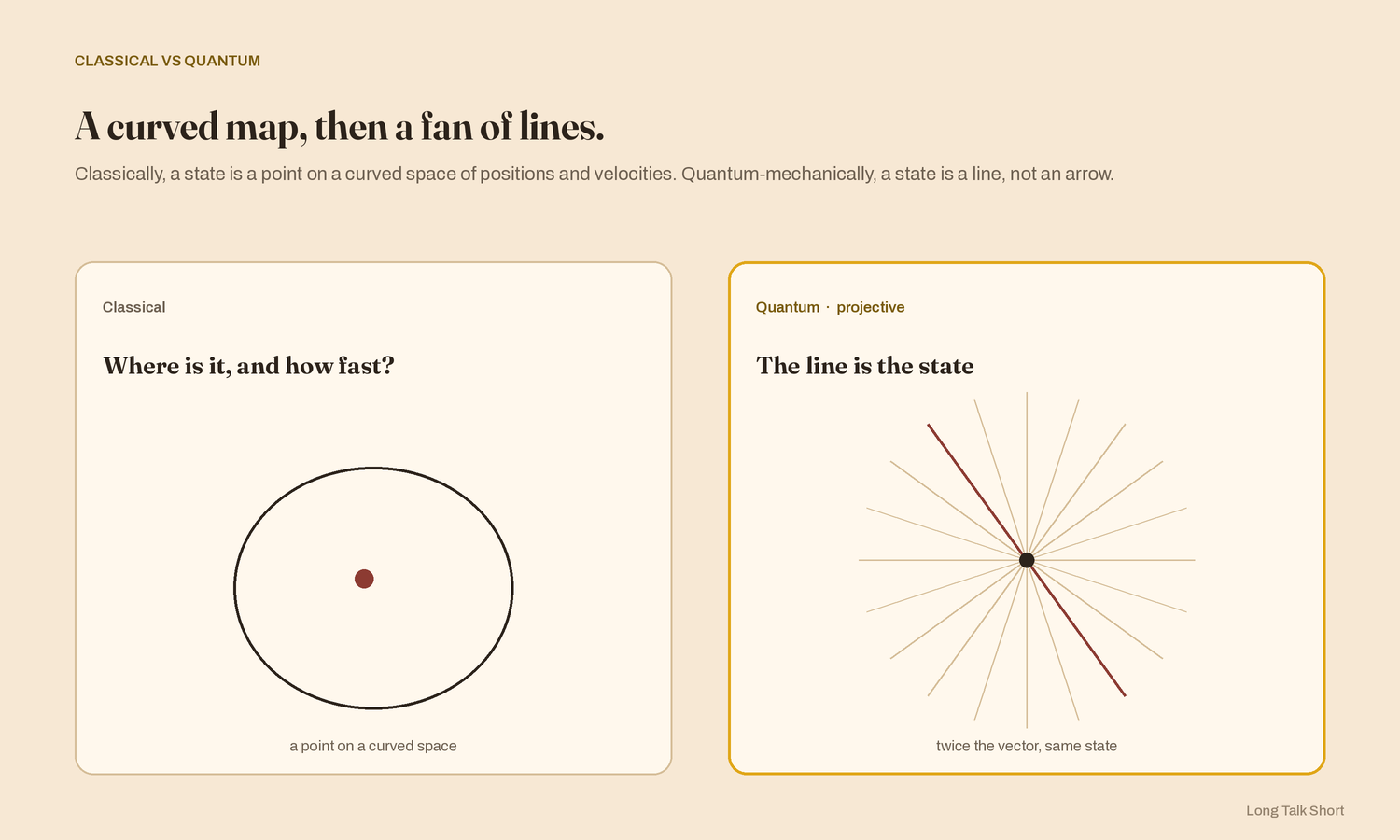
He starts in a place a non-specialist can stand. Imagine a classical particle moving on the surface of a sphere. To describe the state of the system at a given time, you need to know where the particle is and how it is moving — its position and its velocity, or momentum. Those parameters form a curved space. If there are several particles, the space gets larger, still curved, still the sort of geometry, he says, that “lies behind classical physics.”
Quantum mechanics replaces that curved manifold with something linear, because of superposition: states can be added. But the physical states are not the vectors themselves. “One of the things you learn in elementary quantum mechanics,” Freed says, “is if you have a state that’s represented by a non-zero vector, if I take twice that vector, that represents the same state.” What matters is the line through the origin — the whole collection of scalar multiples — not any one arrow on that line. The collection of those lines is projective space. “From the get-go,” he says, “the pure states of a quantum mechanical system” form that kind of space. “There’s a really well-defined sense in which quantum mechanics is projective geometry, not linear geometry.”
Linear geometry still matters, because physicists need to add things up. When you “turn some of the variables from classical into quantum” in a path integral, “we need them to be linear so we can do sums, whereas in projective space we wouldn’t be able to do that. So then we have to take the projective system and linearize it.” That linearizing step, he says, is a well-known problem in mathematics, especially once symmetries are in play. There are “obstructions,” and a developed theory of how to handle them. In quantum field theory, those obstructions are not a side computation. They are, in his telling, the anomaly.
2. Anomalies as a theory, not just a bug
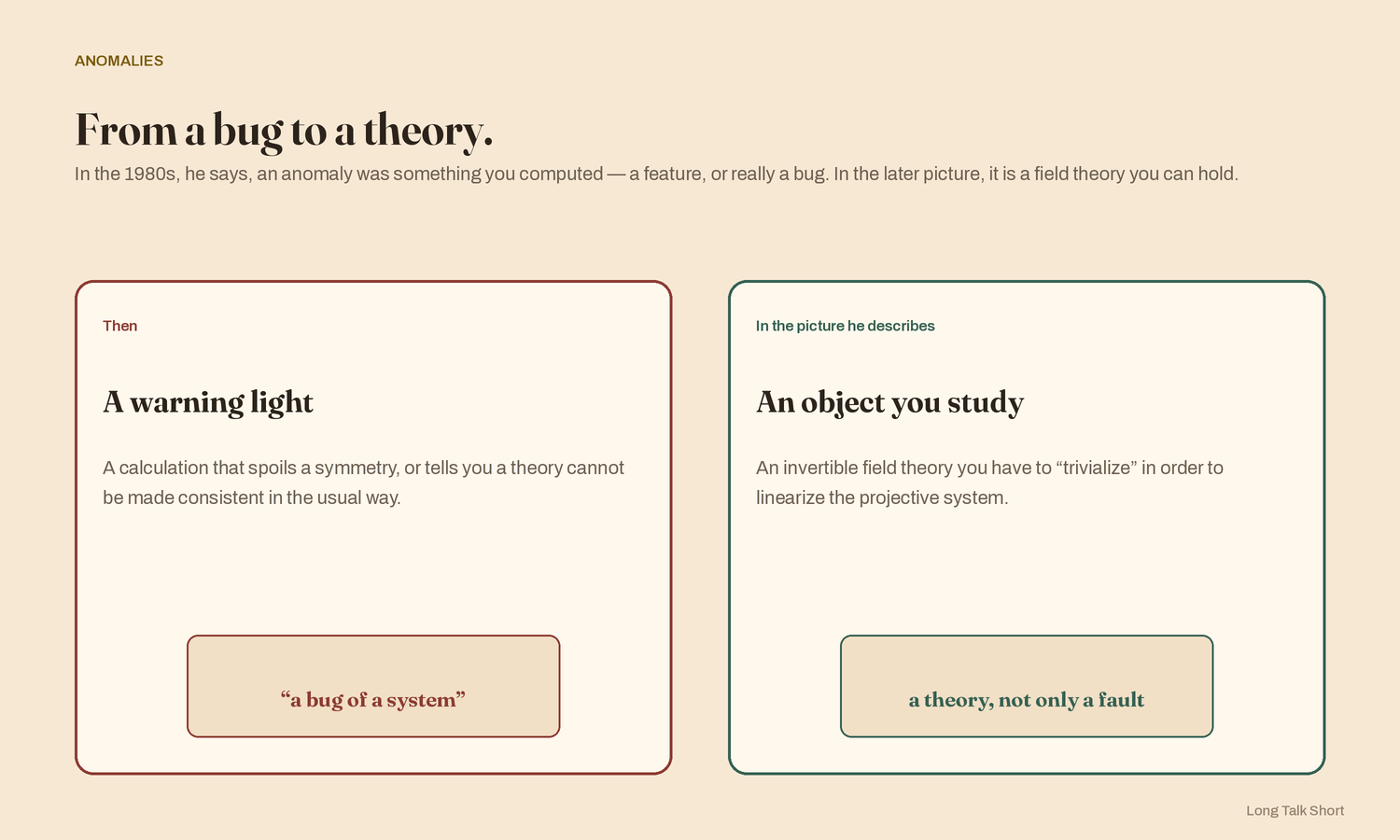
In the 1980s, he says, “an anomaly was thought to be just something you compute, a kind of feature or really a bug of a system.” The later mathematical picture is more ambitious. The anomaly “fits together into a quantum field theory” of a special kind — an invertible field theory, “very amenable to mathematical analysis.” It has the locality properties of a field theory, and it is “the thing you have to trivialize in order to linearize this projective system.” In plainer language: the obstruction that appears when you try to make the quantum geometry linear enough to compute is not only a warning light. It is itself a structured object you can study.
Freed does not claim a private axiom system of his own. A lot of the community, he says, has started from Graeme Segal’s axioms for Wick-rotated field theory and then extended them. He has been “part of that,” but “I wouldn’t say that it’s fundamentally different.” The modest tone is consistent with the elephant: you work inside a framework that keeps getting elaborated, not from a finished constitution of nature.
He also places the 1980s anomaly work in a wider meeting of mathematics and physics. His adviser, Isadore Singer, “was very prescient,” Freed says, about mathematicians engaging “directly with quantum field theory,” not only with the classical geometry they had already loved. Anomalies turned out to be related to the Atiyah–Singer index theorem, a 1963 result that, as Freed puts it, tells you “how to count, so to speak, using topology,” the solutions of certain differential equations. A theorem from one side of the elephant was suddenly talking to a calculation on the other.
3. A famous theory of knots, and a question about four dimensions
The conversation also turns to a showcase rather than a definition. Witten’s paper “Quantum Field Theory and the Jones Polynomial” — Freed says “1988 maybe” — used Chern–Simons theory to produce a way of telling knots apart, work often cited among the results that helped win Witten a Fields Medal. The useful point for a lay reader is simple: a quantum field theory, treated carefully, can make a mathematical object that was not sitting in obvious view.
Jaimungal then asks about a famous oddity of dimension four: ordinary four-dimensional space admits uncountably many distinct smooth structures — “exotic R⁴s” — a wildness that does not appear in the same way in other dimensions. Does that have anything to do with our 3+1 spacetime, or is it numerology? Freed does not grab the coincidence. He points to a survey talk and leaves the mystery in place. Four is strange; on this show, that strangeness is not cashed out as an explanation of the world we live in.
Weighing it: what holds up
This is a mathematician’s tour, not a complete account of quantum field theory as physicists use it in a lab, and it is based on auto-captions rather than an official transcript. Freed is careful about axioms and about the four-dimensional question; he does not overclaim a finished picture of the elephant. A few dates are given from memory — “1988 maybe” is how he dates Witten’s paper. The useful caution is the one he starts with: confusion, at this scale of idea, is a sign you are still looking.
Related reading: A cell is not a gadget · Origin mysteries physics can’t yet explain
Long Talk Short
- Freed’s first metaphor is the elephant: you can see a trunk or a tail of quantum field theory, but not the whole animal, and “if you’re not confused, you’re not working.”
- He treats quantum mechanics as projective geometry: a physical state is a line of equivalent vectors, not a single arrow, and linearizing that picture — so you can add things up in a path integral — is where anomalies appear.
- In the 1980s, anomalies were often treated as a bug you compute. In the framework he describes, the anomaly itself is a special quantum field theory you have to “trivialize.”
- He credits Isadore Singer with pushing mathematicians into quantum field theory, and he discusses Witten’s Chern–Simons work as a case of a field theory producing new mathematics. He does not treat exotic four-dimensional geometry as an explanation of our spacetime.
The one thing to remember: Hold the popular picture of quantum states as simple vectors in probation, and treat an anomaly as a structured object — a piece of the elephant — rather than as a mere error term.
Independent summary; not affiliated with Dan Freed or Theories of Everything.
Source: Dan Freed on Theories of Everything with Curt Jaimungal, on YouTube. Independent summary; not affiliated with Dan Freed or Theories of Everything.