Borrowed Resilience: Mohamed El-Erian on the Iran War, $116 Oil and Why a Second Shock Could Cost More
Mohamed El-Erian says the world survived the first Iran-war oil shock on borrowed resilience. Those buffers are spent, and a second disruption could mean $150 oil while borrowing costs are high. We check his numbers.
Why hasn't the world economy cracked under a war in the Gulf? Mohamed El-Erian's answer: it borrowed its way through, and you can't borrow the same buffer twice.
Talking to Mario Nawfal after Brent crude closed above $116 a barrel, the economist and former PIMCO chief explains how countries, companies and markets got through the first oil shock by spending buffers they can't spend again. Then he sets out what could break if the fighting resumes.
In short: El-Erian thinks the global economy has held up partly by drawing down inventories and savings. If the Iran war restarts and shipping is disrupted again, he sees oil nearer $150 than $120, at a time when borrowing costs are already high. Nobody knows where the pain will show up first.
1. What borrowed resilience means
He starts with the Gulf, which has been "incredibly resilient" while its basic model is disrupted from outside. Some of that is genuine: economies have diversified. Some is borrowed: governments are drawing on "massive sovereign savings."
- UAE and Qatar: expected to "bounce back really quickly."
- Kuwait: will take longer.
- Saudi Arabia: "the most uncertain right now."
- Yemen: a dimension "not sufficiently understood."
To judge who copes, he borrows a test from Donald Sull's The Upside of Turbulence, written after the 2008 financial crisis: resilience (taking blows), optionality (more options, thinking in scenarios) and agility (moving fast once things become clear). Small states such as the UAE and Singapore score well because they know they "don't control outcomes." He says Singapore will record about 6% growth after repositioning around the AI boom.
The bigger question is why oil didn't break the world the first time.
2. Why oil didn't hit $150, and why it still could
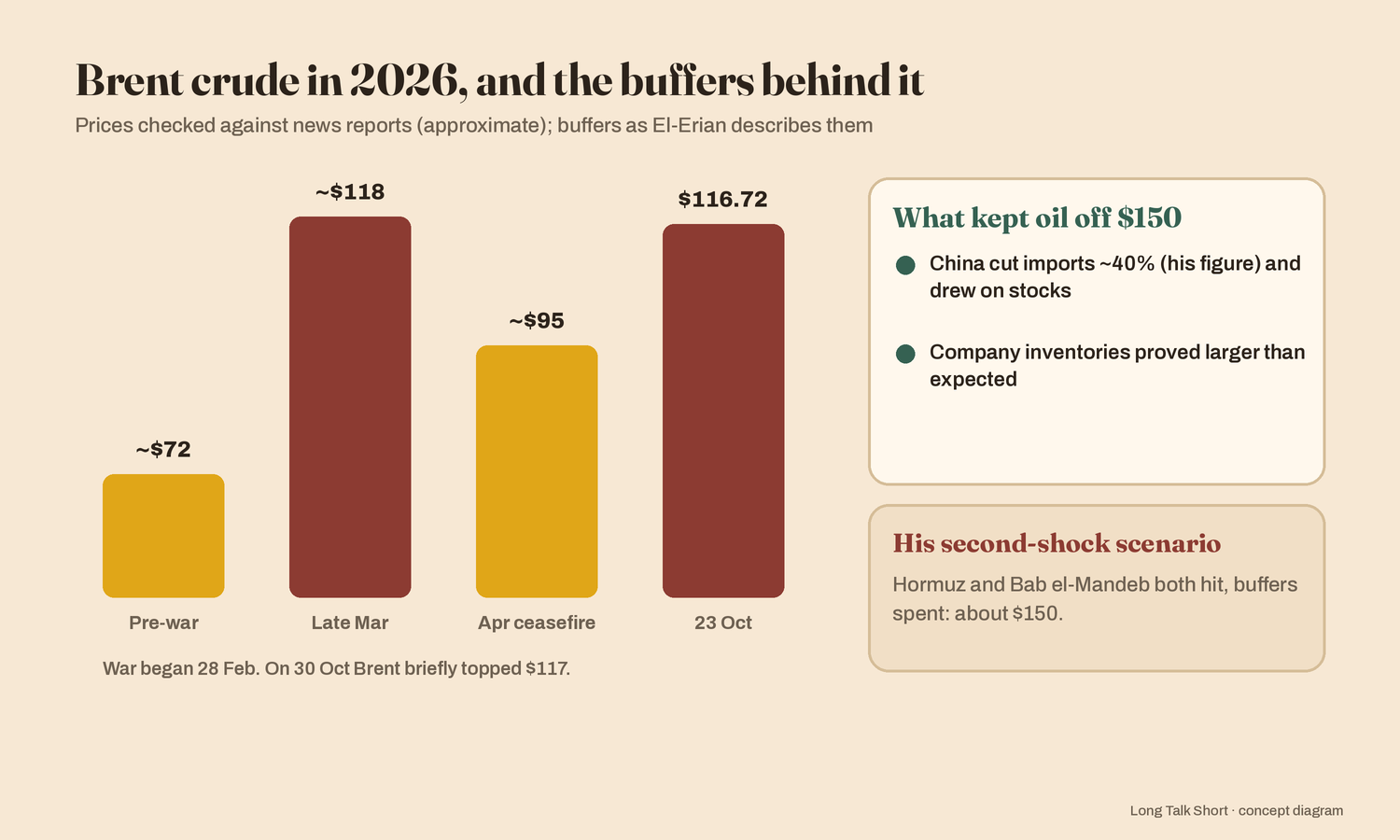
Earlier in the war, he says, the world avoided $150 oil for two reasons:
- China cut its imports by about 40% and drew on its own stocks.
- Companies held far more inventory than anyone had counted, on top of government reserves.
You don't get to go to heaven twice for the same good deed
Those inventories have been run down. So his scenario is stark: if tanker traffic is disrupted again, especially through both the Strait of Hormuz and the Bab el-Mandeb at the mouth of the Red Sea,
this is not oil at 120, this is oil at 150
That shock would land while borrowing costs are high. What breaks first? Nobody knows. Before Britain's 2022 Liz Truss crisis, no one thought pension funds were the weak point, "and yet, the pension system almost collapsed." His worry is a loop in which "economic volatility fuels financial volatility," and the reverse.
3. Our yields, your problem
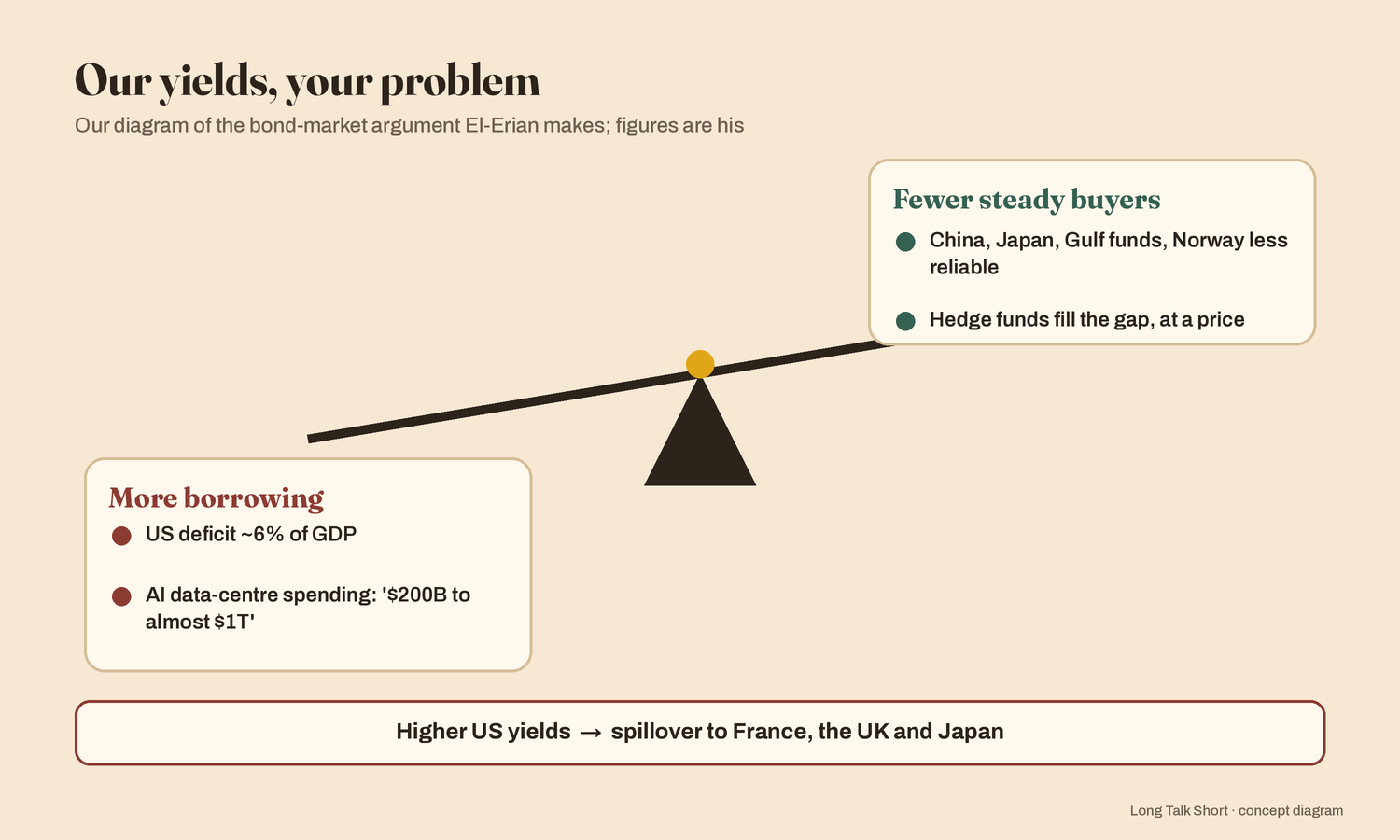
The second pressure point is the bond market. El-Erian points to his Financial Times column, "our yields, your problem," a play on US Treasury Secretary John Connally's 1971 line that the dollar was America's currency but the world's problem.
Higher yields start in the US, he argues:
- Deficits: Washington is running a deficit of about 6% of GDP.
- AI borrowing: the AI giants want to borrow heavily for data centres, with investment plans he says have jumped from $200 billion to almost $1 trillion in a year.
- Fading buyers: the old reliable buyers, "the Chinas, the Japans, the GCC, the Norways," are less reliable.
So rates have to rise to attract hedge funds, and that exposes weak spots in France, Britain and Japan. Would a new war push yields up or down? "I really don't know," he says: slower growth pulls them down, higher inflation pushes them up.
4. AI: a rational bubble
El-Erian repeats his view that markets are in a "rational bubble." Investors are funding far more projects than will pay off, so "there will be tears." But the winners pay off enough that spreading bets like a venture capitalist makes sense. Markets are testing the return on all that spending and whether funding stays plentiful.
No one is questioning the economic engine of AI.
He splits the US-China race into three buckets:
- Frontier: the US leads.
- Deployment and power: China leads, and dominates the electricity AI runs on.
- Collateral damage: both are "seriously lagging." This worries him most. Citing Nobel laureate Michael Spence: "If you try to solve a cooperative game uncooperatively, bad things happen."
Briefly: Europe has three engines idling in first or second gear; China's slowdown is "totally fixable"; US currency support for Argentina worked, while Japan's yen support only half-worked.
Weighing it: what holds up
The oil numbers check out:
- December Brent futures settled at $116.72 on 23 October 2026, the highest close since April.
- The war began on 28 February. Brent peaked near $118 in late March before an April ceasefire knocked it back to about $95.
- Al Jazeera, citing Kpler, reports that Gulf exports have recovered while freight costs have soared, and the International Energy Agency puts global stocks about 509 million barrels below pre-war levels. That fits the spent-buffers point.
- Note that $116 comes from the episode title. El-Erian himself talks about $120 and $150.
Some figures run hot:
- Singapore: the official 2026 forecast is 4.5% to 5.5%, and banks raised theirs to about 5.5% to 5.7% after a strong third quarter. Close to 6%, but not 6%.
- AI spending: the four biggest US hyperscalers spent about $416 billion in 2025, not $200 billion, and their 2026 plans total roughly $725 billion. Broader estimates go higher.
Confirmed: the Oxford Economics projection Nawfal shows (China at about 84% of US output by 2040) and the FT column.
Not verified: the 40% cut in Chinese oil imports, his account of the US interventions and the yen levels. The $150 call is a scenario, not a forecast, and he says so.
Related reading: on the AI debt pile, see AI Isn't the Bubble. The Debt Behind It Might Be. and Who Pays for the Chips?; on why sea lanes matter, see Sarah Paine's The Sea Beats the Land.
Long Talk Short
- The world got through the first oil shock on borrowed resilience: inventories, sovereign savings and financial wealth.
- Two buffers kept oil off $150: China drawing on its stocks and unexpectedly large company inventories. Both are depleted.
- If Hormuz and the Red Sea are both hit again, he sees about $150 oil arriving while borrowing costs are high.
- US deficits and AI borrowing push yields up as traditional buyers step back; other countries feel the spillover.
- AI is a rational bubble with a real engine, and containing its risks needs cooperation nobody is offering.
The one thing to remember: a buffer you've already spent can't protect you twice. Judge the next shock by what's left in reserve, not by how well the last one went.
Source: "The Iran War, $116 Oil & the Next Global Economic Crisis", Mohamed El-Erian with Mario Nawfal. This is an independent summary and is not affiliated with Mario Nawfal or Mohamed El-Erian.
Quotes are taken from automatic captions and lightly cleaned. This article is for general information only and is not investment advice.