Why You Did That: Robert Sapolsky's Behave, Rewinding One Act From a Second to a Million Years
Why did you do that? Robert Sapolsky's Behave rewinds a single act through your brain, hormones, childhood, genes and culture. His case that biology amplifies rather than dictates, which studies aged badly, and the free-will fight.
You snap at a colleague, hand your last tenner to a stranger, or swerve to avoid a dog. Ask why and you'll give a reason. Robert Sapolsky thinks your reason is the least of it.
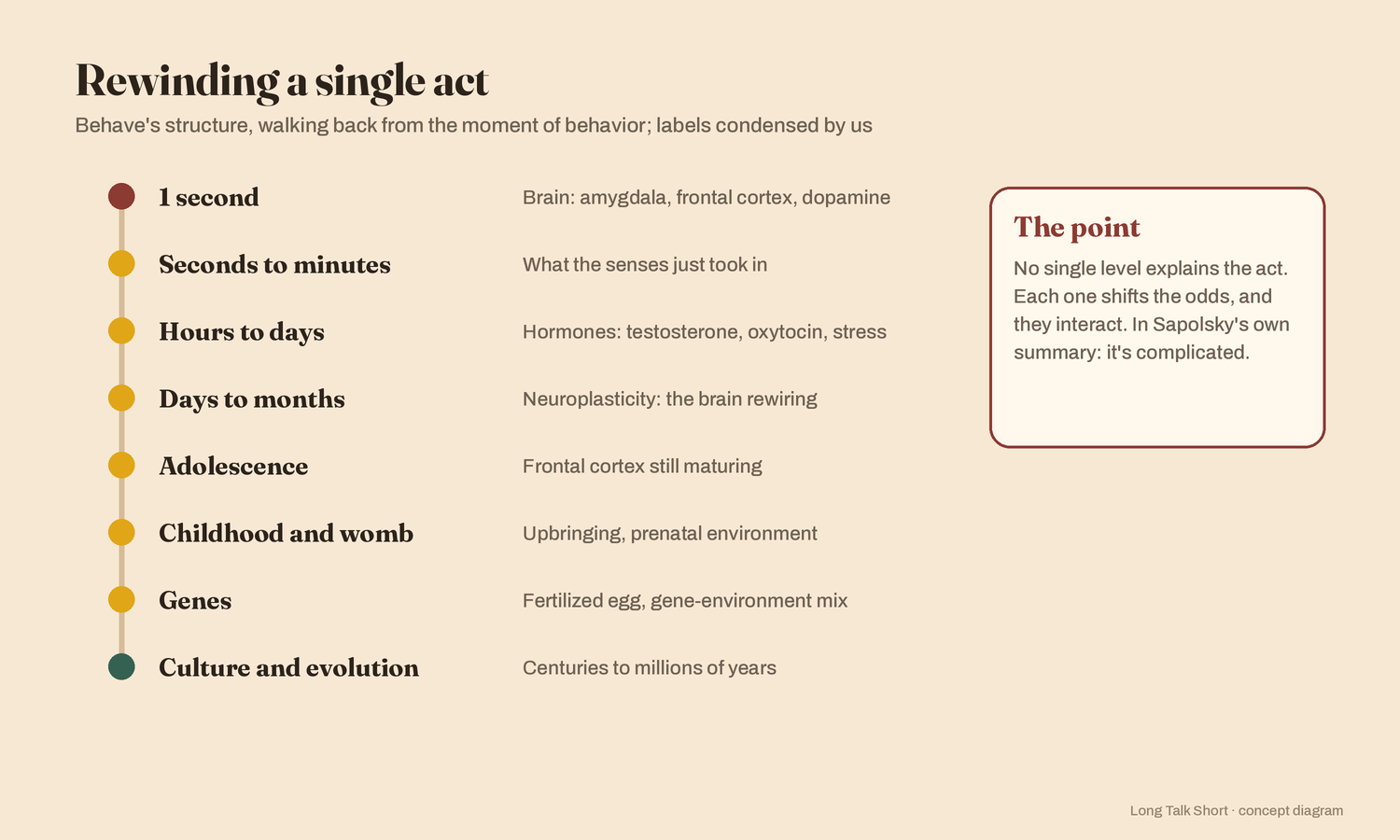
Sapolsky, a Stanford neuroscientist and primatologist who spent decades studying baboons in Kenya, takes a single act in Behave and rewinds the tape: what was happening in your brain a second before, in your blood hours before, in your childhood, your genes, your culture and the evolution of your species.
In short: no single cause explains what you do. Brain circuits, hormones, recent experience, upbringing, genes and culture each nudge the odds, and they interact. Biology rarely forces a behavior; it changes how strongly you react to the situation you're in. His most provocative conclusion, that this leaves no room for free will, is the part most open to argument.
Sapolsky's own one-phrase summary of his book:
It's complicated.
1. Rewinding one act
The book's structure is its best idea. Each chapter steps further back in time:
- One second before: the amygdala flags threats and fuels fear and aggression; the dopamine system is less about pleasure than about wanting and anticipating; and the frontal cortex, in his phrase, makes you do the harder thing when it is the right thing.
- Seconds to minutes: what your senses just took in, often without your noticing: a face, a smell, a sound.
- Hours to days: hormones enter.
- Days to months: the brain has physically rewired itself through experience and stress.
- Further back: adolescence, childhood, the womb, genes, and finally centuries to millennia of culture and evolution.
The hormone chapters show what this patient rewinding reveals.
2. Hormones amplify, they don't dictate
Testosterone is popularly blamed for aggression. Sapolsky's reading is subtler: rather than causing aggression outright, it amplifies the power of something else to cause it. In a classic 1977 study of talapoin monkeys, raising testosterone didn't reshuffle the dominance hierarchy; it exaggerated the aggression each monkey already showed toward those below it. Context decides what testosterone does. Where status is won by being generous, it can make people more generous.
Oxytocin, sold in pop science as the "love hormone," gets the same treatment. He describes studies in which it increased trust, empathy and cooperation, but only toward people seen as part of your group. Toward outsiders, the same studies suggested it can make people more wary and less generous.
Biology, in his telling, is rarely good or bad in itself. It turns up the volume on what the situation already supplies.
3. Teenagers, childhood and culture
The adolescence chapter, subtitled "Dude, Where's My Frontal Cortex?", makes a point with legal consequences. The frontal cortex is the last part of the brain to mature, not fully online, in Sapolsky's words, until the mid-twenties. That helps explain why teenagers take risks and respond so strongly to peers. The book links this research to two US Supreme Court cases:
- Roper v. Simmons (2005) ended the death penalty for crimes committed under 18.
- Miller v. Alabama (2012) banned mandatory life without parole for juveniles.
Further back, he traces how childhood adversity, prenatal stress and the interplay of genes and environment shape the adult brain, and how culture leaves marks too: why some cultures prize honor and others harmony, and how quickly we sort people into "us" and "them." His tone stays hopeful. Group boundaries, he argues, are real but surprisingly easy to redraw, and our best behaviors are just as biological as our worst.
Which raises the uncomfortable question the book builds toward.
4. No room for free will?
In the penultimate chapter, Sapolsky turns all this on criminal justice. He mocks the idea of a "homunculus," a little decider in your head that weighs the brain's inputs but stands apart from biology. If every behavior has prior causes all the way down, he argues, blame and punishment as we practise them make little sense. Justice should look more like how we treat a car with faulty brakes: keep people safe, but without moral condemnation. He develops the argument at book length in Determined (2023).
Weighing it: what holds up
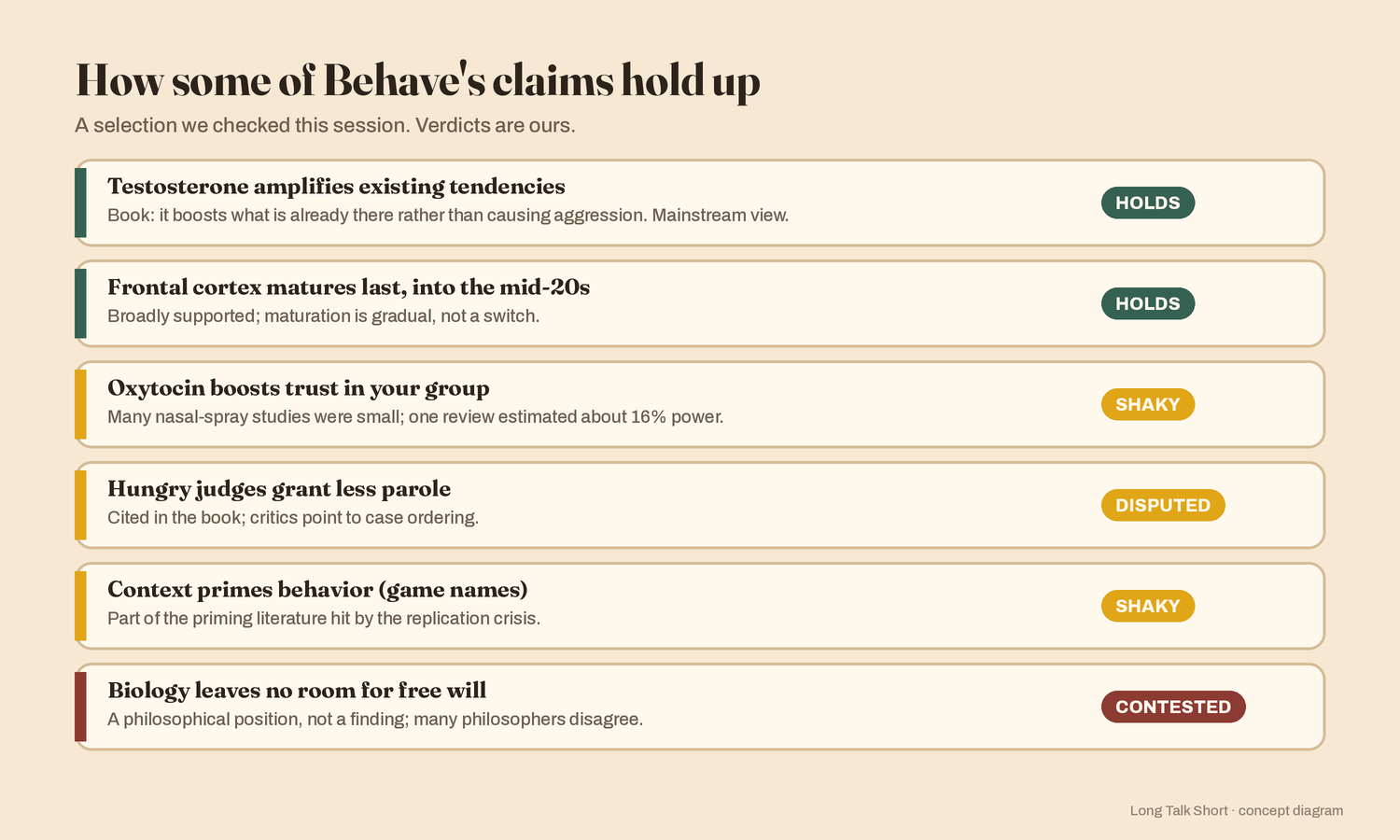
Holds up: we checked the testosterone, oxytocin and frontal-cortex passages against the book text. Steven Poole's review in the Guardian called it a "miraculous synthesis" careful to point out the limits of knowledge, and agreed that testosterone amplifies existing tendencies rather than causing aggression. The mid-twenties figure for frontal maturation is widely cited, though maturation is gradual rather than a switch.
Shaky: like any synthesis, Behave cites studies that later took a knock. The oxytocin work relied heavily on small nasal-spray experiments. A 2016 review in Biological Psychiatry by Hasse Walum and colleagues estimated such studies in healthy people had only about 16% statistical power, which makes many positive results unreliable. The book also cites the "hungry judges" parole study and priming experiments, both of which have been challenged. Neither is central to the argument, but treat those passages with care.
Disputed: the free-will conclusion is a philosophical position, not a scientific finding. Poole noted that Sapolsky sidelines conscious reasoning for much of the book and cites mainly neuroscientists and legal scholars rather than philosophers. Many philosophers are "compatibilists," who argue that responsibility survives even if behavior is caused. Poole also spotted a tension: Sapolsky urges readers to reflect and do better, which is hard to square with a view in which no one can choose to.
Worth knowing: it's long, hundreds of pages plus appendices and notes. The grouping of claims in our scorecard is ours.
Related reading: on how quickly we split into tribes, see Jonathan Haidt's The Righteous Mind; on how early adversity marks body and brain, see The Body Keeps the Score.
Long Talk Short
- Any act has causes on many timescales at once, from the last second of brain activity to millions of years of evolution.
- Hormones and brain circuits mostly amplify your response to a context; they rarely dictate behavior on their own.
- Testosterone magnifies existing tendencies, and oxytocin's warm effects seem to apply mainly to your own group.
- The teenage brain is still building its brakes, a finding that has shaped US rulings on juvenile sentencing.
- Some cited studies are weaker than they looked, and the free-will conclusion is a contested philosophical claim.
The one thing to remember: before you judge someone's behavior, or your own, ask what happened a second, a day, a year and a childhood before. The answer is rarely one thing.
Source: Behave: The Biology of Humans at Our Best and Worst by Robert M. Sapolsky (Penguin Press, 2017). This is an independent summary and is not affiliated with the author or publisher.