Can You Stand Up Without Your Hands? A Stanford Physician’s Plain List of Habits That Add Healthy Years
Stanford’s Michael Fredericson argues that healthspan habits are mostly ordinary: movement all day, enough protein as you age, sleep you don’t over-optimize, and connection. Guideline figures checked against the CDC. Not medical advice.
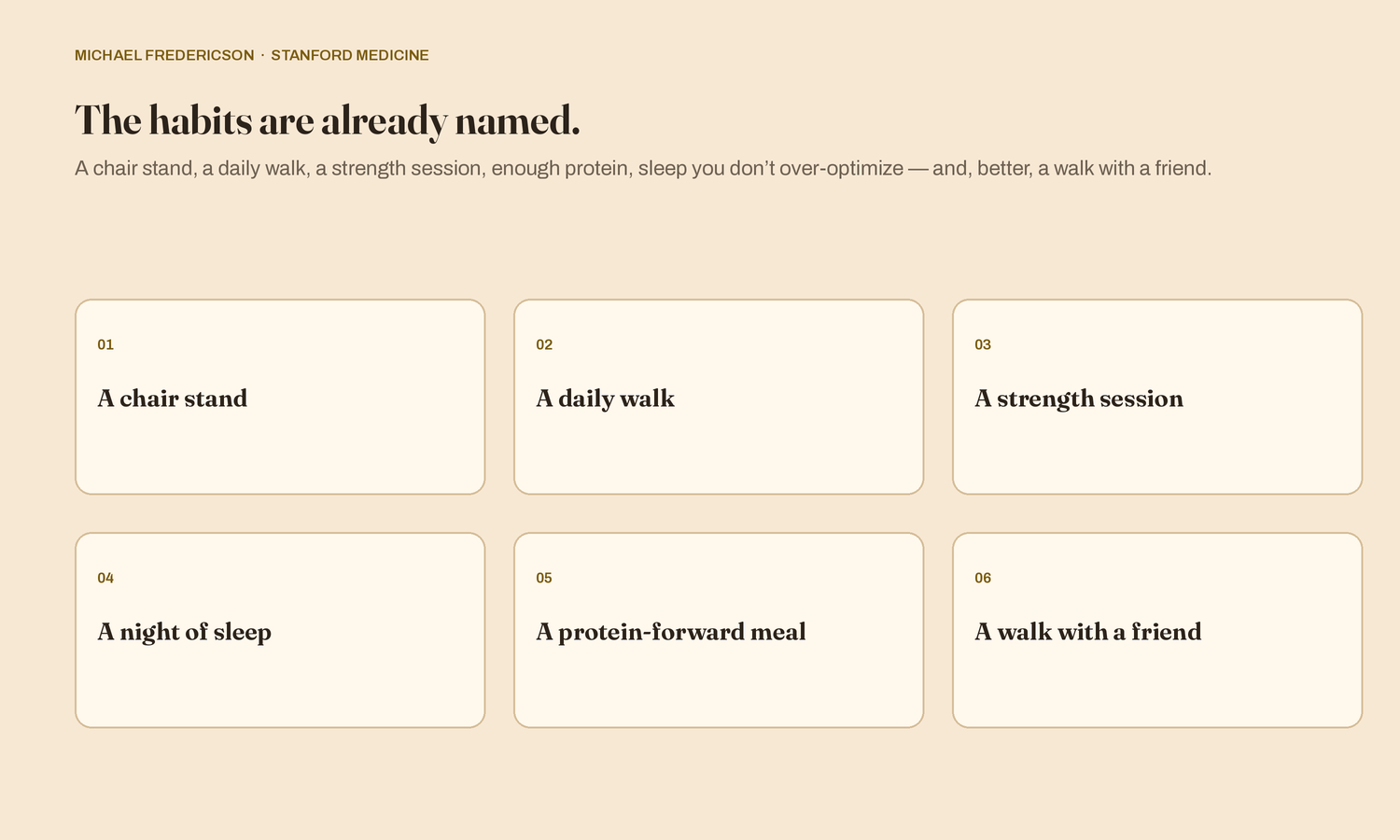
If you have been hunting for a longevity stack — a supplement, a wearable, a biological-age score — Michael Fredericson would like you to look down at the week you are already living. On Stanford Medicine’s Health Compass, the sports-medicine physician walks through the habits that, in his view, keep people strong and independent: movement, food, sleep, stress, and connection, plus gratitude and purpose. The host, Maya Adam, opens with questions that are almost embarrassingly practical. Can you get up from a chair without using your hands? Can you balance on one foot? How are you sleeping? Are you eating vegetables? Do you walk every day, and do you ever walk with a friend?
The episode of Stanford Medicine’s Health Compass podcast is “What are the habits that add healthy years to your life? | Ep.4: Health Compass Podcast,” at youtube.com/watch?v=ByDttRQtihs. Fredericson is a professor of orthopedic surgery and of physical medicine and rehabilitation at Stanford, and the founder and director of Stanford Lifestyle Medicine, so he is describing a field he leads, on his own institution’s show. Auto-generated captions were used for wording; his name is spelled as it is on Stanford’s materials, not as the captions sometimes render it. This is not medical advice, and it is not a plan for any one person’s body.
In short: Fredericson says the habits that add healthy years are mostly ordinary — move all week and break up sitting, keep balance and strength, eat enough protein as you age (he suggests about 1.2 to 1.6 grams per kilogram), do not turn sleep into a project, and stay connected. The exercise figures match CDC guidance, and the protein range matches the federal 2025–2030 dietary guidelines. This is not medical advice.
The frame he uses is lifestyle medicine: everyday behavior as a way to prevent and treat chronic disease, and a way to cut through a market of tools that, as Adam notes, are only sometimes supported by science. His list is movement, “healthful nutrition,” restorative sleep, stress management, social engagement, and “cognitive enhancement,” plus gratitude and purpose, which he says are too often left out. Colleagues have asked him, in the middle of a debate about the perfect workout, “what about joy?” and “what about your meaning?”
1. Move all week, not only in one session
On exercise he starts where the U.S. guidelines already are, then tightens the emphasis. Adults, he notes, are told to get 150 minutes a week of moderate aerobic activity, plus at least two days of strength training, with some mobility and stretching. Those numbers match the CDC’s adult guidance and the Physical Activity Guidelines for Americans, which also allow 75 minutes of vigorous activity as an alternative. Balance work, in the federal language, is added for people 65 and older. Fredericson’s objection is timing. “Why wait till you’re losing your balance?” For someone who is not an athlete, his example is almost comically small: stand on one foot while you brush your teeth.
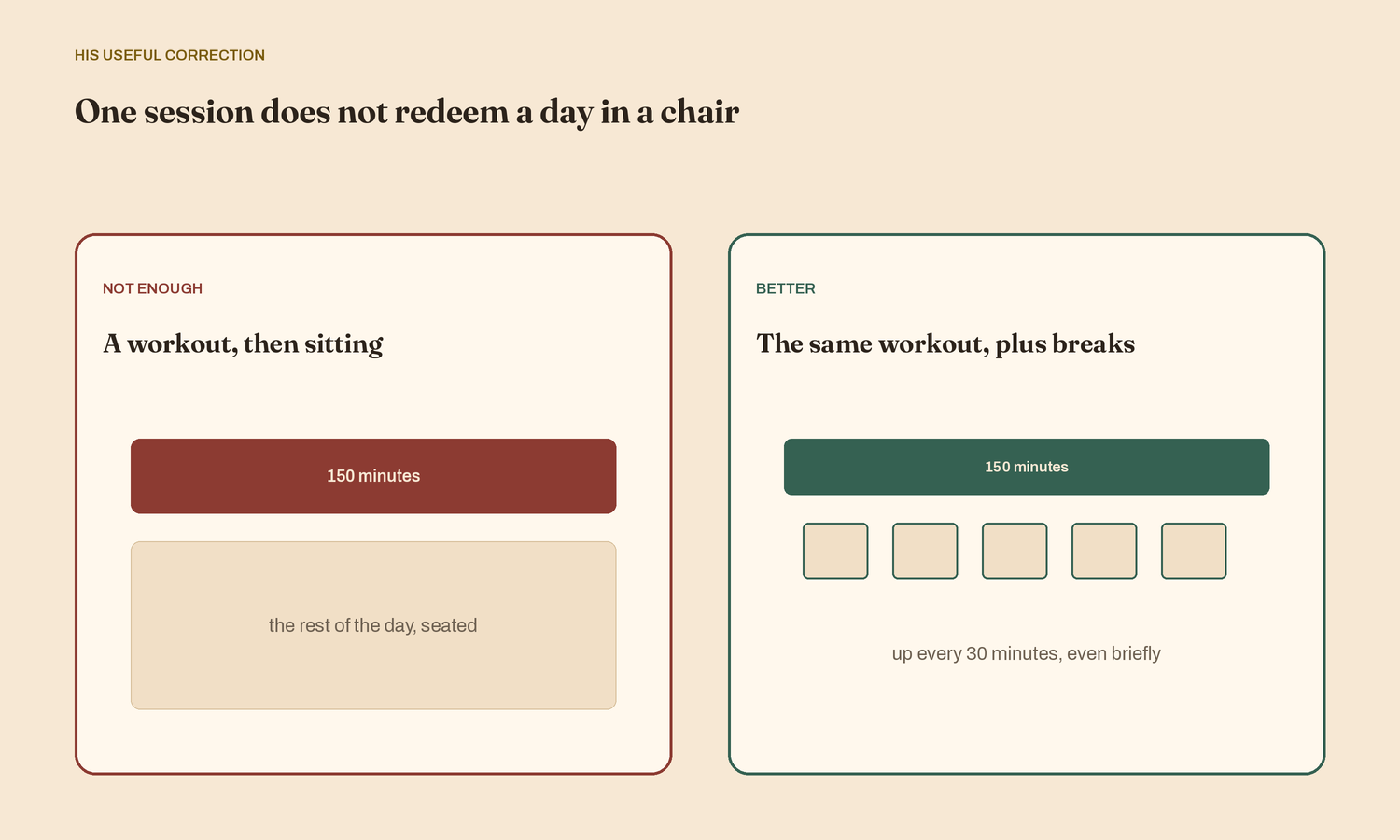
He is equally firm about sitting. The guidelines say to move more and sit less, and he wants that taken seriously. You can hit the 150 minutes, he says, “but if you sit the rest of the day, it really negates that exercise session you had.” His fix is to “move all day”: at least every 30 minutes, get up for a couple of minutes and walk around. That “negates” language is stronger than the federal “sit less,” and it is his emphasis. He also says it is “never too late.” He has patients in their 80s and 90s who still get a lot out of starting resistance work.
2. Protein, sleep, and the things a plan can become
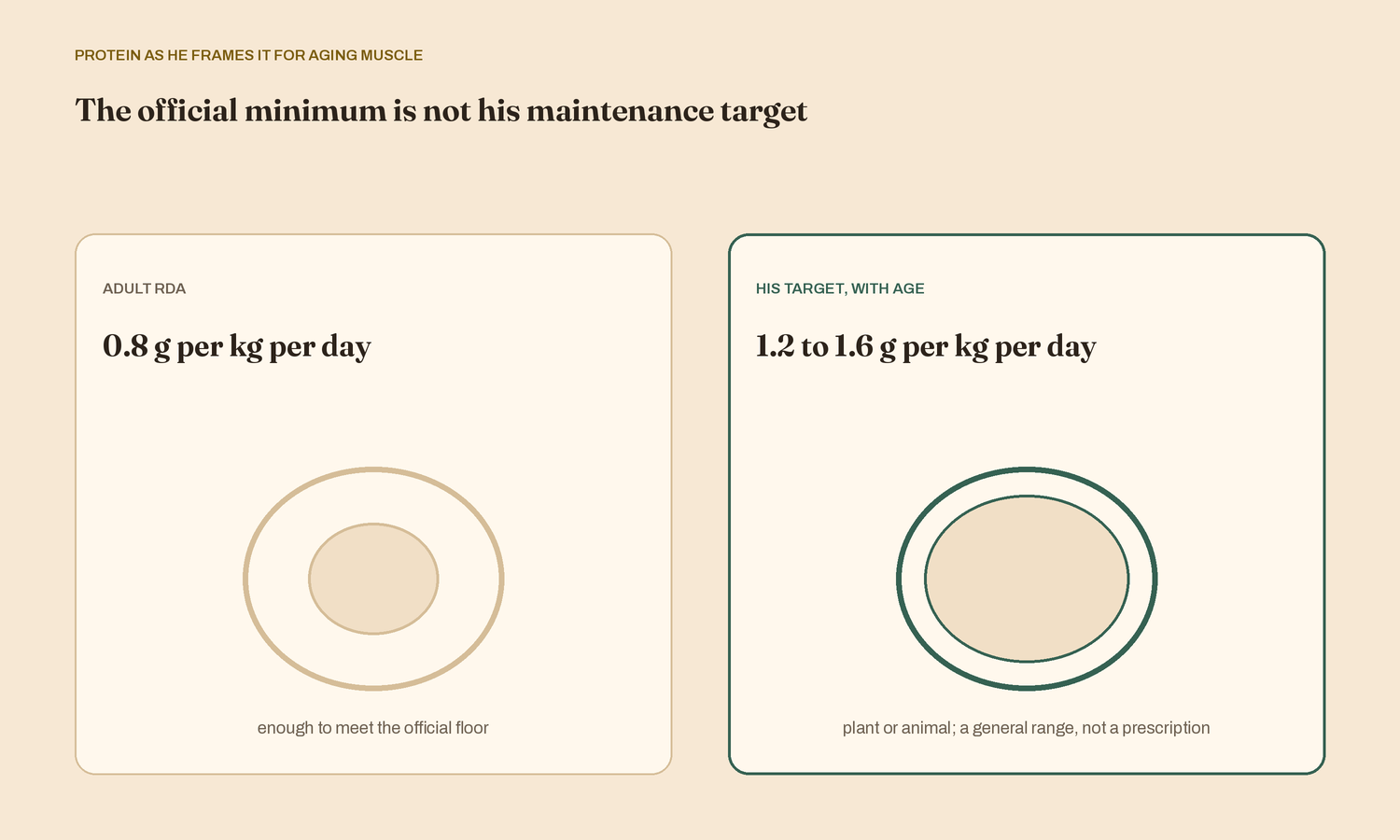
On protein, he is willing to leave the official adult RDA behind. That figure, 0.8 grams per kilogram per day, is, he says, a poor target once “anabolic resistance” sets in with age. To help maintain muscle, he recommends about 1.2 to 1.6 grams per kilogram, from plants or animals; total amount matters most, and a solid morning dose appears, in his account, to help the day’s rhythm. People who skip breakfast, he says, should “be a little bit careful.” The range is not fringe: the federal Dietary Guidelines for Americans, 2025–2030 set a goal of 1.2 to 1.6 grams per kilogram for adults, and the PROT-AGE expert position paper suggested at least 1.0 to 1.2 for people over 65, and 1.2 to 1.5 with illness. The 0.8 RDA remains the amount that prevents deficiency in most healthy adults, not an optimum. Still, it is a general range, not a prescription, and people with kidney disease in particular should ask a clinician before raising their protein.
His sleep advice is similarly un-fancy: do not eat within a couple of hours of bed; keep the room cooler; keep exercising. He also warns, with Adam, against turning sleep into another optimization project. The stress of trying to get “enough” and “good quality” sleep can be what keeps you from sleeping. Sometimes, he says, “we get so stressed about trying to optimize everything that it can be counterproductive.” Social engagement is on his list for a reason. A walk is better, the host suggests, if it is a walk with a friend.
Weighing it: what holds up
This is an institutional podcast, not a systematic review, and it should be used as a map of habits, not as a personal plan. The 150-minute, 75-minute vigorous, two-day strength, and 65-plus balance figures match CDC guidance; his language about sitting “negating” a workout is an emphasis, not a quoted CDC sentence. His 1.2–1.6 grams-per-kilogram protein range is above the 0.8 RDA but matches the federal Dietary Guidelines goal and sits at the upper end of what expert groups have suggested for older adults; individual needs vary, and kidney disease changes the advice. Fredericson leads the Stanford program he is describing. Gratitude and purpose are his additions, not substitutes for movement or sleep. Auto-generated captions are close, not official. This is not medical advice. If you have an injury, a chronic condition, or a question about diet or exercise, talk to a clinician who knows your case.
Related reading: Right About Sleep, Shaky on the Numbers · A Real Day, a Real Night
Long Talk Short
- Fredericson’s healthspan list is ordinary on purpose: movement, food, sleep, stress, social engagement, plus gratitude and purpose.
- He starts from the standard 150 minutes of moderate aerobic work and at least two days of strength, then insists on balance training before age 65 and on breaking up sitting all day, not only in one session.
- For muscle with age, he recommends about 1.2 to 1.6 grams of protein per kilogram per day, above the adult RDA of 0.8, from plants or animals.
- He would rather you keep the room cool and stop eating a couple of hours before bed than turn sleep itself into a source of stress.
The one thing to remember: The habits that add healthy years are mostly already on the public guidelines — the work is doing them often enough, and not letting a search for an exotic fix crowd them out.
Independent summary; not affiliated with Stanford Medicine or Michael Fredericson. Not medical advice.
Source: Stanford Medicine’s Health Compass podcast, Ep. 4, with Michael Fredericson, on YouTube (linked above); guideline sources are linked in the article. Independent summary; not affiliated with Stanford.