A Real Day, a Real Night: Kristen Holmes's Four Habits for a Calmer Nervous System, and What the Studies Show
WHOOP scientist Kristen Holmes says health depends on switching cleanly between effort and rest. Her four habits (light, a 12-hour eating window, breathing, zone 2) seem to work through one thing: regular sleep.
Your body needs a real day and a real night, and most of us give it neither.
Kristen Holmes, a performance scientist at the wearable company WHOOP, argues that health and performance depend on how cleanly you can switch between effort and rest, and that the most reliable lever is surprisingly ordinary: when you eat, see light, move and sleep.
On Rangan Chatterjee's Feel Better, Live More, she makes the case from her new book, Aligned. The autonomic nervous system, which runs below conscious control, governs heart rate, digestion and the switch between activation and recovery. Some people can steer it, she says. Most of us can learn.
In short: give the body a real day (light, food, movement) and a real night (dark, still, no food), and keep the timing steady. Her own WHOOP study backs four simple habits, though it wasn't a randomized trial. The second half of her case is about the mind: how you frame stress, and how you find joy.
1. Capacity lives in the nervous system
A healthy nervous system, in Holmes's account, can "toggle" between activation and deactivation, with enough awareness to notice which state you're in. Her proxy is heart rate variability (HRV), the beat-to-beat variation in timing between heartbeats. Higher is generally better, but compare it to your own baseline, not someone else's.
She has a name for what many of us do when we feel internal tension:
parasympathetic fixes
The parasympathetic branch is the calming side; the fixes are sugar, scrolling or a drink, things that quiet the feeling without touching its source. Her alternative: treat the tension as information and change the inputs.
So which inputs?
2. The core four
Holmes ran a study with WHOOP members who were asked to keep four behaviors for a month, as consistently as they could:
- A 12-hour eating window, with the last food two to three hours before bed. She chose 12, not 10 or 8, to keep it manageable.
- Morning light, outdoors when possible, or bright indoor lights if it's still dark.
- Breathing: slow breathing and the physiological sigh, a double inhale followed by a long exhale.
- Zone 2 exercise, easy cardio for 30 minutes to an hour, which she calls a recovery modality, not a workout.
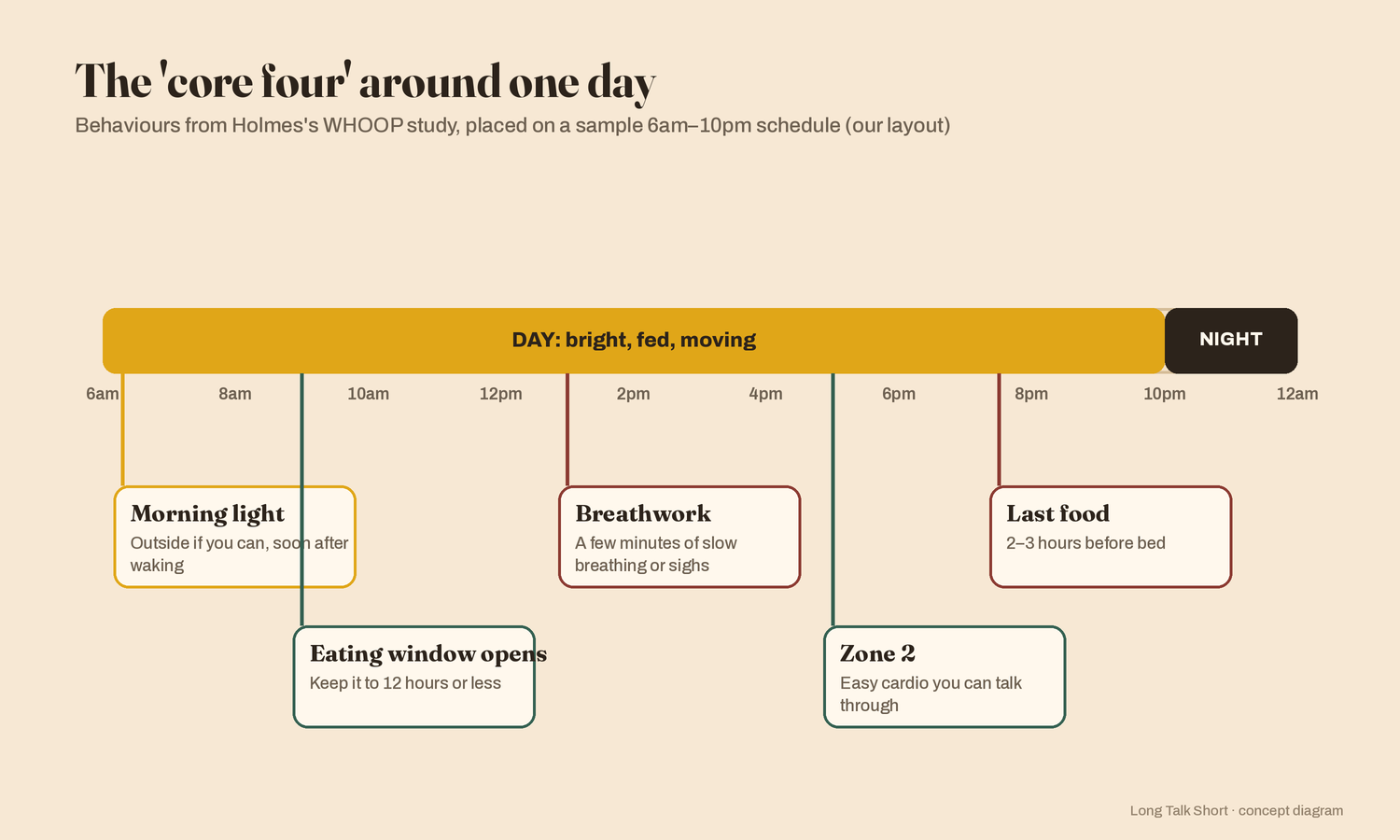
What interests her most is how it worked. People who stuck with the habits slept on a more regular schedule, and that regularity appeared to carry much of the improvement in resting heart rate and HRV.
3. Regularity beats heroics
The lever, she argues, is going to bed and waking up at similar times. Late nights happen; she mentions getting to bed after half past midnight following a big event and saying that's fine. The overall pattern is what counts.
To find your natural bedtime, she suggests an experiment:
- Wake at the same time every day.
- Get as much daylight as you can, and keep the evening dark.
- Avoid caffeine after 2pm and dozing on the couch at 7pm.
- Notice when you naturally get sleepy.
She cites research on hunter-gatherers who, without electric light, fell asleep about 3.3 hours after sunset, whatever their chronotype. Much of what we call being a night owl may really be our environment.
4. The inside work
How you frame tomorrow shows up in tonight's sleep. In Holmes's stress-appraisal research, people expecting a threat had a higher heart rate during sleep; those expecting a challenge had a lower one. She pairs this with her principle of non-neutrality: for 72 hours, ask of each action whether it supports or undermines the person you want to be.
She separates joy from happiness. Happiness depends on circumstances; joy, she says, is an internal relationship you can cultivate. She argues for fewer, clearer desires, quoting Naval Ravikant:
desire is a contract you make with yourself to be unhappy until you get what you want
She discusses "high-functioning depression," a term from psychiatrist Judith Joseph's book and not a formal diagnosis: the flat, joyless feeling of someone who looks fine from the outside. She speaks openly about being abused by her grandfather for 10 years, and about forgiveness as part of not letting it define her. Among her practices is loving-kindness meditation, and she advises professional support alongside self-help.
Weighing it: what holds up
Her WHOOP study: published in the journal SLEEP, it followed 38,838 members who chose to take part for 31 days in August 2023. The protocol: morning sunlight, an eating window of 12 hours or less, zone 2 exercise three to five times a week and five minutes of daily breathwork. Compared with matched non-participants, they improved sleep consistency, resting heart rate and HRV, and sleep consistency partly explained the gains. Volunteers who opt in aren't a randomized sample, so this is encouraging, not proof. Holmes works for WHOOP, and the data came from its customers.
The case for regularity is strong. A 2024 UK Biobank study of 60,977 people found the most regular sleepers had 20 to 48% lower all-cause mortality than the least regular, and regularity predicted mortality better than duration. A 2017 study of 61 Harvard students linked regular sleep, not total sleep, with higher grades (an association only). The 3.3-hours-after-sunset figure checks out, from a 2015 study of the Hadza, San and Tsimane. Her threat-and-challenge study in Emotion drew on about 11,000 WHOOP members; it was observational, with small effects.
Claims that need care:
- The sigh: a 2023 randomized trial found five minutes a day of cyclic sighing improved mood more than mindfulness meditation, and all groups reduced anxiety. We found no support there for her line that the sigh reduces anxiety "up to 5 hours" afterward.
- Loving-kindness and vagal tone: contested. A 2015 reanalysis of the main study found no significant effect; the original authors disputed it.
- "No mental health disorder without circadian misalignment": sweeping. Disrupted rhythms are common across many conditions, but we didn't check so strong a claim.
Related reading: for what sleep science does and doesn't support, see Right About Sleep, Shaky on the Numbers: Why We Sleep; for zone 2 as long-term training, see Peter Attia's Outlive.
Long Talk Short
- Health and performance depend on a nervous system that can switch cleanly between effort and recovery.
- Her core four: a 12-hour eating window, morning light, slow breathing and zone 2 exercise.
- Regular sleep and wake times appear to be how those habits work, and large studies link regularity with better health.
- Expecting a threat rather than a challenge is linked with a higher heart rate during sleep.
- Joy is internal and can be practiced; fewer, clearer desires help, and so does professional support.
The one thing to remember: make your days brighter and your nights darker, then keep the schedule steady. Consistency beats any single perfect habit.
Source: "Regulate Your Nervous System, Sleep Better and Find Joy", Feel Better, Live More with Dr Rangan Chatterjee and Dr Kristen Holmes. This is an independent summary and is not affiliated with the show, Kristen Holmes or WHOOP.
This article is for general information only and is not medical or mental health advice. If you are struggling with low mood, past abuse or thoughts of self-harm, please reach out to a qualified professional. In the US you can call or text 988 (Suicide & Crisis Lifeline); elsewhere, contact your local crisis line. Quotes are taken from automatic captions and may contain small transcription errors.