Right About Sleep, Shaky on the Numbers: What Why We Sleep Gets Right, and the Statistics That Don't Hold
Matthew Walker's Why We Sleep is right that sleep runs memory, mood and health, and that adults need seven-plus hours. But several of its scariest numbers, including a WHO "epidemic", don't hold up.
Why We Sleep made millions of readers take their bedtime seriously. Some of the numbers that did it were wrong.
Matthew Walker's science of how sleep works mostly holds up. Several of his scariest statistics don't, starting on page four.
There, Walker, a neuroscientist at UC Berkeley, writes:
WHO has now declared a sleep loss epidemic throughout industrialized nations.
In 2019 a researcher named Alexey Guzey went looking for that declaration and couldn't find one. Walker's footnote pointed to a National Geographic documentary that doesn't mention the WHO. That gap between a sound message and shaky numbers runs through the whole book.
In short: sleep isn't optional downtime. It runs memory, mood, metabolism and immunity, and most adults need seven or more hours. Walker's explanations and practical advice mostly hold up; several headline statistics don't.
1. Two clocks run your night
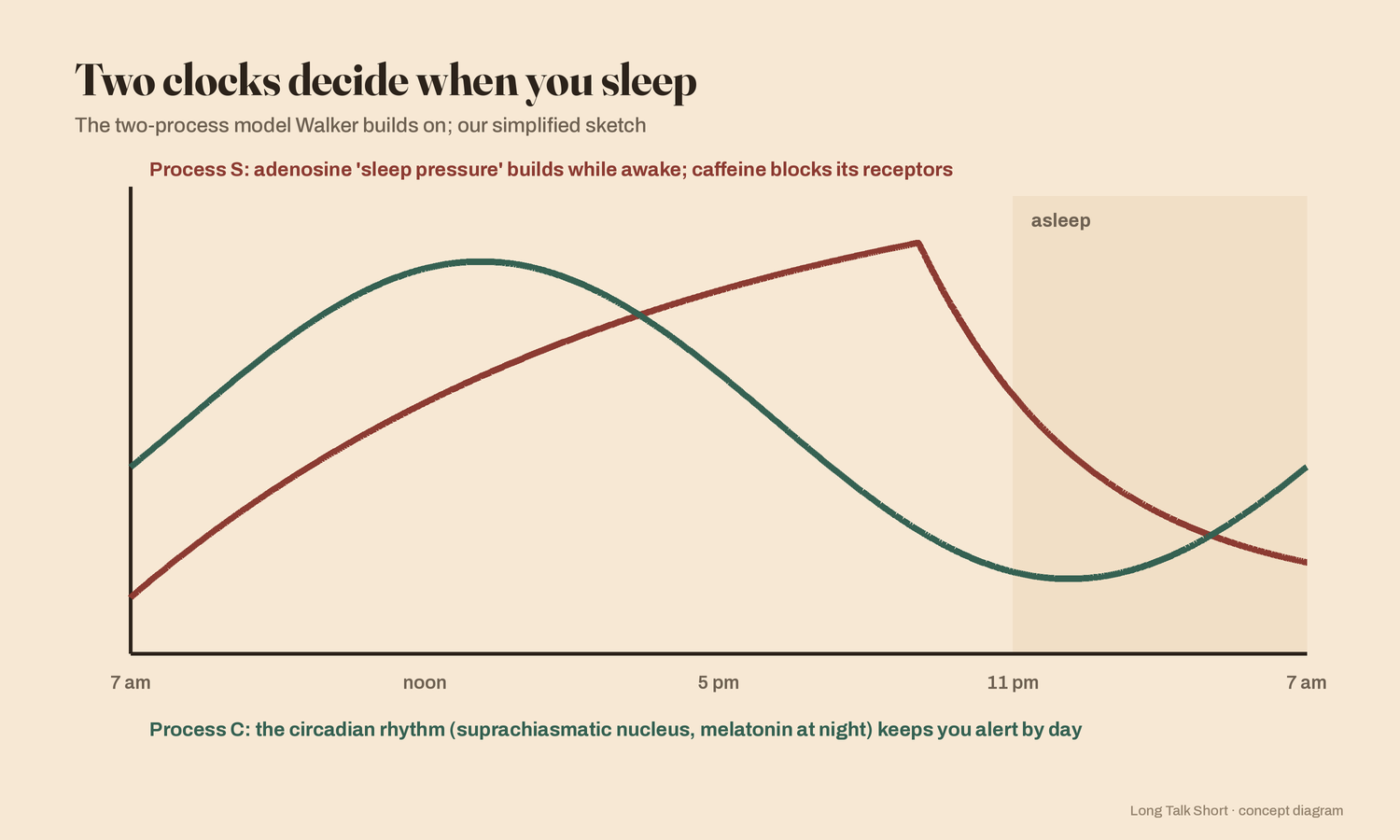
- Process C is your circadian rhythm, a roughly 24-hour cycle run by the brain's suprachiasmatic nucleus. It raises alertness by day and releases melatonin after dark, which signals night rather than knocking you out.
- Process S is sleep pressure: adenosine builds up the longer you're awake.
Caffeine blocks adenosine receptors, so the pressure is masked, not removed. Because caffeine clears slowly, an afternoon coffee can still be working at bedtime. You sleep best when high pressure lines up with the night-time circadian dip. Jet lag, shift work and teenagers' later body clocks are what happens when the two fall out of step.
Once you're asleep, though, the real work starts.
2. What each stage of sleep does
Sleep runs in cycles of non-REM and REM, roughly 90 minutes each. Deep non-REM dominates early in the night; REM dominates towards morning.
- Deep sleep files memories, moving them from the hippocampus into longer-term storage in the cortex.
- REM links and softens them, which Walker credits with creative problem-solving and taking the sting out of emotional memories. A 2010 Nature Reviews Neuroscience review by Susanne Diekelmann and Jan Born describes a similar division of labour.
- Cutting sleep short in the morning cuts mostly REM.
- Short sleep, he argues, dysregulates appetite hormones, weakens immunity and raises cardiovascular risk.
3. Two myths about getting to sleep
- Alcohol isn't a sleep aid. A 2013 review by Irshaad Ebrahim and colleagues found it helps you fall asleep but disrupts the second half of the night, and higher doses suppress REM.
- Sleeping pills mostly sedate rather than restore. For chronic insomnia, the American College of Physicians (2016) recommends cognitive behavioral therapy for insomnia (CBT-I) as first-line treatment, as Walker does.
4. From bedroom to society
Walker wants later school start times, and the American Academy of Pediatrics agrees: its 2014 statement says middle and high schools should start no earlier than 8:30 a.m., since teenagers need 8.5 to 9.5 hours. He also wants to stop glorifying sleepless work and fix hospital schedules for exhausted doctors. His evidence includes daylight saving time: a 2014 study by Amneet Sandhu and colleagues found 24% more heart-attack admissions on the Monday after clocks spring forward, and 21% fewer on the Tuesday after they fall back.
5. His twelve tips, condensed
- Keep a fixed schedule, and don't lie in bed awake for long.
- Exercise, but not too close to bed; no naps after 3 p.m.
- Avoid caffeine, nicotine, alcohol and large meals near bedtime.
- Wind down, take a hot bath, and keep the bedroom dark, cool and gadget-free.
- Get daylight during the day.
So which of the book's claims survive a close check?
Weighing it: what holds up
We checked the most-quoted claims against their sources. Guzey's 2019 essay goes through Chapter 1 line by line, and we cross-checked his main points.
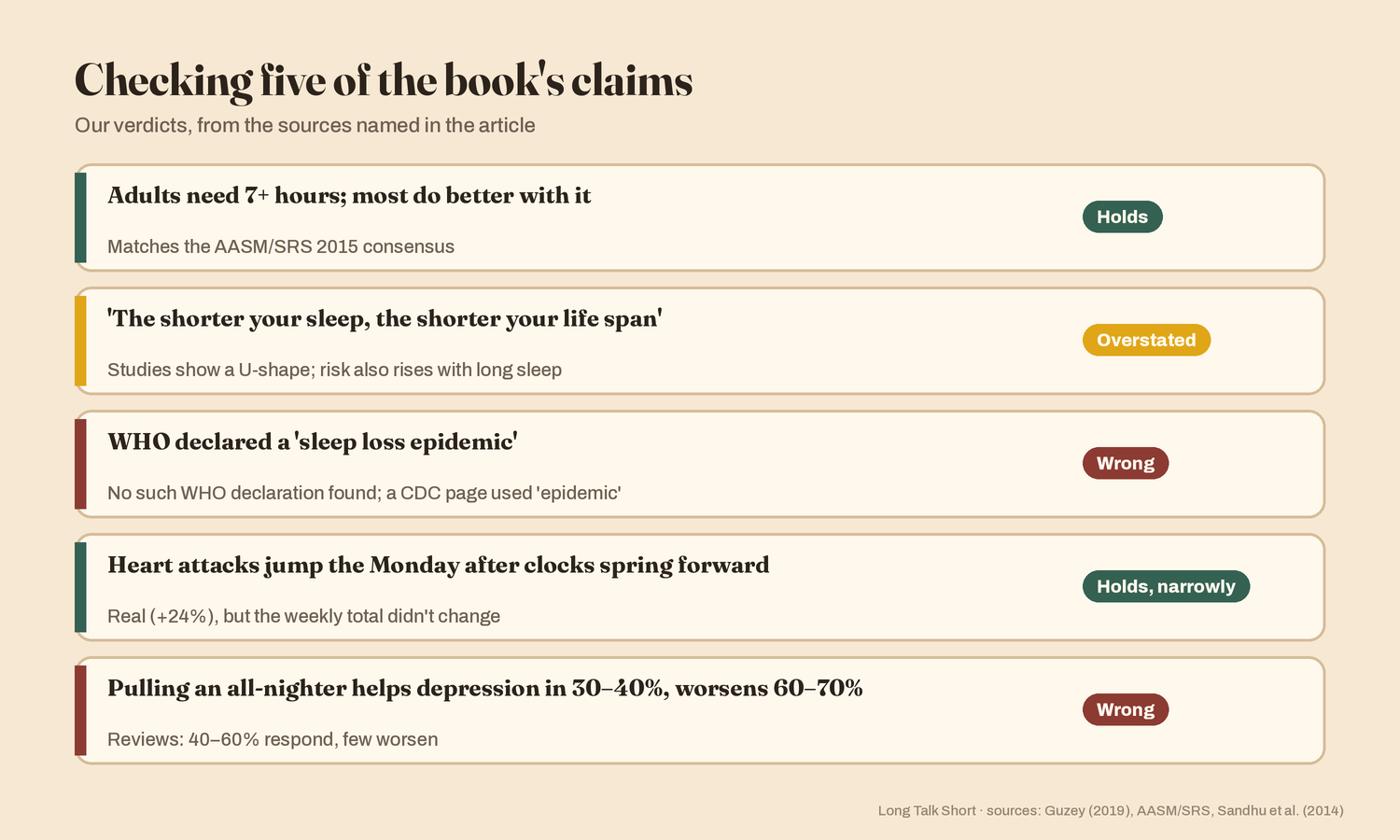
What holds. The 2015 consensus statement from the American Academy of Sleep Medicine and Sleep Research Society says adults should sleep seven or more hours a night, and that regularly sleeping less is linked to weight gain, diabetes, hypertension, heart disease, depression and more errors. The two-process model, the alcohol and caffeine advice, CBT-I and later school start times are all mainstream.
What is overstated or wrong.
- "The shorter your sleep, the shorter your life span" doesn't match the evidence. Meta-analyses find a U-shape, with the lowest death rates around seven hours. That doesn't prove long sleep causes harm, but the simple line is wrong.
- Cancer: a 2018 BMC Cancer meta-analysis of 65 studies found no overall link between sleep duration and cancer, against the book's doubling claim.
- The WHO declaration doesn't exist, as far as Guzey or we could find; the likely source is a CDC page once titled "Insufficient Sleep Is a Public Health Epidemic." The WHO has no adult sleep-hours recommendation, and the National Sleep Foundation recommends seven to nine hours, not eight.
- Depression: Walker says one night without sleep helps 30–40% of depressed patients and worsens 60–70%. Reviews put responders at 40–60% and worsening at a few percent.
- A chart on teen athletes' injuries dropped one bar without saying so.
- Daylight saving: real but narrower than it sounds. In Sandhu's data the week's total heart attacks didn't change; the time change seemed to shift them earlier, not cause new ones.
The response. UC Berkeley said it found "some minor errors" that Walker intended to correct, and no research misconduct. Walker posted answers to readers' questions on his blog; Guzey says they didn't address most of his points. Whether people sleep less than they used to is itself disputed: some time-use surveys show stable or rising sleep since the 1970s.
Related reading: for what happens when you learn to stay aware in REM sleep, see You Can Learn to Wake Up Inside Your Dreams; for sleep as one pillar of a longer healthspan, see Peter Attia's Outlive.
Long Talk Short
- Two systems set your night: the circadian rhythm and adenosine sleep pressure. Caffeine masks the pressure; it doesn't remove it.
- Deep sleep consolidates memories and REM links and softens them; cutting sleep short in the morning cuts mostly REM.
- Alcohol fragments the second half of the night. For chronic insomnia, CBT-I beats pills as a first step.
- Mainstream bodies back his targets: 7+ hours for adults, 8.5–9.5 for teens, school starting no earlier than 8:30.
- Several famous numbers don't hold: no WHO "epidemic" declaration, a U-shaped mortality curve, and an unsupported cancer-doubling claim.
The one thing to remember: protect a regular seven-plus hours, and read sleep statistics as carefully as Walker wants you to guard your bedtime.
Source: Why We Sleep: Unlocking the Power of Sleep and Dreams by Matthew Walker (Scribner, 2017). This is an independent summary and is not affiliated with the author or publisher.
This article is for general information only and is not medical advice. Talk to a clinician about persistent sleep problems.