One Root, Many Branches? What Good Energy Gets Right About Metabolic Health, and What It Oversells
Fatigue, weight gain, blood pressure, low mood: Casey and Calley Means's Good Energy blames one root cause. Its everyday advice is sound. Its 93% statistic, glucose targets and the authors' business ties deserve a closer look.
Your fatigue, your creeping waistline, your blood pressure, your low mood and your parent's dementia may look like separate problems handled by separate specialists. What if they were branches of one tree?
That is the claim of Good Energy, by Casey Means, a Stanford-trained doctor who left surgical residency, and her brother Calley Means, a former food- and drug-industry consultant. The trunk, they say, is metabolic dysfunction: cells that can no longer turn food into energy properly. Fix that, they promise, and much of the rest improves.
In short: the book's everyday advice is sound and widely shared: eat far less ultra-processed food, sleep enough, move often, manage stress. Its bigger claims are shakier. Its headline statistic, that 93% of American adults are metabolically unhealthy, uses a much stricter yardstick than the phrase suggests. Some of its targets, such as tighter blood sugar ranges for healthy people, are not medical standards. And both authors have commercial interests in the solutions they recommend.
1. One trunk, many branches
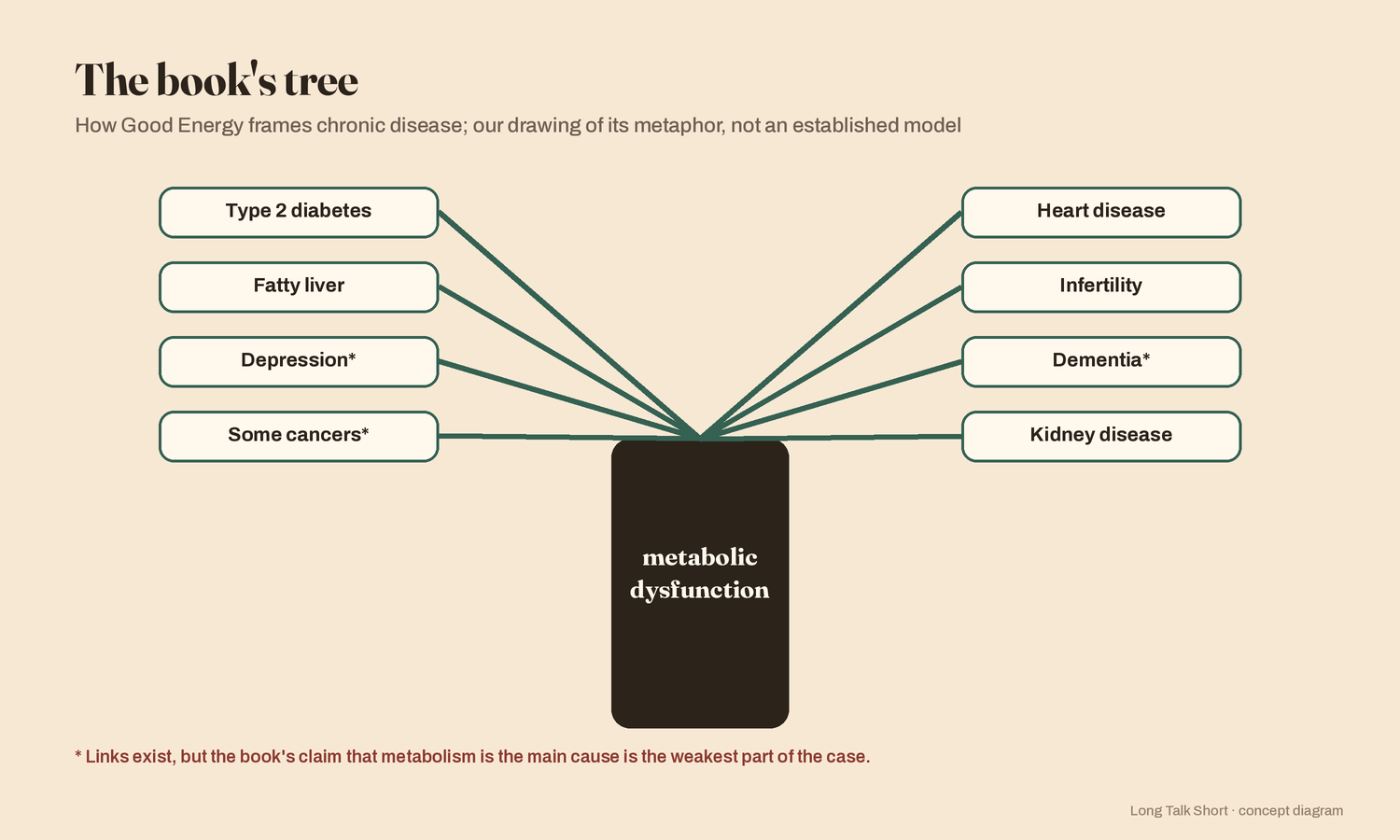
The book's central image is a tree. Its trunk is metabolic dysfunction. Its branches include:
- Well-established metabolic diseases: type 2 diabetes, obesity, heart disease, fatty liver and chronic kidney disease.
- Conditions with weaker links: dementia, some cancers, and others the authors also tie to metabolism, such as depression and infertility.
The deeper cause, in their account, lies in the mitochondria, the parts of your cells that make energy. Overloaded by sugar and refined starch, stressed by poor sleep and toxins, they stop working well. In an NPR interview, Casey Means compared the body to a Ferrari with no gas.
The story is also personal. Their mother died of pancreatic cancer within weeks of her diagnosis, and the authors describe a medical system that, in their view, treats each branch separately and profits from repeat visits rather than prevention. Casey describes leaving her surgical training disillusioned, then practising functional medicine.
So what do they actually tell you to do?
2. The prescriptions are familiar
The advice is more conventional than the framing:
- Cut ultra-processed food, refined grains, added sugar and industrial seed oils.
- Eat more fibre, protein, omega-3 fats and fermented food.
- Sleep seven to eight hours.
- Move: walk after meals, build muscle, and spend time outdoors and in heat or cold.
- Limit exposure to chemicals in plastics and pesticides.
The authors also suggest tracking yourself, including with a continuous glucose monitor (CGM), a small sensor worn on the arm that shows how your blood sugar rises after each meal.
3. Tighter numbers than your doctor uses
Standard medicine calls a fasting blood glucose under 100 mg/dL normal. The approach the Means promote treats roughly 70 to 85 as a better target, and urges you to avoid large glucose spikes after meals. This is where the book moves furthest from mainstream medicine, and where the evidence is thinnest.
Weighing it: what holds up
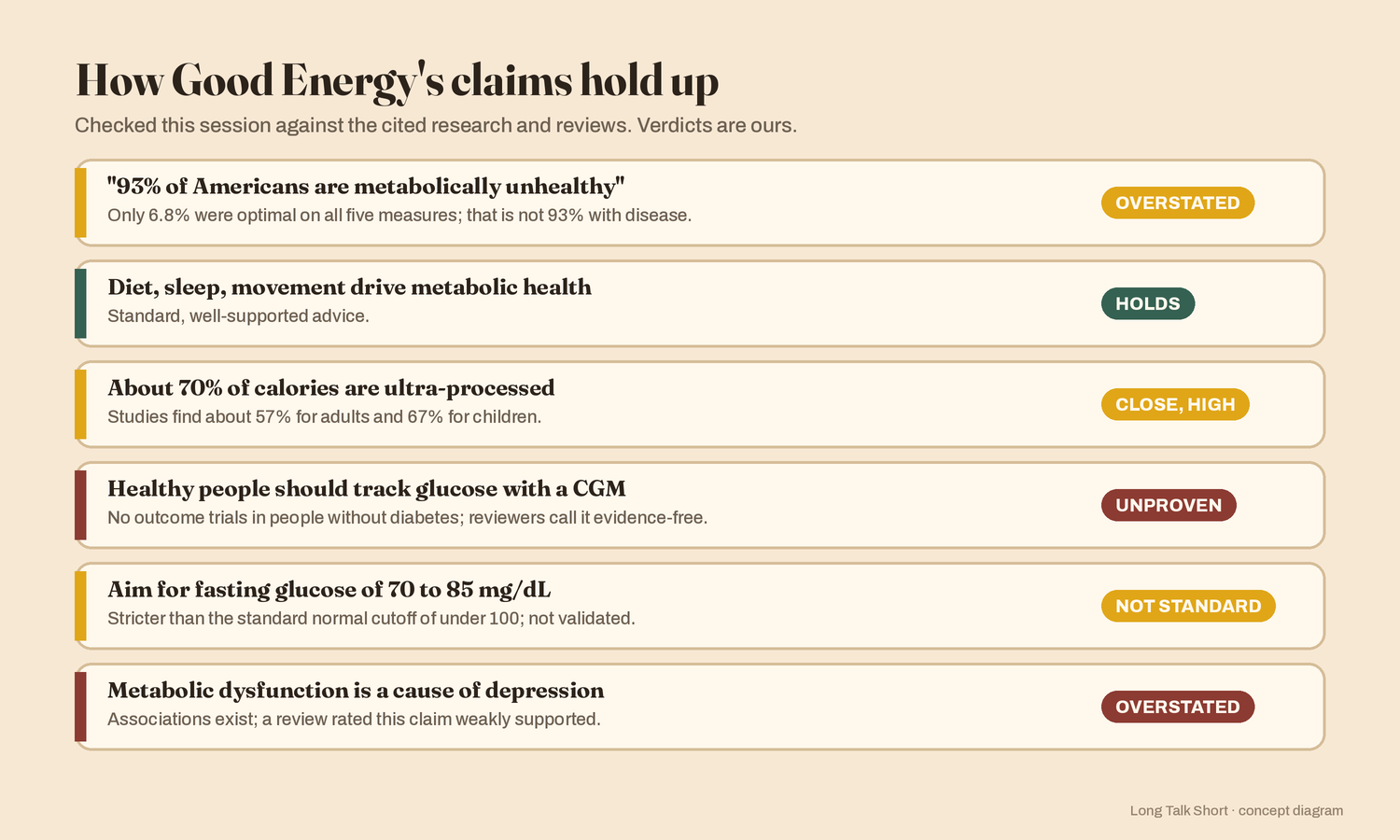
Holds up: ultra-processed food does dominate the American diet. We checked the book's figure of about 70% of calories. Large national surveys put it at 57% for adults (Juul and colleagues, 2022, American Journal of Clinical Nutrition) and 67% for children and teenagers (Wang and colleagues, 2021, JAMA), so the claim is high but in the right territory. Poor diet, inactivity and short sleep are well-established risk factors for many of the book's "branches."
Overstated: the 93% figure comes from a 2022 study in the Journal of the American College of Cardiology of about 55,000 US adults. It found that only 6.8% had optimal cardiometabolic health on five measures at once, including a BMI under 25, a fasting glucose under 100 and blood pressure under 120/80. Missing any one of those is not the same as being metabolically sick. The paper is a real warning, but "93% are unhealthy" stretches it. The links between metabolism and depression are also stronger in the book than in the evidence: Red Pen Reviews, an independent nutrition-book rater, scored the book 3 out of 4 for accuracy overall but 2 out of 4 for its depression claims.
Fair point: the complaint that medicine splits the body into specialties and pays more for treatment than prevention is shared by many doctors and health economists, even if the book states it in its most sweeping form. Making metabolic health visible early, before a diagnosis, is reasonable; the dispute is over how far to take it.
Unproven: CGMs are a valuable tool for people with diabetes. For healthy people, experts quoted in NPR, AP and Science News coverage say there are no validated targets, and studies show healthy people's glucose regularly spikes after meals without signs of harm. One diabetes journal editorial called non-diabetic CGM use an
evidence-free zone
The 70–85 fasting range is not a clinical standard. Notably, the same 2022 study the book uses for its 93% figure counted a fasting glucose under 100 as optimal.
Conflicts worth knowing: Casey Means co-founded Levels, a company that sells CGM-based metabolic tracking, and was its chief medical officer until late 2023. Calley Means co-founded TrueMed, which helps customers use pre-tax health savings accounts on wellness products. A 2025 New York Times report raised questions about whether that model complies with IRS rules, which the company disputes. Both became prominent in the Make America Healthy Again movement. Calley served as a senior adviser at the Department of Health and Human Services, and Casey was nominated for US surgeon general in May 2025, a nomination that was withdrawn in April 2026. None of this makes their advice wrong, but the book recommends products and approaches the authors have profited from.
Not checked: the book's claims about specific chemicals, seed oils, or cold and heat exposure. Verdicts in our scorecard are ours.
Related reading: for a doctor's prevention-first plan with its own evidence check, see Peter Attia's Outlive; on sleep claims that also needed a fact check, see Why We Sleep.
Long Talk Short
- The book argues that many chronic diseases share a root cause: cells that handle energy poorly.
- Its practical advice, less ultra-processed food plus better sleep, movement and stress management, is sound and widely supported.
- The headline claim that 93% of Americans are metabolically unhealthy rests on a strict definition of optimal health.
- Tighter glucose targets and glucose monitors for healthy people are not supported by clinical evidence.
- Both authors have business ties to the tools and approaches the book recommends.
The one thing to remember: you don't need a sensor or a new theory of disease to act on the book's best advice. Eat mostly real food, sleep, and move, and ask your doctor before you treat a normal reading as a problem.
Source: Good Energy: The Surprising Connection Between Metabolism and Limitless Health by Casey Means, MD, and Calley Means (Avery, 2024). This is an independent summary and is not affiliated with the authors or publisher.
This article is for general information only and is not medical advice. Talk to a doctor before changing your diet, starting a fast or interpreting your own test results. If you are struggling with low mood or thoughts of self-harm, talk to a doctor or, in the US, call or text 988, the Suicide & Crisis Lifeline.