Not Running Out, Running Late: Why Time, Not Copper, Limits AI Abundance
Copper has averaged about 38 years of reserves from 1960 on. Grand Angle argues the real shortage for AI is time, not matter. We check the copper, yttrium and turbine numbers, and the Simon-Ehrlich bet.
You have probably heard that AI-driven abundance is a fantasy because the Earth is finite. Grand Angle, a French economics channel, disagrees. It accepts that AI is physical: every answer runs on a chip, and every chip runs on energy and copper. It rejects the conclusion. What we are short of, it argues, is not matter or money. It is time.
In short: the planet's stocks of copper, energy and rare earths are not the binding limit on AI. The binding limits are how fast we can mine, refine, connect and build, plus the heat every computation gives off. Abundance is possible, the video argues, but only a relative kind, and whoever controls the bottlenecks will set its pace.
1. The deadline that keeps moving
Start with copper, which is in every cable, transformer and grid. From 1960 on, the video says, the world has on average had about 38 years of copper reserves ahead of it. Copper has been due to run out "in 38 years" for 66 years. The video says reserves have more than doubled from 2000; the data we checked show them nearly tripling, from about 340 million to 980 million tonnes.
The horizon moves with us.
That is the host's line (quotes are translated from French). Yet a large gas turbine for a data centre takes at least three years to arrive, the video says. The copper and the money are there; the machines can't be plugged in. So why did people expect the opposite?
2. The bet, and the rematch
In 1980 the biologist Paul Ehrlich, who expected population growth to exhaust the planet, took a bet from the economist Julian Simon, who saw human ingenuity as the ultimate resource. Ehrlich picked five metals; if their inflation-adjusted prices rose by 1990, Simon paid, and if they fell, Ehrlich did. All five fell, and Ehrlich mailed a cheque for $576.07.
But a 2010 study replayed the same bet over a century of data and found Ehrlich would have won about six times in ten. The bet, the host says, measured a race between how fast we use up good deposits and how fast we find others. Reserves are deposits worth mining at prevailing prices, so they grow when prices rise. If the metal is there, where does the friction come from?
3. Every fix moves the problem
Extraction is getting harder. In Chile, the largest copper producer, a tonne of ore held 1.13% copper in 2002 and about 0.6% in 2024, so nearly twice as much rock must be processed for the same metal. Recycling helps less than you'd hope: metals mixed into alloys are often "physically recycled but functionally lost."
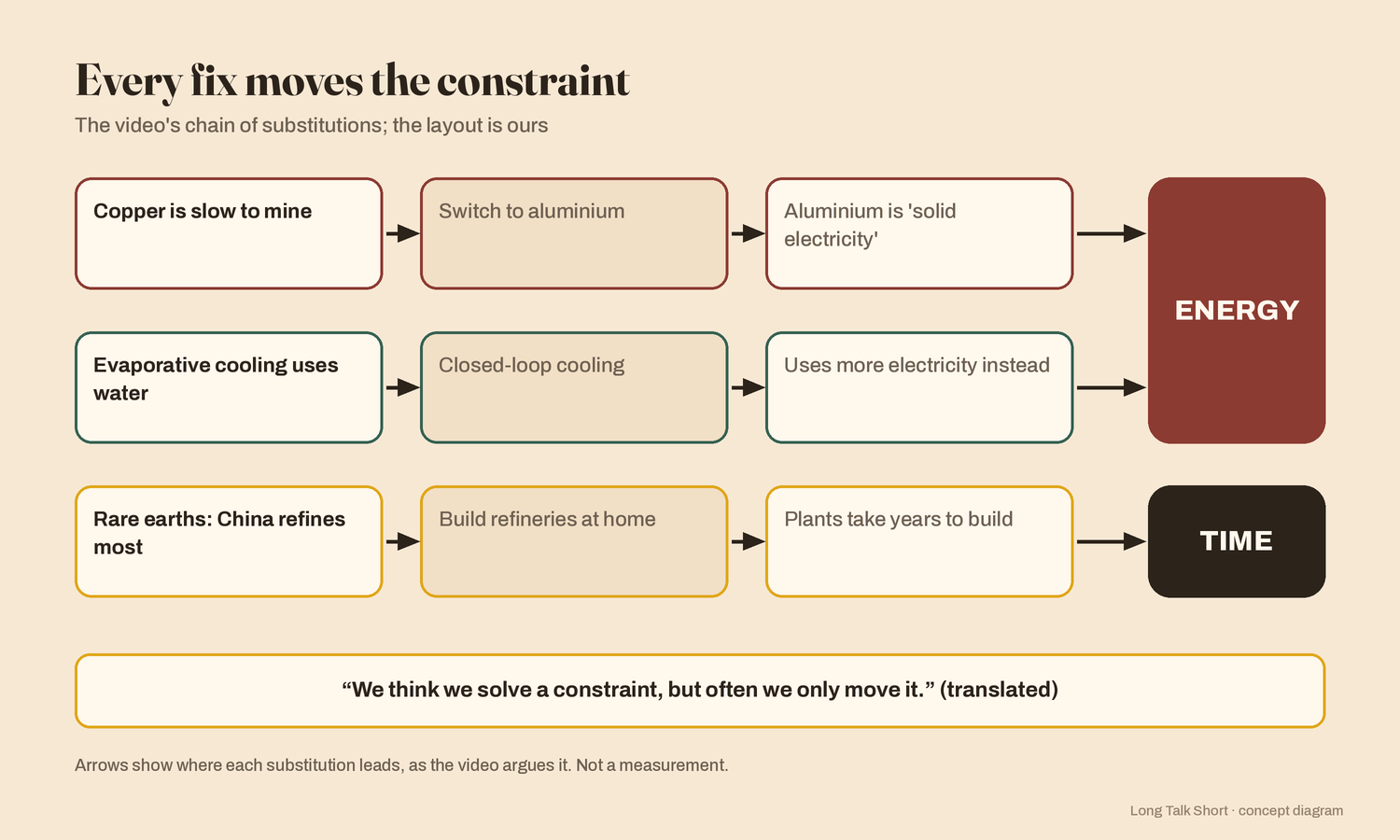
Then come AI's own constraints. Data centres may use about 950 terawatt-hours a year by 2030, roughly Japan's use but about 3% of world electricity. The International Energy Agency expects copper mines to fall short of demand by 2035. A mine takes about 17 years from discovery to production. Swap copper for aluminium and you need far more electricity, because aluminium is nicknamed "solidified electricity."
Rare earths aren't rare; China's grip on refining is the issue. When Beijing required export licences for seven of them in April 2025, the price of yttrium oxide, used in heat-shield coatings for gas turbines, rose more than fortyfold in Europe. Closed-loop cooling saves water but uses more power.
We think we solve a constraint, but often we only move it.
Everything comes back to energy and time.
4. Time is the scarce thing
Then follow the incentive. A one-gigawatt AI data centre costs about $38 billion to build and $8.5 billion a year to own, and electricity is about 7% of that. Chips without power leave over $20 billion of servers idle. So AI firms care less about the price of power than about getting it soon.
The video sees three ways out. Need less: Google says a typical Gemini prompt's energy fell 33-fold in a year, yet its electricity use still jumped. Make it yourself: xAI ran on-site gas turbines in Memphis. Or leave: Google's Project Suncatcher put AI chips into orbit on a SpaceX launch, and SpaceX has asked to launch up to a million computing satellites. Whoever controls launches controls access. But can any of this escape physics?
5. The limit that comes along
One limit travels with the machines: heat. Almost all the electricity a chip uses ends up as heat. The physicist Tom Murphy calculated that if energy use grew 2.3% a year, waste heat alone would make Earth unlivable within a few centuries. Yet chips, the video says, use about a million times the minimum energy Rolf Landauer showed in 1961 that computing requires, so there is huge room to improve.
The host's verdict is relative abundance: nearly unlimited for services, limited by throughput for goods, and impossible for what the economist Fred Hirsch called positional goods, like the best beach. His closing question: if time is the scarce resource, who decides how fast abundance arrives?
Weighing it: what holds up
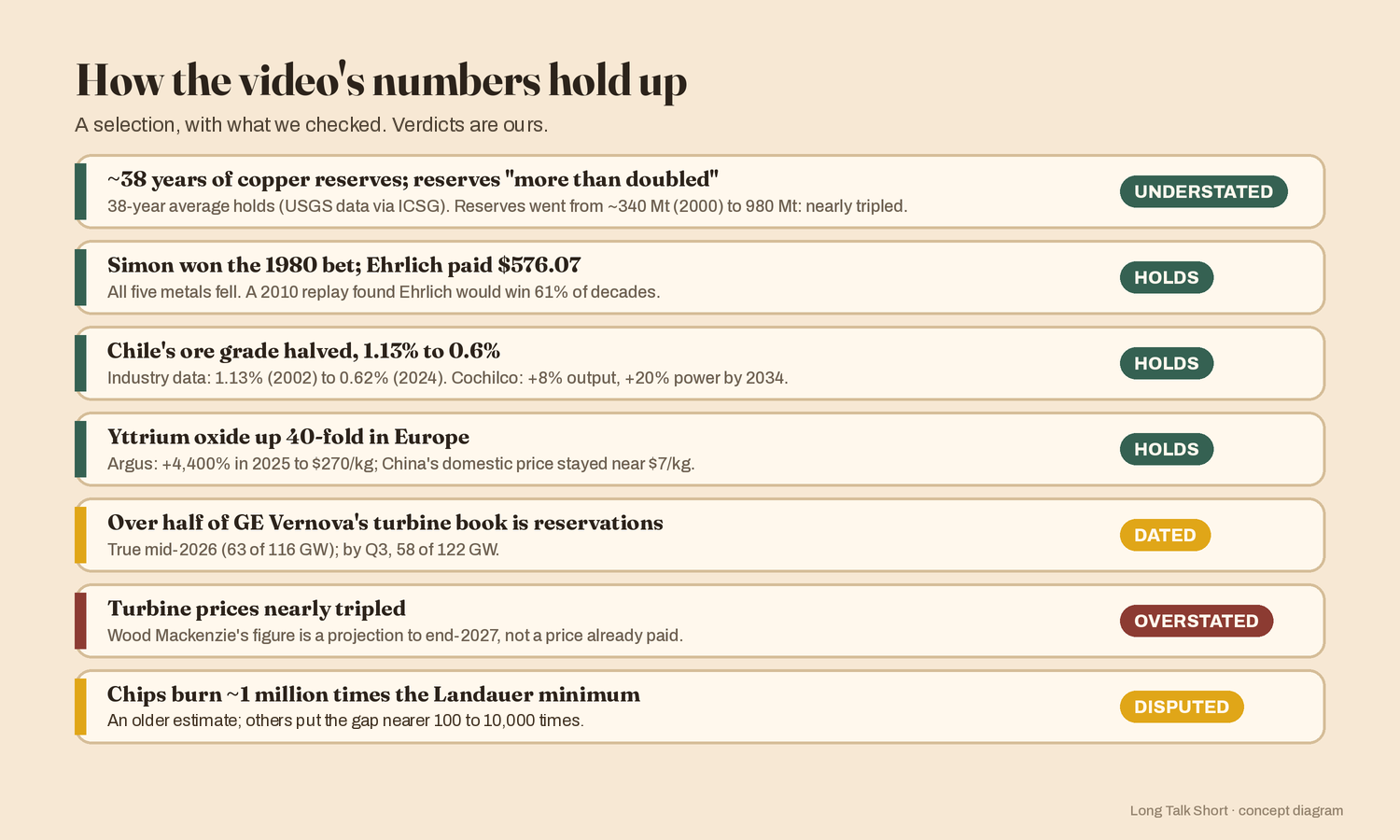
Holds up: The 1980 bet and its 2010 replay check out (Ehrlich wins 61% of ten-year periods from 1900 to 2007; a 2020 study excluding war years had Simon ahead about 70% of the time). So do the 38-year copper average, Chile's figures, the IEA's projections, Argus's +4,400% yttrium price, Google's figures, the Suncatcher launch and Murphy's calculation. One slip: the captions date the Pentagon's MP Materials deal to 2005; it was July 2025.
Understated: Copper reserves went from about 340 million to 980 million tonnes, nearly tripling, not merely doubling.
Overstated: Wood Mackenzie's "nearly tripled" turbine price is a projection for end-2027, and it cites six-year lead times, not three. Turbine-slot reservations were over half of GE Vernova's book in mid-2026 but under half by the third quarter.
Disputed: The million-fold Landauer gap is an older estimate; other estimates say 100 to 10,000 times. SpaceX's own filing says space data centres may not be commercially viable, so treat orbital computing as conditional.
Not checked: China's mining and refining shares, chip-output growth and the Strauss and Altman quotes. Treat them as the video's claims.
About this piece: We worked from YouTube's automatic French captions, a machine transcript with errors; quotes are our translations. It covers physical limits, not the financing question. The verdicts and groupings are ours.
Bottom line: The core argument holds: reserves keep pace on paper, while lead times, refining and heat set the real speed limit.
Related reading: AI Isn't the Bubble. The Debt Behind It Might Be. · Anthropic's Numbers Are Real. So Is the Bill · Who Pays for the Chips? 20VC on AI's Build-Out
Long Talk Short
- Copper has averaged about 38 years of reserves from 1960 on, because reserves depend on price and technology.
- Simon won the 1980 bet, but over a century it's closer to a toss-up.
- Most fixes move the constraint: copper to aluminium to electricity, water to electricity, rare earths to years of plant building.
- For AI firms, power is cheap but delay is costly, so they pay for speed or look to orbit.
The one thing to remember: the planet is not running out first. Time is, and whoever controls the bottlenecks controls the pace.
Source: Grand Angle, "Pourquoi la planète ne s'épuise pas comme prévu ?" (Why isn't the planet running out as predicted?), a French-language video. Quotes translated by Long Talk Short. This is an independent summary and is not affiliated with the channel.
This article is for general information only and is not investment advice.