Ultra-Competitive, Unjust, Unstable: Stanford’s Nir Halevy on Fixing a Broken Hierarchy From Any Rung
Stanford GSB’s Nir Halevy says a broken hierarchy is ultra-competitive, unjust, and unstable, and that anyone, without a title or budget, can start repairing it. Studies are as he describes them; he is promoting his book.
If you have been waiting for a title, a budget, or a reorg before you can fix a toxic org chart, Nir Halevy’s claim is that you can start without any of those. Hierarchies, he tells a Stanford GSB audience, are not the enemy. Some help teams win. Some “harm individual well-being and they undermine team success and they hurt organizational performance.” The work is telling those two apart, and then practicing a few moves that do not require you to be in charge.
The talk is “How to Fix a Broken Hierarchy | Nir Halevy on Level Up | Stanford GSB,” at youtube.com/watch?v=MT6cMeg_eb4. Halevy, a Stanford GSB professor, wrote Level Up: Why Hierarchies Are Broken and How to Fix Them. Andrea Puig, an MSx student, moderates. Stanford GSB’s Corporations and Society Initiative (CASI) and the Program on Capitalism and Democracy (CDDRL) hosted. Auto-generated captions were used for wording; they often render his first name as “Near.” Studies are cited as he describes them, and where we could check them against the published papers, we say so.
Disclosure: Halevy is discussing and promoting his own book, at an event hosted by his own university, and he is a co-author of two of the studies he cites. That is a reason to listen closely, not a reason to doubt the findings.
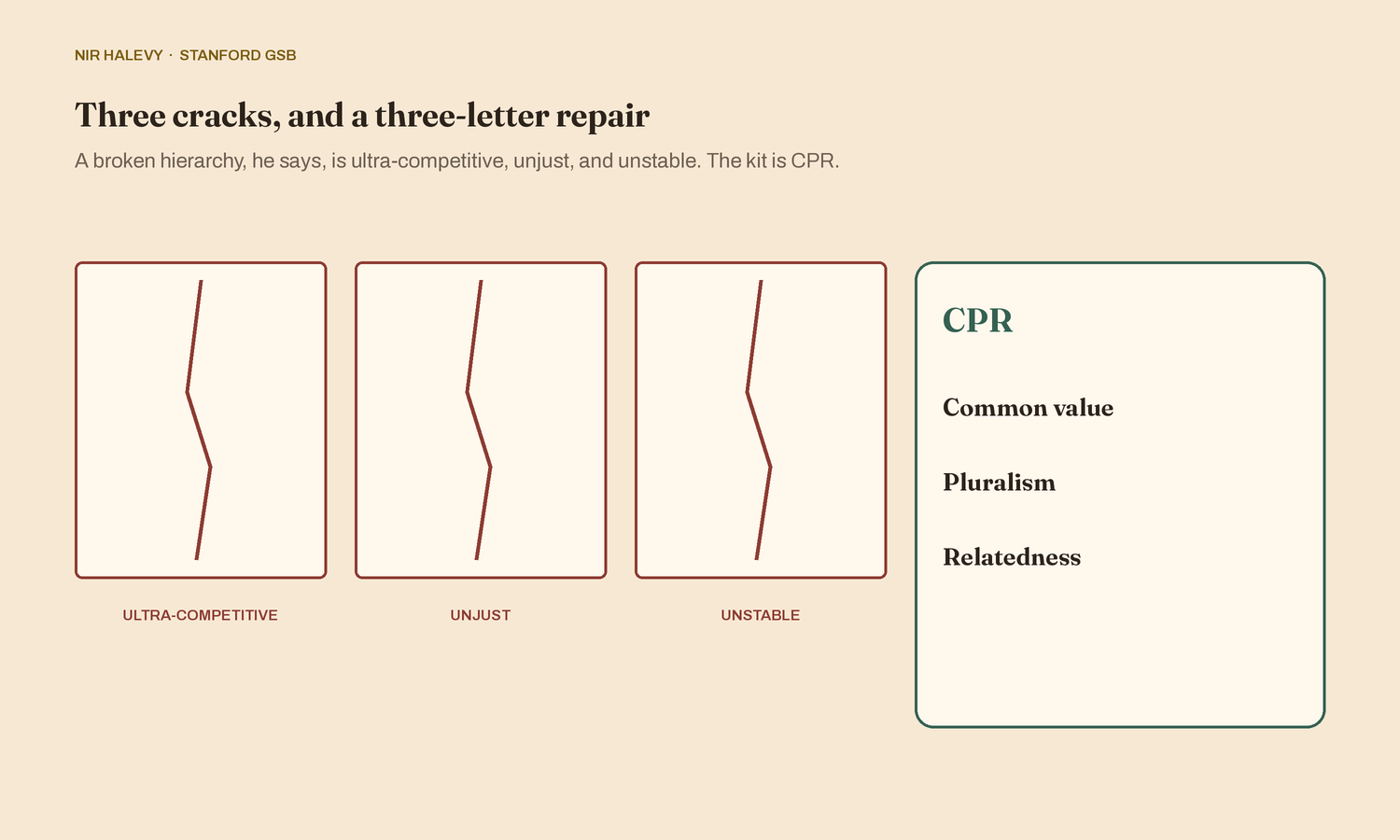
In short: Halevy says a hierarchy is broken when it is ultra-competitive, unjust, and unstable, and that anyone, from any rung, can start repairing it with three habits he calls CPR: common value, pluralism, and relatedness. His two no-title moves are a handwritten gratitude letter and a habit of asking to co-lead.
1. When a steep ladder both wins and kills
The puzzle, as Puig frames it from the book, is stark. “NBA teams that have steeper hierarchies win more often,” she says, “and in Himalayan expeditions, cultures that come from stronger hierarchies reach the summit, but more of their climbers die.” Halevy’s first cut is psychological safety, a construct he attributes to “Amy Edmondson, our colleague at Harvard.” Without it, “people are afraid to speak up” and worry that voicing concerns will be punished.
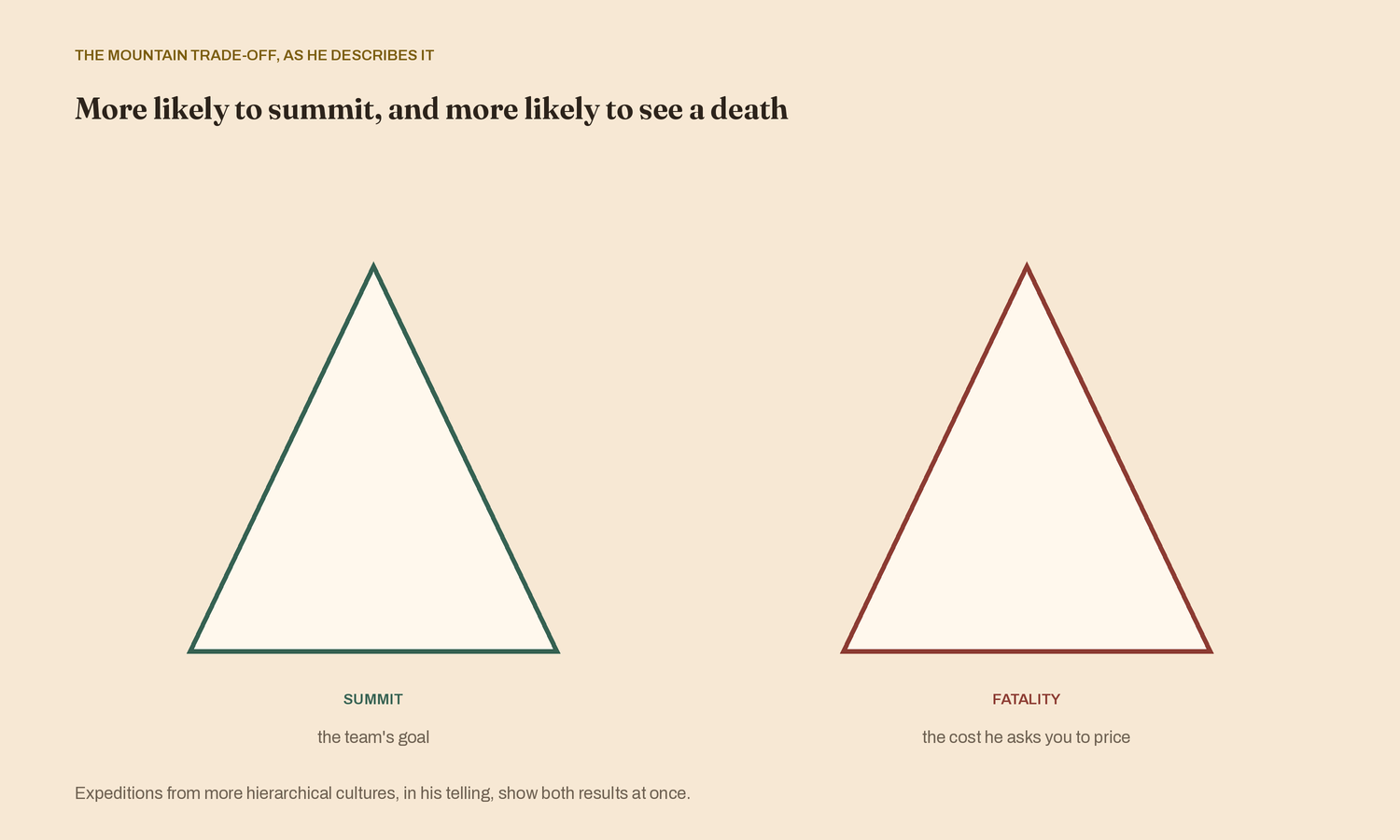
On the mountain, he says, expeditions from “more hierarchical cultural contexts,” where “subordinates might feel worried and apprehensive to bring up concerns with supervisors,” show two results at once. They are “significantly more likely to make it to the top,” and “significantly more likely to have someone die during the expedition.” “Think about yourselves as leaders. Would you take this trade-off?” When safety is missing, the room “tends to be this kind of ultra competitive, unjust, unstable environment.” Those are the three symptoms he wants you to recognize. On checking: the NBA result matches the published paper by Halevy and colleagues (Halevy, Chou, Galinsky and Murnighan, 2012), which links steeper hierarchy to better team performance, and the expedition result matches Anicich, Swaab and Galinsky, 2015, an observational analysis of 5,104 Himalayan expeditions, with statistical controls, that finds the pattern for group expeditions and not for solo climbers. Both show a pattern, not a controlled experiment.
A second line of work, which he co-authored (Fast, Halevy and Galinsky, 2012), is about power without status — control over resources without “freely conferred respect and admiration.” In a lab experiment, people randomly assigned to that combination “chose significantly more demeaning behaviors for other people to do in order to get paid,” including tasks like “bark like a dog.” “It’s not their personality,” he says. After the paper appeared, a consultant working with the federal government told him they had “the same problem.” The portable claim is that rank has more than one face, and that power minus respect is a design problem, not just a bad boss.
2. CPR: common value, pluralism, relatedness
The repair kit is a three-letter frame he calls CPR. Common value, he says, has “two elements.” “We want a hierarchy that represents who we are, what we believe in, who we wish to be.” And “we also want to make sure it creates benefits for everyone, not just for the people at the top.” Daily respect is part of that: reiterating a colleague’s point, or changing what gets measured. He takes the room to Televerde, a business-to-business marketing firm that, in his telling, employs people in prisons. In interviews, employees described getting something they did not get in the yard or from guards: respect. When the CEO “came to the prison with a big client… he just sat back there like a proud father and let us speak.” Halevy wants both “the respect and dignity that all humans deserve just by being humans” and “individualized respect” for a particular achievement.
Pluralism is the second letter: many ways to contribute, not one prototype of the “typical employee.” Puig’s example is a Mount Everest expedition in which Marco Siffredi — the captions stumble on the name; she means the climber, not the actor — “slept very late” and “skipped all the morning chores” until the leader, Owen West, found that Marco “was staying until super late to cook for the Sherpas.” “No foreigner from that team could have reached the summit without the Sherpa.” Halevy’s moral is “active listening.” Elite ballet dancers described “at least a dozen ways” to contribute besides technical perfection: a large social audience, a reliable partner in a lift, advising younger dancers, welcoming guest choreographers. He also cites research “showing that when you highlight other people’s contributions, you both elevate in status. It’s not coming at your expense.”
Relatedness is the third. It is not, he says, “just kind of this fluffy soft kind of concept. It’s a way to keep talent in.” He points to research by Matthew Bidwell and a co-author on people moving laterally inside an organization rather than leaving it. If “competitiveness and injustice and instability are making people leave, they’re not going to be able to contribute.” A daily reminder: ask about someone else’s day, and listen.
3. Two things you can do without a title
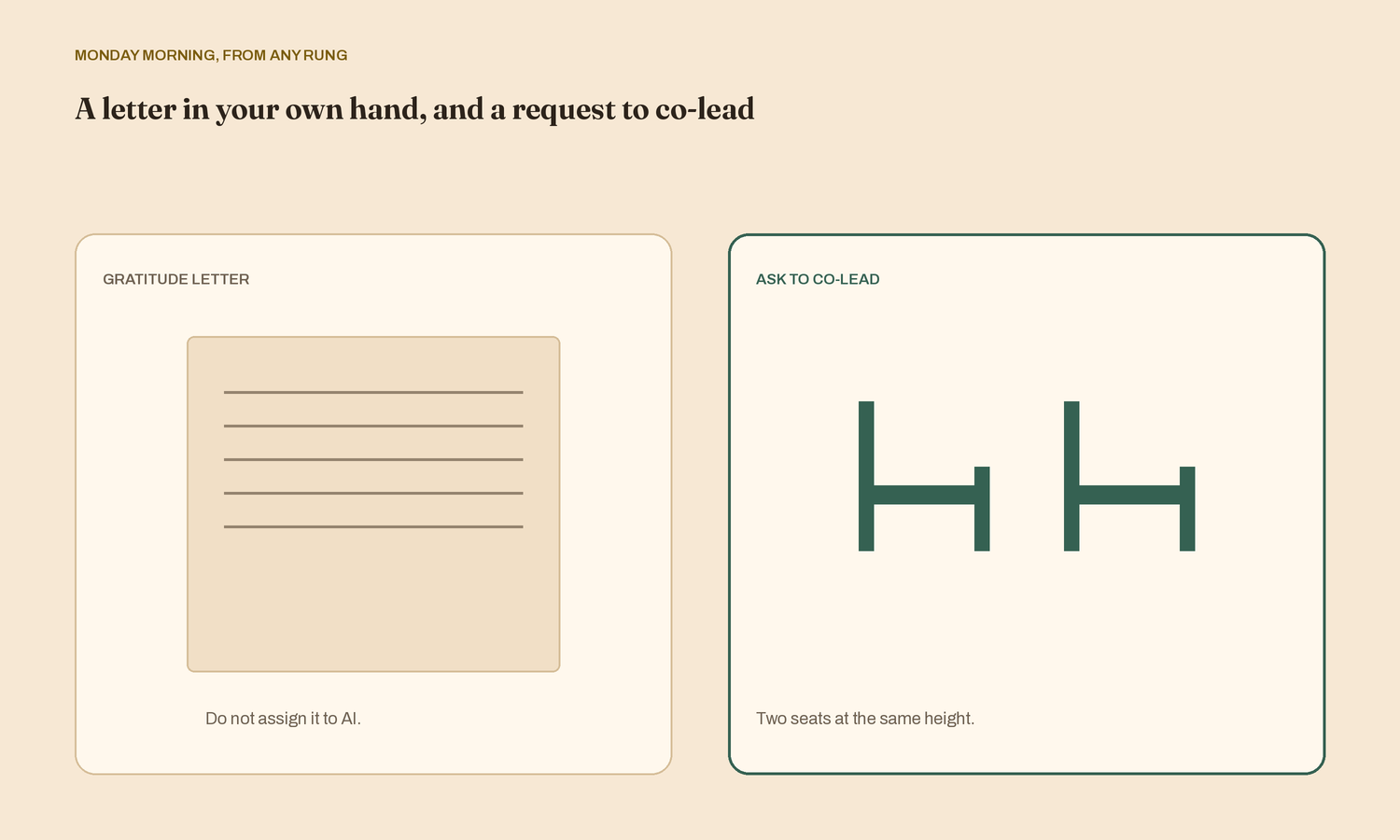
Puig poses a Monday-morning case: someone with “no title,” “no budget,” staring at a broken hierarchy. Halevy offers two moves. First, “write a gratitude letter… do it today,” to a colleague, an intern, or “someone who might be your co-founder.” “There are no barriers.” Then a hard rule: “Do not assign it to AI. Write it by hand.” Second, the next time you are asked to head a task force or chair a committee, “ask to do it with someone else.” You lower your own burden, “elevate someone else,” and “start reinforcing the notion of shared leadership.” He points to co-CEO and co-division-head pairings, including complementary leads in Stanford Healthcare, and says organizational-behavior research speaks to when tandem leadership works. The market, as he describes it, “actually rewards companies that announce” co-CEOs.
Weighing it: what holds up
Halevy is teaching from his own book and from studies he has run or is retelling. The NBA, Himalayan, and power-without-status studies match the published abstracts and findings, with the caveat that two of them have Halevy as an author and all three show associations in particular settings, not universal laws. The Bidwell mobility work, the ballet interviews, and the claim about how markets greet co-CEO announcements are presented as he describes them, not re-analyzed from the original papers here. Televerde and the Everest anecdote are illustrative cases in that same telling. Auto-generated captions stumble on names (Edmondson, Televerde, Siffredi, Nadal). Psychological safety is a real research program; it is not a guarantee that a handwritten note will repair a broken shop.
Related reading: War, Coalitions, and the Human Mind · Power Without a Vote
Long Talk Short
- Halevy’s test of a broken hierarchy is a pattern: ultra-competitive, unjust, and unstable, often in a room that lacks psychological safety.
- A steep ladder can deliver a win and still be a bad bargain, as in the Himalayan expeditions he describes, more likely both to summit and to see a death.
- His repair frame is CPR: a hierarchy that expresses shared values and benefits more than the top, recognizes many kinds of contribution, and keeps people related enough to stay.
- The Monday-morning moves he offers, from any rung, are a handwritten gratitude letter — not an AI draft — and a habit of asking to co-lead.
The one thing to remember: You do not have to wait for the org chart to change: Halevy argues that respect, many ways to contribute, and a bit of shared leadership can start from any rung.
Independent summary; not affiliated with Stanford GSB or Nir Halevy. Studies are as Halevy describes them unless linked above.
Source: Stanford GSB, “How to Fix a Broken Hierarchy | Nir Halevy on Level Up,” on YouTube (linked above); the published studies are linked in the article. Independent summary; not affiliated with the school or its guest.