War, Coalitions, and the Human Mind
You've heard that war made us smart. Evolutionary psychologist David Geary argues male coalitions and conflict shaped the human mind. Here's his case, the 17-to-1 genetic signal, and where hypothesis stops.
If you have ever wondered why human intelligence looks so socially sharp and so ready for conflict, David Geary has a blunt evolutionary answer. On Modern Wisdom with Chris Williamson, the University of Missouri evolutionary psychologist argues that coalitional competition—especially among male kin groups armed with tools—helped drive brain expansion, cooperation and institutions. Treat that as a hypothesis about deep history, not a verdict on any living person, and not a license to naturalize violence.
In short: Geary links bigger brains and complex social minds to between-group conflict amplified by technology and male philopatry. He cites archaeology and a Holocene Y-chromosome diversity collapse often summarized as roughly seventeen female ancestors per male lineage. Those are patterns under scientific debate. Group averages are not individual destinies.
1. The conflict pressure story
Geary starts with australopithecines and tracks brain growth through Homo habilis and Homo erectus. Better foraging, tools and later cooking, he argues, raised calories, cut mortality and grew populations. Larger groups then faced per-capita resource stress and pushed into others' ranges. On his reading, regions with more coexisting Homo species show higher extinction risk for some of them. Ecological competence alone, he says, underplays the conflict dynamic that follows population success.
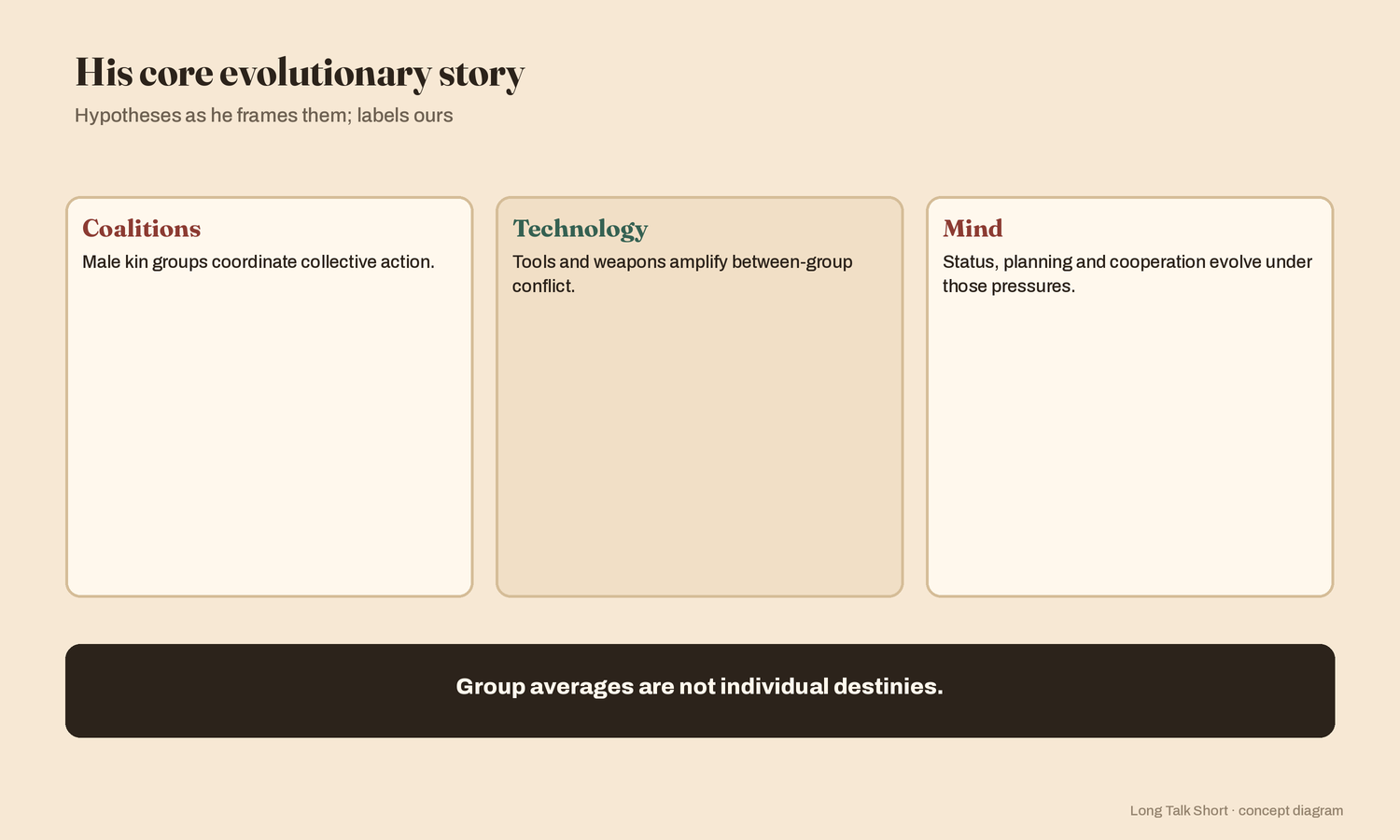
He attributes much of the expansion drive to male kin-based coalitions. In chimpanzees and, he argues, in our ancestors, males more often remained in the birth group while females dispersed to avoid inbreeding, which makes durable male coalitions easier to assemble. Tools were not only for hunting; many were weapons. Archaeological violence and genetic patterns, in his account, track expansions that erased rival male lineages while often incorporating women. Reproductive skew among men—already wider than among women in hunter-gatherer contexts—became extreme in early empires, he says, as dominant coalitions monopolized mating.
2. The 17-to-1 signal
The sharpest number in the episode is a roughly 17-to-1 ratio of female to male ancestors in the mid-Holocene, after early agriculture, inferred by comparing mitochondrial DNA lineages with Y-chromosome lineages. Geary argues famine or epidemic should hit both sexes, so a sex-specific collapse in male lineage diversity points to organized elimination of men by expanding patrilineal groups. Williamson presses the distinction: total headcount need not fall seventeen-fold if men are preferentially removed while women survive.
That Holocene Y-chromosome bottleneck is a real reported genetic pattern. Interpreting it as proof of worldwide clan warfare is a live debate. Population geneticists, including work popularized around Stanford modeling, have argued patrilineal-clan competition can slash Y diversity without a literal disappearance of most men—related men share similar Y chromosomes, so one clan's victory erases many lineages at once. Geary's "that must have happened" is stronger than careful consensus wording.
3. Minds, status and modern leaps
Geary ties cognitive evolution to status: self-generated future imagery biased toward higher status, better resources and safer positions for offspring—historically buffers when disaster hit. He treats intense cooperation and intense conflict as two sides of coalition life; hierarchies that suppress internal violence can project force outward. In comparatively peaceful societies, he suggests, competitive motives migrate into digital prestige fights and institutional politics rather than vanishing.
He is explicit that "patriarchy," as he uses the word, has deep roots in male coalitions that built institutions, and that many women prefer different social tactics while a minority compete inside male-typical hierarchies. That is among the interview's most contested moves: a prehistoric sketch turned toward present workplaces and culture-war arguments. It is not a controlled demonstration that any modern organization must work that way, and it does not license discrimination.
A recurring line is that intense cooperation and intense conflict are two sides of the same coin. Larger coalitions beat smaller ones, so agricultural communities and nomadic raiders ratchet organization, defenses and weapons in an arms race that, Geary argues, also diversifies economies—weapons makers, harvesters, markets—while the original stressor remains between-group competition. Once a hierarchy stabilizes, elites suppress the in-group violence that threatens them, until revolt or external displacement resets the cycle.
He also folds in paternal investment deep in the hominin past and the long dependency of human children: costly offspring make status, protection and coalition membership more consequential for survival. Those threads support his account of why minds track status and future plans so obsessively. They still do not turn average sex differences into rules for any one child, student or worker.
When Williamson asks what happens if societies become much more peaceful, Geary's half-serious answer is that people get bored and attack each other on social media—status drive without spears. Even as a joke, it shows the model he is selling: motives persist when outlets change. That is a hypothesis about continuity of competition, not evidence that online cruelty is genetically required or morally excused.
Weighing it: what holds up
Framing: An evolutionary hypothesis about deep history, not a verdict on living people and not a license to naturalize violence.
Holds up: Brain-size trends and archaeological violence are widely discussed. The Holocene Y-chromosome bottleneck is a documented genetic pattern. Studying whether conflict shaped cognition is compatible with refusing to excuse violence.
Partly holds: Geary's weighting of war as a central engine is his synthesis. Causes of the Y-bottleneck remain argued; patrilineal-clan models can slash Y diversity without a literal disappearance of most men.
Corrections: "war only" as the explanation is a contested claim, not a settled law. Group evolutionary averages do not determine individual character.
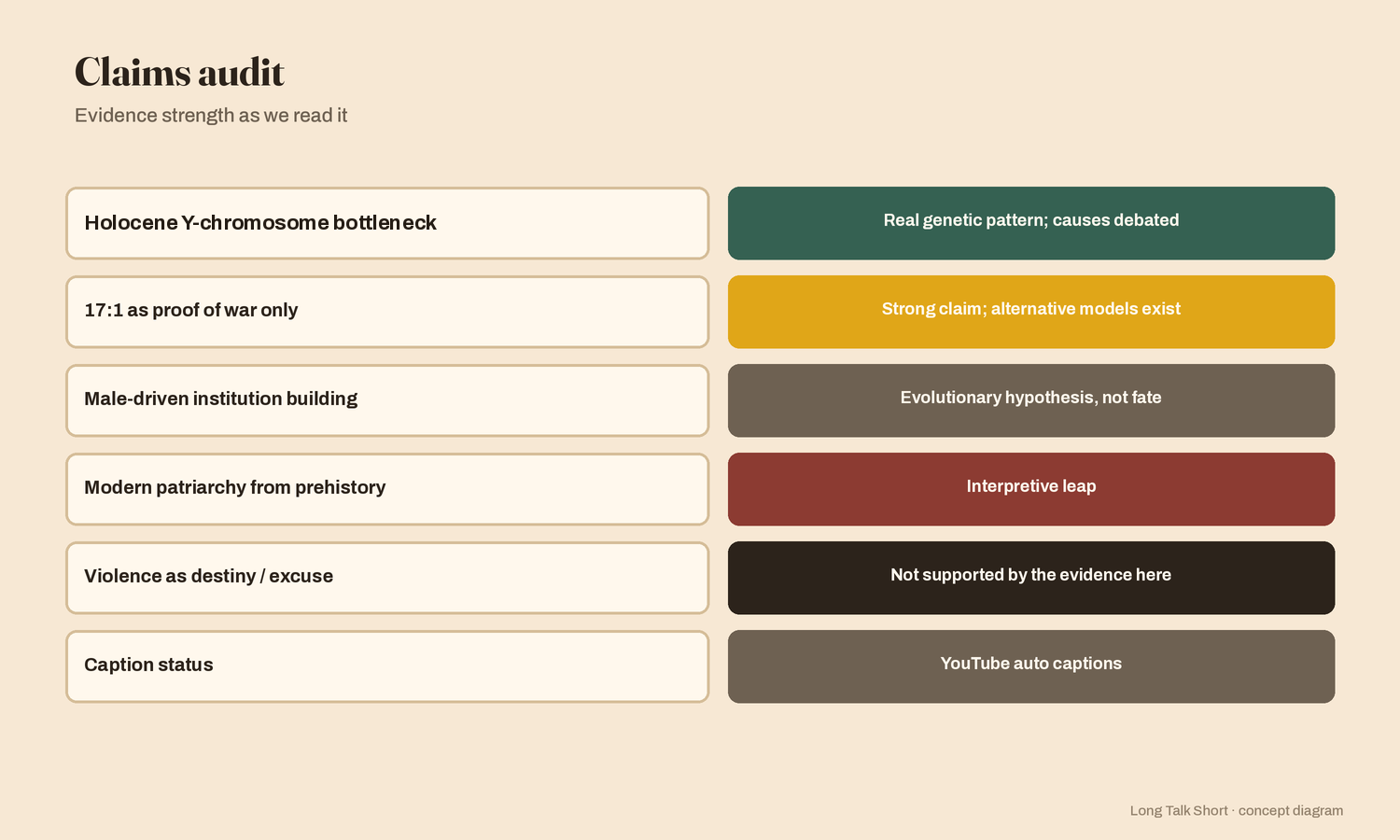
Not checked: Modern institutional sex-composition claims follow from his model rather than from a decisive experiment presented here. Our transcript is YouTube automatic captions. The figure groupings are ours.
Disclosures: Modern Wisdom interleaves long interviews with advertiser reads; those ads are unrelated to the thesis but mark a commercial podcast. Geary is revising The Origin of Mind; the episode advocates that framework.
Bottom line: you can study how conflict may have shaped minds without mistaking an evolutionary hypothesis for a moral command.
Related reading: Sapolsky on why you did that · Haidt on moral tribes · Annie Duke on judging the bet
Long Talk Short
- Geary argues male coalitional conflict, amplified by weapons and organization, helped shape human minds and societies.
- He points to archaeology and a Holocene collapse in Y-chromosome diversity often summarized as about 17 female ancestors per male lineage.
- The genetic bottleneck is real as a pattern; "war only" is a contested explanation, not a settled law.
- Group evolutionary averages do not determine individual character or justify violence.
- Leaps from prehistory to modern workplace sex dynamics remain interpretive.
The one thing to remember: you can study how conflict may have shaped minds without mistaking an evolutionary hypothesis for a moral command.
This summary is for general information only and is not professional advice.
Source: Modern Wisdom / Chris Williamson, "How War Shaped Human Evolution - David Geary," on YouTube. This is an independent summary and is not affiliated with Modern Wisdom or David Geary.