Interests or Prophecy? Jiang Xueqin's End-Times Theory of the Iran War, Checked
You've heard the war explained as a fight over oil or China. YouTube forecaster Jiang Xueqin says neither fits, and blames end-times belief instead. His argument, what checks out, what doesn't, and why the headline goes far beyond the evidence.
If the war with Iran makes no sense to you as a contest of national interests, Jiang Xueqin agrees, and he thinks he knows why: belief. On Jack Neel's podcast, the Beijing-based teacher behind the YouTube channel Predictive History argues that the usual strategic explanations fail, and that a committed religious minority sees the conflict as a step toward the end times. It is a striking thesis. Much of it is asserted rather than shown, and several of his facts do not survive checking.
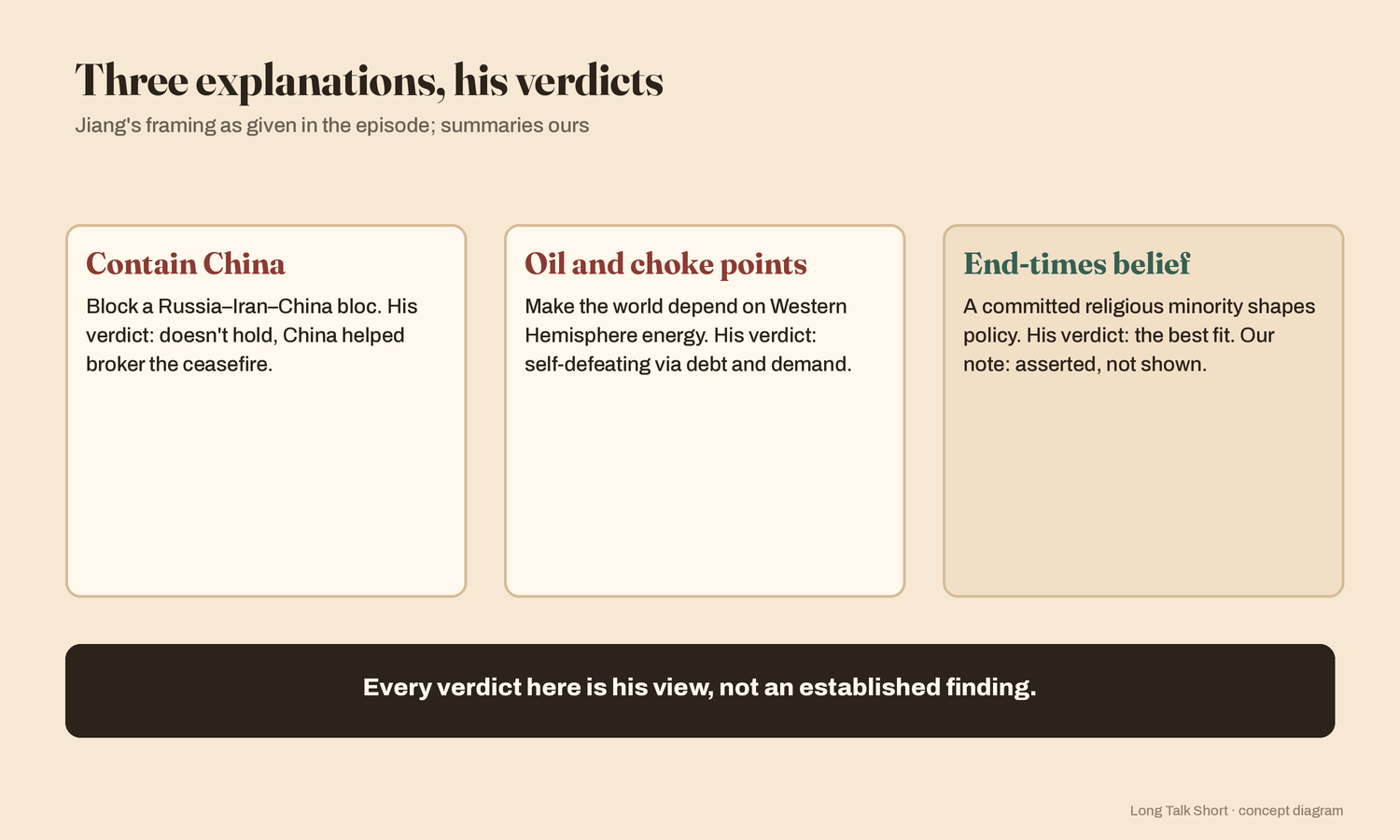
In short: Jiang tests three explanations for the war. Containing China fails, he says, because China helped broker the ceasefire. Controlling oil and shipping choke points fails because it pushes the US toward a debt crisis. That leaves end-times belief, which he argues works through a small, organized minority. He also forecasts a long-term alliance between Israel and India. These are his interpretations and predictions, not established findings.
1. Who is making the argument
Jiang is billed as "Professor Jiang," but that is his YouTube persona, not an academic post. Press profiles report that he holds a Yale degree in English literature and teaches history and philosophy at Moonshot Academy, a private high school in Beijing. He has no faculty appointment. His following grew after a lecture predicted that Donald Trump would win the presidential election and that the United States would then be drawn into war with Iran. Both happened. His third prediction, that the US would lose that war, is unresolved, and critics note that a Trump-Iran confrontation was a common forecast at the time. So how does he explain the war itself?
2. Why he rejects the realist explanations
Jiang starts with realism, the school that says states fight over interests, and argues that the Middle East war makes no sense in those terms. The first common explanation is that the war aims to contain China by blocking a Russia–Iran–China bloc. He rejects it. In his account, Iran was "essentially winning" when it signed a ceasefire memorandum after weeks of heavy bombing, and did so only because China pressed it to, with security guarantees attached. He offers this as what he believes happened, not as documented fact.
The second explanation is that Washington wants control of oil and maritime choke points so that Asia and Europe depend on Western Hemisphere energy. Jiang gives this more credit, but argues that it defeats itself. His chain: Japan loses cheap Gulf energy, the yen weakens, and Japanese investors repatriate money instead of buying US Treasuries. America then has to pay higher rates on roughly $40 trillion of debt. With interests set aside, what is left?
3. The belief thesis
Neel opens with a complaint, filed through the Military Religious Freedom Foundation, alleging that a commander told troops President Trump was "anointed by Jesus to light the signal fire in Iran to cause Armageddon." The complaint is anonymous and unverified, but Jiang takes it as a clue. In his view, believers scattered through the government, military and national security system see the war as fulfilling biblical prophecy.
His mechanism is political organization, not numbers. "The world is not run by logic or reason or truth," he says, but by people who "will fight and die for what they believe in." He puts the committed core at perhaps 1 or 2% of the population, organized while the majority stays silent. As evidence of donor power, he cites the defeat of Representative Thomas Massie in Kentucky's Republican primary. He also claims Democratic leaders "railroaded" Bernie Sanders in his presidential runs, a contested claim we did not adjudicate. Where does he think this leads?
4. His forecast: Israel and India
Asked for a fresh prediction, Jiang forecasts "a grand alliance between Zionist capital and Hindu labor." His reasoning is demographic: Israel has technology and capital but not population, and India has more young people than jobs. He describes exporting Indian labor to Canada and the Middle East as a deliberate replacement strategy by "transnational capitalists." That is a sweeping claim about intent that he does not support with evidence. Parts of it echo replacement narratives, and some of his generalizations about national groups are stereotypes, not analysis.
The episode ends with a quick round of predictions. Will elites stage an alien invasion? He says yes. Might Japan alone among rich countries choose euthanasia for its elderly? He says possibly, illustrating ageing societies with Calhoun's "rat utopia" experiment.
Weighing it: what holds up
Framing: The title, "This Will Be Armageddon! The US Military Wants to End The World," is not what the episode shows. At most there is an anonymous complaint about one commander and Jiang's argument that a religious minority shapes policy. Nothing presented establishes that "the US military" wants the world to end. About a third of the episode covers other subjects, and it is part one of his second appearance.
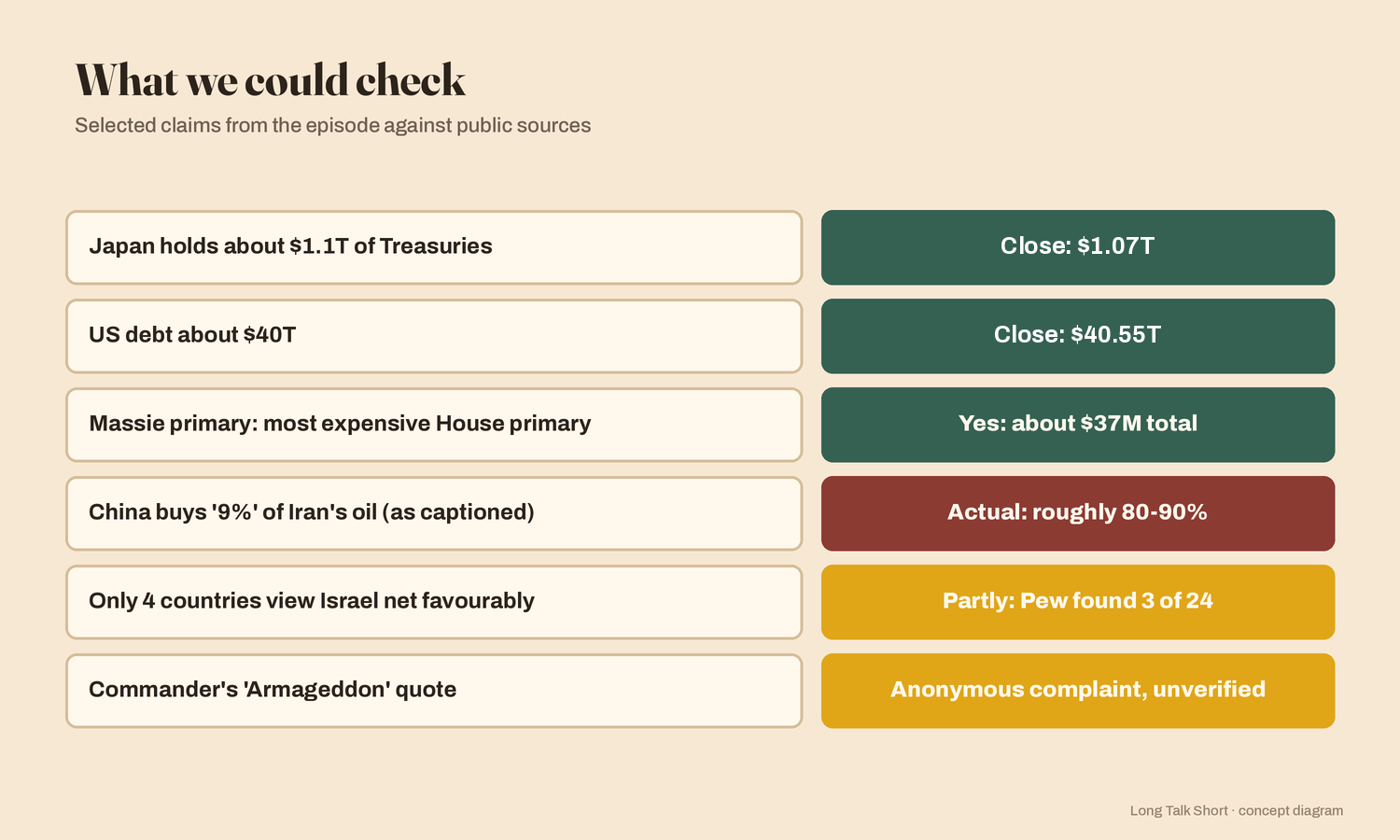
Holds up: His debt figures are close: Treasury data put Japan's holdings at $1.07 trillion and total US debt at $40.55 trillion. Massie did lose; the roughly $37 million race was reported as the most expensive House primary on record, and Miriam Adelson, Paul Singer and John Paulson were among donors to PACs opposing him.
Partly holds: He says only four countries view Israel net favourably; Pew's survey found three of 24 (India, Kenya, Nigeria), and Ghana, which he named, was not surveyed.
Corrections: The captions have him saying China buys "9%" of Iran's oil; estimates are 80–90%, so this may be a slip or a caption error. As president pro tempore, Senator Chuck Grassley is third in the line of succession, not fourth. The rat experiments were John B. Calhoun's, not "James." Canada has alleged Indian involvement in the killing of a Sikh leader there; India denies it, so it is not "all factual" as he says.
Not checked: The Armageddon quote is unverified: the MRFF published the complaint, but it is anonymous, and Snopes and Lead Stories found no recording or independent confirmation. China's alleged security guarantees, the ceasefire's terms and his membership figures are his. Claims about anyone's intent, whether religious factions, party leaders or investors, are interpretation, and the Israel–India alliance is a forecast. Quotes were checked against YouTube's automatic captions, a machine transcript.
Disclosures: The episode includes a Morgan & Morgan legal ad. Our figure groupings are ours.
Bottom line: a provocative argument by elimination whose leftover explanation is never actually demonstrated; treat it as one commentator's hypothesis about a contested war.
Related reading: Mohamed El-Erian on the Iran war and oil · Jiang Xueqin's case against the meritocracy, checked · Sarah Paine on why the sea beats the land
Long Talk Short
- Jiang argues that neither containing China nor controlling oil explains the Iran war in realist terms.
- His alternative, that an organized religious minority with end-times beliefs shapes policy, is asserted, not shown.
- His debt warning rests on real numbers: about $40 trillion owed and large Japanese Treasury holdings.
- Several specifics were wrong or overstated, from China's oil share to the Pew results.
- He is a high-school teacher and YouTuber; two election-era calls landed, but his core prediction is unresolved.
The one thing to remember: when an argument works by ruling out the alternatives, check whether the leftover explanation was ever proven, or only left standing.
This summary is for general information only and is not investment, financial or political advice. Claims about the war and anyone's motives are contested and should be read as the speaker's views.
Source: Jack Neel and Jiang Xueqin, "Professor Jiang: 'This Will Be Armageddon!' The US Military Wants to End The World," Jack Neel, on YouTube. This is an independent summary and is not affiliated with Jack Neel or Jiang Xueqin.