You Might Be Breathing Wrong: James Nestor's Breath, and Where the Evidence Runs Thin
James Nestor's case for slow, nasal breathing, from his nose-plug experiment to mouth taping, weighed against what the studies can actually show.
You take something like 20,000 breaths a day, give or take, and probably think about none of them. James Nestor thinks you should. In Breath, the journalist argues that how you breathe, through your nose or your mouth, fast or slow, deep or shallow, affects your sleep, your stress and possibly your health more than you would guess. It is a lively, persuasive book. It is also one where the size of the claims often runs ahead of the evidence, so it is worth reading with a pencil.
In short: Nestor's main advice is to breathe through your nose, breathe slower and breathe a little less. Some of that has reasonable support, especially slow breathing for calm and breathing exercises for asthma. Some of his most shared tips, like taping your mouth shut at night, rest on thin or mixed evidence. Treat the book as a set of things to try carefully, not as settled science.
1. The nose-plug experiment
The book opens with a stunt. Nestor and Anders Olsson, a Swedish breathing teacher, worked with the Stanford rhinologist Jayakar Nayak on a self-funded test. For ten days the two men plugged their noses and breathed only through their mouths. Then they spent ten days breathing only through their noses.
Nestor reports that mouth breathing went badly. His blood pressure rose by about 13 points, his snoring increased by 1,300%, he had roughly four times as many sleep apnea events, and he slept poorly. When he switched back to nasal breathing, the numbers recovered. The nose, he argues, is built to filter, warm and humidify air and to slow breathing down, and mouth breathing skips all of that. On that stunt he builds a playbook.
2. The playbook
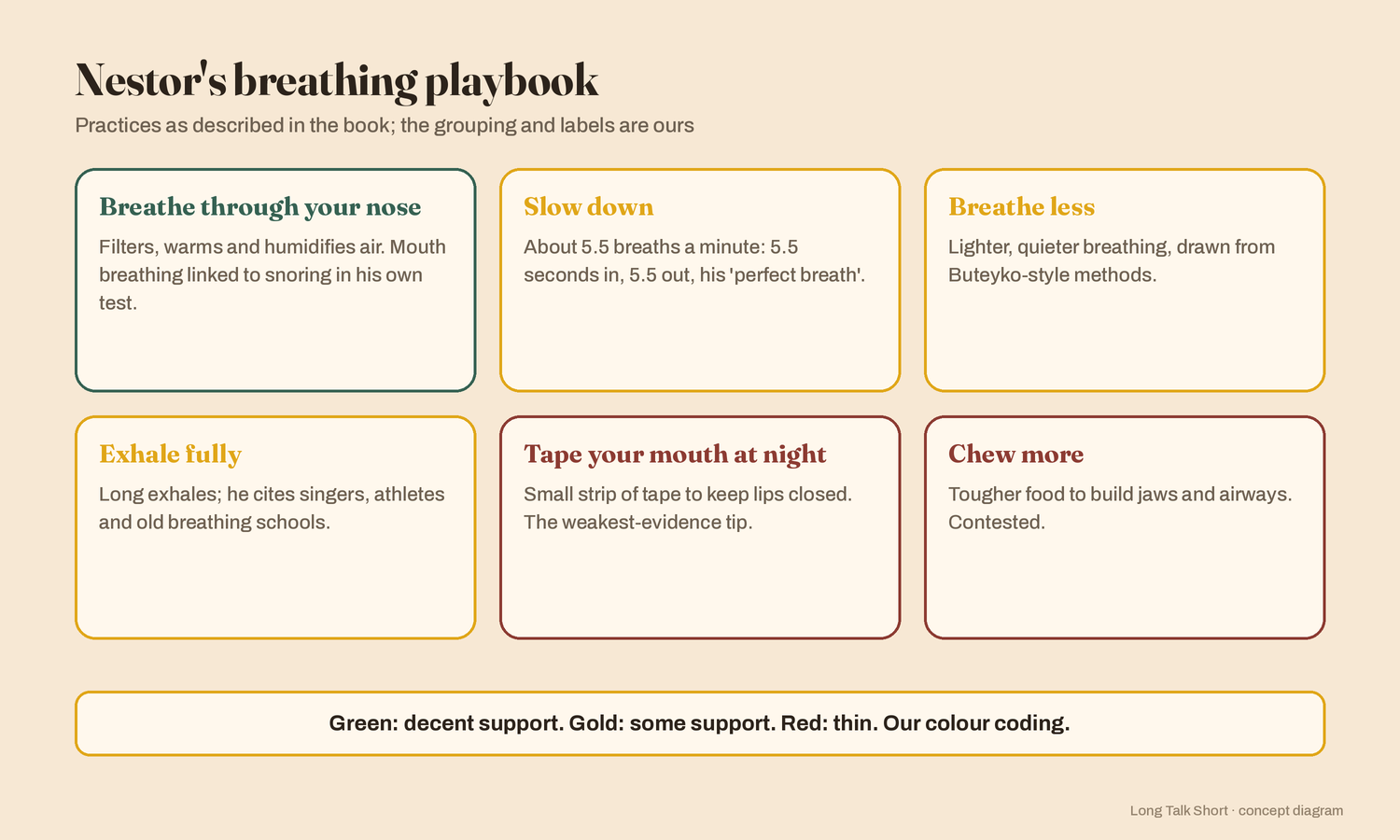
Nestor draws on medical research, old breathing traditions and modern enthusiasts. His practices boil down to a few habits. Breathe through your nose, day and night. Breathe slowly: his "perfect breath" is about 5.5 seconds in and 5.5 seconds out, around 5.5 breaths a minute. Breathe less: drawing on the Buteyko method, he argues many people breathe more air than they need. Exhale fully, letting the out-breath run long.
He goes further in places. He recommends taping your mouth at night with a small strip of tape to keep your lips closed. He argues that soft modern diets have shrunk human jaws and crowded airways, and that chewing harder food and some dental approaches can help. And he covers more intense methods, such as Wim Hof's rapid-breathing technique and the Tummo practice it draws on.
3. Why it matters, in his telling
Nestor's larger case is that breathing is one of the few parts of the nervous system you can control on purpose. Slow, steady breaths, he argues, shift the body toward its calmer "rest and digest" mode, while fast, shallow breathing keeps it on alert. If that is right, a few minutes of slow breathing is a cheap tool for stress, and better nasal breathing might help with snoring and sleep. Those are the claims worth testing.
There is also a quieter thread about carbon dioxide. Nestor argues that we tend to treat it as waste, when the body uses it to help release oxygen from the blood into tissues. Breathing too much, in his account, blows off too much carbon dioxide and can leave you feeling anxious or lightheaded, which is the logic behind the "breathe less" advice and the Buteyko exercises he describes.
4. If you want to try it
The lowest-risk version of the book fits in a lunch break. Sit comfortably, close your mouth and breathe through your nose, in for about five seconds and out for about five, for a few minutes. Notice how you feel afterwards. During the day, check from time to time whether your mouth has drifted open. None of this needs equipment, and none of it should replace treatment for asthma, sleep apnea or anxiety. The more intense methods, like rapid breathing and breath holds, carry real risks: never do them in or near water or while driving. So which parts of the book survive a closer look?
Weighing it: what holds up
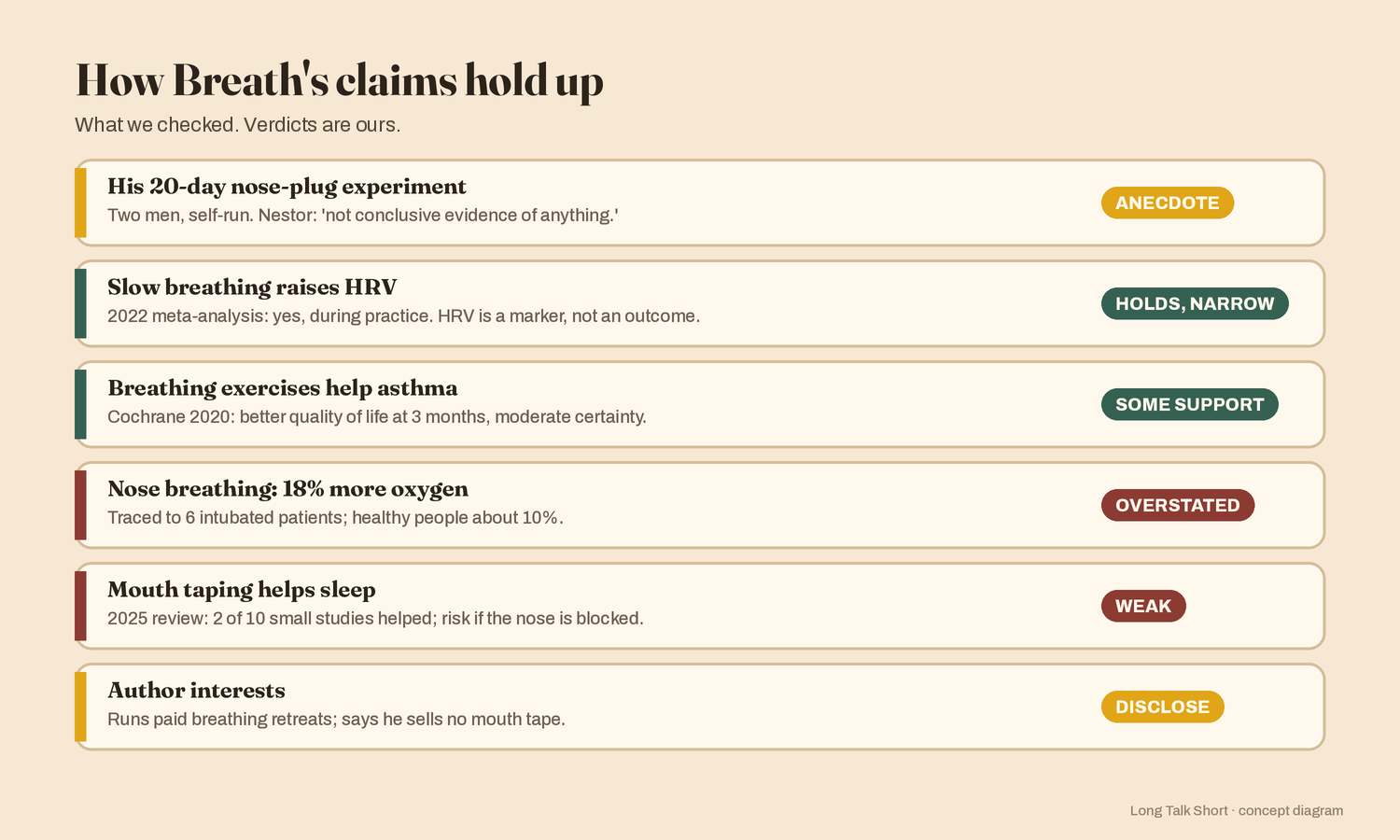
Anecdote, not a study: The experiment had two men, no control group, and participants who knew what they were testing. Nestor has said so himself, telling Sleep Review:
My experiment is not conclusive evidence of anything.
Holds up, narrowly: A 2022 meta-analysis in Neuroscience and Biobehavioral Reviews found that slow breathing at around six breaths a minute raises heart rate variability, a marker linked to the calming side of the nervous system, during practice. That supports the calm-down use, though HRV is a marker, not a health outcome. A 2020 Cochrane review of breathing exercises for adults with asthma found moderate-certainty evidence of better quality of life at three months, with less certainty beyond that.
Overstated: The claim that nose breathing gives you about 18% more oxygen was traced by Jonathan Jarry of McGill's Office for Science and Society to a 1996 study on six intubated patients. Healthy volunteers in related work averaged closer to 10%, and two of the six patients saw no increase. On mouth taping, a 2025 systematic review in PLOS One found ten small studies with 213 patients; only two showed a significant improvement in sleep apnea scores, in mild cases, and the authors warned it could be dangerous if your nose is blocked.
Disputed: Nestor calls the science on Wim Hof's method "rock solid"; given how few and small the trials are, we think that overstates it. The jaw and face claims are the most disputed in the book.
Interests: Nestor runs paid breathing retreats; McGill reported a week in Costa Rica at USD 2,500 to 4,250. He says he has no mouth tape brand and suggests generic tape. McGill also notes that he picked up mouth taping from a dentist who sells mouth tape and affiliate products.
Not checked, and bottom line: We checked the points above but not every source in a long book; the table's verdicts are ours. Slow nasal breathing is a reasonable thing to try. The bigger promises need better evidence than a good story.
Related reading: Right About Sleep, Shaky on the Numbers: What Why We Sleep Gets Right · A Real Day, a Real Night: Kristen Holmes's Four Habits for a Calmer Nervous System
Long Talk Short
- Nestor's core advice is to breathe through your nose, more slowly and a little less.
- His famous nose-plug experiment involved two men and, in his own words, is not conclusive evidence of anything.
- Slow breathing at about six breaths a minute has decent support as a short-term calming tool.
- Breathing exercises have moderate evidence for improving quality of life in asthma, alongside normal treatment.
- Mouth taping, the 18% oxygen claim and the jaw-shaping ideas rest on thin or mixed evidence.
The one thing to remember: a few minutes of slow nasal breathing is cheap and low-risk to try for stress; anything that sounds like a cure needs better evidence than a good story.
Source: Breath: The New Science of a Lost Art by James Nestor (Riverhead Books, 2020). This is an independent summary and is not affiliated with the author or publisher.
This article is for general information and is not medical advice. If you snore heavily or might have sleep apnea, see a doctor rather than taping your mouth, and talk to a doctor before changing how you manage asthma, anxiety or any other condition.