Laughter Needs a Room: Jimmy Carr on Why Comedy Is Connection, and Why He Doubts AI Can Be Funny
Jimmy Carr tells Sam Harris that comedy's real purpose is connection, that it should be taught like music, and that AI won't be funny because it can't laugh with anyone. His craft, his view of AI, and what we checked.
Think about the last time you laughed until it hurt. Chances are you weren't alone. Jimmy Carr believes that detail explains both why comedy matters and why he doesn't fear AI taking his job. Talking with Sam Harris on Making Sense, the comedian, promoting his book on how jokes work, makes a case that sounds odd from someone famous for offensive one-liners: comedy is a way of connecting, and anyone can learn it.
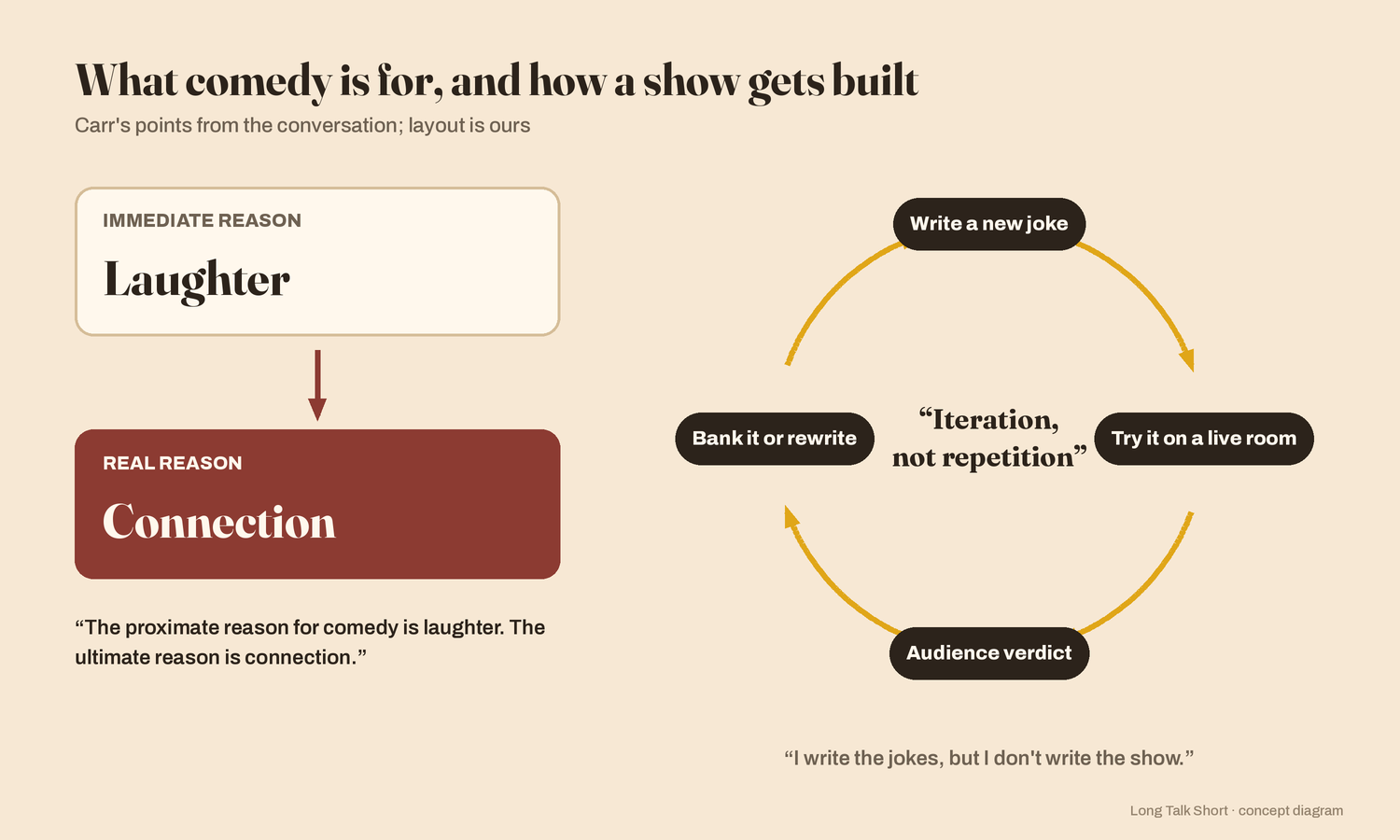
In short: Carr says the immediate goal of comedy is laughter, but the real one is connection. He wants comedy taught like music, treats every show as an experiment the audience grades, and argues that AI may write jokes but won't know what is funny, because it can't laugh with anyone. The title's AI question takes about a minute of the free preview; the rest of the episode is for subscribers.
1. Be a participant, not a spectator
Carr's book, On Jokes, written with Amanda Baker and Abi Grant, takes jokes apart to show how they are built. His point is not that everyone should turn professional. When people moved from villages to cities, he says, we stopped singing in choirs and dancing ourselves and started paying specialists to do it for us.
The opposite of a spectator is not a professional, it's a participant.
So he thinks comedy should be taught in schools. Learning a few guitar chords makes you appreciate a great guitarist more, and five minutes at an open mic would do the same for comedy. He wants more people to hear their "own authentic voice" because, as AI handles more, the things it can't do matter more. But who decides what is funny?
2. The audience writes the show
"I write the jokes, but I don't write the show," Carr says. Even a room of 30 people tells you what is funny with uncanny reliability. He tours constantly, about 200 dates a year by his count, and treats each night as "iteration, not repetition". After every show he marks off the untested jokes on paper: some are ready to bank, others need rewording, and many he simply replaces.
Most people who shout out at his shows aren't really hecklers, he says; it's like a crowd singing the chorus at a Bruce Springsteen gig.
3. What a joke does to a room
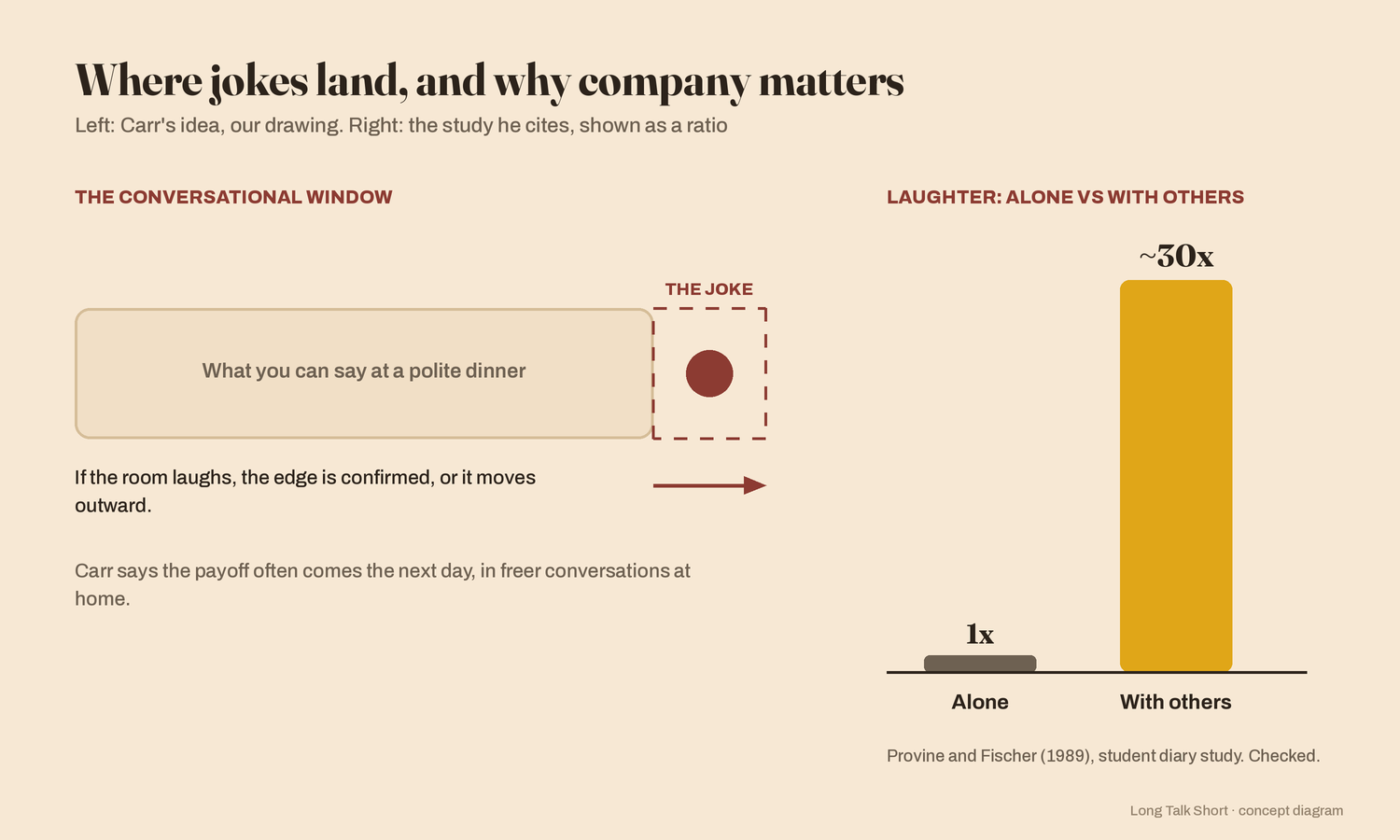
Carr borrows the idea of the Overton window, the range of opinions acceptable in polite company, and applies it to conversation. When a comic says something and the room laughs, the laughter proves the idea sat inside the boundary, or shows that the boundary has moved. The payoff often comes the next day, he suggests, when you and your partner talk more freely about something you heard on stage.
He describes the "ha-ha moment" as recognition: seeing something you'd noticed but never put into words. Jokes, he says, are pleasure bribes that let us think forbidden thoughts, crediting the idea to Freud.
Asked how harsh crowd work stays humane, he calls his job "friendship at scale". Friends mock each other because they're close, and the show is a sort of safe space where the comic plays the trickster. Remove anything that could offend anyone, he says, and you're left with juggling, "and someone would complain that the balls are the wrong colour." He aims to offend everyone equally, and calls it a "category error" to criticise jokes for not being kind:
I wasn't trying to be kind. I was trying to get massive laughs.
4. A god made in our image
Harris suggests Carr is as AI-proof as anyone, because his value lies in gathering people to laugh together. Carr cites research that you laugh about 30 times more with others than alone, even at your favourite show.
His view of AI is "quite spiritual". We wanted a god so much that we built one in our image: "all powerful, all knowing, can perform miracles and lives in a cloud." We give the phone four hours a day as an offering and get back a like, which he calls, quoting the philosopher Byung-Chul Han, "the digital amen".
If comedy can be taught, Harris counters, a machine could learn it and become superhumanly funny. Carr's reply: "They won't know what's funny because they won't know how to laugh. It's the connection."
The rest of the free portion is about attention. News cycles are short, he says; the Las Vegas shooting left the headlines in about two days. We choose what to fear, too: lost nuclear weapons barely worry anyone, while AI dominates the conversation. Carr argues we've treated mental health as a private failing; Harris adds that we over-diagnose ordinary worry and sadness, and Carr agrees.
Weighing it: what holds up
Holds up: On Jokes is co-written with Amanda Baker and Abi Grant. Robert Provine and Kenneth Fischer's 1989 diary study found people about 30 times more likely to laugh in company than alone. "The like is the digital amen" is Byung-Chul Han's. The 2017 Las Vegas shooting is the deadliest by a single gunman in US history. The US did lose six nuclear weapons it never recovered, though only one could have produced a nuclear explosion.
Corrections: Carr's "98% worked in agriculture" two centuries back is too high: Our World in Data puts Britain at about 31% in 1801 and the US at 63% in 1840. Carr's "song still in them" isn't Thoreau's: Walden has only "lives of quiet desperation". Freud described a joke's pleasure as an "incentive bonus" that overcomes inhibition; "pleasure bribe" is Carr's paraphrase. On risk, Harris's Manhattan Project comparison uses 10% to 30% odds of catastrophe; a 2024 survey of 2,778 AI researchers found a median of 5% for extinction-level outcomes, though some lab leaders estimate far higher.
Not checked: The claims about social contagion on TikTok, privatised mental health and gain-of-function research are opinions we didn't test.
Disclosures: We transcribed the free YouTube portion by machine, so quotes may contain small errors, and the video skips a short passage. Cancel culture comes up only indirectly, and meditation not at all, despite the description. Carr was promoting his book.
Bottom line: The laughter-is-social point rests on real research. The AI argument is a comedian's intuition, not a test, and only a sliver of the conversation.
Related reading: Never Open With a Joke: MIT's Rules for Speaking · The Last Class: What Tuesdays with Morrie Teaches · This Is the Worst AI Yet: Ethan Mollick's Four Rules
Long Talk Short
- Carr says comedy's immediate goal is laughter; its real goal is connection.
- He wants comedy taught like music, to make participants, not professionals.
- Each show is an experiment: write, test, let the audience decide, then bank or rewrite.
- Laughter shows where a conversation's limits sit, and can move them.
- He sees AI as a god built in our image, and doubts it can be funny without being able to laugh with anyone.
The one thing to remember: the funniest moments in your life probably happened in company, so protect the rooms where people laugh together.
Mental health comes up only briefly here, and this summary is not medical advice. If you are struggling, talk to a qualified professional; if you are in crisis, call or text 988 (the Suicide & Crisis Lifeline in the US) or contact local emergency services.
Source: Making Sense with Sam Harris, "Can AI Ever Be Funny? | Jimmy Carr," on YouTube (free preview of a longer subscriber episode). This is an independent summary and is not affiliated with Sam Harris, Making Sense or Jimmy Carr.