Not a Verdict, an Iteration: Joe Hudson on Why Every Decision Is an Emotional Problem
Coach Joe Hudson tells Chris Williamson that deciding is an emotional problem, not an information one: feel the worst case first, decide by principle, and treat each choice as one bet in a portfolio. His claims, checked against decision research.
If you've ever spent weeks stuck on a choice about a job, a move or a relationship, you've probably treated it as an information problem: one more spreadsheet, one more opinion. Joe Hudson, an executive coach and the founder of the Art of Accomplishment, tells Chris Williamson on Modern Wisdom that you're solving the wrong problem. In his view, deciding is "100% an emotional problem". You're stuck because some outcome feels unbearable, and the fix is to feel it ahead of time, then treat the choice as one bet among many.
In short: Hudson argues that fear narrows your thinking to black and white and makes every choice feel final. His remedies are to rehearse the feared outcome until it loses its grip, to decide by principles most of the time, to treat each decision as part of a portfolio, and to see setbacks as iterations rather than failures. The research supports parts of this and complicates others. Hudson sells courses on these ideas.
1. Choices, decisions and the role of feeling
Hudson separates choices, which you make without noticing, from decisions, which you deliberate over. He claims that most of what you do is aimed at feeling something or avoiding a feeling. For support he cites the neurologist Antonio Damasio, whose patients with damage to a brain region that links emotion to reasoning could analyze options but struggled to choose. Hudson's conclusion is that logic's job is to forecast how each option will feel, not to decide. So what does fear do to that forecast?
2. Fear creates a false ending
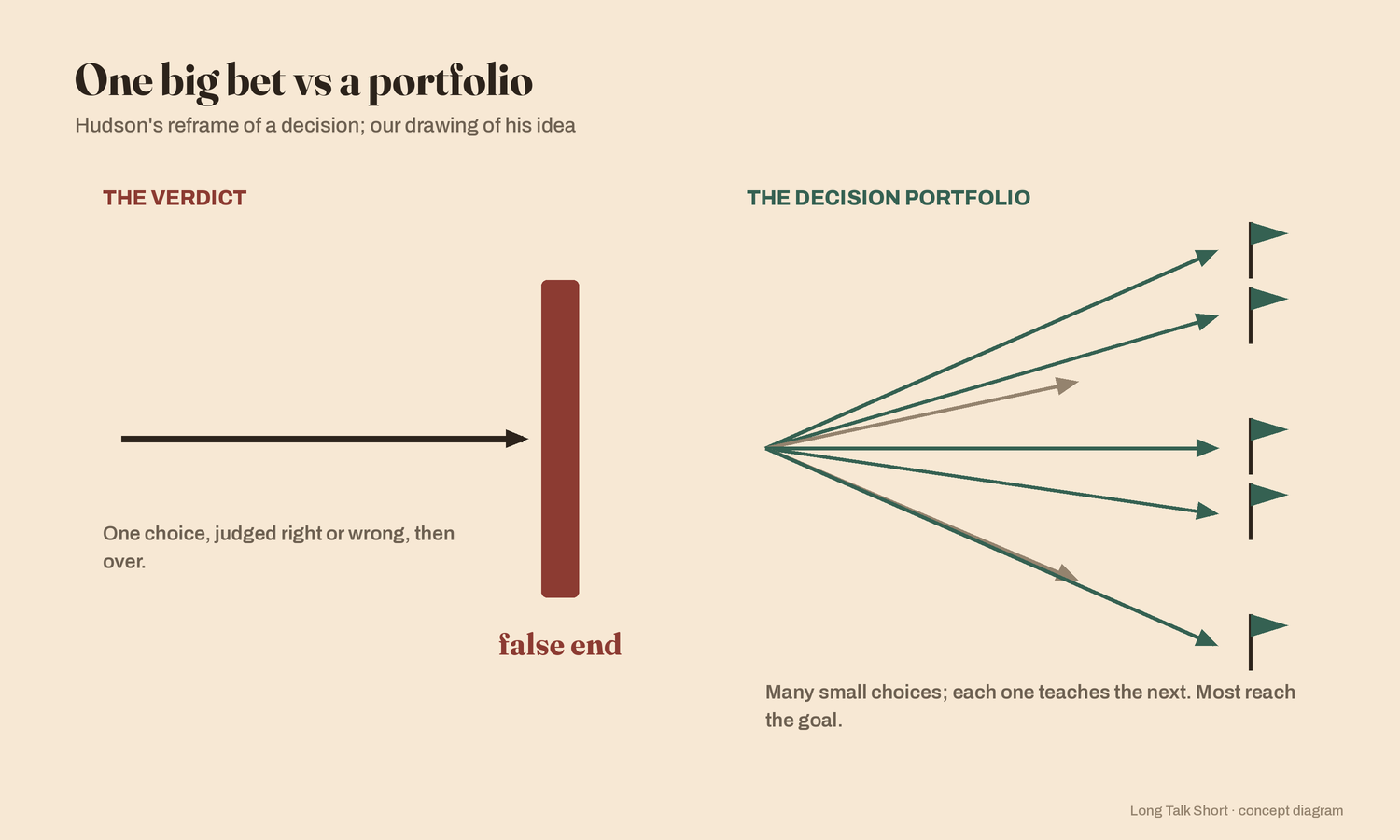
Fear, he says, does two things. It collapses options into black-and-white thinking, and it creates a "false end": the sense that this decision is final and a wrong call will ruin everything. In reality, another decision always follows this one. So he suggests thinking like a fund manager. You don't need every pick to work; you need to be principled about what you buy, "because a majority of them will work out". He cites Amazon's distinction between reversible and irreversible decisions.
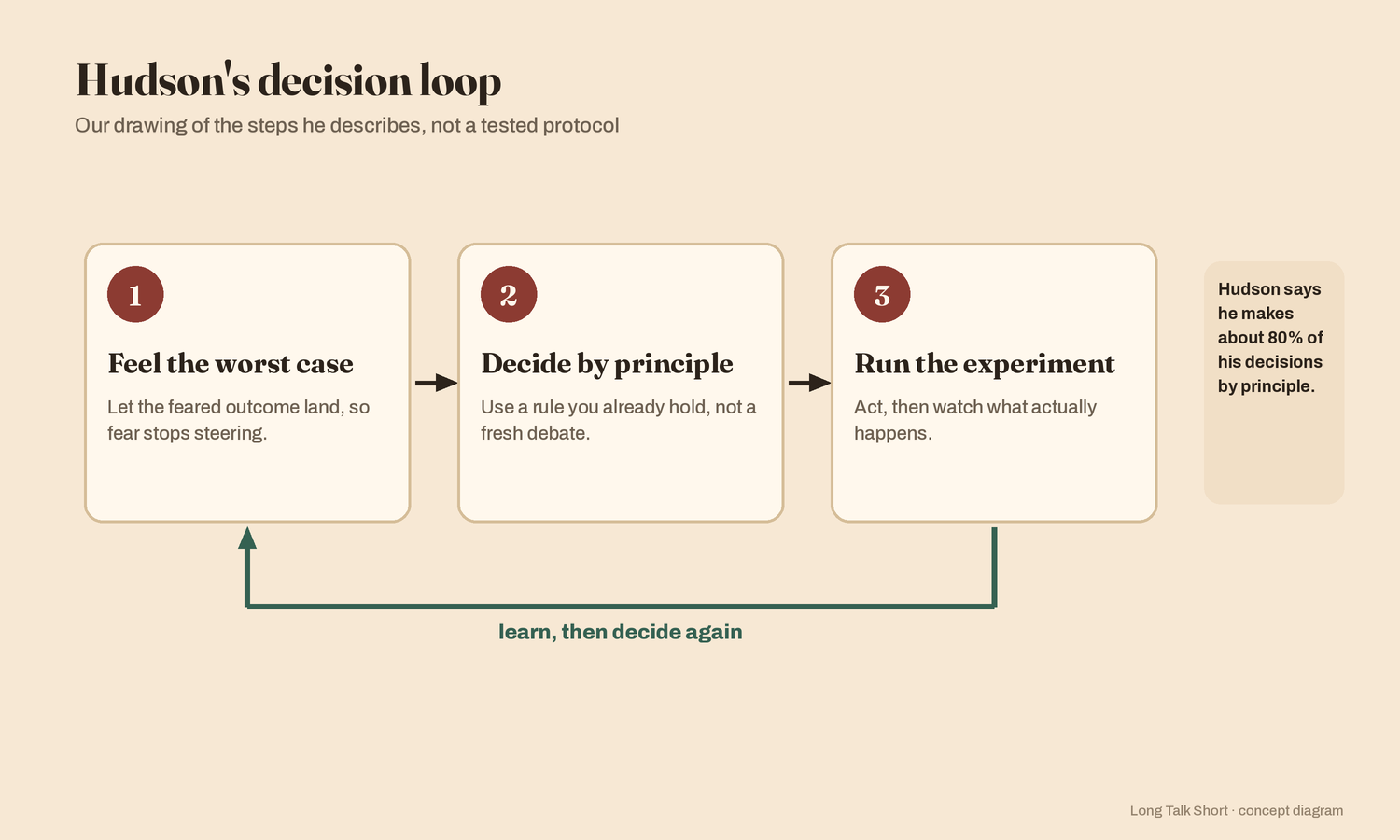
His most striking technique is to feel the feared consequence before you choose. He says that in rough patches of his 27-year marriage, he and his wife have mourned it in advance, imagining the loss and the lonely aftermath, so the fear of losing each other stopped steering their choices. He compares this to Stoic and samurai practices of contemplating death. Williamson adds the entrepreneur Alex Hormozi's line that fear is "an inch deep and a mile wide".
3. Principles first, iterations always
Hudson says he makes about 80% of decisions by principle, so he isn't reopening every question. He compares this to Berkshire Hathaway, which sits on cash until something fits its rules. One of his own principles is "build the thing you know least about first", because that's where the risk hides. Another is "everything is an iteration": there's no failure, only experiments.
He links this to the habenula, a small brain structure involved in processing disappointment, and to a study of people on low wages who lost weight and kept it off by treating slips as experiments. He tells the story of a barber he coached, who was paid $2,000 to collect 50 rejections and came back with two acceptances. And he says a surgeon who also trained dogs used clicker training, an instant signal when a movement was right, to teach students precise skills. Does speed matter more than accuracy, then?
4. Indecision, reassurance and resentment
Hudson says that making more decisions matters more than getting each one right: a leader who makes 100 decisions a day learns faster than one who makes 10. He argues that people regret indecision more than wrong calls. He also has harder-edged claims: constantly seeking reassurance is "a self-abandonment", handing responsibility for your happiness to someone else, and resentment is a sign you abandoned yourself somewhere along the way. Agency, he adds, isn't the same as being assertive.
Weighing it: what holds up
Framing: The episode title, "Making Decisions Is Easy When You Do This," oversells it. Hudson's method asks you to sit with painful feelings, which is rarely easy.
Holds up: The idea that emotion is needed for good decisions is well supported. Damasio's best-known patient, Elliot, had real-life decision problems despite largely intact test scores. The weight-loss study exists: a 2023 npj Digital Medicine paper interviewed 51 low-wage workers who kept weight off for two years and found an "iterative mindset". The surgery study also exists: Levy and colleagues in 2016 found that clicker-trained students tied knots more precisely, though they learned more slowly at first. The research leans Hudson's way on action: in Steven Levitt's coin-flip study, people nudged to make a big change, such as quitting a job, reported being happier six months later.
Partly holds: "100% emotional" is Hudson's stretch, and Damasio's somatic marker hypothesis has faced serious critiques, such as Dunn, Dalgleish and Lawrence in 2006. Research on regret, notably by Thomas Gilovich and Victoria Medvec, finds people regret things they didn't do more over the long run, but regret their actions more in the short run. Calling reassurance-seeking and resentment "self-abandonment" is his coaching framework, not a finding.
Corrections: Damasio's book is Descartes' Error (1994), not a 2012 work, as the captions render it, and Elliot's damage was to the ventromedial prefrontal cortex rather than an "emotional center". The habenula is found across vertebrates, not "all invertebrates", and it signals disappointment rather than "preventing failure". Berkshire's cash pile was about $397 billion in early 2026, far above the roughly $230 billion he cites.
Not checked: the barber story, the 100-versus-10 decisions figure, and a Jeff Bezos quote he paraphrases. Treat them as anecdotes.
Disclosures: Hudson sells coaching and courses through the Art of Accomplishment; the Great Decisions Course he promotes in the episode is listed at $4,000 for five weeks. Hudson says Williamson has been through his Groundbreakers program, the two are friendly, and Williamson urges listeners to sign up for the course. Williamson mentions a business partner at Neutonic, a drink company he co-founded, and the episode carries sponsor reads, including Momentous and LMNT. We worked from YouTube's automatic captions, so quotes may contain small errors.
Bottom line: treating decisions as reversible experiments and naming the feeling you're avoiding are useful, research-friendly ideas. The neuroscience is looser than he presents it.
Related reading: Ethan Evans on Jeff Bezos and strategic patience at Amazon · Ed Mylett on making room and resetting your worry thermostat
Long Talk Short
- When you're stuck, ask which outcome you're afraid to feel, not what information you're missing.
- A single decision rarely ends the story. Think in portfolios.
- Rehearse the worst case until it stops steering you.
- Settle recurring questions with principles so you can spend attention on the rest.
- Treat setbacks as data from an experiment, then run the next one.
The one thing to remember: the decision is rarely the hard part; the feeling you're avoiding is.
This summary is general information, not therapy or medical advice. If you're struggling with your mental health, talk to a qualified professional. If you're in crisis or thinking about harming yourself, call or text 988 (the Suicide & Crisis Lifeline in the US) or contact local emergency services.
Source: Chris Williamson with Joe Hudson, "Making Decisions Is Easy When You Do This," Modern Wisdom, on YouTube. This is an independent summary and is not affiliated with Chris Williamson, Modern Wisdom, Joe Hudson or the Art of Accomplishment.