Letting Go of the Lever
If the hardest habit is the need to keep steering, Anna Lembke calls that addiction to control. Here is the thesis, what is simplified, and why medical care still comes first.
If the hardest habit is less the substance than the need to keep steering, Anna Lembke has a name for that. On Huberman Lab she argues that severe addiction often becomes addiction to control — one lever that still changes how you feel. That thesis, and the spiritual surrender she pairs with it, is the ground beyond Dopamine Nation. It is also clinical teaching, not a license to quit dangerous drugs alone.
In short: Lembke, a Stanford addiction psychiatrist, says compulsive behaviors can become a way to manage uncertainty, and that recovery sometimes requires a "spiritual pivot" — handing over the will to control. The dopamine balance she uses is a teaching image, not a precise map. Sponsors fund the show, she sells books, and nothing here replaces care from a clinician, especially if stopping alcohol or sedatives could be dangerous.
1. Who is talking
Stanford's faculty profile lists Anna Lembke, M.D., as Professor of Psychiatry and Behavioral Sciences, medical director of Addiction Medicine, program director of the Addiction Medicine Fellowship, and chief of the Addiction Medicine Dual Diagnosis Clinic. Huberman's description matches the clinic title. The episode description names AG1, Function, Helix Sleep, Lingo and LMNT as sponsors. Lembke wrote Dopamine Nation (2021) and Radical Surrender: Letting Go in a World Addicted to Control, from Dutton.
2. Addiction to control, not only to a substance
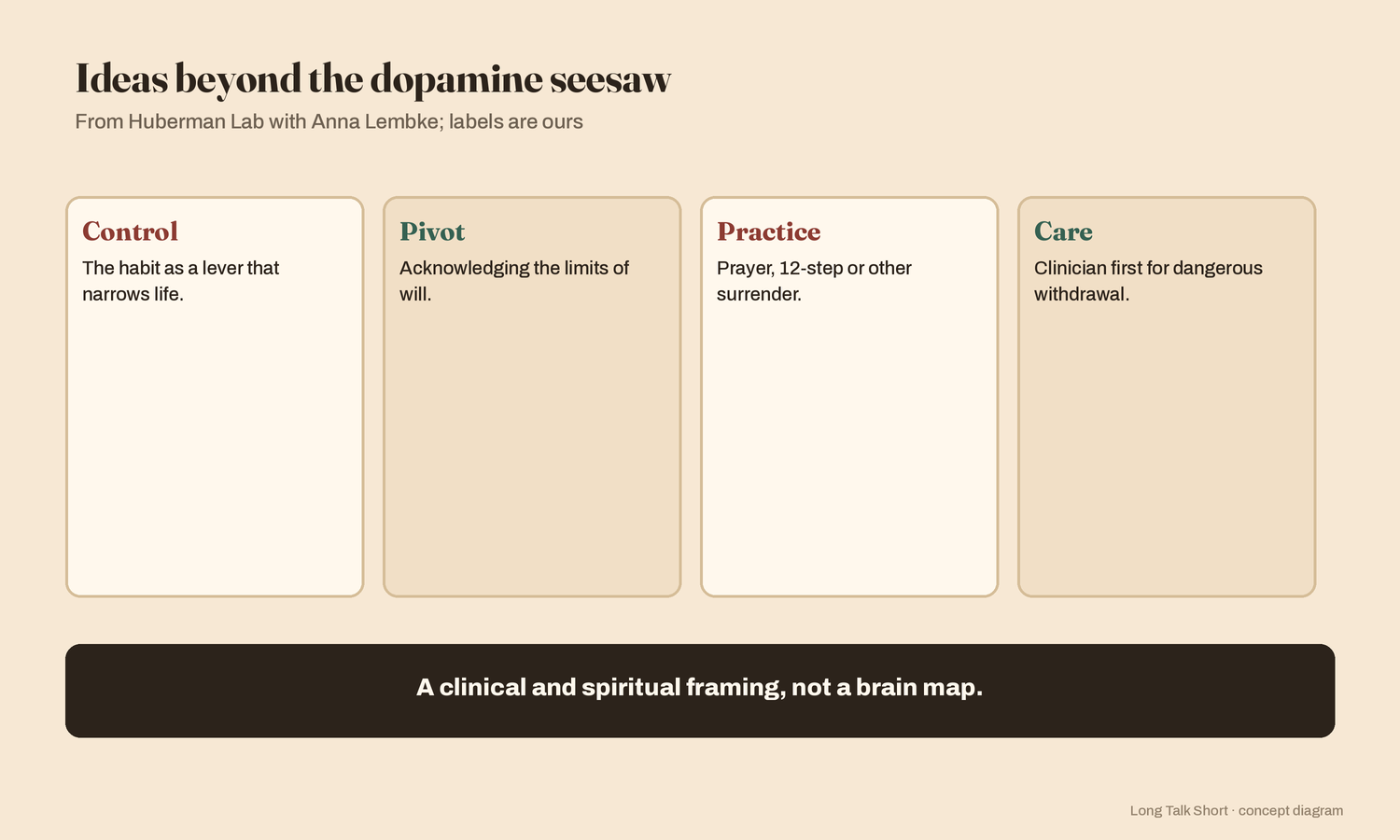
Her opening line is the thesis of the book: "In the severest cases of addiction, people are not actually addicted to that substance or that behavior. What they're addicted to is control." Through the habit, she says, focus narrows, everything else falls away, and "I've simplified things. I just have this one lever like a rat in a cage." That is her clinical and personal framing, not a formal diagnostic category.
She defines addiction in familiar terms: continued compulsive use despite harm, plus the four C's — out of control use, compulsive use, craving and continued use despite consequences — along with tolerance and withdrawal. She notes that digital habits are often woven into work and social life, which makes them harder to see as optional.
3. The spiritual pivot
Asked about people who get sober through religious or 12-step paths, Lembke says a "spiritual pivot" has been key for many who could not recover any other way. She ties it to surrender: acknowledging the limits of what you can control and "giving that will over however we define it". She links the moment, cautiously, to quieting of prefrontal control networks and activation of structures such as the periaqueductal gray (PAG) during surrendered prayer. That is a hypothesis she teaches from neuroanatomy, not a proven mechanism for recovery.
She is open about her own limits. In Radical Surrender she writes about her son's diagnosis and death from leukemia; on the show she says psychotherapy and reading papers were empty for her until she surrendered the need to know why. She also discusses codependency: the old model of one partner enabling another, and wider loops of constant reactivity online. She recommends Al-Anon and similar groups for families.
4. What she repeats from Dopamine Nation — briefly
Huberman revisits the pleasure-pain balance. Lembke again describes pleasure and pain as opposite sides of a balance that wants to return to level, with withdrawal symptoms such as anxiety, irritability, insomnia, depression and craving when the balance sits on the pain side. She again cites roughly a month as average time to begin resetting reward pathways. Treat that dopamine story as a simplified teaching model. We covered the book's rat percentages, homeostasis framing and 30-day rule in more detail in our Dopamine Nation article; this episode's ground beyond that book is control and surrender.
On recovery she stresses that abstinence alone is not enough. In 12-step language she mentions the "dry drunk": someone who is abstinent but still living out the same pathology. "Recovery is going to be something different for everybody," she says, and often includes a values-based life, not only stopping the drug. Huberman asks about replacement behaviors at 12-step meetings; she treats swapping one compulsive outlet for another as common and something to watch, not a free pass.
On families, she says that when the identified addict gets well, another person's problems can surface, and the family system has to change. She is careful not to claim hard numbers on gender patterns; she reports what she sees clinically, with mothers more often caught in enabling loops and fathers more often detaching.
Weighing it: what holds up
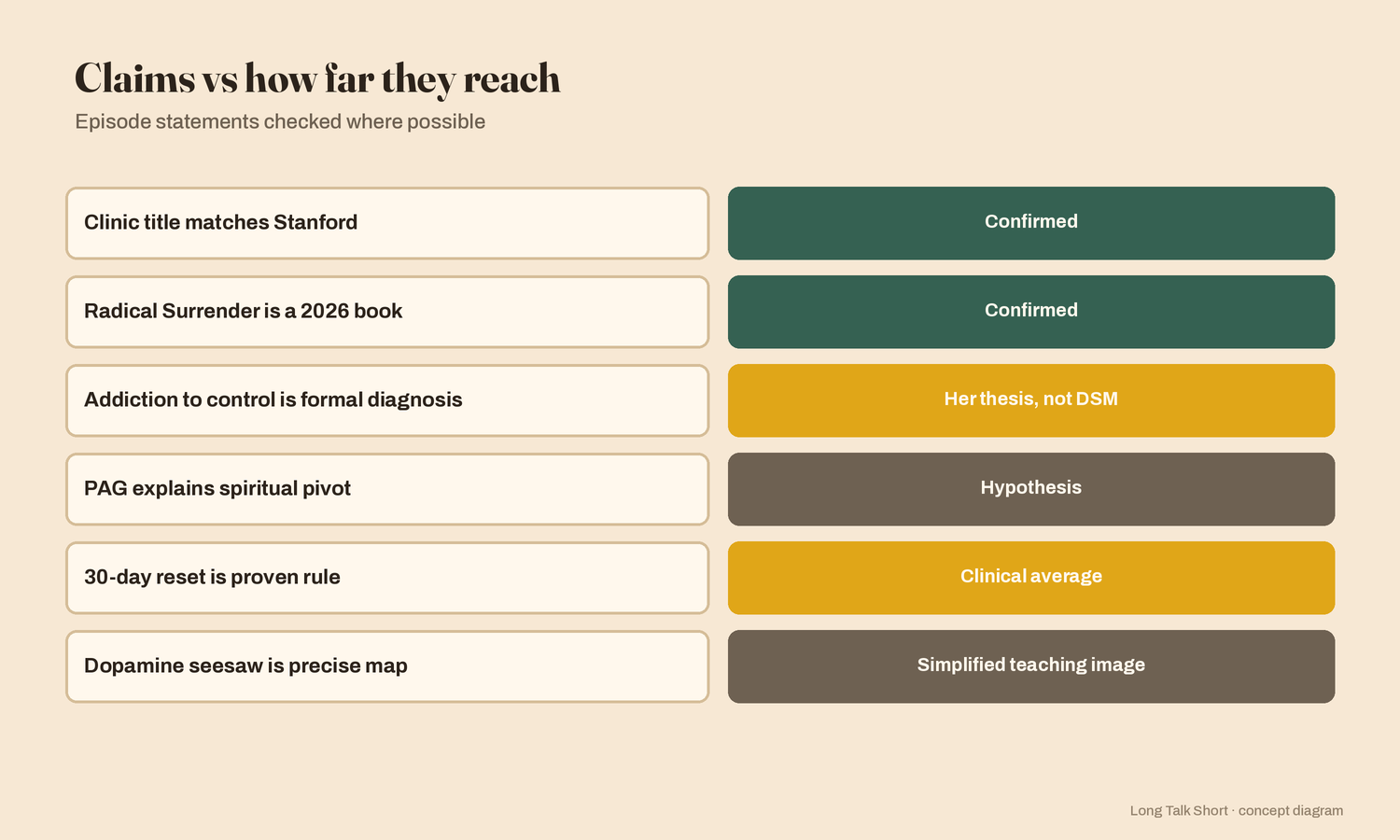
Checked. Her Stanford titles, the Dual Diagnosis Clinic page, the publisher listing for Radical Surrender, and the episode's named sponsors.
Unverified. Patient anecdotes, the claim that many recover only after a spiritual pivot, and any specific brain imaging of prayer. Her link from PAG activity to spiritual recovery is a teaching connection, not a clinical trial result. Auto captions misspell her name; we used Stanford's spelling. Huberman's show description calls her "one of the world's leading experts"; that is publisher praise, not a ranked measure.
Sources. Stanford profile, Dual Diagnosis Clinic, Radical Surrender (Dutton), Huberman Lab episode page.
Safety. If you are dependent on alcohol, benzodiazepines or other substances where sudden stopping can cause seizures or death, do not use a "dopamine fast" or home abstinence as a plan. See a clinician first. Lembke sells books and appears to promote Radical Surrender; Huberman's show runs on sponsors. This is not medical advice.
Disclosures: Huberman Lab names AG1, Function, Helix Sleep, Lingo and LMNT as sponsors. Lembke sells Dopamine Nation and Radical Surrender. This episode is a different angle from our Dopamine Nation summary: the distinctive ground is addiction to control and surrender, not a rehash of the pleasure-pain seesaw alone.
Related reading: Lembke's Dopamine Nation, weighed · James Hollis on old patterns
Long Talk Short
- Lembke's emphasis here is addiction to control: using a habit as the one lever that still changes how you feel.
- Radical Surrender argues for a spiritual pivot — handing over the will to control — drawn from clinic work and her own loss.
- The pleasure-pain dopamine balance is a simplified teaching image; the roughly-a-month reset is a clinical average, not a proven rule.
- Abstinence without a values-based life is not her definition of recovery.
- The show is sponsored; she has books to sell; stop dangerous substances only with medical care.
The one thing to remember: If the habit is really about control, the next step may be surrender — and a clinician if stopping could hurt you.
This summary is for general information only and is not medical or mental health advice. Do not stop alcohol, benzodiazepines or other substances with dangerous withdrawal without clinical care. If you are struggling or in crisis in the US, call or text 988 to reach the Suicide & Crisis Lifeline.
Source: Huberman Lab, "Overcome Addictions and Obsessions of All Kinds | Dr. Anna Lembke," on YouTube. This is an independent summary and is not affiliated with Huberman Lab, Stanford or Anna Lembke.