Memory Series, Part 3: You're Built to Forget Most of Your Life. A Memory Scientist on How to Keep What Matters
Most of your life will be forgotten, and that's by design. Memory scientist Charan Ranganath explains why your phone splits your memories, how curiosity makes things stick, and which habits really protect memory.
Memory Series, Part 3 of 3, the final part. New here? Start with Part 1: the memory palace with Nelson Dellis and Part 2: Jim Kwik's case that memory is a verb.
Most of your life will be forgotten.
That isn't your brain failing. It's your brain working as designed, and memory scientist Charan Ranganath says the real question isn't why you forget, but what you choose to keep.
Ranganath is a professor of psychology and neuroscience at UC Davis and the author of Why We Remember. On Huberman Lab, he explains why your phone breaks your memories into pieces, why curiosity makes even unrelated things stick, and which habits do more for an aging brain than any memory trick.
In short: memory serves the present and the future, attention is easily hijacked, and remembering on purpose means setting an intention, cutting task switches, using curiosity, and looking after the brain that does the work.
1. Memory isn't about the past
Ranganath starts with a reversal:
I actually don't think memory is about the past. I think memory is about the present and the future.
The brain pulls selectively from experience to predict what's in front of it.
That's why the famous gorilla video works. People counting basketball passes often miss a person in a gorilla suit walking right through, because expectations decide what gets seen.
He splits the work in two:
- The hippocampus ties details to a specific place and time, so this conversation stays separate from the last one you had with the same person.
- The prefrontal cortex provides "cognitive control": it lets your goals decide what you do and notice.
Which raises the obvious question: if your goals are supposed to steer, why does your attention keep going everywhere else?
2. Attention gets grabbed. Intention decides.
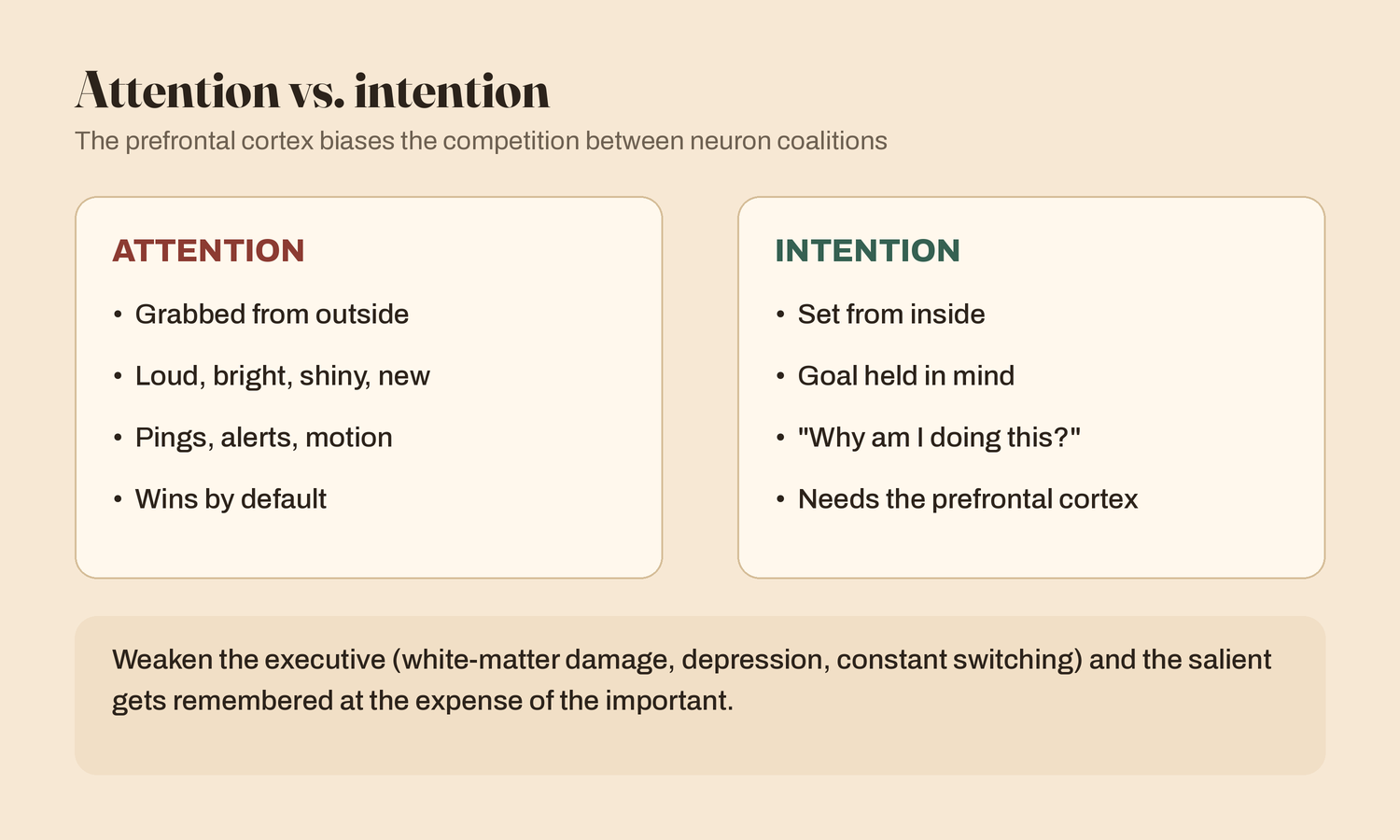
His central distinction rhymes on purpose. Attention can be grabbed by anything loud, bright or new. Intention is "directing your attention based on some reason that's an internal goal."
He describes neurons as rival coalitions. The salient one shouts down the important one unless the prefrontal cortex tips the contest.
That changes how memory problems in older adults look. In a study by Karen Campbell and Lynn Hasher, as Ranganath describes it, older people did worse on what they were told to remember, but just as well on the distractions they were told to ignore. The problem wasn't storage. It was the filter. White-matter damage, depression and inflammation can all weaken it.
His own fix: Ranganath, who has ADHD, ranked his values with a coach. Before a task he dreads, he asks why he's doing it and ties it to a value, because "the goal just doesn't pop up for me automatically."
A weak filter is one problem. One everyday habit makes it worse.
3. Every switch splits the memory
Checking your phone mid-conversation costs more than a few seconds. You lag when you come back, and the memory itself breaks up.
His lab and others see a burst of hippocampal activity at "event boundaries," the moments a scene or topic changes. That burst seems to save what just happened as one chunk.
Cross too many boundaries and you get the familiar doorway effect: you walk through three rooms and forget why you came into the kitchen.
- Constant switching produces "fragments of memory."
- Those fragments compete with each other.
- Competition is a big part of forgetting.
His rule is simple: do one thing, then the next.
Cutting distractions protects memory. But one feeling actively switches learning on.
4. Curiosity puts your brain in learning mode
His favorite example is a study by his former postdoc Matthias Gruber. People saw trivia questions in a brain scanner and waited several seconds for each answer. The more curious they were, the more activity appeared in dopamine-rich midbrain areas and the nucleus accumbens, before the answer arrived.
The twist came from an unrelated face shown during the wait. People later remembered faces seen during high-curiosity moments better, even though the faces had nothing to do with the questions.
Ranganath reads this as curiosity putting the brain into a general state of plasticity. The effect holds in older adults too, so a habit of seeking surprise, new people and the chance to be proven wrong may keep that system in use as you age.
Curiosity helps you take things in. What you do afterward decides how they come back.
5. Take fewer photos, and know that recall rewrites
Filming a whole concert tends to weaken your memory of it. You collect footage instead of noticing what was distinctive: how it felt, who you were with.
The better move: shoot the one moment worth a cue, then later use the photo to test yourself on what happened.
The catch is that every retrieval rewrites the memory. Recalling something makes it easier to reach, but more story-like and less immersive. That lets retelling and group therapy reframe painful memories. It also feeds the rumination loop in depression, where each negative recall makes the next one easier.
Recollection is really a double-edged blade.
All of these strategies depend on one thing: the organ doing the remembering.
6. Plan to forget, and protect the hardware
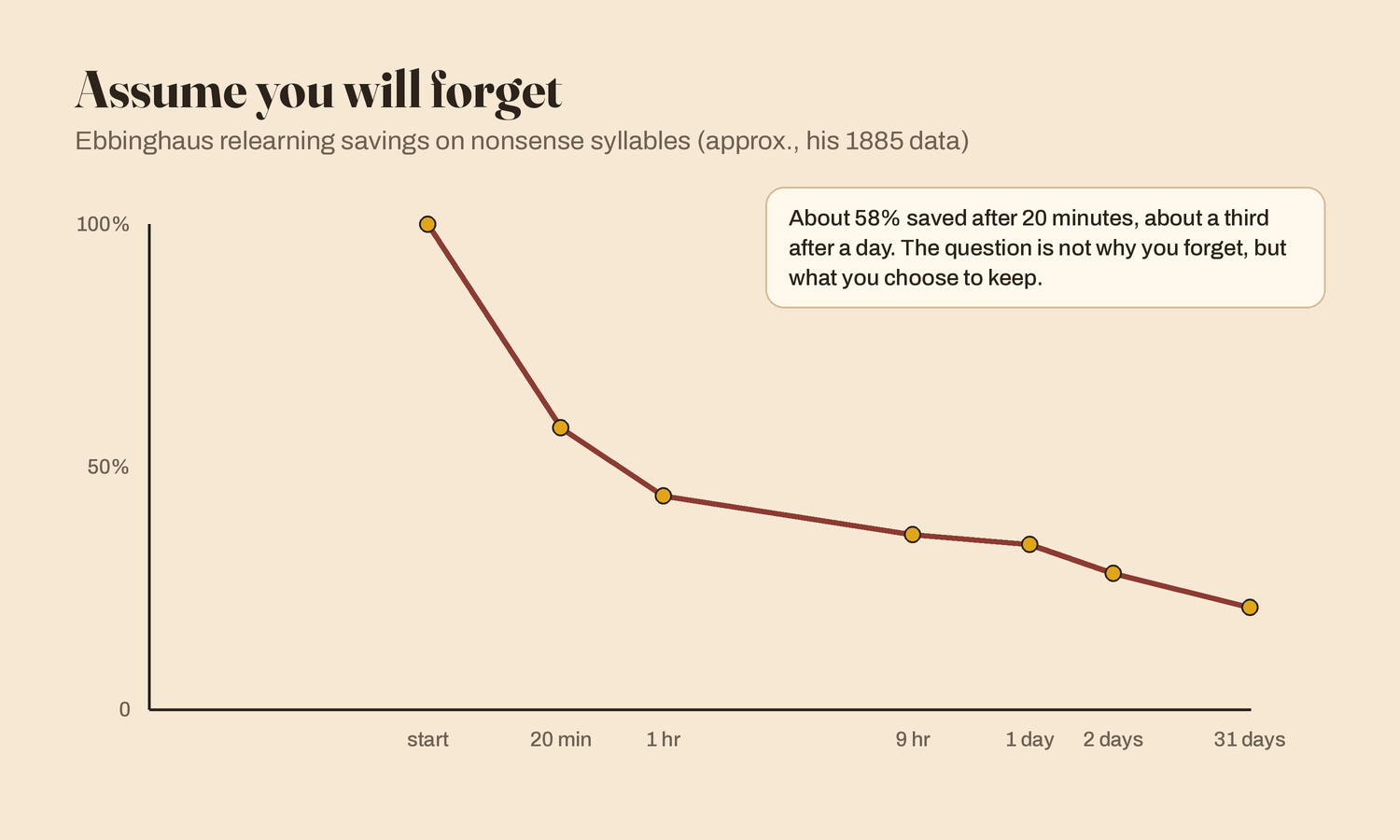
Hermann Ebbinghaus found he forgot nonsense syllables quickly, and Ranganath takes the lesson to heart: "assume that you will forget." Details go first. Gist lasts longer.
He admits it's almost embarrassing that the strongest protective factors are just health:
- Sleep, exercise and a minimally processed diet.
- Social and mental activity.
- Not smoking, and limiting alcohol.
- Treating hearing and vision loss, gum health, avoiding head injury and managing blood sugar.
People would take a drug with nasty side effects that cut Alzheimer's risk by 40%, he says, yet lifestyle may do as much. Purpose matters too; for him, that includes walking a shelter dog every morning.
Related reading: how a memory champion uses the memory palace with Nelson Dellis, and Jim Kwik's case that memory is a verb.
Weighing it: what holds up
Most of the science holds up, but several numbers and attributions were loose.
The gorilla. Ranganath said "about 40%" miss it. In Simons and Chabris's 1999 study, 46% of observers missed the unexpected event overall, and 56% missed the gorilla specifically. Strictly, it's inattentional blindness, not change blindness.
The China lifestyle study. Jia and colleagues (BMJ, 2023) followed 29,072 adults aged 60 and over for about ten years. The six factors match his list. But the paper reports slower memory decline (0.028 points a year on a word-list test, favorable versus unfavorable groups), not scores "almost twice as high." It's observational.
The 40% figure. The 2024 Lancet Commission estimates that removing 14 modifiable risk factors could prevent or delay about 45% of dementia cases, consistent with his "at least 40%." It lists hearing and vision loss among the 14 and warns some links may be only partly causal.
The curiosity study. Gruber, Gelman and Ranganath (Neuron, 2014) is as described. The face effect was small: 42.4% versus 38.2% corrected recognition.
The photo effect. Linda Henkel's 2014 museum study found photographing whole objects impaired memory for them. Zooming in on a detail removed the impairment.
The quote. "The cure for boredom is curiosity. There is no cure for curiosity" isn't Dorothy Parker's. Quote Investigator traces it to an Ellen Parr in Reader's Digest in 1980.
Not re-checked. The Campbell and Hasher distraction finding, the sugar and gut-microbe rat study, and the Rebecca Burwell and Anne Cleary déjà vu experiments. Treat those as his summaries.
Long Talk Short
- Memory is a prediction tool: it keeps what helps you handle the present and the future.
- Attention gets grabbed; intention decides. Name why you're doing something and link it to a value.
- Task switching breaks memories into competing fragments. Batch your distractions.
- Curiosity creates a learning state that helps even nearby, unrelated information stick.
- Take fewer, deliberate photos and use them later as cues to recall.
- Every recall rewrites the memory, which can heal or feed rumination.
- Sleep, exercise, diet, social life, hearing and vision care do more for aging memory than any trick.
The one thing to remember: forgetting is the default, so decide in the moment what you want to carry forward, and give it your undivided attention.
Source: "How to Improve Memory & Focus Using Science Protocols | Dr. Charan Ranganath", Huberman Lab, September 30, 2024. This is an independent summary and is not affiliated with the show.
This article summarizes and comments on a public conversation for educational purposes. It is not medical advice. Talk to a qualified clinician about memory concerns, ADHD, or medication.