Michael Singer Says the Noise in Your Head Isn’t You, and the Daily Work Is Learning to Stop Closing
Michael Singer tells Dr Rangan Chatterjee that joy is the default, the noise in your head is not you, and the daily work is to stop closing. The spiritual claims are his view; books and sponsors disclosed. Not medical advice.
If you have been waiting for the world to match your preferences before you can feel all right, Michael Singer’s claim is that the waiting is the problem. Joy, in his view, is “our natural default state.” What gets in the way is not a shortage of good events. It is the habit of closing — of pushing against the moment in front of you, storing the leftover charge, and then needing everyone else to rearrange themselves so you can feel safe.
The episode is “How To Feel Joy Every Single Day | Michael Singer” (episode 697), on Dr Rangan Chatterjee’s Feel Better, Live More podcast, at youtube.com/watch?v=QyGWfzX52P4. The show carries a medical disclaimer: the conversation is not a substitute for professional medical advice, diagnosis, or treatment. Spiritual claims below are presented as Singer’s view. Auto-generated captions were used for wording; obvious names have been corrected from the official title and description.
Disclosure: Singer is the author of The Untethered Soul, The Surrender Experiment, Living Untethered, and Wisdom Untethered – The Time for Questions, and the conversation draws on them. The episode lists The Way app and Bon Charge as sponsors, and Chatterjee also promotes his Built to Thrive community and Thrive Tour. Those are commercial interests alongside the conversation, not evidence for or against what Singer says.
In short: Singer’s view is that joy is the default state and that what blocks it is the habit of resisting the moment and storing the leftover charge. His practical advice is to practice letting go in small, ordinary moments and to sit further back as “the witness,” so thoughts and emotions pass like clouds. The spiritual vocabulary is his; this is not medical advice.
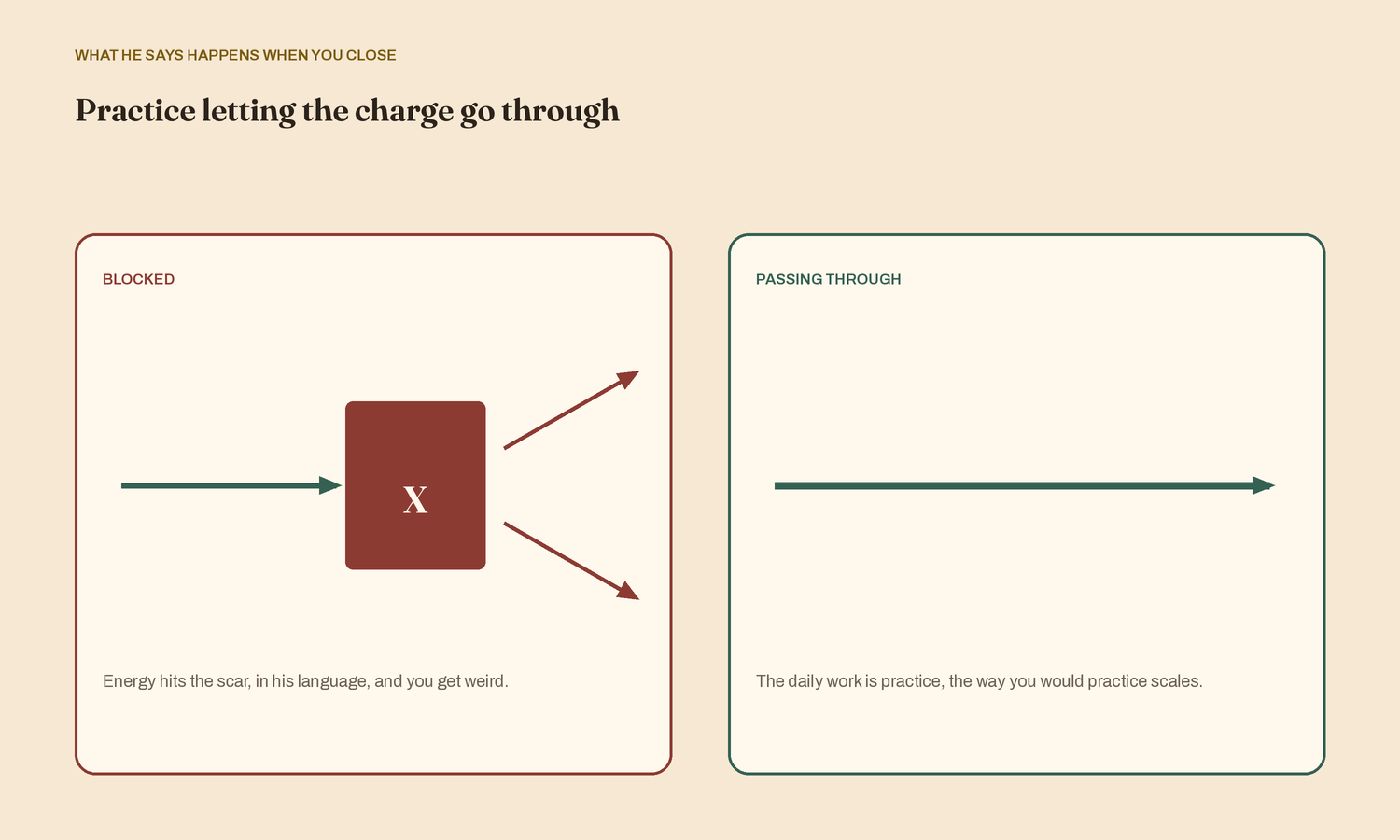
Chatterjee opens on the daily habit that has, he says, had “the biggest impact on my life”: time set aside morning and evening for “willing to let go and letting go.” Singer’s picture of why that would matter is physical in his own language. Experience is “energy trying to pass through me.” If your will stops it, “energy can’t stop. So your will has created a blockage.” Even “the tiniest thing” can leave “what we call some scar, a blockage.” Later energy “hits that blockage,” and “you get weird.” “That is the energy of joy hitting the blockages that you” built. This is his account of inner life, not a clinical finding.
1. Stop asking the driver to be different
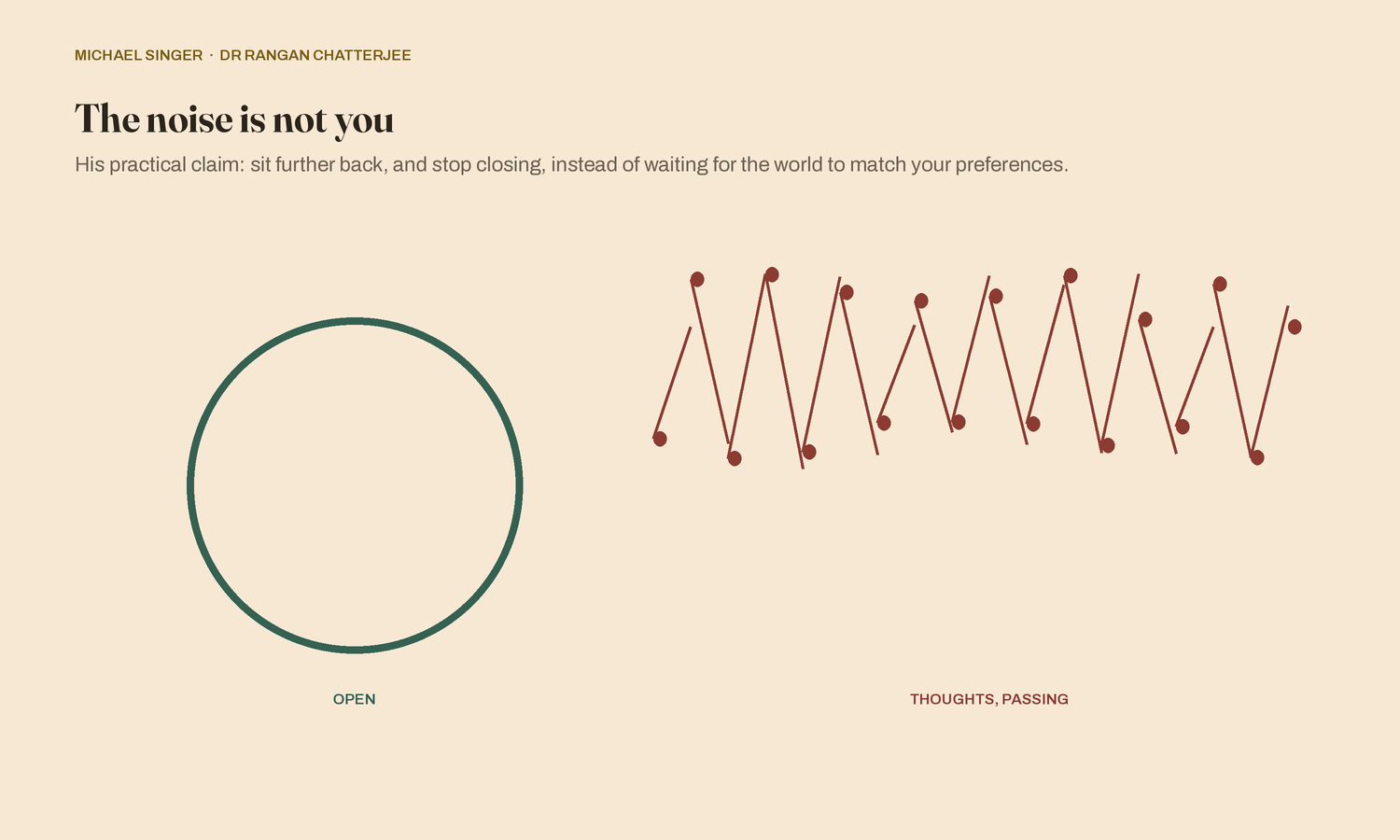
The alternative to closing, he says, is not a better plan for controlling people and weather. If an event “matches your preconceived notion of what you want, you open, you open, you open, you stop closing,” and “the energy can flow better.” If it does not match, the usual move is to lean on “everybody else” “to match what you want.” “Why don’t you just sit there and say, well, maybe I can let go of all these preferences and all these fears and anxieties that got programmed in me.” The work, in his telling, is to notice that you are “bringing your garbage out into the world and making everybody else be the way you need them to be.”
He likes ordinary tests. “The driver in front of me is bothering me? No, he’s not. He’s just driving the way he drives. He’s not bothering you.” Chatterjee presses the harder case: the principle is easy enough with weather, harder with road rage, and harder still “as situations in life get more and more challenging.” Singer’s answer is that it is “the same principle.” You still have “a choice about reality. You have a choice what you do about it.” You do not, in his view, have a choice about whether the moment arrived.
He talks about this as practice, not as a mood that descends. “You practice a piano, you don’t know how to play, you play the scales. You practice a sport. We call practice. Practice makes perfect. You practice letting go. You practice” handling “the moment in front of you.” “Just to practice being okay.” People come “from all over the world,” he says, and tell him it works. “Of course it works. Practice works.” That is his testimony, not a trial. The spiritual vocabulary he uses for what you meet when you stop staring at your thoughts — “Shakti, energy, God, call you want” — is his. The portable instruction is more modest: do the reps when the moment is small, so you have them when it is not.
2. Sit further back
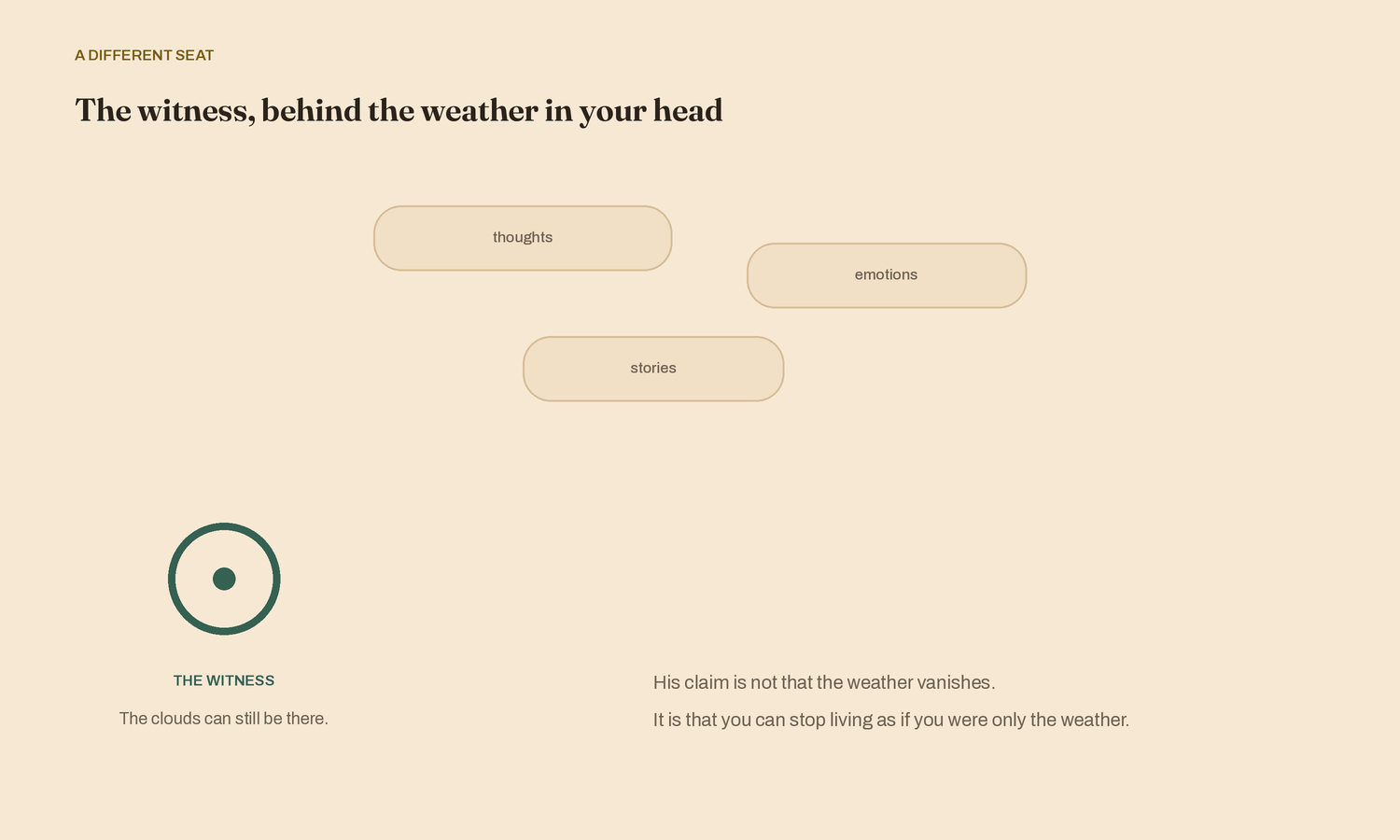
A second practical move is a change of seat. If you “stop fighting with life and you let go, you’ll find that you’re further back.” “It’s called the witness.” Thoughts and emotions are, in his image, “just stuff.” “They’re clouds in the sky.” “You who’s aware, awareness” is not the cloud. “The cloud may still be there, but if you” have taken a different seat, it does not have to run the day. He suggests a morning check: “you wake up in the morning and sit there and say, I’m back.” The point is not to have no thoughts. It is to stop “staring at yourself” — “your thoughts, your emotions, your” story — as if that were the whole of what you are.
Chatterjee keeps returning the conversation to daily life rather than to a retreat. Singer’s counsel, even when the subject is an open heart or a difficult history, stays close to the same move: let the charge “pass through you” instead of shoving it down, because “anything you shove down there is trying to come back up. Energy doesn’t want to be blocked.” You can, in his view, “honor and respect reality” without agreeing that the story you put on it is the only one available. “I get to frame everything. I get to put the story on the situation.” That framing, he says, is optional, and often heavy.
Weighing it: what holds up
Singer is teaching a spiritual and psychological practice he has written about for years, not reporting a clinical trial. Blockages, scars, Shakti, and an inner energy that “can’t stop” are his way of describing experience. They are not claims checked here against physiology. The practical layer — notice the preference, stop fighting the driver, practice letting go in small moments, take a seat as the witness — can be tried without accepting every metaphysical step. “Let it pass through” is not advice to ignore or avoid real danger or harm, and it is not a treatment for depression, anxiety, or trauma. The show is not medical advice, and neither is this article. Singer’s books, the sponsors, and Chatterjee’s own community and tour are commercial relationships alongside the conversation. Auto-generated captions are close, not word-perfect; they render Bon Charge as “Bond Charge.”
Related reading: Letting Go of the Lever · You Are Not What Happened to You
This is a contemplative practice, not treatment for depression, anxiety, or trauma; if those are weighing on you, a licensed clinician can help. If you or someone you know is in crisis or thinking about suicide, you can call or text 988 to reach the Suicide & Crisis Lifeline in the US. Outside the US, contact local emergency services or a local crisis line.
Long Talk Short
- Singer’s view is that joy is the default, and that what blocks it is the habit of resisting the moment and storing the leftover charge.
- The alternative to making other people match your preferences is to practice letting those preferences go, starting with ordinary friction such as the driver in front of you.
- He talks about sitting further back as “the witness,” so thoughts and emotions can pass like clouds instead of being treated as the whole of who you are.
- The spiritual language is his; the daily work he keeps returning to is practice, the way you would practice scales, including a morning return to that seat.
The one thing to remember: You may not get to choose the situation in front of you, but Singer’s claim is that you can practice what you do with it, starting with the small stuff.
Independent summary; not affiliated with Michael Singer, Rangan Chatterjee, or the show’s sponsors. Spiritual claims are Singer’s own. Not medical advice.
Source: Feel Better, Live More with Dr Rangan Chatterjee, “How To Feel Joy Every Single Day | Michael Singer,” on YouTube (linked above). Independent summary; not affiliated with the show or its guest.