Real Life Beats Cheap Dopamine: Jimmy Carr on Young Men, Agency and Kept Promises
You may be living better than any king in history and still feel worse. Jimmy Carr says comparison is why, and that young men trade career, sex and freedom for online proxies. His case for agency, risk and kept promises, and what the data actually show.
If you have a hot shower, enough to eat and a phone full of entertainment, Jimmy Carr thinks you are living like a king. So why do so many people, and so many young men in particular, feel worse than ever? On The Diary of a CEO, the comedian and host Steven Bartlett dig into that gap. Carr's answers are less about therapy than about agency, risk and real life.
In short: Carr argues that life has "never been objectively better and subjectively worse," because we judge our lives by comparison. For young men, he says, the problem is missing agency: video games, porn and life online stand in for career, sex and freedom, while real-world risk is discouraged. His fixes are gratitude, small daily wins, kept commitments and being present.
1. Better lives, worse feelings
Carr opens with what he calls "life dysmorphia." We adapt to how good things are and stop noticing. His friend George Mack's exercise is to pause in a hot shower and remember that no one you admire from generations past had that simple pleasure. Carr's formula for happiness is blunt: your quality of life minus envy. Because our desires copy other people's, he says, it is easy to look at how everyone else is doing and take no pleasure in what you have.
He pairs gratitude with a demand for difficulty. "You can't have an easy life and a great character," he says. He flips a familiar slogan: it's not the pursuit of happiness, it's the happiness of the pursuit. And he notes that adult life is self-assigned. After school, nobody hands you the next task, so you can take the easy path, which he calls "short money," or set yourself a hard one. So why do so many young men seem to pick neither?
2. What's going on with young men
Bartlett raises the episode's title theme: young men who seem lost, rising suicidality, and influencers such as Andrew Tate gathering a following. Carr calls Tate "a 14-year-old boy's idea of what masculinity might look like." His larger point is that "nature abhors a vacuum" and there is "a real vacuum for elders." Young men learn to shave from a YouTube video rather than from their fathers, and something in that bond is lost.
His diagnosis is a set of substitutes. Video games, he argues, are "a proxy for career," with levels and progress that real jobs are not providing. Online porn is a proxy for sex. Life online is the only place many young people get freedom, because in the real world they are not trusted to take risks. Teenagers who once worked as babysitters, he quips, are treated as if they need one. Reversing Orwell, he says our power won't be taken by an authoritarian master: "We're going to give it away for cheap dopamine."
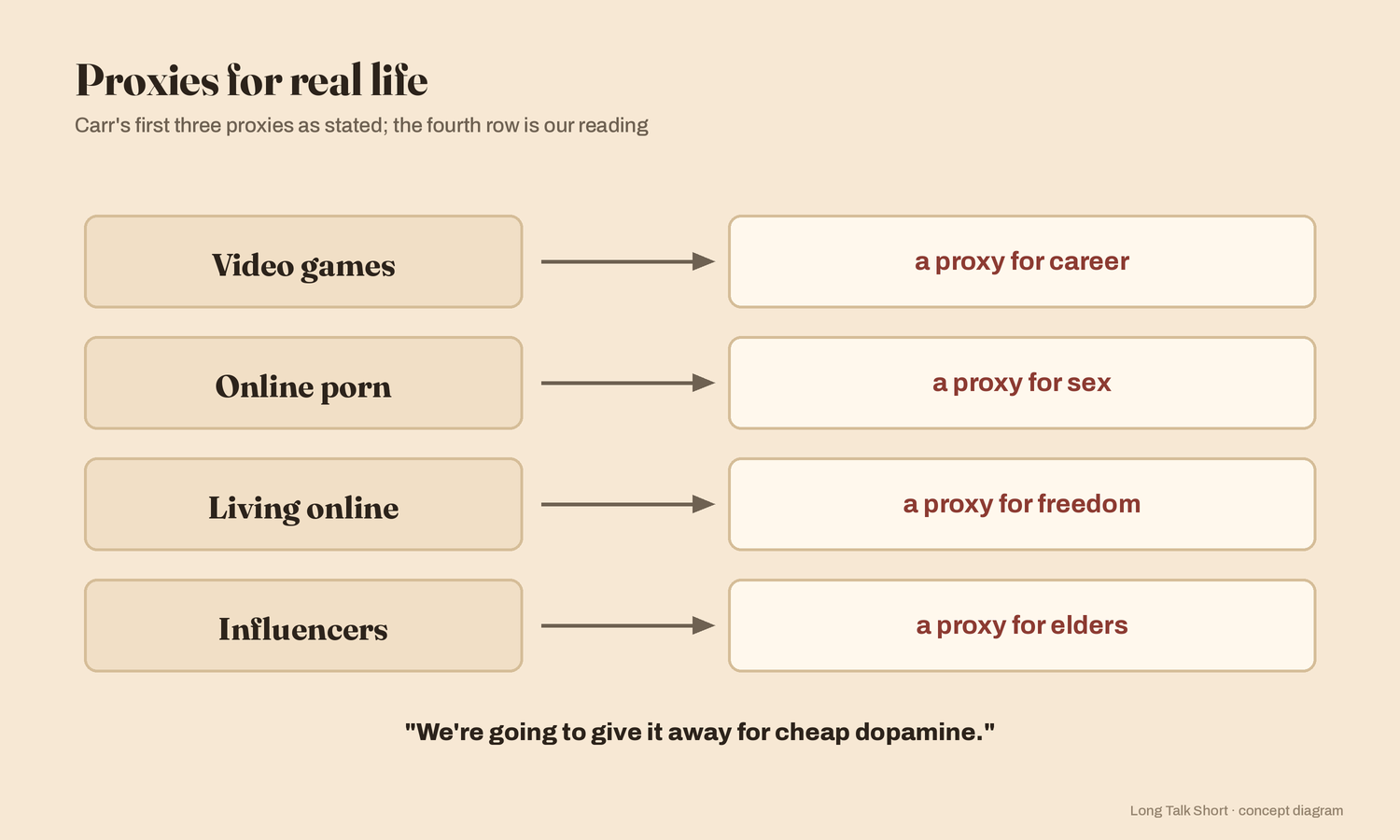
He names the core problem directly: agency. Young people, he says, don't feel they have control. His advice to young men is simple: be a gentleman, take real risks, and live in real life. But risk toward what?
3. Meaning without the old scaffolding
Carr connects the problem to a wider loss. Two centuries back, he says, people had the bottom of Maslow's pyramid unsolved but the top sorted: they knew who they were, what their purpose was, and whom they belonged to. For us it is reversed. We are "free-floating individuals" who forget that, as the old line goes, there is no such thing as a baby, only a baby and someone caring for it. "We're all still babies."
Both men say they lost their religious faith in their twenties, and both say they miss it. Carr misses not the stories but the coming together. Losing religion felt to him like a rush of freedom and like putting on a backpack full of weights: the responsibility is yours. So how do you carry it day to day?
4. Small proofs, kept daily
For mindset, Carr offers a 24-hour test he worked out with Chris Williamson and George Mack: what could you do in the next day that your future self will be glad of? The gym, the right food, ten fresh jokes. "You won't rise to your goals, you'll fall to your systems." Over time, those small gifts to your future self add up.
Confidence, in his view, has to be earned. You have to give the world "irrefutable proof you are who you say you are." Bartlett adds that confidence is the culmination of commitments you have kept to yourself, and Carr agrees, adding that there is "a mirror up as well." So don't make promises to yourself that you won't keep.
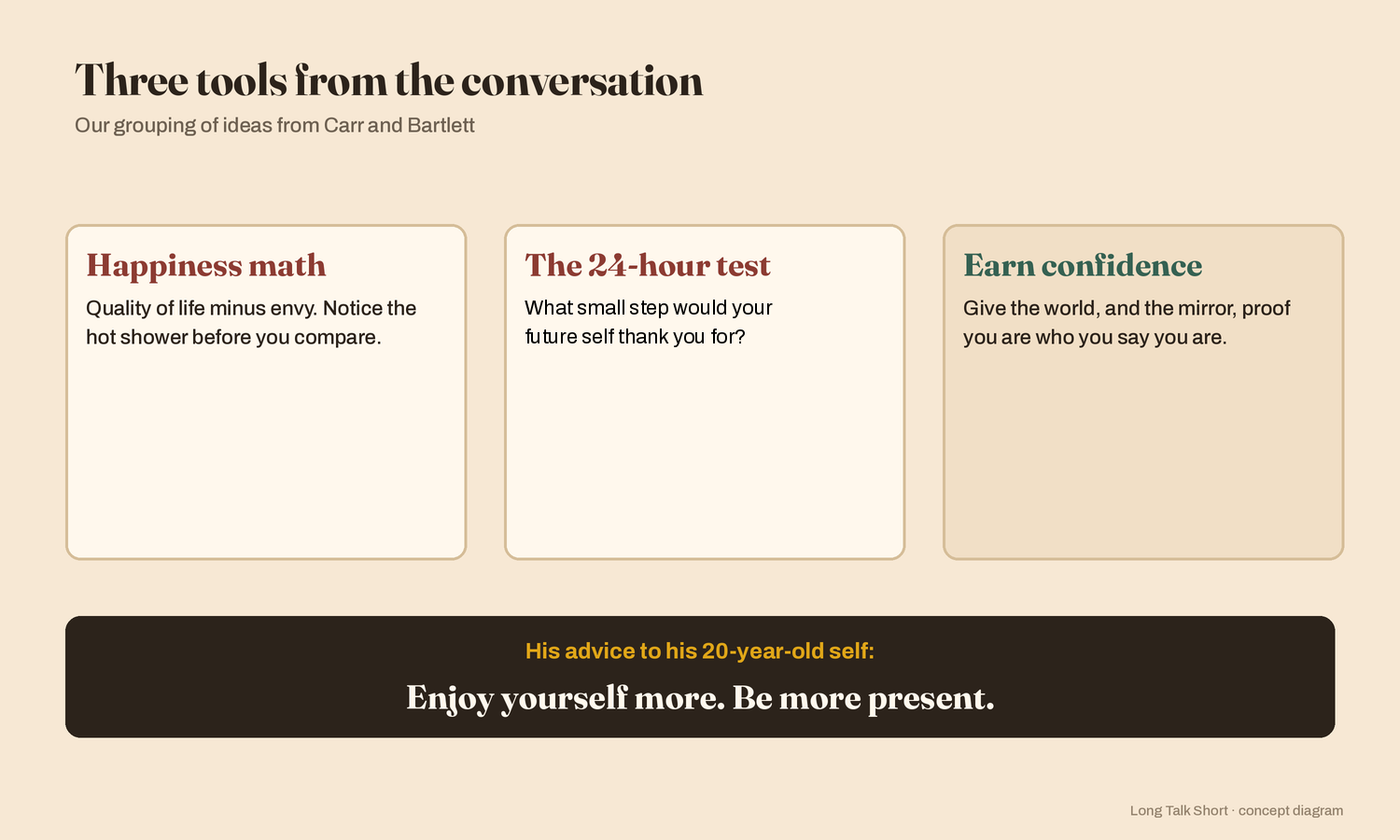
The episode ends with an unexpected counterweight to all that striving. Asked what he would tell his 20-year-old self, Carr says: "Enjoy yourself more. Try and be more present." He was worried about "the results and not the process," about his degree grade, when he should have been having more fun.
Weighing it: what holds up
Framing: The title, "There's A Crisis Going On With Men!", covers only a small part of a long episode. The groupings in our figures are ours.
Holds up: Gratitude, small daily habits and keeping commitments to yourself are sensible, low-risk advice, and his point about adapting to good fortune matches what psychologists call hedonic adaptation.
Partly holds: Neither man cites a figure on male suicide. Office for National Statistics data for England and Wales show males account for about three-quarters of registered suicides, with a male rate of 17.4 per 100,000. The same data show the highest male rate among men aged 45 to 49, not young men, so if Carr's "horrific with young men" is meant comparatively, it is incomplete.
Corrections: Carr's dating of when hot showers became common is at best loose.
Not checked: His "100 billion people ever" is broadly in line with common estimates but was not verified. His proxies and his account of agency are opinion, not research. Quotes were checked against YouTube's automatic captions, a machine transcript, so small errors are possible.
Disclosures: No paid ad reads appear in our transcript. Carr promotes his Netflix special, Natural Born Killer, his tour, his memoir-style book and a book in progress with Amanda Baker, and Bartlett also recommends the special. This was Carr's return visit to the show.
Bottom line: a sharp, quotable case for agency and real-world risk; treat the diagnosis of young men as one comedian's opinion, not settled science.
Related reading: Jimmy Carr on why laughter needs a room · Tali Sharot on adaptation and habituation · James Hollis on breaking old patterns
Long Talk Short
- Happiness, in Carr's formula, is quality of life minus envy; notice what you already have.
- He sees games, porn and life online as stand-ins for career, sex and freedom.
- Missing agency and missing elders, not just mood, are his diagnosis for young men.
- Ask what small step your future self will thank you for.
- Confidence follows kept commitments, so stop making promises to yourself you won't keep.
The one thing to remember: the real-life version is harder, riskier and slower, and that is exactly why it builds you.
This summary is for general information only and is not medical or mental health advice. If you are struggling or in crisis in the US, call or text 988 to reach the Suicide & Crisis Lifeline.
Source: Steven Bartlett and Jimmy Carr, "Jimmy Carr: 'There's A Crisis Going On With Men!'", The Diary of a CEO, on YouTube. This is an independent summary and is not affiliated with The Diary of a CEO, Steven Bartlett or Jimmy Carr.