The $50,000 Gold Rumor: What Is on the Books, and What Is Only an Argument
George Gammon and Tom Bilyeu argue over a rumored plan to reprice official U.S. gold as high as $50,000 an ounce. The statutory $42.22 book price is real; no official plan has been announced. Grok Bot sponsors the episode. Not investment advice.
This is a rumor and a thesis, not a policy. If you have seen a headline that the Treasury and the Fed have a plan to reprice gold as high as $50,000 an ounce, the first thing to hold onto is that no such plan has been announced or confirmed. On Tom Bilyeu’s show, George Gammon walks through a report that claims Scott Bessent and Kevin Warsh are building what the episode’s title calls a “secret gold accord” to revalue America’s gold and use the paper gain against a debt load he puts around $40 trillion. As far as we could find, the report traces to an independent analyst’s Substack post, which infers the link from hires and meetings, cites no statement from either official, and acknowledges that nothing official has happened. Neither official has announced such a plan. Bilyeu is interested, and also visibly incredulous. By the end he is not buying the plan as something that is actually underway.
The episode is “The Secret Gold Accord: Why Bessent and Warsh Might Reprice Gold to $50,000,” at youtube.com/watch?v=g-k6L4nSCFM. Auto-generated captions were used for wording; names have been corrected from the official title. This is not investment advice.
Disclosure: Grok Bot (listed in the show notes as “Grokbot”) is a sponsor of this episode, and this article was written with Grok Bot. Other sponsors include HeyGen, and Bilyeu also promotes his own products, including an AI masterclass, founder programs, and a game.
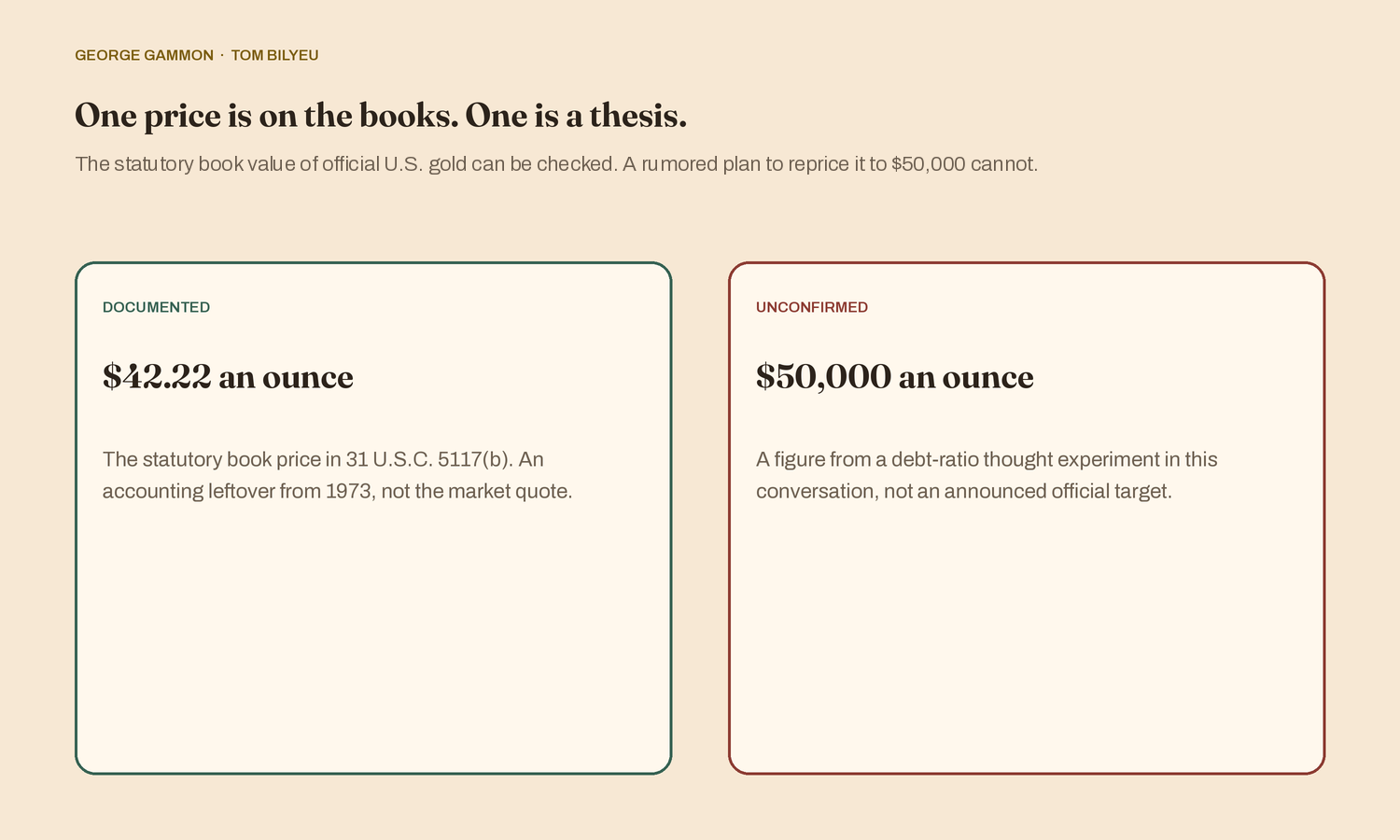
In short: A report claims Treasury and the Fed could revalue official gold, as high as $50,000 an ounce, to pay down debt. No official plan has been announced, and nothing here suggests wrongdoing by anyone named. What is documented: the statute values Treasury’s gold at $42.22 an ounce, and the government holds about 261.5 million ounces. Gammon’s $50,000 is a debt-ratio calculation, and Bilyeu concludes a repricing is unlikely. This is not investment advice.
What can be checked, and what cannot, should be kept apart. The United States does hold a large official gold stock — about 261.5 million fine troy ounces in the Treasury’s gold reserve report — which is consistent with Gammon’s “call it 260 million ounces or so.” On the government’s books that metal is still valued at the statutory price in 31 U.S.C. § 5117(b): “42 and two-ninths dollars a fine troy ounce,” usually written $42.22 — not the market price, and not “around $40,” the rounded figure he uses. That book value is an accounting leftover from 1973. It is real. A “secret accord” to jump the official price to $50,000 is not, on the public record reviewed for this article, an announced policy, and we found no official statement of any such plan. Warsh called in 2025 for a new Treasury–Fed accord in the spirit of 1951, but about the size of the Fed’s balance sheet (Reuters), which is not the same thing as naming a new gold price. In early 2025, asked about revaluing gold, Bessent said it was “not what I had in mind” (Bloomberg). No official revaluation plan turned up in that check.
1. The arithmetic that produces $50,000
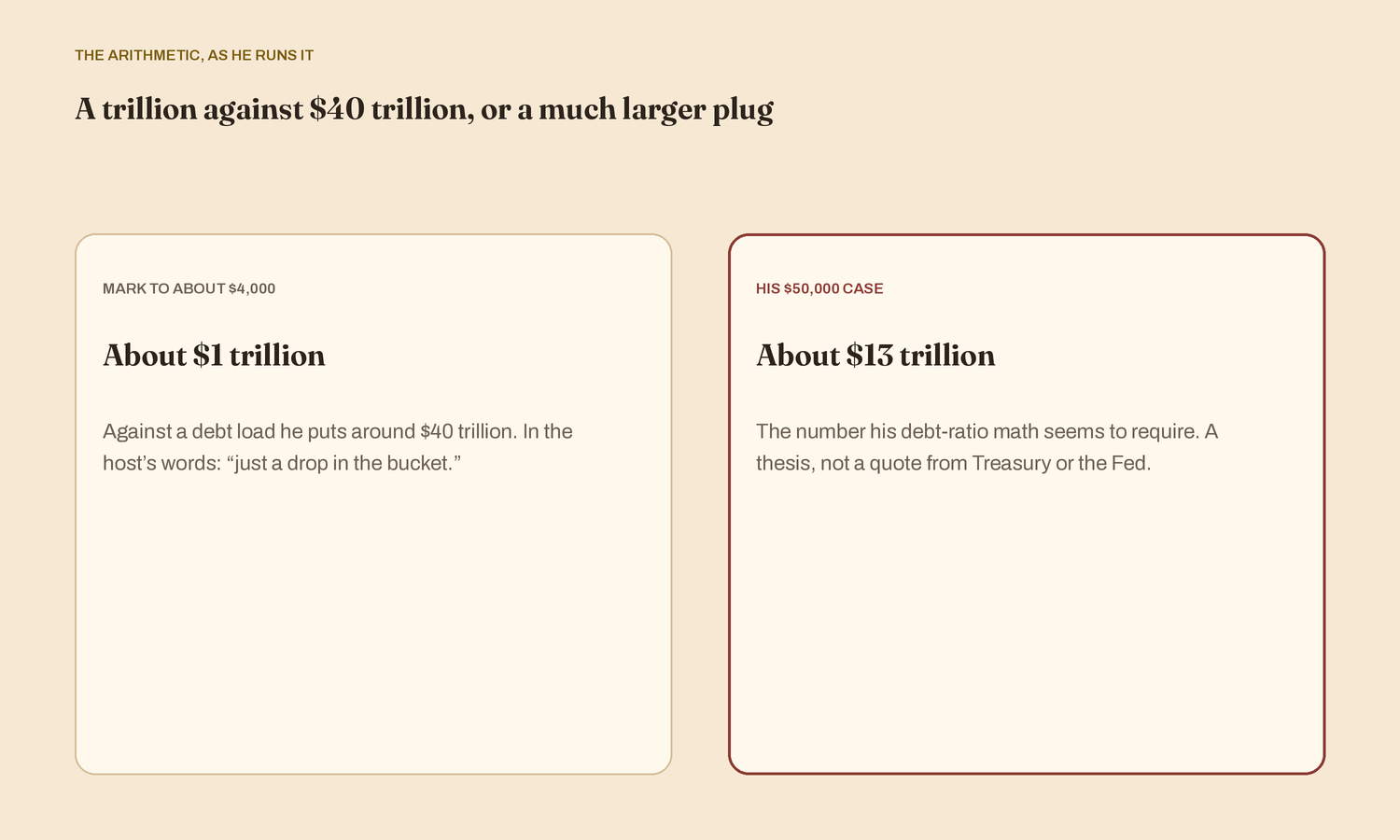
Gammon’s mechanics, as he sketches them, are an accounting story. Treasury gold sits on the government’s books at the old official price. If the official price were raised, larger gold certificates could be issued to the Fed, and the difference could be credited to Treasury’s general account, cash that could then be used to buy back debt — at least in this telling. Mark the hoard to a market price he puts “right around $4,000 an ounce,” and he gets “only be about a trillion” against $40 trillion of debt. “That ain’t going to do nothing,” Bilyeu says. “Trillion down to 39. That’s just a drop in the bucket.”
The $50,000 figure, in Gammon’s own math, is what you would need if the goal were to shrink debt-to-GDP from his chart’s “right around 120%” to something under 100%. Take “260 some odd million ounces” times $50,000, and he gets “around 13 trillion,” which on his numbers would take debt from 40 trillion toward 27 and debt-to-GDP to “a very sustainable 81%.” Those debt and GDP figures are his charts. The important point is the logic: $50,000 is not a forecast of what gold would trade at in a market. It is a plug in an equation about the debt ratio. Bilyeu calls it “such an absurd number. There’s no justification for it whatsoever. You’re just saying we’re going to inflate the currency.” Even then, he says, it “doesn’t pay off your debt.” The episode never fully explains how the official price would actually be walked up to $50,000; Gammon postpones “the mechanics” to “a separate video,” which is one of the moments that most visibly frustrates his host.
2. Bilyeu’s case against treating the rumor as a plan
Bilyeu then says he wants to “lay out my case against this.” He agrees that the bond market is not pricing a gold revaluation, or a debt crisis, as imminent. In his telling, the dollar still sits at the center of a global funding system — he leans on the eurodollar — and that convenience is why the debt has been tolerated. He worries about de-dollarization and about financial repression if the easy confidence ever breaks. “Fine until it’s not” is the mood of that section. On the specific rumor, he comes out plainly: “I think he’s right. They’re not going to reprice the gold.” The report remains a report. The statutory $42.22 remains the book price. The $50,000 number remains a thought experiment with a very large jump in it.
Weighing it: what holds up
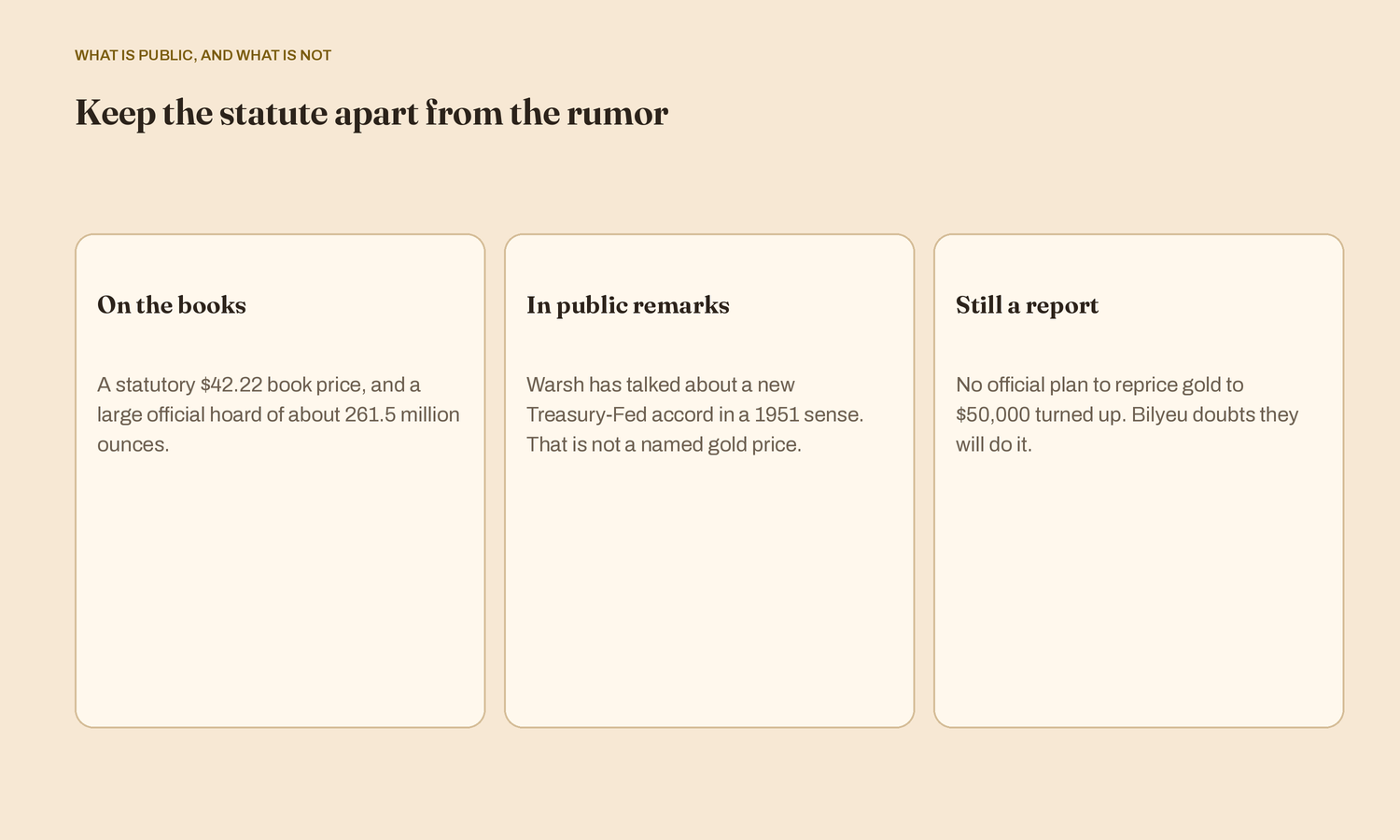
This is a market-commentary conversation built on an unconfirmed report, not a policy announcement. The statutory book price and the existence of a large official hoard check out against the U.S. Code and Treasury’s own report; the rounded “$40” figure is slightly loose. The $50,000 path, the “secret accord,” and the idea that such a markup would cleanly retire enough debt to settle the ratio are arguments, and Bilyeu himself treats the price as unjustified. Changing the statutory price would, on the face of the code, take an act of Congress, and we found no such proposal. Neither Bessent nor Warsh has announced a plan, and nothing here suggests wrongdoing by either; the claim is about a possible accounting policy. Debt, GDP, and market-gold figures in the episode are the speakers’ own, not a substitute for official series. Grok Bot is a sponsor of the episode and the tool used to write this article. Auto-generated captions are close, not official. Nothing here is a recommendation to buy or sell gold, bonds, or dollars.
Related reading: A Hike Into Softness? · A Lead, Sitting in a Warehouse
Long Talk Short
- A report claims Treasury and the Fed could revalue official gold and use the paper gain against a very large federal debt; no official plan has been announced.
- What is documented is more modest: the United States books its gold at a statutory $42.22 an ounce, far below the market price.
- Gammon’s $50,000 figure is the number his debt-ratio arithmetic seems to require, not a quoted official target, and even he postpones the hardest mechanics.
- Bilyeu calls that price absurd, and concludes they are probably not going to reprice the gold; his worry is more about confidence in the dollar if it ever stops being easy.
The one thing to remember: A statutory price on the books is real, and a viral revaluation story is not the same thing — the first is documented, the second is still only a thesis.
Independent summary; not affiliated with Impact Theory, Tom Bilyeu, George Gammon, the Treasury, or the Federal Reserve. Grok Bot sponsors the episode and wrote this article. Not investment advice.
Source: Impact Theory with Tom Bilyeu, “The Secret Gold Accord: Why Bessent and Warsh Might Reprice Gold to $50,000,” on YouTube (linked above); public-record sources are linked in the article. Independent summary; not affiliated with the show or its guest.