The Fight About the Dishes Is Really Two Fears: Esther Perel on Losing the Other, or Losing Yourself
Esther Perel tells Jay Shetty that one partner often fears losing the other, the other fears losing themselves — and that this split, not the dishes, drives many small fights. From a shorter cut of a longer conversation.
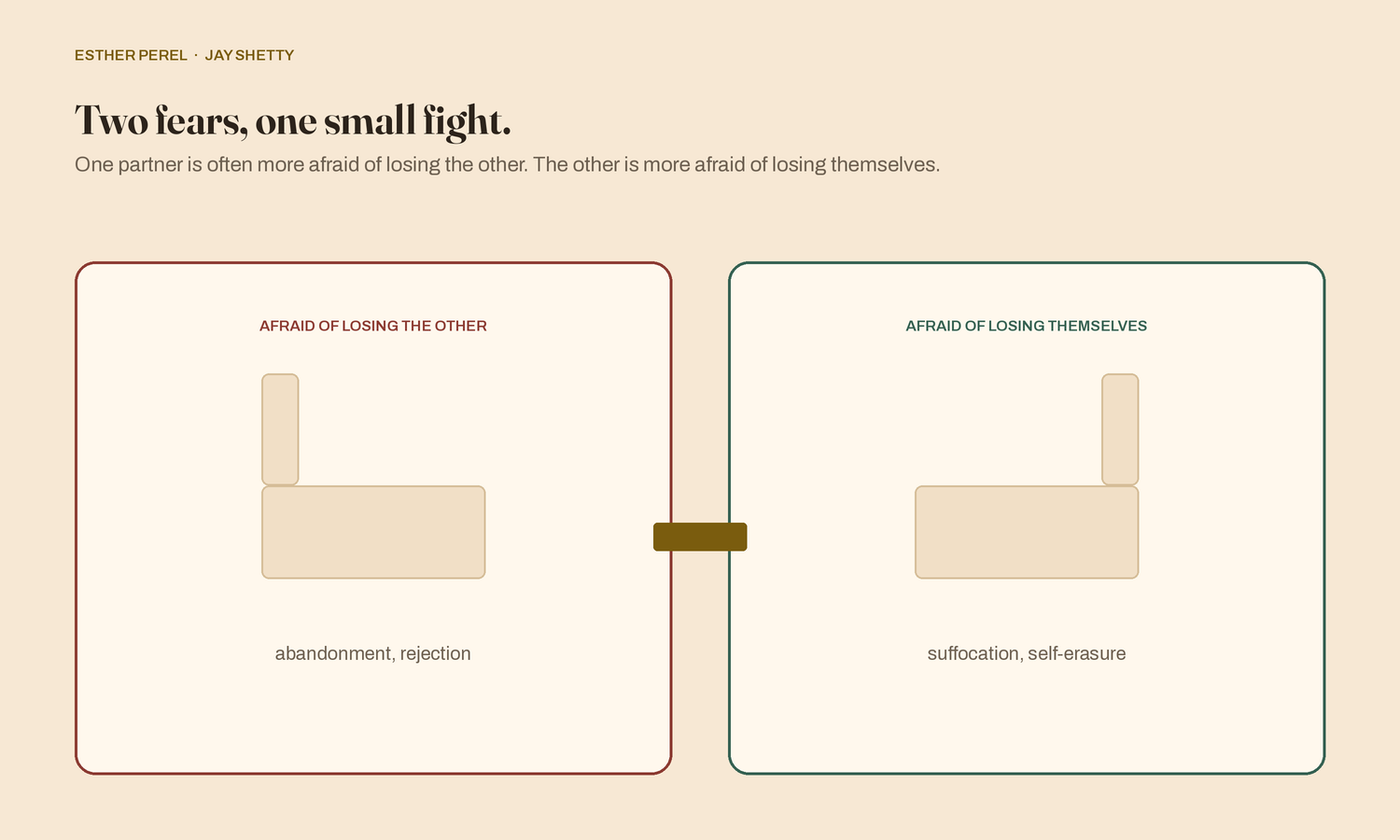
If a small fight in your house keeps turning into something larger than the dishes, Esther Perel’s account is that you may already know why, even if you keep arguing about the sink. “In every relationship,” she tells Jay Shetty, “you will find that there often is one person who is more afraid of losing the other and one person who is more afraid of losing themselves.” One leans toward abandonment and rejection. The other leans toward suffocation, and so fights for “their ideas, their ways of doing it, the timing of the dishes.” That fight, she says, “is less about power. That is more about the nature of connection.”
The YouTube episode is “Relationship Therapist: The Hidden Question Behind Every Small Argument You Have | Esther Perel,” at youtube.com/watch?v=WysKRcaqqxQ. It is a shorter cut of a longer On Purpose conversation; the description points to a full episode on Netflix, Spotify, and YouTube. This article follows the shorter cut, so it may leave out context from the full conversation. Auto-generated captions were used for wording.
In short: Perel says one partner is often more afraid of losing the other and the other more afraid of losing themselves, and that many “power struggles” are really fear using control as a defense. Underneath most fights, she says, are power, trust, and value. The habit she offers is a pause: which fear just arrived? It is a therapist’s teaching frame, not a diagnosis.
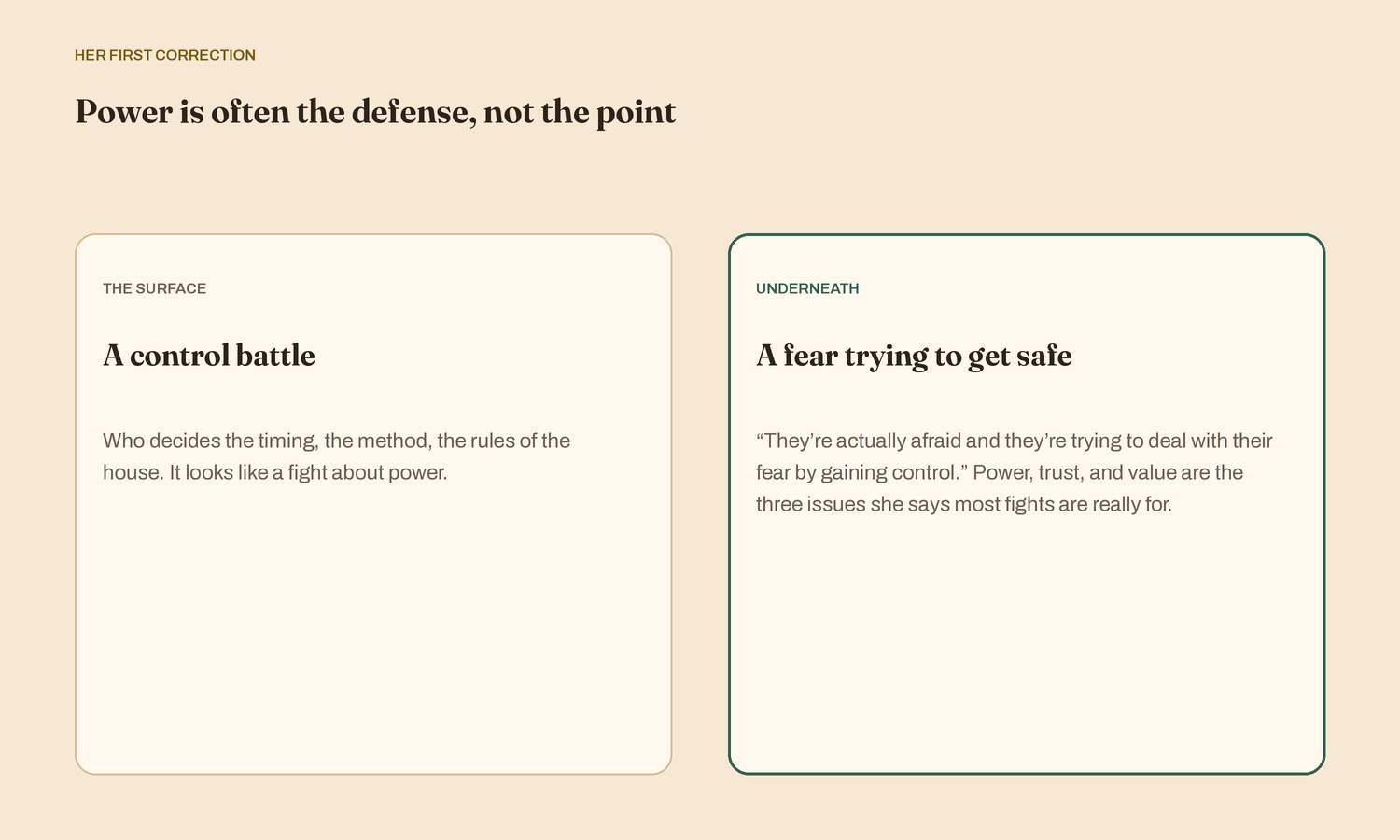
The move she wants you to make is to stop taking the surface argument at face value. “The majority of power struggles in a relationship are not power struggles,” she says. “Power is the defense. The control battle is the way people are defending, trying to get something for something else that they are worried about.” What looks like stubbornness about timing, or a need to win, is often fear with a strategy. “They’re actually afraid and they’re trying to deal with their fear by gaining control.” Her warning is simple: “Don’t just go for what you see, cuz what you see isn’t necessarily just what” is going on.
1. The dishes were never only about the dishes
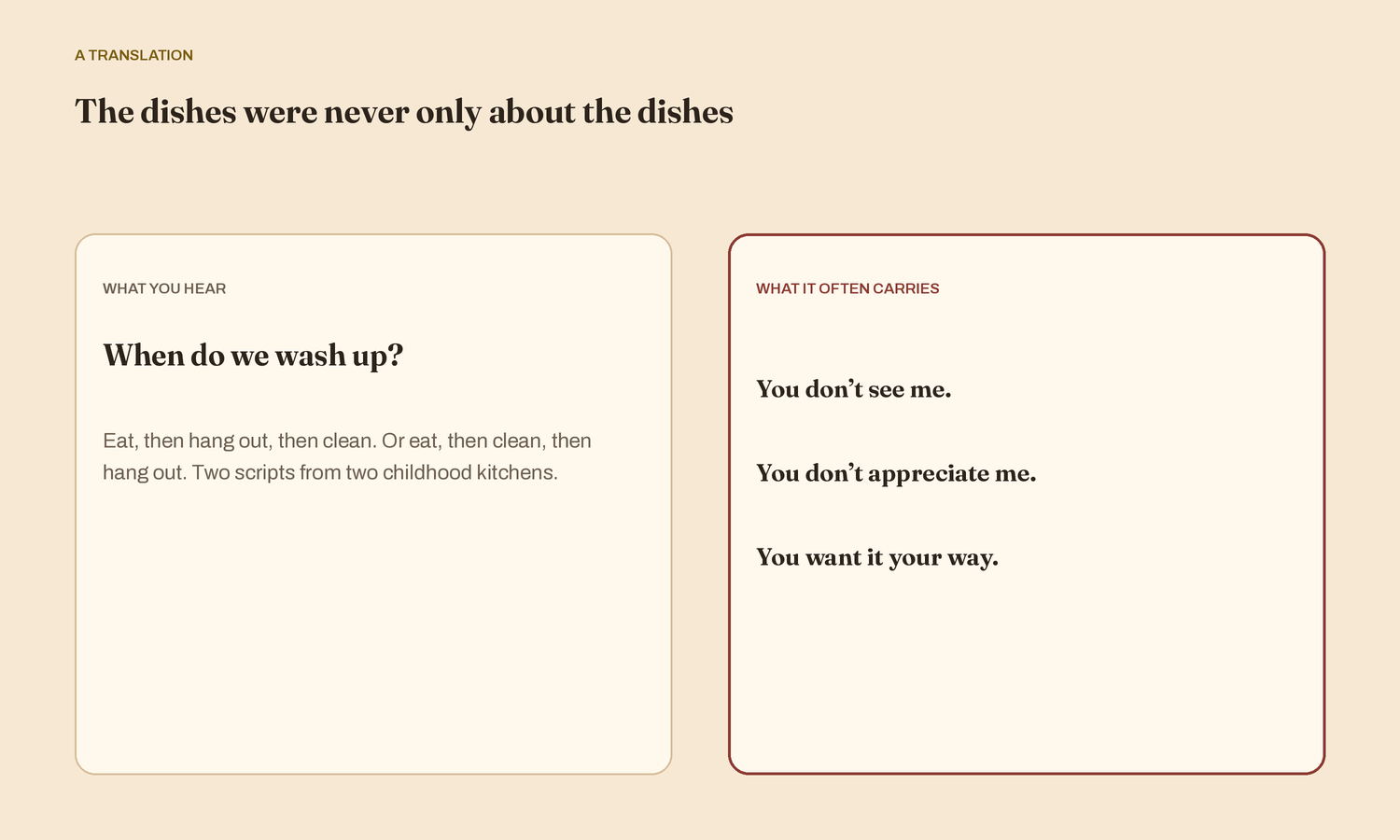
Shetty offers a domestic example that could have come from almost any kitchen. In his childhood home, he says, they would “eat, hang out, and then at the end of the night, we’d wash the dishes.” In his wife’s home, they would “eat, wash the dishes, and then hang out.” After they married, the same evening produced two scripts, then friction, then a larger charge: “you don’t care about me and you don’t love me and you don’t appreciate me.” Perel translates the scene. “You were fighting about what’s the right moment to do the dishes, but in fact… what we were talking about is you don’t care, you don’t see me, you don’t appreciate me, you want it your way.”
Underneath most fights, she says, “there are usually three sets of issues that we are actually fighting for. And that is power, trust, and value.” The dishes become a referendum: do you value my way of making a home, can I trust you to see me, who gets to decide? That is why a small scheduling difference can feel like a verdict on the relationship. It is also why winning the point about the sink rarely settles anything. If the hidden question is “do I matter here?” or “do I still get to be myself here?,” a correctly timed clean-up will not answer it.
2. When helplessness turns into blame
She describes a fight with her husband in the car after nearly forty years of marriage — not as a scandal, but as evidence that the pattern does not retire. The useful mechanism is helplessness. In a frustrating situation, she says, “instead of dealing with the frustration of the situation, you start to blame the other.” The hidden demand is sharp: “Why are you not competent so that I don’t have to feel so helpless?” The partner becomes the place you put a feeling you do not want to hold. That is a different claim from “this person is the problem.” It is closer to: I am scared, I feel powerless, and control or blame is what I reach for.
The same lens, in her telling, is what makes the need to win look less like a personality and more like armor. If one of you is defending against being left, and the other is defending against being erased, then every small argument is a chance to restore a little safety — or to confirm the fear. The portable habit is not a technique for never fighting. It is a pause that asks, before the dishes become a trial, which of those two fears just entered the room, and what it is trying to protect.
Weighing it: what holds up
This is a therapist’s reading of couple dynamics, delivered on a popular interview show, not a study of any one household. The two-fear pattern and the triad of power, trust, and value are teaching frames she has used for years; they will fit some fights better than others. The frame is for ordinary couple conflict. It is not a way to read abuse or coercive control, where control is not simply a defense against fear and safety comes first. If you feel unsafe in a relationship, the National Domestic Violence Hotline is 1-800-799-7233 (or text START to 88788). This article follows a shorter cut of a longer conversation. Auto-generated captions are close, not official. Nothing here is a diagnosis, a reason to stay, or a reason to leave, and it is not a substitute for professional help if you need it.
Related reading: The Invisible List · Right Person, Wrong Time?
Long Talk Short
- Perel’s opening claim is that one partner is often more afraid of losing the other, and the other more afraid of losing themselves — and that this split shapes the small fights.
- Most power struggles, in her telling, are not really about power. Power is the defense; control is how fear tries to get safe.
- A fight about when to do the dishes can be a fight about being seen, valued, or allowed to keep a self.
- When you feel helpless in a situation, it is easy to turn that feeling into blame, as if a more competent partner would spare you the fear.
The one thing to remember: Before you argue harder about the sink, ask which fear just arrived — of being left, or of disappearing — because that is often the fight you are actually in.
Independent summary; not affiliated with Esther Perel, Jay Shetty, or On Purpose. Not therapy or mental-health advice.
Source: Jay Shetty, On Purpose, a shorter cut of the conversation with Esther Perel, “Relationship Therapist: The Hidden Question Behind Every Small Argument You Have,” on YouTube (linked above). Independent summary; not affiliated with the show or its guest.