Why Quitting Nicotine Feels Worse Than You Expected: Huberman on the Chemistry and the First Week
A condensed Huberman Lab episode explains how nicotine acts in the brain, why vaping can be hard to drop, and which quit tools he reviews. His statistics are attributed to him. Help: 1-800-QUIT-NOW. Not medical advice.
If you have tried to quit smoking or vaping and found that willpower ran out in a few days, a condensed Huberman Lab episode is trying to explain the chemistry that made that so hard. Andrew Huberman’s first move is a distinction a lot of advice blurs: nicotine is not the same thing as the cigarette, the vape, the dip, or the snuff that delivers it. The molecule, he says, is what reinforces the habit. The delivery method is what does most of the damage. Both facts matter if you want to stop.
The episode is “Essentials: Nicotine’s Effects on the Brain and Body and How to Quit Smoking or Vaping,” at youtube.com/watch?v=8YHTMsy0bT8. It is a condensed recut of an earlier, full Huberman Lab episode on nicotine. Sponsors are Eight Sleep, AG1, and Our Place. Auto-generated captions were used for wording; technical names have been corrected. The statistics below are Huberman’s own citations, attributed to him. This is not medical advice.
In short: Huberman separates nicotine, which drives the reinforcement, from the cigarette, vape, or tin that delivers it and does most of the documented damage. He says withdrawal can start within hours and that the first week is where many unaided attempts fail. He reviews hypnosis, bupropion, and nicotine replacement as options to discuss with a clinician. Free help: 1-800-QUIT-NOW. This is not medical advice.
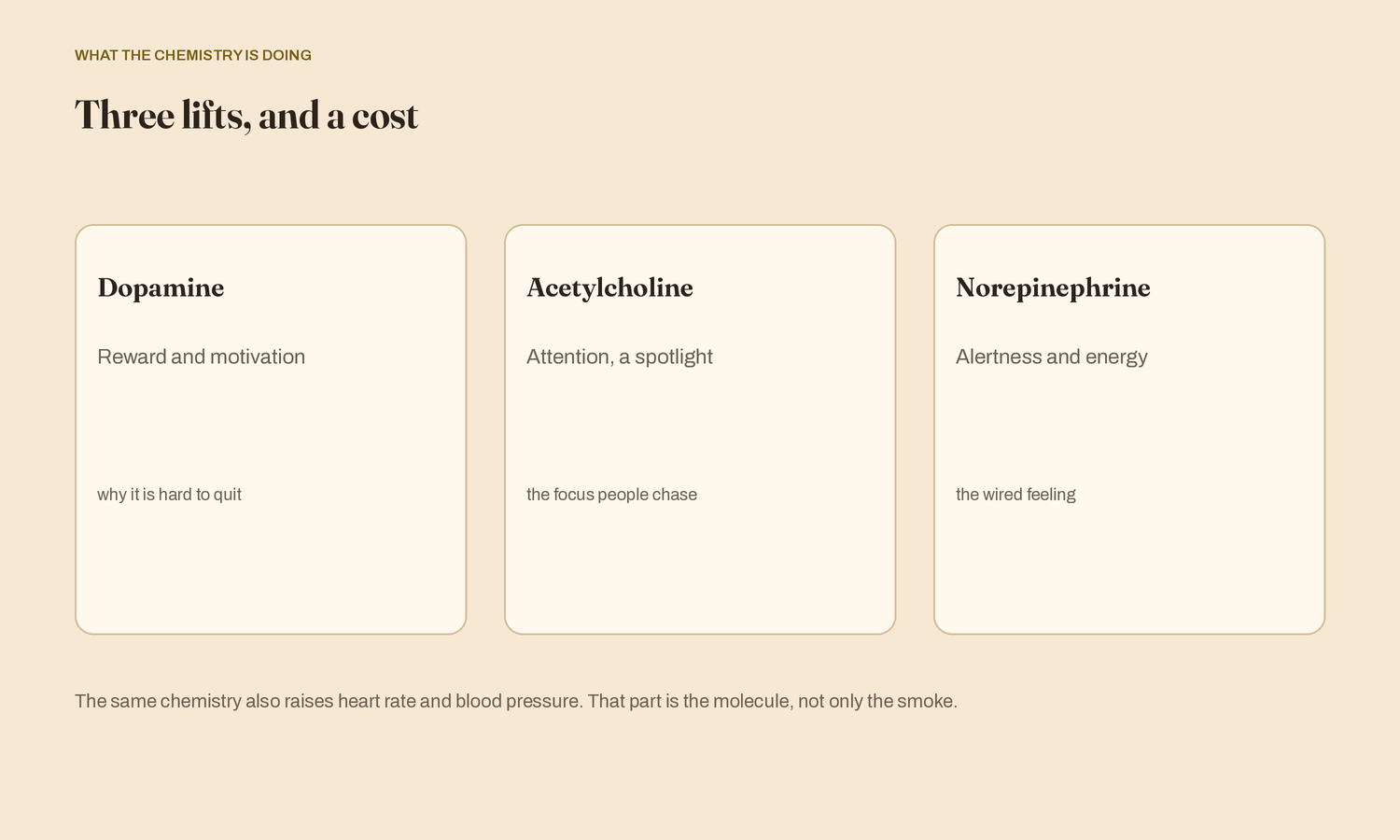
Nicotine, in his account, hits several systems at once. It triggers dopamine in the mesolimbic reward pathway — which is “what gives nicotine its rewarding properties,” and why it is “so hard to quit.” It also acts through nicotinic acetylcholine receptors, which he ties to attention, and it raises norepinephrine, which he ties to alertness. The same chemistry also raises heart rate and blood pressure and constricts blood vessels. That mix can feel like a focused mind in a quieter body — useful, he thinks, for short-term cognitive work, and a poor idea for physical performance. None of that is a reason to start.
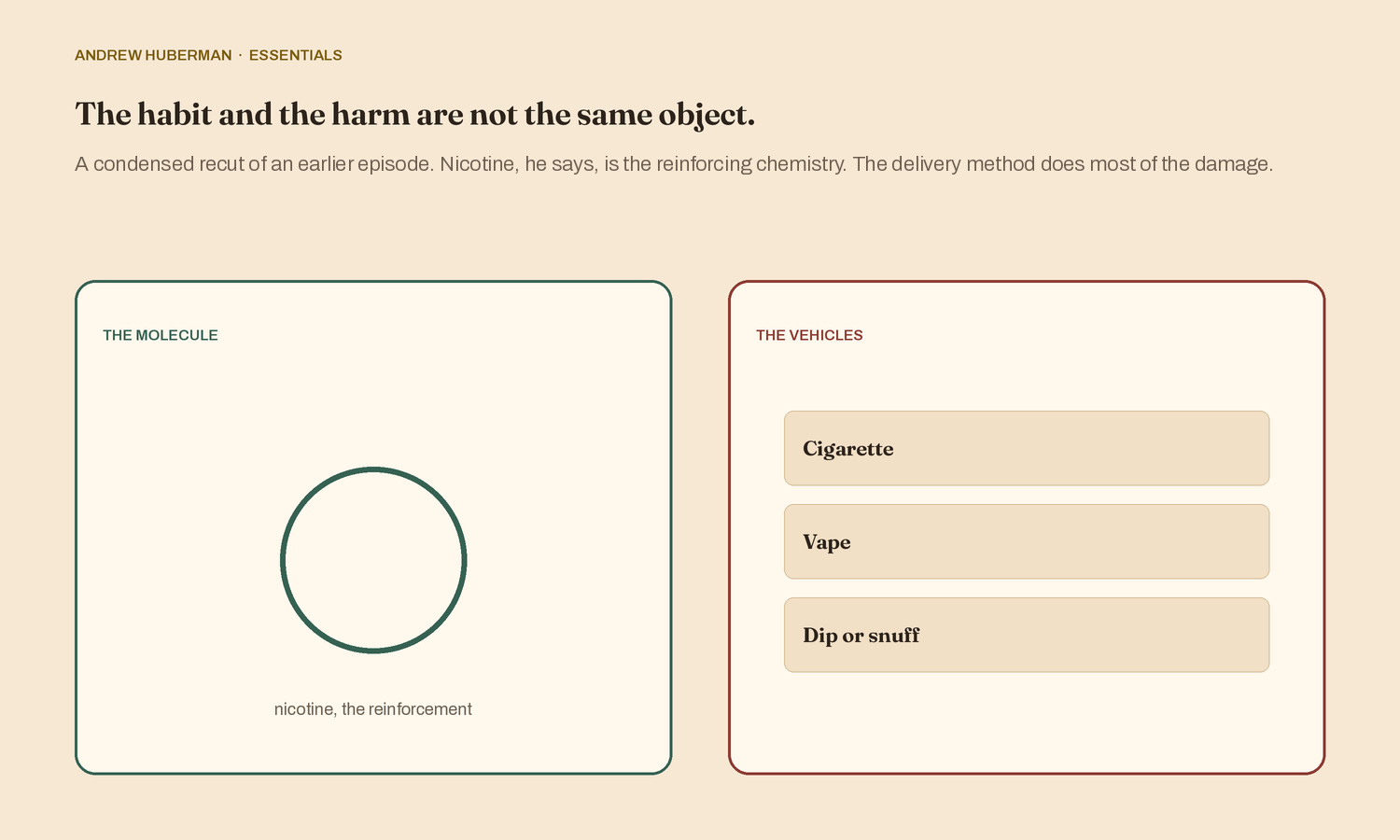
1. The delivery method is the dangerous part
He is blunt about the vehicles. Smoking, vaping, dipping, and snuffing, he says, “negatively impact every organ and tissue system” by damaging endothelial cells, the lining of blood vessels. Cigarettes, in a figure he cites, contain “anywhere from 4,000 to 7,000 toxins.” He offers a stark lifespan estimate: “for every pack of cigarettes smoked per day, we can reliably estimate a 14-year reduction in lifespan.” That “per pack per day” framing is his, and lifespan estimates in the wider literature are not all that tight. Dipping, he says, substantially raises the risk of mouth cancers; the auto-captions render his figure as a “50-fold increase,” while third-party episode notes record it as a 50 percent increase, so treat the number as unresolved. Vaping, even with lower tars, is still tied in his account to endothelial damage and to higher risks of vascular disease, heart attack, stroke, and cognitive decline.
Speed of onset is why he thinks vaping is especially hard to drop. Smoking hits the blood faster than nicotine in the mouth; “vaping even faster.” Addiction, in his framework, depends not only on the dopamine peak but on “how steep the curve is.” Vaping, he says, “is actually harder to quit than cigarette smoking for most people.” “nicotine is not the cause of cancer. Nicotine is not the carcinogen. It’s the other things in tobacco or associated with the nicotine delivery device.” That is a real distinction, and it is not a clean bill of health for the molecule. The cardiovascular effects he describes come from nicotine itself.
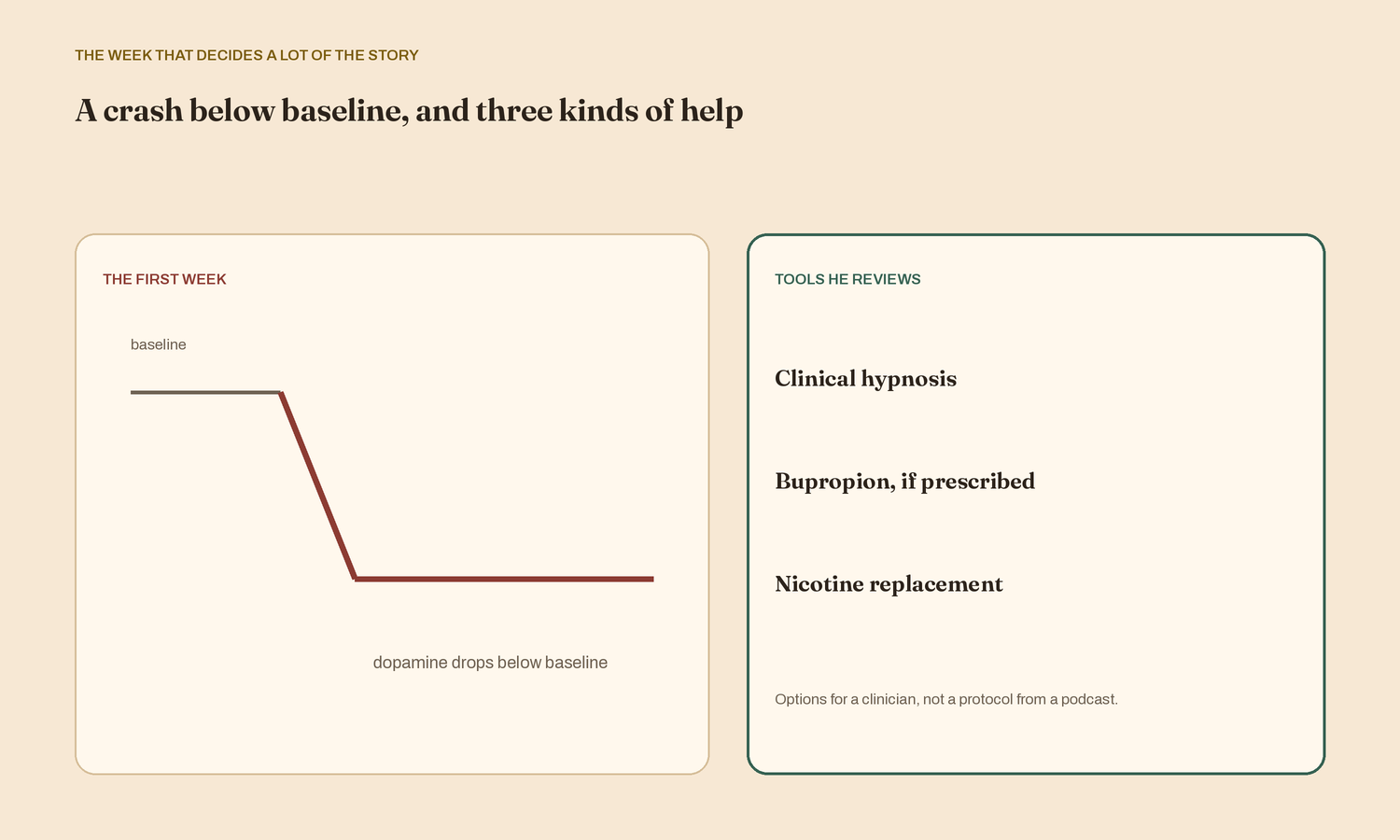
2. The first week, and the tools he puts on the table
Most people who smoke, he says, would rather not. In “the best surveys,” at least 70% of cigarette smokers “want to quit.” Withdrawal can start “as soon as 4 hours” after the last dose: agitation, craving, a drop in dopamine “below baseline,” Cold turkey, with no assistance, has a success rate he puts at 5%; of that group, “a full 65%” relapse within a year. Relapse within the first week, he says, is 75%, in part because people “don’t expect to feel even worse than they did prior to ever smoking or vaping.” If you can get through that week — by grit, or by exercise, cold exposure, and “positive social interactions” — “chances are quite a bit higher.” Alcohol, he adds, raises the odds of relapse.
The tools he reviews are not home remedies. A clinical-hypnosis method from Stanford psychiatrist David Spiegel’s work, including a 1993 study he says has been repeated, is cited as taking a single-session success rate to 23%. Bupropion (Wellbutrin), a prescription drug, moves unaided success toward “about 20%” in his reading; he flags an increased seizure risk and says a physician has to decide if it is appropriate. Nicotine replacement — patch, gum, nasal spray — is often more effective, he says, when forms are switched so the brain does not settle on one pattern. These are options to discuss with a clinician, not a protocol to copy from a podcast. If you want help starting, you can also call 1-800-QUIT-NOW.
Weighing it: what holds up
This is a condensed recut of an earlier lecture, not a clinical trial. Several figures — the 14-year lifespan line, the dipping and oral-cancer estimate, the unaided quit rates — are his citations, some are tighter than others in the wider literature, and we did not independently verify each one. The nicotine-versus-delivery distinction is useful and can be over-read as permission. Auto-generated captions are close, not official. This is not medical advice. If you are quitting, or have a question about medication, talk to a clinician who knows your case.
Related reading: Cold, Heat, and Metabolic Claims · Letting Go of the Lever
If you want help quitting, you can call 1-800-QUIT-NOW (1-800-784-8669) or visit smokefree.gov. Quitting and withdrawal can be hard on mood. If you or someone you know is struggling or thinking about suicide, you can call or text 988 to reach the Suicide & Crisis Lifeline in the US. Outside the US, contact local emergency services or a local crisis line.
Long Talk Short
- Huberman separates nicotine, which drives the reinforcement, from smoking, vaping, dipping, and snuffing, which do most of the documented harm.
- The molecule can lift dopamine, attention, and alertness for a while; it also raises heart rate and blood pressure, and withdrawal can start within hours.
- He argues that vaping hits the blood faster than smoking, and that the steeper dopamine rise helps explain why it can be harder to drop.
- Unaided quitting, in the figures he cites, fails most of the time, especially in the first week; hypnosis, bupropion, and nicotine replacement are the tools he reviews, as options for clinical care.
The one thing to remember: The chemistry that made nicotine feel useful is the same chemistry that makes stopping feel worse than you expected — and the first week, with help, is where a lot of the story is decided.
Independent summary; not affiliated with Andrew Huberman or Huberman Lab. Not medical advice.
Source: Huberman Lab Essentials, “Nicotine’s Effects on the Brain and Body and How to Quit Smoking or Vaping,” on YouTube (linked above). Independent summary; not affiliated with the show.