Cold, Heat, and Metabolic Claims
You're told cold plunges and saunas will fix your metabolism. Susanna Søberg explains brown fat, contrast therapy and weekly targets on Huberman Lab Essentials. Here's what her study measured, and what it did not.
If cold plunges and saunas are sold to you as a metabolic upgrade, Susanna Søberg is one of the researchers the wellness circuit cites. In Huberman Lab Essentials, she and Andrew Huberman revisit deliberate cold and heat exposure, brown fat, insulin markers and weekly exposure targets. Essentials episodes are abridgments of her longer Huberman Lab conversation. Treat the numbers as attributed research talking points, not a personal prescription.
In short: Søberg argues that uncomfortable cold, often alternated with heat, can activate brown adipose tissue and improve some metabolic markers in studied groups. Her winter-swimming paper was small and limited to young healthy men. Biomarkers are not clinical outcomes. Cold shock and heat strain can be dangerous, and she has commercial ties beside the science.
1. Cold, shiver and afterdrop
Søberg's practical starting rule is "uncomfortably cold": if water or air leaves you that way, it is cold enough for her framework. She distinguishes whole-body cold water from a brisk walk in a T-shirt. Water contacts more skin receptors and drives a faster autonomic spike—norepinephrine, diving responses, brown-fat pathways—but cooler ambient air can still matter. Brown fat, in her telling, is a first responder for thermoregulation; shivering muscle is a partner, not a failure state, so long as you avoid true hypothermia.
She explains afterdrop in plain physiology. In cold water, vessels constrict to keep blood central and protect organs. When you get out, those vessels reopen; blood that cools in the periphery returns and can lower core temperature further. That is why bravado sessions and rapid extremes are unwise. She compares repeated cold and heat to exercise training: hormetic stress that can upregulate cold- and heat-shock proteins if you do not exhaust the system. Overdoing exposure, she warns, can work against cardiovascular risk rather than for it.
2. What her study actually measured
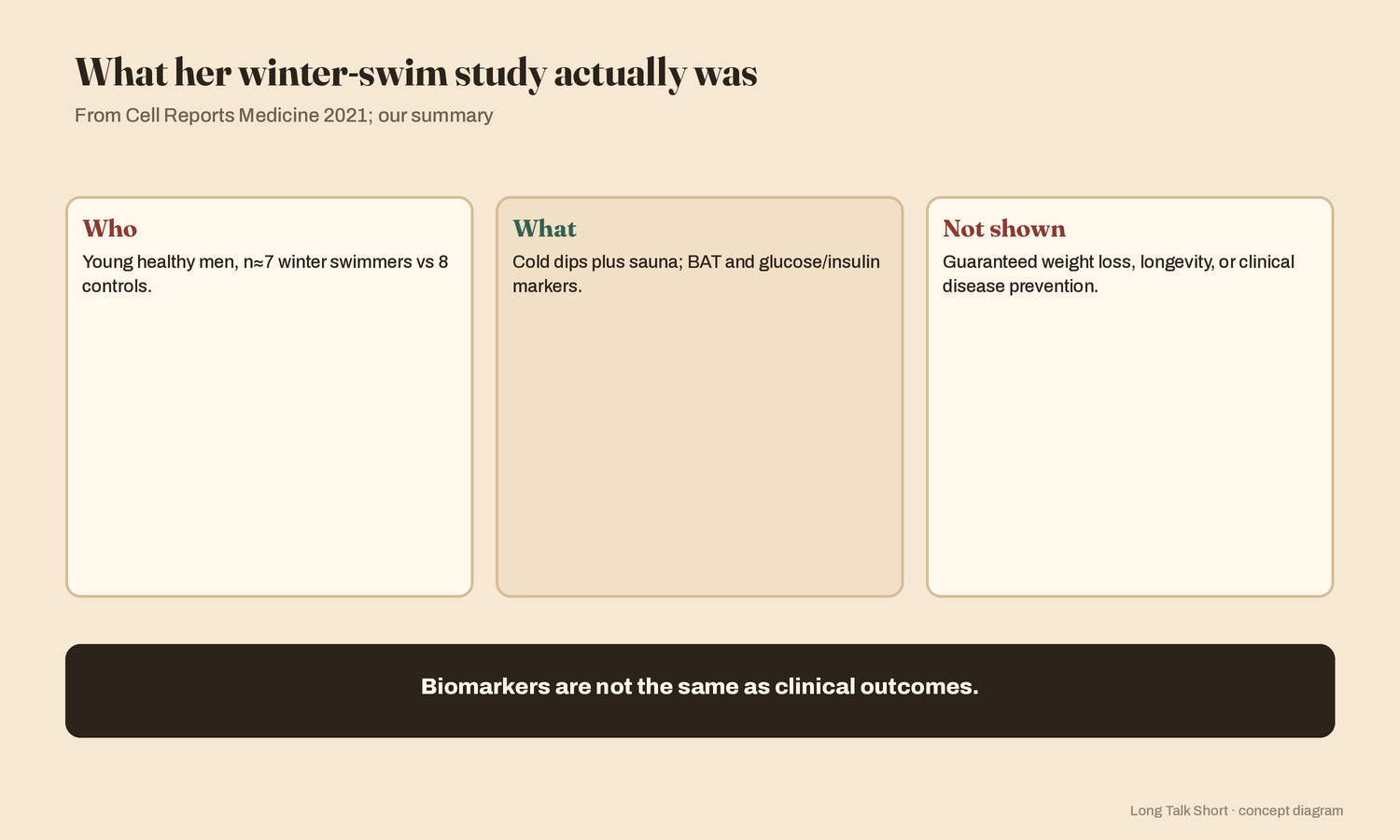
The paper behind much of this conversation appeared in Cell Reports Medicine. Søberg's team compared experienced Danish winter swimmers with matched controls. Subjects were young healthy men; after exclusions the analyzed winter-swimmer group was seven and controls eight. Inclusion required repeated cold-water practice across winter seasons; most swimmers also used sauna, while controls were asked to avoid deliberate cold and heat. Outcomes included brown-fat thermoregulation under cooling and oral glucose tolerance testing. Swimmers showed lower insulin production on experimental days and faster glucose clearance in the reported comparisons.
That design cannot randomly assign a winter-swimming lifestyle. Selection and other habits can confound. Huberman and Søberg also discuss cooler-sleep research (Hansen and colleagues, as cited in the episode): sleeping in a cooler room, still under a duvet, linked with higher brown-fat activity and better insulin sensitivity than warmer periods in the same people—likely driven largely by facial cold receptors. Separate from her swim trial, it still illustrates her broader claim that mild, repeated thermal challenge can shift metabolic markers.
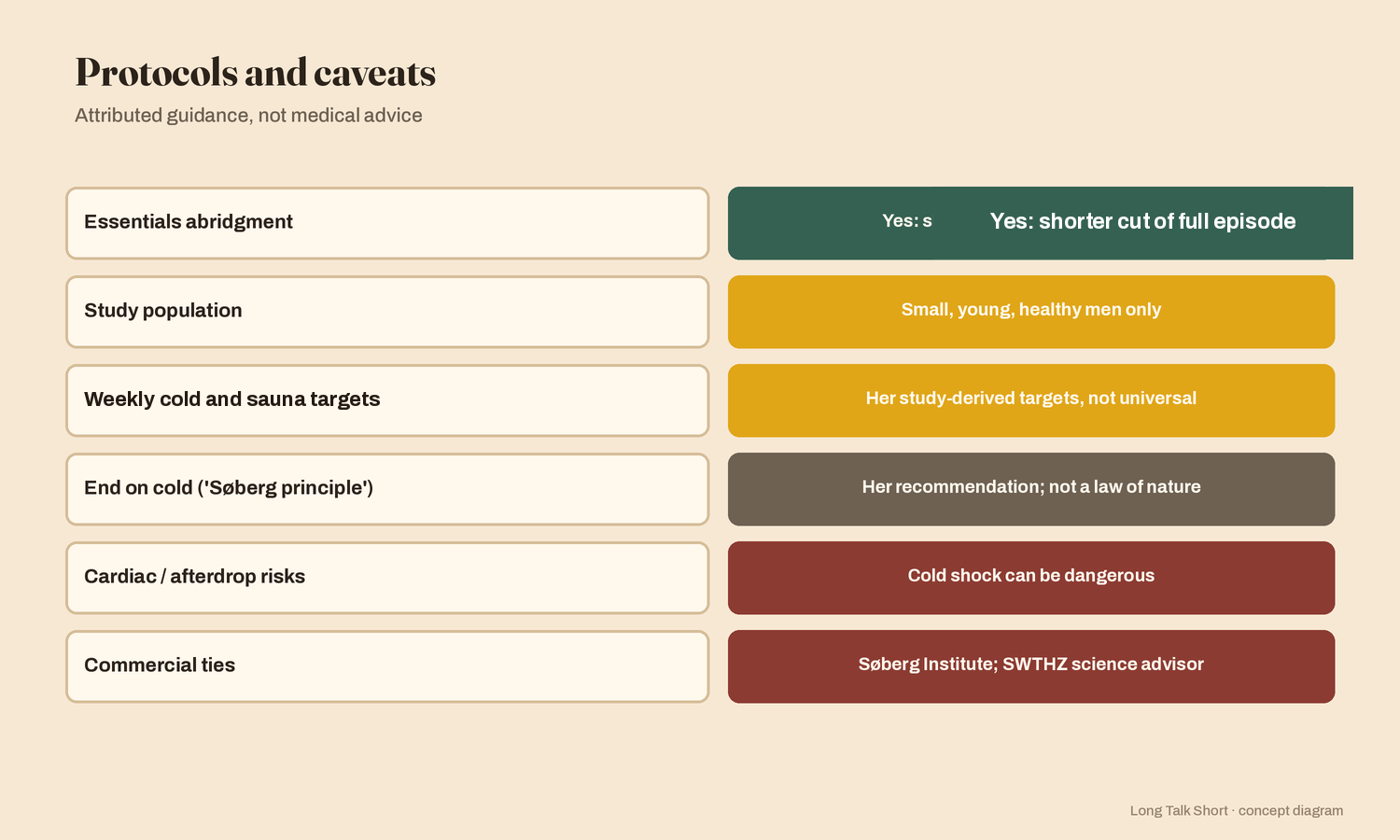
From the winter-swimming work she offers low-threshold weekly targets discussed on air: a modest weekly dose of cold, often as brief dips a few days weekly, and a larger weekly sauna total—commonly short rounds at roughly 80°C in her study setting—often ending on cold. Huberman calls ending on cold the "Søberg principle," forcing the body to rewarm itself and, in her view, extending the metabolic "workout" after you leave. These are protocol suggestions from her research context, not universal medical rules and not a promise of weight loss.
3. Inflammation hopes, contrast practice and hard limits
Søberg links cold and heat to inflammatory markers such as IL-6/IL-10 patterns and to longer-term hopes around blood pressure, insulin sensitivity and lifestyle disease risk. She even connects lower inflammation to mental-health and neurodegenerative risk families as a research association. Those are pathways and correlations discussed in the episode. They are not demonstrated clinical prevention trials for depression, anxiety or Alzheimer's caused by plunges.
Huberman asks whether someone with only a couple of cold days weekly should stack short dips—brief immersions, out, then back in—to accumulate toward a weekly total. Søberg says yes: the temperature change itself challenges cells, so repeated short swings can matter more than one long suffer session. She also stresses that you do not need half-hour polar swims; short exposures that still feel uncomfortably cold are the point of her low-threshold framing. That flexibility helps people start, and it still does not turn a podcast protocol into individualized medical care.
On brown fat versus ordinary movement, she treats dedicated cold as a more potent activator than casual non-exercise activity thermogenesis, while noting multiple pathways—including from muscle once shivering begins. She repeatedly draws a parallel to the gym: people already accept that muscles adapt to progressive stress, and she wants cold and heat understood as another training modality with recovery limits. If you exhaust the system, she warns, you can raise rather than lower cardiovascular risk. That caution belongs next to every viral clip of ice barrels.
Weighing it: what holds up
Framing: An Essentials abridgment of a longer Huberman Lab conversation on cold and heat protocols.
Holds up: Peer-reviewed winter-swimming work exists; marker shifts were reported in that small sample. Cold shock, afterdrop and heat strain are real physiological risks she and Huberman flag.
Partly holds: Weekly exposure targets and ending on cold are her attributed protocols from her research context, not universal medical rules. Cooler-sleep findings are separate research discussed in the episode.
Corrections: Biomarkers are not clinical outcomes. The winter-swimming sample is small, male-only and young. Marker shifts are not proof of fat loss, longevity or disease prevention.
Not checked: Essentials omits the full methods texture of the longer episode; neither replaces reading the paper. Our transcript is YouTube's automatic English captions. The figure groupings are ours.
Disclosures: Søberg founded the Søberg Institute and Thermalist education programs that train and license thermal-therapy practice. Public announcements also list her as a science and education advisor to SWTHZ (SweatHouz), a contrast-therapy studio brand. That does not falsify her papers; it is a financial interest beside protocol talk.
Bottom line: a biomarker shift in a small volunteer study is a clue, not a guarantee that plunges will make you lighter or live longer—and safety limits come first.
Related reading: Huberman on guarding focus windows · Matthew Walker on sleep · James Nestor on breath
Long Talk Short
- This Essentials episode abridges Søberg's longer Huberman Lab conversation on cold and heat.
- She links deliberate cold, often with sauna contrast, to brown-fat activation and metabolic markers.
- Her winter-swimming study was small and limited to young healthy men; it tracked markers, not hard clinical endpoints.
- Weekly exposure targets and ending on cold are her attributed protocols, not universal prescriptions.
- Cold shock, afterdrop and heat strain are real risks; seek personal medical advice when relevant.
The one thing to remember: a biomarker shift in a small volunteer study is a clue, not a guarantee that plunges will make you lighter or live longer.
This summary is for general information only and is not medical advice. Cold-water immersion and heat can be dangerous; get individualized medical advice before copying any protocol if you have relevant conditions.
Source: Huberman Lab Essentials, "Cold & Heat Exposure for Metabolic Health | Dr. Susanna Søberg," on YouTube. This is an independent summary and is not affiliated with Huberman Lab or Susanna Søberg.