Protect the Two Work Bouts: Andrew Huberman on Guarding Your Focus
You probably can't focus for eight hours, and Andrew Huberman says you shouldn't try. He argues most people get two sharp windows a day, and shares the short training routine he's used for decades. His advice, what checks out, and his commercial ties.
If you try to be focused for eight hours straight, Andrew Huberman thinks you are already losing. On the a16z show, the Stanford neuroscientist and podcaster walks through a single ordinary day: what he ate, how he trained, what he took. He then distills it into advice for founders. His most useful idea is not a supplement or a gadget. It is that most people get two windows of real cognitive capacity a day, and the job is to find them and defend them.
In short: Huberman's three health priorities are morning light, a short, low-volume weight routine and the best sleep you can manage. For focus he adds three habits: identify your peak windows, step out of stimulus-response mode once a day, and pace your work like an endurance event. Much of it is his personal experience. He also lists many supplements, some tied to his sponsors.
1. Find your windows and treat them like a fight
Huberman's first rule for cognitive performance is to learn when your mind is sharpest. For him that is mid-morning into early afternoon, and again from late afternoon until early evening. He stresses that these times are personal; some people peak in the middle of the night. What he thinks is nearly universal is the number: roughly two blocks of about three hours. He doubts many people sustain eight or nine focused hours without paying for it the next day.
He calls these blocks "work bouts" and describes them as a fight. Letting your attention be captured during a bout costs more than the hours themselves, he argues, because output in those windows is far higher than catch-up work done later, and the spillover eats into your personal life. He schedules exercise around them: training before the first bout gives him energy for the day, while training inside a peak window leaves him exhausted by mid-afternoon.
His second habit is to step out of "stimulus-response" mode once a day, even briefly, to check whether your energy is going where you want it. He says what you see online can shape your thoughts for hours afterward, and that some people compartmentalize better than others. His third, borrowed from neurologist Bob Knight, is to work out the maximum real work you can do consistently, then find a non-destructive way to reset every week. People who "blitz" on stimulants, he says, are the ones who crash.
2. The low-volume training template
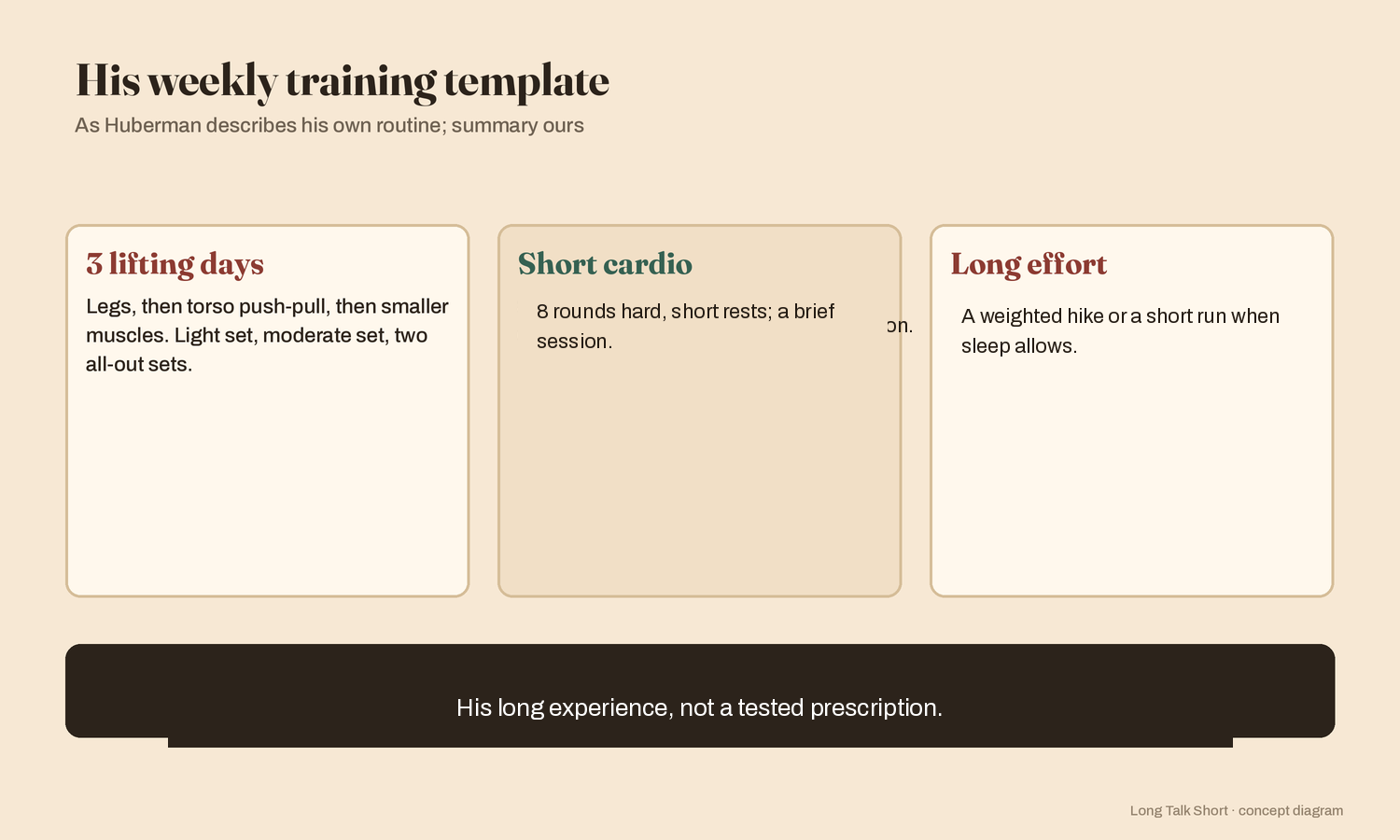
His three health priorities are morning bright light within about an hour of waking, his weight routine and the highest-quality sleep your life allows. The routine is the most concrete part of the episode. He lifts three days a week: legs first, then a torso push-pull day, then smaller muscle groups. Each exercise gets one light set, one moderate set of a few reps and then just two all-out sets to failure, with long rests and a goal of adding weight or reps every session. He adds a roughly six-minute interval session of 20 seconds all-out and 10 seconds rest, plus a long hike or run.
He says he has followed this for decades without a major injury, and credits that partly to what he avoided, such as joining other people's workouts out of pride. A former college athlete, he says, told him it worked with a third of her old volume.
3. Sleep, light and the rest of the day
On sleep he is unusually candid. He rarely gets eight unbroken hours and says he is fine on six because he knows how to manage his energy. Instead of chasing perfect sleep, he suggests learning to fall back asleep: long exhales to slow the heart rate, and moving your closed eyes side to side, which he says helps you lose track of body position. In the afternoon he uses a brief non-sleep deep rest session rather than a nap. He traces his habit of watching the sunset to staff at a Stanford sleep lab in the mid-1990s, before the eye cells that signal light to the body clock had been identified.
He also recommends keeping your phone in another room, and admits he moved his social apps to a separate phone kept in a lock box. Diet comes up too: starch and fruit after training, protein and vegetables at lunch, and a suggestion to test single-ingredient foods to learn which ones disagree with you.
Weighing it: what holds up
Framing: "Focus, Energy, and Performing at Your Best" fits, though a large share of the episode is a tour of his own day and supplement list. Most of the advice is his experience, not a trial-tested protocol, and he says so in places.
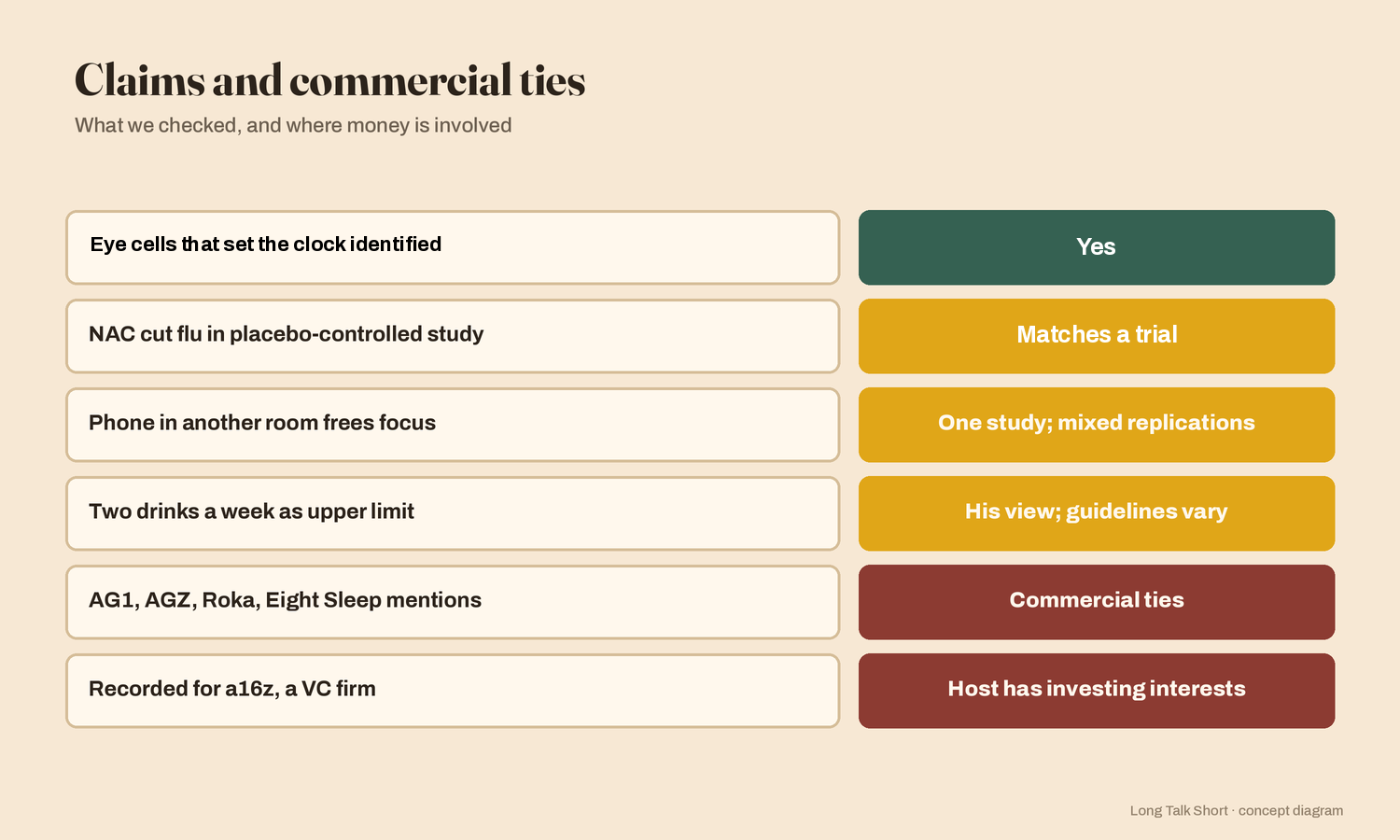
Holds up: The light-sensing retinal cells that tell the brain's clock about ambient light were identified in the early 2000s, consistent with his timeline. His N-acetylcysteine (NAC) example roughly matches a placebo-controlled trial in older adults that found far fewer symptomatic flu cases in the NAC group than in placebo. That trial followed people through a flu season rather than deliberately exposing them, and he himself said to double-check his numbers.
Partly holds: The phone study he describes resembles an experiment that found better working-memory scores with phones in another room; later replications have been mixed. His claim that two drinks a week is "probably the upper limit" is his view; official guidance differs between countries.
Corrections: None needed beyond those caveats.
Not checked: We did not check his herbal supplement claims, which deserve caution. Quotes were checked against YouTube's automatic captions, a machine transcript.
Disclosures: He takes AG1, a longtime sponsor of his show, and an evening product he says he "helped them create"; he co-designed red-lens glasses with Roka and praises Eight Sleep. He says he has no financial ties to some other products he named. The show is produced by a16z, a venture capital firm, and Huberman openly hoped the firm would back sleep-inducing masks, while the host mentioned being pitched a focus device. The figure groupings are ours. This piece focuses on his performance advice, not the themes of our other Huberman coverage.
Bottom line: practical focus advice wrapped in a personal day-in-the-life; keep the two-window idea and treat the supplement list as marketing-adjacent.
Related reading: James Hollis on Huberman Lab on old patterns · Kristen Holmes on sleep regularity · Matthew Walker on sleep, fact-checked
Long Talk Short
- Huberman thinks most people get about two windows of real focus a day, usually around three hours each.
- He treats those windows as "work bouts" to defend, and schedules exercise so it does not eat into them.
- His training template is short: two hard sets per exercise, three lifting days, and brief intervals.
- On sleep he aims for good enough, not perfect, and teaches himself to fall back asleep.
- Several product mentions involve sponsors or products he helped design, and the host's firm invests in tech.
The one thing to remember: find the two times of day when your mind is sharpest, and guard them more carefully than any supplement.
This summary is for general information only and is not medical advice.
Source: Andrew Huberman, "Andrew Huberman on Focus, Energy, and Performing at Your Best," a16z, on YouTube. This is an independent summary and is not affiliated with a16z or Andrew Huberman.