Fewer Problems, Same Worry: James Smith on Why Success Never Empties the Worry Jar
James Smith tells Chris Williamson his first $100,000 month felt smaller than his first $10,000 one. Why worry expands as life improves, the monthly number that buys calm, and ambition as a game, with claims checked.
You probably have a list of things that would finally make you relaxed: a pay rise, a paid-off card, a better flat. Chris Williamson opens this Modern Wisdom episode with a warning about that list:
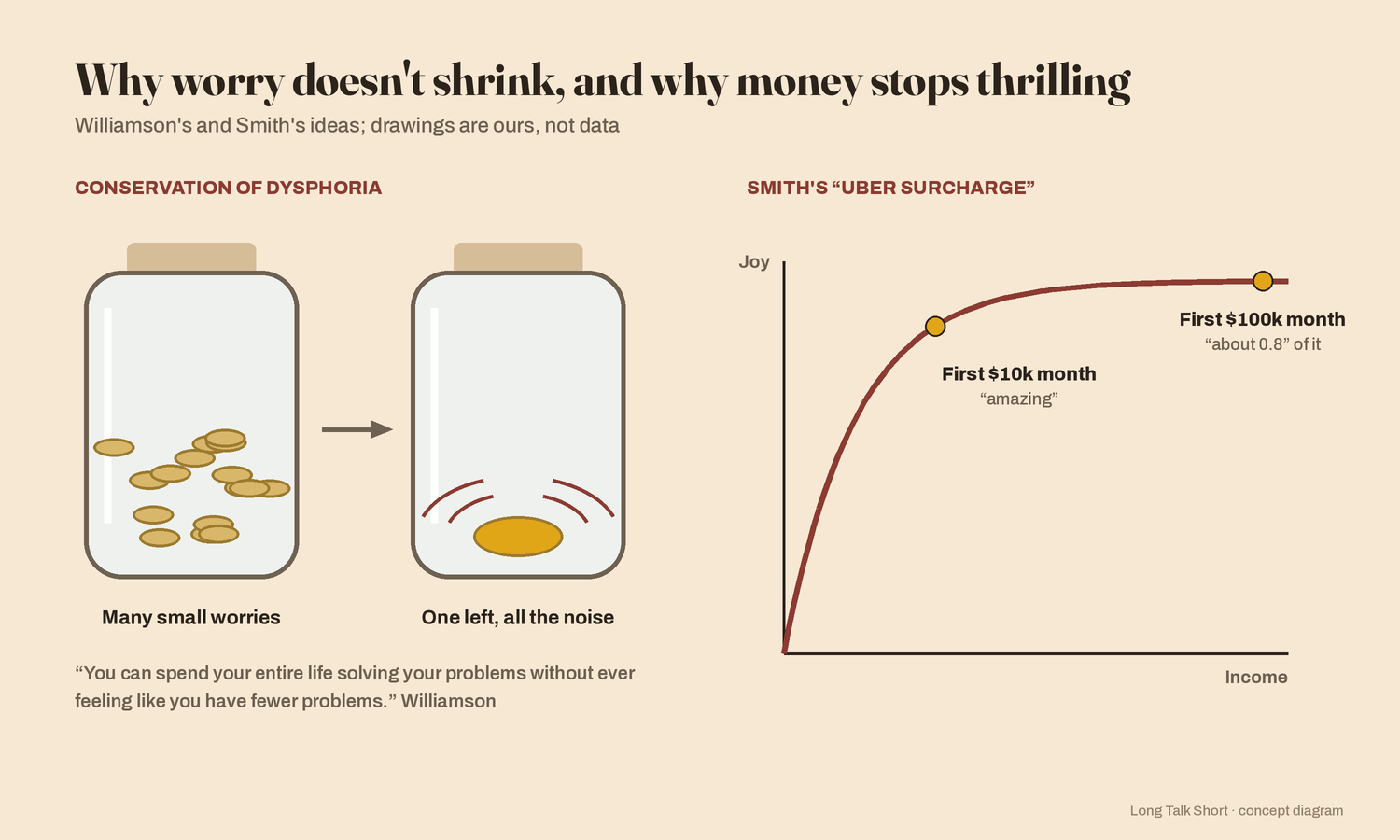
You can spend your entire life solving your problems without ever feeling like you have fewer problems.
His guest, the fitness entrepreneur James Smith, went from expelled teenager to fitness businesses and a drinks brand, and the two spend the conversation on why the finish line keeps moving.
In short: Smith says his first $100,000 month felt smaller than his first $10,000 month. Williamson argues that worry expands to fill whatever space success leaves. Their fixes: know the monthly number that keeps your head above water, stretch your milestones out, and treat ambition as a game whose score isn't your worth.
1. Worry expands to fill the space
Williamson credits the psychologist Martin Seligman, a past guest, with the idea he calls "conservation of dysphoria": as life improves, many people pick up a bigger magnifying glass and inflate small worries until they carry the same total load as before. Smith adds an image: a single coin in a vase makes the most noise. Take away every problem but one, and that one gets all your attention.
Smith's twist is that brain chemistry doesn't charge a premium for status. There is no "Uber surcharge" on serotonin or dopamine because you live in a bigger house: a student laughing with friends feels what a billionaire laughing with friends feels. So what does more money actually buy?
2. Ten times the money, less of the thrill
Smith's evidence is personal. Earning $10,000 a month for the first time felt "amazing". On a straight line, his first $100,000 month should have felt ten times better; he puts it at "about 0.8" of the first, and says the $10,000 made him happier.
Williamson calls it habituation: the first trip abroad with friends can't be repeated at the same dose. Their lesson is to stretch out your achievements rather than collect them all at once.
Smith says his son is his "sole driver of happiness, everything else is noise", and that fatherhood made him less ambitious elsewhere. He discloses that he and his fiancée are going through secondary infertility, and urges friends who want children but are waiting for a house or financial security to ask themselves: if you knew it would take two years, would you start straight away?
3. Know your head-above-water number
Smith's most practical idea is what he calls "head above water". Write down your rent, car, bills and a holiday fund, and find the monthly total you need. A rowing coach he knows opens champagne each month when he and his wife hit theirs; work harder and it comes on the 7th, not the 29th. Smith says he has cleared his own number every month from the start of his business around 2014, and that made him "invincible": he once turned down his first brand deal with about £1,300 in his account. Most people, he says, set the line "miles ahead of them" and fill the gap with anxiety.
Williamson's version is a definition: wealth is reality minus expectations. Overdeliver on what you expect and you are wealthy; by that measure, he says, many billionaires are broke. But what happens when you do arrive?
4. Three ways to react when the prize disappoints
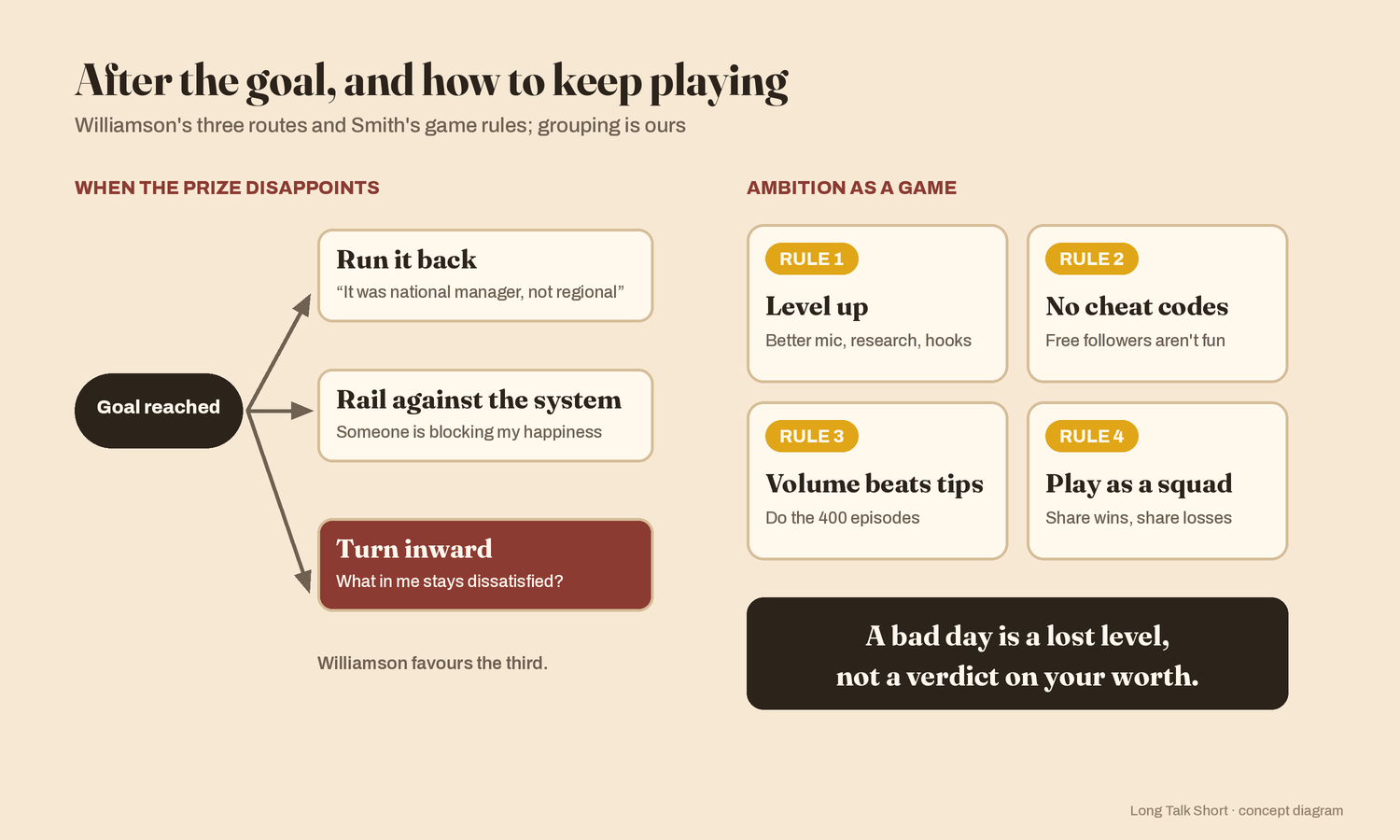
Williamson calls the disappointment of reaching a goal the arrival fallacy, and sees three responses. The first is to run it back: it wasn't regional manager, it was national manager. The second is to rail against the system and blame someone for blocking your happiness. The third, which his "bro science brain" favours, is to look inward at the part of you that stays dissatisfied whatever the dose. He admits it can sound like "a fat guy telling a starving man that food isn't very tasty".
5. Play it like a game
Williamson credits Smith with treating success on social media as game points. Smith breaks it down. Levelling up your character (a better microphone, more research, sharper hooks) is the fun part, and cheat codes ruin it: a million followers handed over overnight wouldn't feel the same. Mastery comes from volume; no advice about starting a podcast beats doing 400 episodes. Organised squads beat four solo players. And a bad day is a lost level, not a verdict.
Williamson ties this to a line from the coach Joe Hudson: unshakable confidence comes from knowing your worth isn't tied to performance. Smith adds a learning rule, "model the rise, not the result": a blue belt often learns more from a purple belt than from a black belt who hasn't been a beginner for ten years.
Weighing it: what holds up
Framing: The "unhinged path" refers to Smith's backstory (expelled from sixth form, a teenage arrest, dropping out of university), which fills much of the episode. The ideas come in bursts between anecdotes and sponsor reads, and several are Williamson's.
Holds up: The 2023 adversarial collaboration by Matthew Killingsworth, Daniel Kahneman and Barbara Mellers found that emotional well-being rises with the logarithm of income for most people, so each tenfold rise buys a similar, modest step, and the least happy fifth plateau above about $100,000. That fits Smith's diminishing returns, though not a drop. Tal Ben-Shahar coined "arrival fallacy". The NHS says about 84% of couples conceive within a year of regular unprotected sex, which supports Smith's point that many don't.
Partly holds: Seligman did argue, in a 2002 Slate exchange, that evolution stamped dysphoria "indelibly" into us and therapy can only move people within a set range; we couldn't find him using the phrase "conservation of dysphoria". Smith's "$100 million drinks business" overstates the brand's reported value: Neutonic raised $6 million at a $60 million valuation in April 2026.
Not checked: Smith's income figures and the doctor-friend anecdote are their own accounts. Smith's "Uber surcharge" is a metaphor, not neuroscience.
Disclosures: We transcribed the episode by machine, so quotes may contain small errors. Williamson and Smith co-founded Neutonic together, which comes up in the episode, and the show carries paid sponsor reads.
Bottom line: The diminishing-returns story matches the research, and the head-above-water number is a usable tool. The rest is lived experience from two people with a shared business.
Related reading: More Pleasure, Less Joy: Anna Lembke's Dopamine Nation · Make Room Before You Add More: Ed Mylett · Viktor Frankl's Man's Search for Meaning: the One Freedom No One Can Take
Long Talk Short
- Solving problems doesn't guarantee feeling you have fewer; the remaining ones tend to grow louder.
- Smith says a tenfold income jump felt smaller than his first milestone; research points to modest, diminishing gains.
- Know the monthly number that keeps your head above water, and celebrate hitting it.
- Wealth, Williamson suggests, is reality minus expectations.
- When a goal disappoints, look inward before chasing a bigger dose or blaming the system.
The one thing to remember: play your ambitions like a game, levelling up and taking losses as lost rounds, so your score never becomes your worth.
This summary is general information, not medical, mental-health or financial advice. For fertility concerns or persistent anxiety, see a doctor or qualified professional. If you are in crisis, call or text 988 (the Suicide & Crisis Lifeline in the US) or contact local emergency services.
Source: Chris Williamson, "The Most Unhinged Path To Success - James Smith," Modern Wisdom, on YouTube. This is an independent summary and is not affiliated with Chris Williamson, Modern Wisdom or James Smith.