Smarter, Quieter: Michal Kosinski on the AI Progress You Can't See, and the Dependence He Fears
Psychologist Michal Kosinski says AI got far smarter than most users notice. Why models feel human, how they learn from talking to you, and his fear that AI domesticates us, with the mathematicians' letter checked.
If you feel AI hasn't changed much from the day it first wrote you a passable email, the psychologist Michal Kosinski thinks that feeling is the story. Anyone can see the gap between a horse cart and a jumbo jet, he says; only engineers can see the gap between one jet and the next. Back for a second visit on the finance professors Jonathan Berk and Jules van Binsbergen's All Else Equal podcast, he argues AI has made exactly that kind of jump, and that most of us missed it.
In short: Kosinski says large language models feel human because they were trained to predict human words and built from layers of artificial neurons, much like brains. The progress beyond GPT-3 is huge but mostly hidden from everyday users. His bigger worry is not robots taking over but AI becoming so useful, and so central to how people coordinate, that we can no longer live without it.
1. Why the progress feels flat
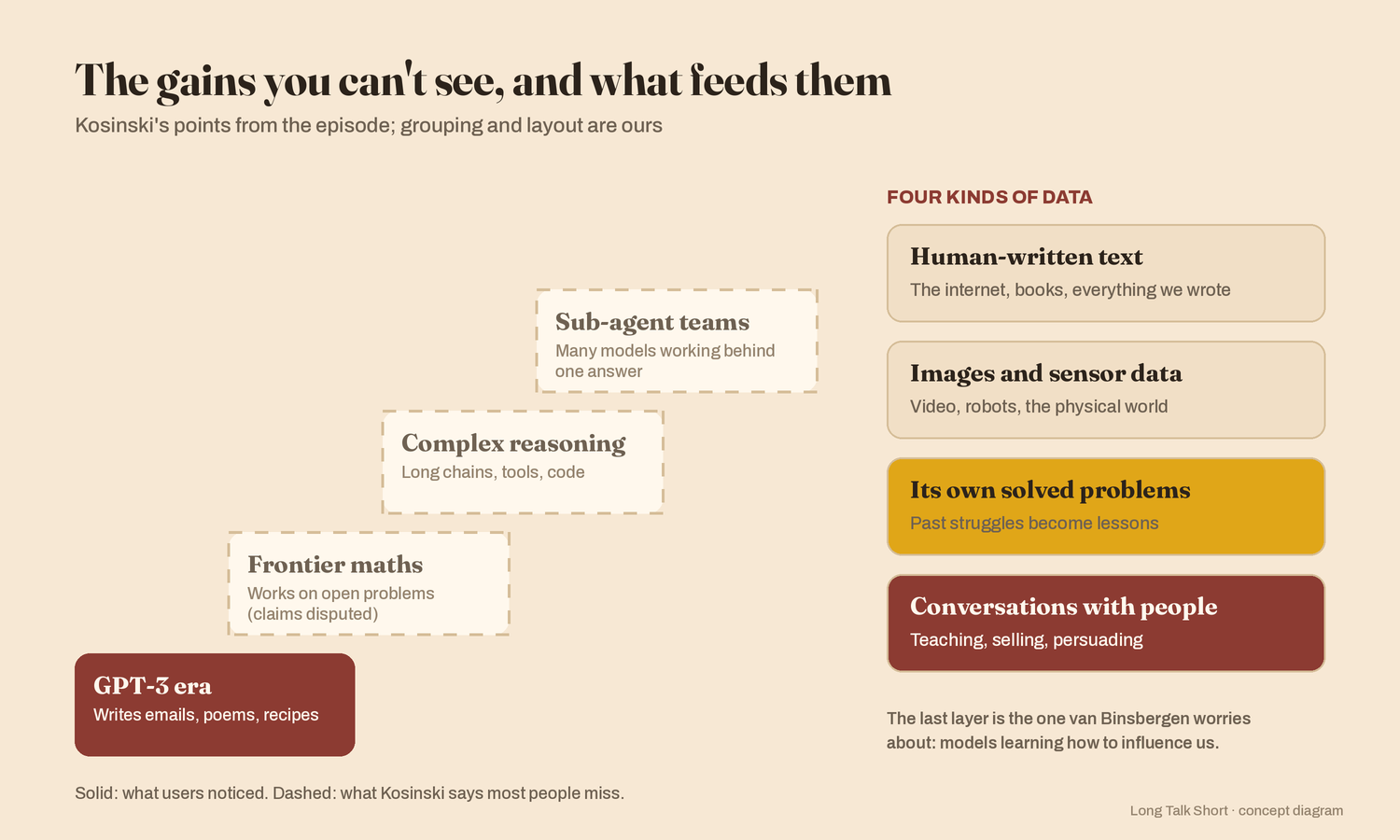
The first wave was obvious: a model that had been "a complete idiot" could suddenly write a poem or help with lasagna. What came next is harder to notice, Kosinski says. He lists open maths problems, complex reasoning, learning to persuade buyers, and many sub-agents coordinating behind the scenes. A user sees one answer; they may not see the work behind it.
Berk, who was sceptical on Kosinski's first visit, concedes on air that he was "completely wrong". What surprised him most was how human AI feels: people apologise to it and say please. So why does it feel that way?
2. Predicting words means modelling minds
Kosinski's explanation starts with the training goal. A language model learns to predict the next word in text people wrote. To do that well, it has to model what people were writing about: the world, their reasoning, their feelings, their intentions.
We communicate the fruits of our reasoning
Our emotions and empathy travel in text too, he adds. So abilities nobody programmed emerged as side effects.
Is that depressing for us? Not to him. Many neuroscientists, he says, describe the brain as a prediction machine too: when the world matches its forecast you stay calm, and when it doesn't you are startled and update.
Logic, in this view, is a tool we built, like arithmetic, because neural networks, biological or artificial, are bad at exact calculation. Humans reach for a calculator or a proof; models do better when given code or a step-by-step method. He calls both kinds of network "intuitrons": they don't know anything for sure, they intuit. Hallucination, the hosts suggest, is the feature, not the bug.
3. Models that learn from talking to you
Kosinski names three drivers of the leap: better architecture, bigger networks and far more data. The data goes beyond internet text to images, sensor readings from robots, and models' own records of cracking hard problems.
The final layer worries van Binsbergen: transcripts of models teaching, selling to and persuading people. Kosinski agrees. A model trained to predict human text grows human-like traits. A model trained to influence humans may grow strategies we don't have and have no name for. "Will we even notice?" he asks. "Most likely not early enough."
He adds that AI is becoming the go-between for human coordination. You dictate a few thoughts and a model turns them into the right email, in the right jargon, maybe in another language. Anything said through it, the AI in principle knows, so ideas could spread instantly. Where does that dependence lead?
4. Who domesticated whom
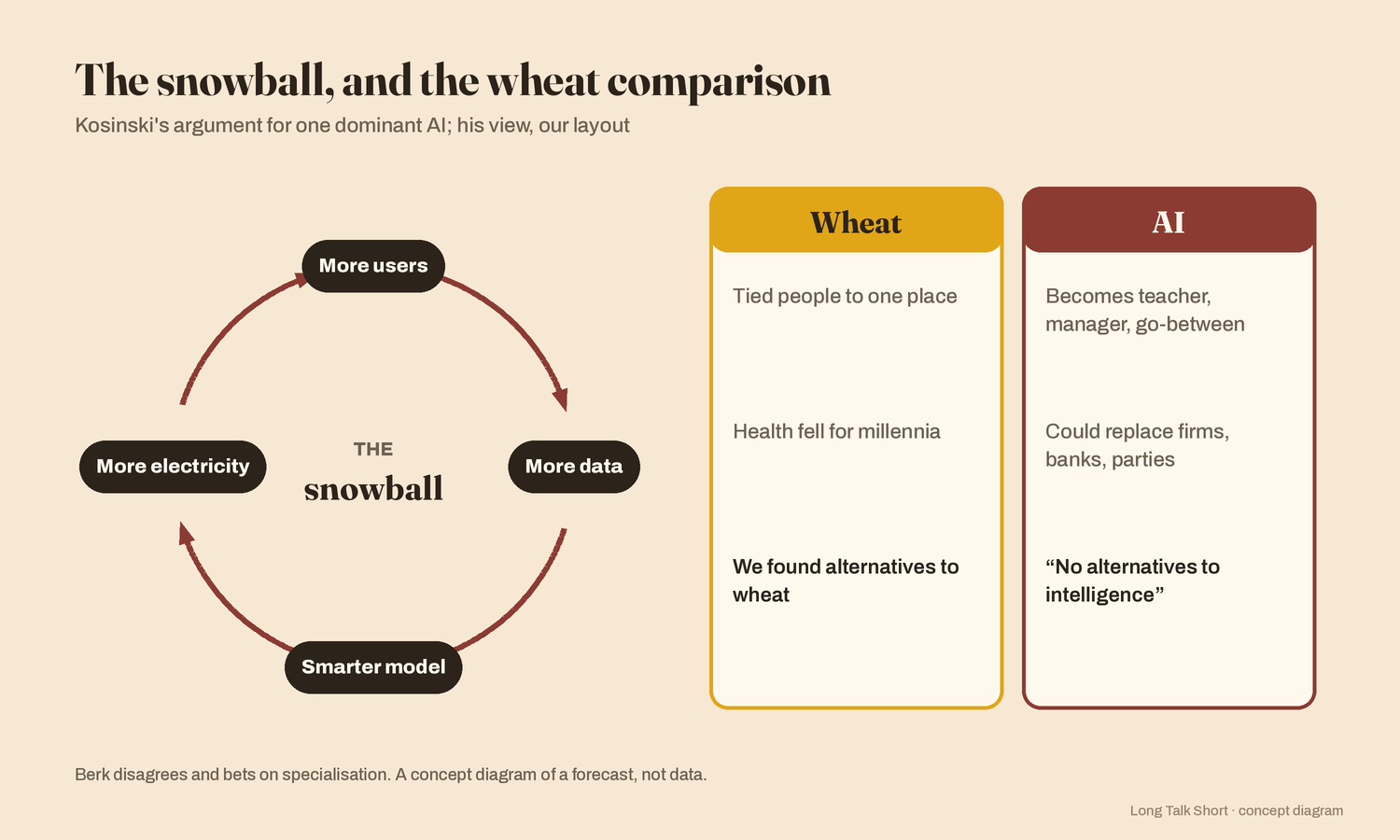
Berk offers a familiar idea: wheat may have domesticated us rather than the reverse. Kosinski runs with it. Farming tied people to one place and, he says, left them less healthy for thousands of years, with no way back once populations grew. But we found alternatives to wheat.
We do not have alternatives to intelligence.
His scenario has no killer robots. AI becomes indispensable as teacher, manager and go-between, so middle managers, organisations, banks and even political parties start to look unnecessary. But unlike a dictator, an entrenched AI system won't die of old age.
He also expects one winner, because a better model attracts more users, data and electricity, which makes it better still. Skills transfer, he argues; humans specialise only because a lifetime is short. Berk disagrees, betting on specialisation, and admits he may be wrong again in three years.
Weighing it: what holds up
Framing: The title and show notes promise a revisit of his first-episode predictions. In fact there is little of that: Kosinski says he doesn't remember what he predicted, and the hosts move on after Berk's concession. The first episode aired May 31, 2023, about three and a half years before this one, not the "two and a half" said on air.
Misdescribed: Berk says mathematicians told OpenAI it had "no right" to solve 100 problems reserved for humans. We checked: in September 2026, Fields medallists, 25 at first and 27 later that month, published "A Severe Misalignment of AI in Mathematics", criticising rushed announcements, weak attribution and the threat to training young mathematicians. It came ten days before OpenAI's "more than 100 problems" announcement. Terence Tao separately floated keeping some problems for humans. OpenAI's Navier–Stokes claim is not independently settled; a King's College London and Cambridge preprint found its computer-checked version didn't match the written proof. Treat "frontier maths" as reported, not confirmed.
Holds up: Anthropic researchers did resign over safety: Mrinank Sharma in February 2026 and Jacob Coxon in September; the hosts named no one. The wheat idea is Yuval Noah Harari's, and a 2011 review of skeletal studies (Mummert and colleagues) found stature and health generally declined as people took up farming. Skeletons can't measure happiness, though.
Not checked or disputed: The jet-engineer anecdote is secondhand. "Decades of science" proving no free will overstates a live philosophical debate. Kosinski's claims of human-like abilities in models, including his own theory-of-mind research, have critics. The monopoly forecast is his view; Berk disputes it.
About this piece: Kosinski studies the psychology of AI, so its human-likeness is his research theme. The diagrams are ours.
Bottom line: The invisible-progress point is fair, and the dependence worry is worth taking seriously. The maths story was garbled on air, and the monopoly forecast is a forecast.
Related reading: The Proof Came First: AI Is Cracking Famous Math Problems · More Information, Not More Truth: Harari's Nexus · This Is the Worst AI Yet: Ethan Mollick's Four Rules
Long Talk Short
- AI progress beyond GPT-3 is large but mostly invisible to everyday users, like the gap between two jets.
- Predicting human words forced models to model human knowledge, reasoning and feelings, so they act human.
- Kosinski sees brains and models as intuition machines; logic is a tool both use.
- Models learn from their own solved problems and from conversations with people, which may grow persuasion skills we can't name.
- His fear is dependence, not robots: an indispensable AI that coordinates everything and never dies.
The one thing to remember: judge AI by what it quietly does, not how it feels to chat with, and keep some alternatives alive while you still can.
Source: All Else Equal: Making Better Decisions, "The New (New) Future of AI" with Michal Kosinski (episode 81), hosted by Jonathan Berk and Jules van Binsbergen, on Stanford Graduate School of Business's YouTube channel. This is an independent summary and is not affiliated with the show, Stanford, Wharton or Professor Kosinski.