People Are Patterns: Robert Greene's Laws of Human Nature, and How Far to Trust Them
Greene's 18 laws for reading the people around you, and yourself. A useful lens for paying closer attention, built on stories from history rather than studies.
Think of the colleague who charmed everyone in the first month and then, slowly, became impossible. Or the friend who is always the hero of their own stories. Or the moment you snapped at someone and only later understood why. Robert Greene's argument in The Laws of Human Nature is that none of this is random. People, you included, run on patterns that are old, predictable and mostly hidden from the person running them. Learn the patterns, he says, and you stop being surprised by people, and a little less surprised by yourself.
In short: Greene sets out 18 "laws", each a recurring weakness such as irrationality, narcissism, envy or the pull of the group, told through long stories from history. It is a useful lens for paying closer attention to people. It is not science, and its evidence is anecdote, so treat the laws as prompts to look harder, not as rules that predict anyone.
1. One idea, eighteen ways
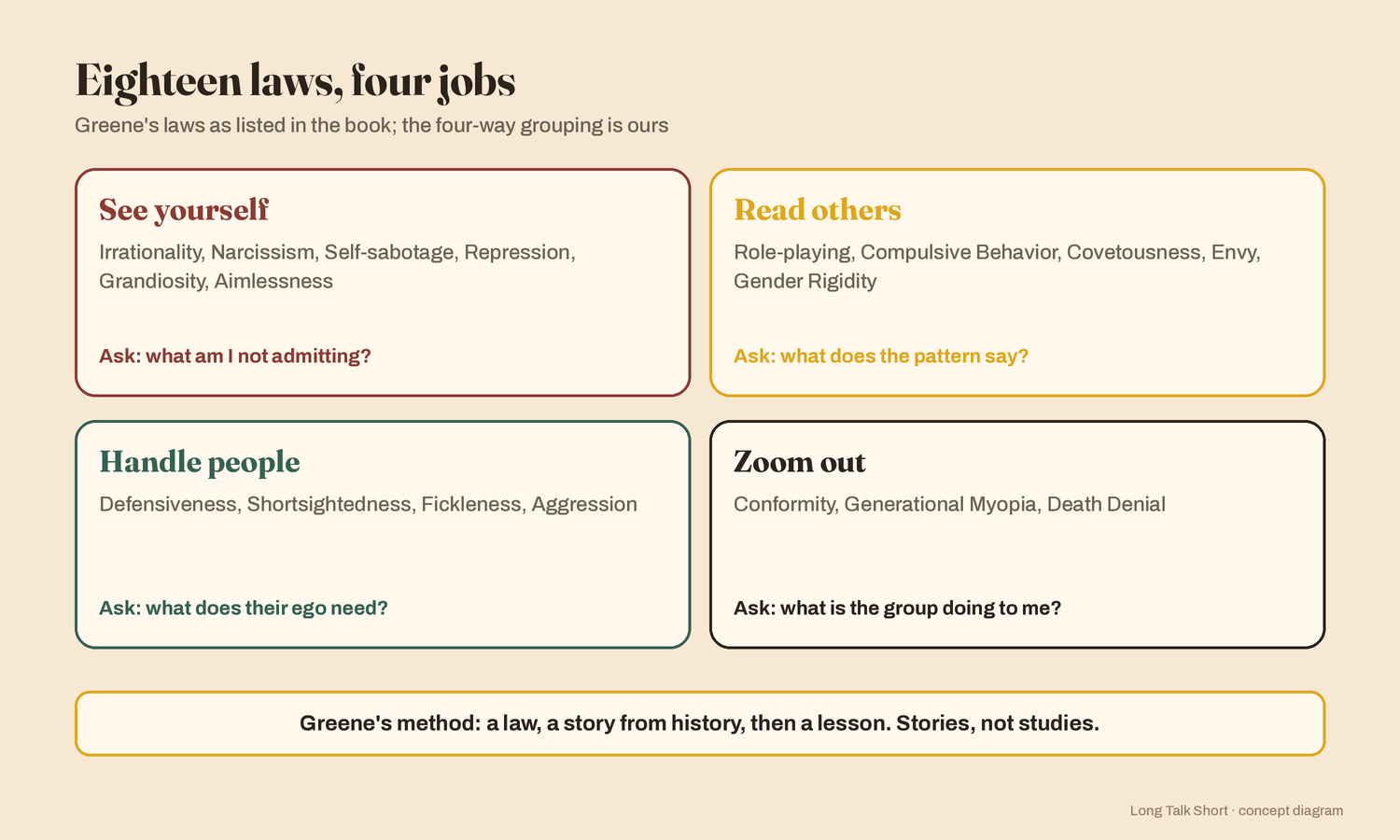
Greene is best known for The 48 Laws of Power, and this book has the same structure. Each chapter names a law, gives it a command for a title, and builds around one or two figures from history whose lives show the pattern at work. Chapter 1, "Master Your Emotional Self", is about irrationality. Emotion decides most of what you do, Greene argues, and reason arrives afterwards to justify it. His ideal is a calm, clear-sighted self he calls the "inner Athena", after the Greek goddess of wisdom. You don't get rid of emotion, in his telling. You notice it early, and you stop it steering.
The book widens from there. The early laws are about your own mind. The middle ones are about reading other people: the masks they wear, the compulsive patterns that show their real character, the envy that hides behind friendliness. Later laws deal with groups, generations and, finally, death. The thread is the same throughout: a first impression, of someone else or of yourself, is a performance. Patterns over time are the truth. So where should you start looking? Greene's answer is the mirror.
2. Read yourself first
Several of the laws point inward, and these are the most practical. Narcissism, in Greene's account, is not a label for other people. It sits on a spectrum, and everyone needs some self-love. The question is whether yours stays healthy, which he links to the ability to turn attention outward and practise empathy. Repression is about your "dark side", the traits you deny and then spot, loudly, in others. Grandiosity is the inflated sense of your own powers that tends to grow after a success; one of the book's examples, which a Kirkus reviewer singled out, is the later career of the Disney chief Michael Eisner. Aimlessness is the drift that sets in when you have no sense of purpose of your own.
The practical move is similar each time: watch for the moment the pattern shows up in you, name it, and act a beat later than you want to. If you feel a sudden rush of contempt for someone, Greene would ask what it is about you that they are touching. Old advice, usefully laid out as a checklist. And once you can see your own patterns, other people's get easier to read.
3. Read other people by what they repeat
The outward-facing laws are where the book earns its reputation, and its critics. Role-playing, "See Through People's Masks", asks you to watch the small signals people leak when they are performing: tone, posture, the gap between what they say and what they do. Compulsive behavior holds that character shows in repeated patterns, so judge people by what they have done many times, not by what they promise. Envy is often disguised as admiration or helpful criticism. And defensiveness carries the most usable rule in the book:
Soften People's Resistance by Confirming Their Self-opinion
If you want to change someone's mind, don't attack the picture they have of themselves; work with it.
The group laws round this out. Conformity warns that groups pull your thinking down to their level and that you will feel the pull before you notice it. Generational myopia says you are shaped by the generation you grew up in more than you think. And the last law, death denial, closes the book on a Stoic note: keeping your own mortality in view makes you take life, and other people, more seriously. All of it sounds wise. The harder question is how much of it is true.
Weighing it: what holds up
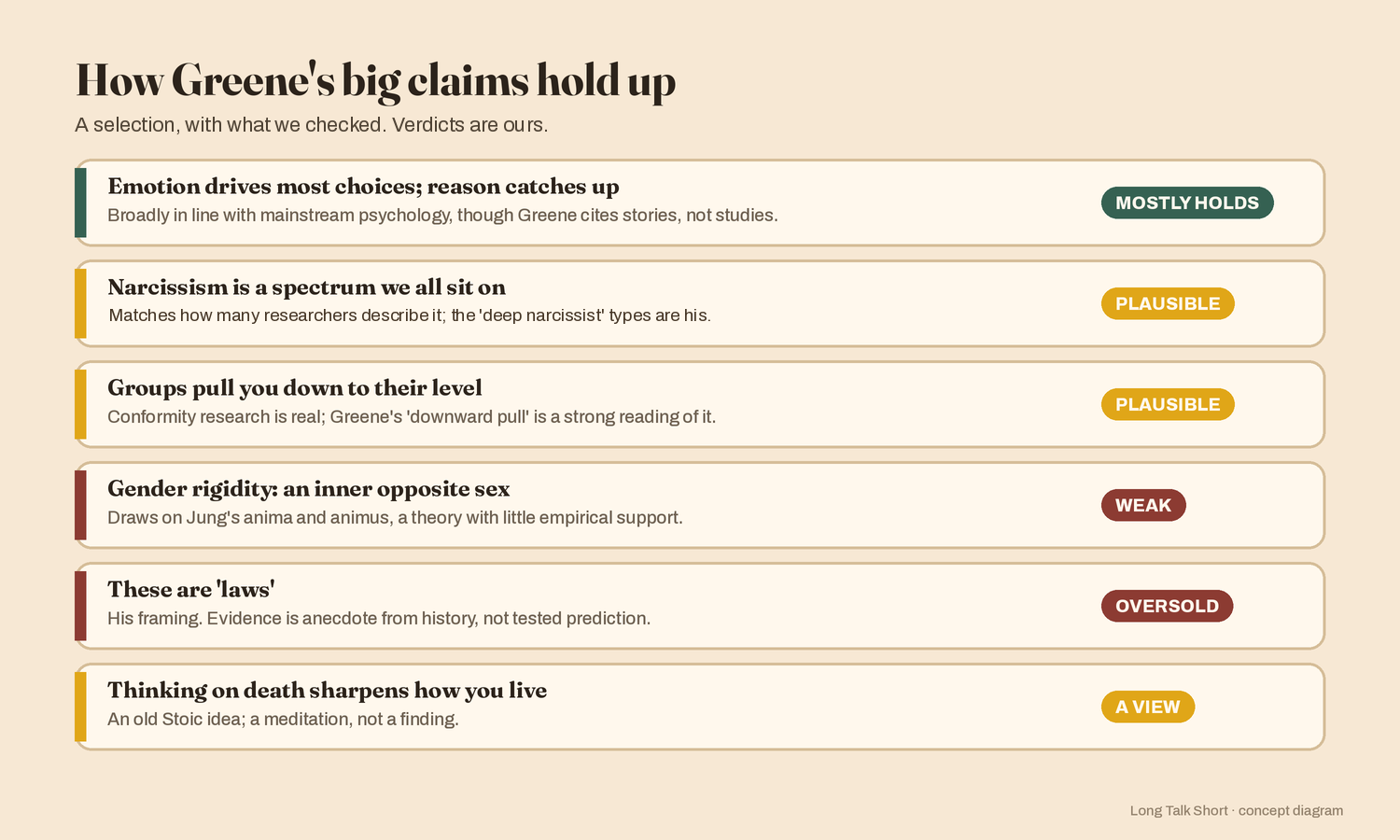
Holds up: Some of Greene's broad claims line up with mainstream psychology: that emotion and quick judgement shape much of what people do, that people defend their self-image, and that groups shape what individuals believe. Treating narcissism as a spectrum, rather than a yes-or-no label, is close to how many researchers describe it. Greene himself doesn't build his case on studies, and we didn't trace each chapter to research.
Overstated: The "laws" are Greene's framing, not laws in any scientific sense. A story about one historical figure can show that a pattern happens, but it can't show how often it happens or predict what the next person will do. Picking vivid examples that fit a rule is exactly the kind of reasoning that makes patterns look stronger than they are.
Weak: The gender rigidity chapter leans on Carl Jung's idea of an inner masculine or feminine side, an idea with little empirical support. And the habit of reading hidden motives into small gestures can tip into suspicion if you apply it to people you live and work with.
Disputed: The Kirkus review was harsh. It called the book "neo-Machiavellian", said it works to a formula of a law, a truism and a long anecdote, and suggested the Stoics "did much better with the much shorter Enchiridion". It is one review, and many readers find the book useful, but the formula criticism matches the book's structure.
Not checked: We checked the publication details, the 18 laws and the chapter titles quoted here against publisher and reference listings. We didn't check the historical stories in detail, or every chapter. The verdict table and the four-way grouping in the diagram are ours, not Greene's.
Bottom line: A good checklist for paying attention, a poor predictor of people. Treat any law as a hypothesis about a person, to be tested against what they do next, not a conclusion.
Related reading: Seven Shortcuts That Say Yes for You: Cialdini's Influence · The Elephant Decides First: Jonathan Haidt on Why Good People Disagree · Why You Did That: Robert Sapolsky's Behave
Long Talk Short
- Greene's 18 laws describe recurring human weaknesses, from irrationality and narcissism to envy, conformity and denial of death.
- Start with yourself: the book works best as a checklist for spotting your own patterns before they steer you.
- Judge people by what they repeat over time, not by first impressions or promises.
- To change a mind, work with the other person's picture of themselves rather than attacking it.
- The evidence is historical anecdote, not research, and calling these "laws" oversells them.
The one thing to remember: when someone surprises you, treat it as a pattern you hadn't seen yet, then check it against what they actually do next.
Source: The Laws of Human Nature by Robert Greene (Viking, 2018). This is an independent summary and is not affiliated with the author or publisher.